Orbit Case Study: Designing an Honest Fintech MVP

Shoaib Vohra


TL;DR
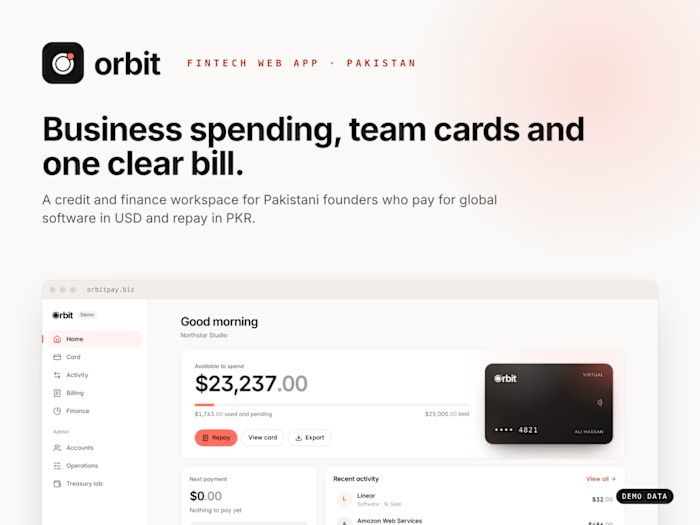
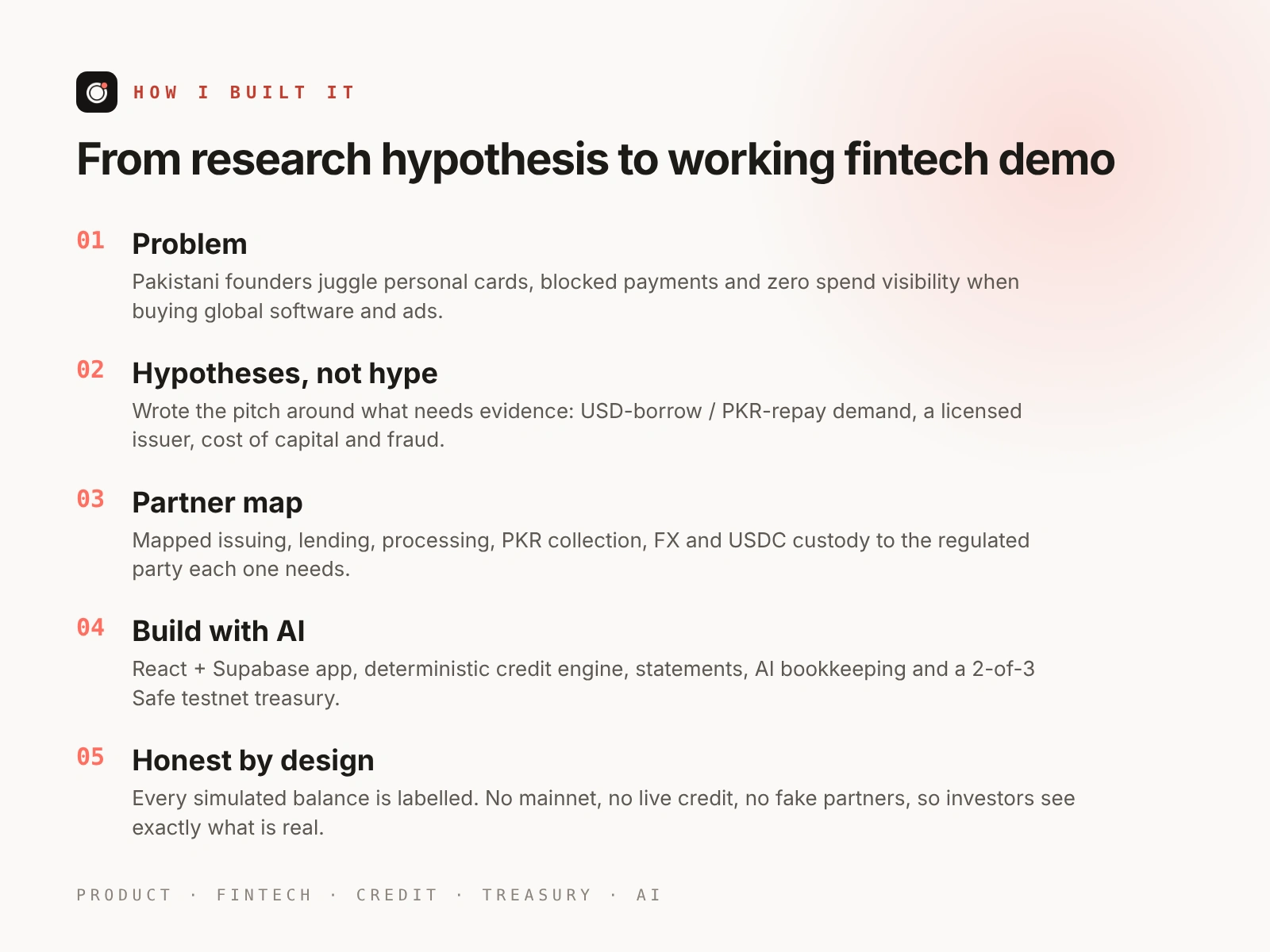
Product: Orbit Business, a credit and finance workspace for Pakistani founders who pay for global software in USD and repay in PKR.
My role: Solo product owner. Research hypotheses, partner mapping, UX, and the build with AI coding tools.
Timeline: 3 weeks, from first commit (17 Sep 2026) to a live demo at orbitpay.biz.
Status: Live behind approved sign-in. All financial integrations are simulated and no live credit is offered.
The problem
Software and creative firms in Pakistan buy subscriptions, cloud and ads in USD. My working hypothesis: they juggle fragmented cards, have little visibility of spend and weak control over limits.
I treated that as a hypothesis to test, not a market fact, and set out to build something founders and partners could react to.
The hard part
A credit product touches regulated functions: card issuing, lending, FX, collections and custody. A solo PM can't license those. The challenge was to make a product credible enough to demo while staying 100% honest about what is real.
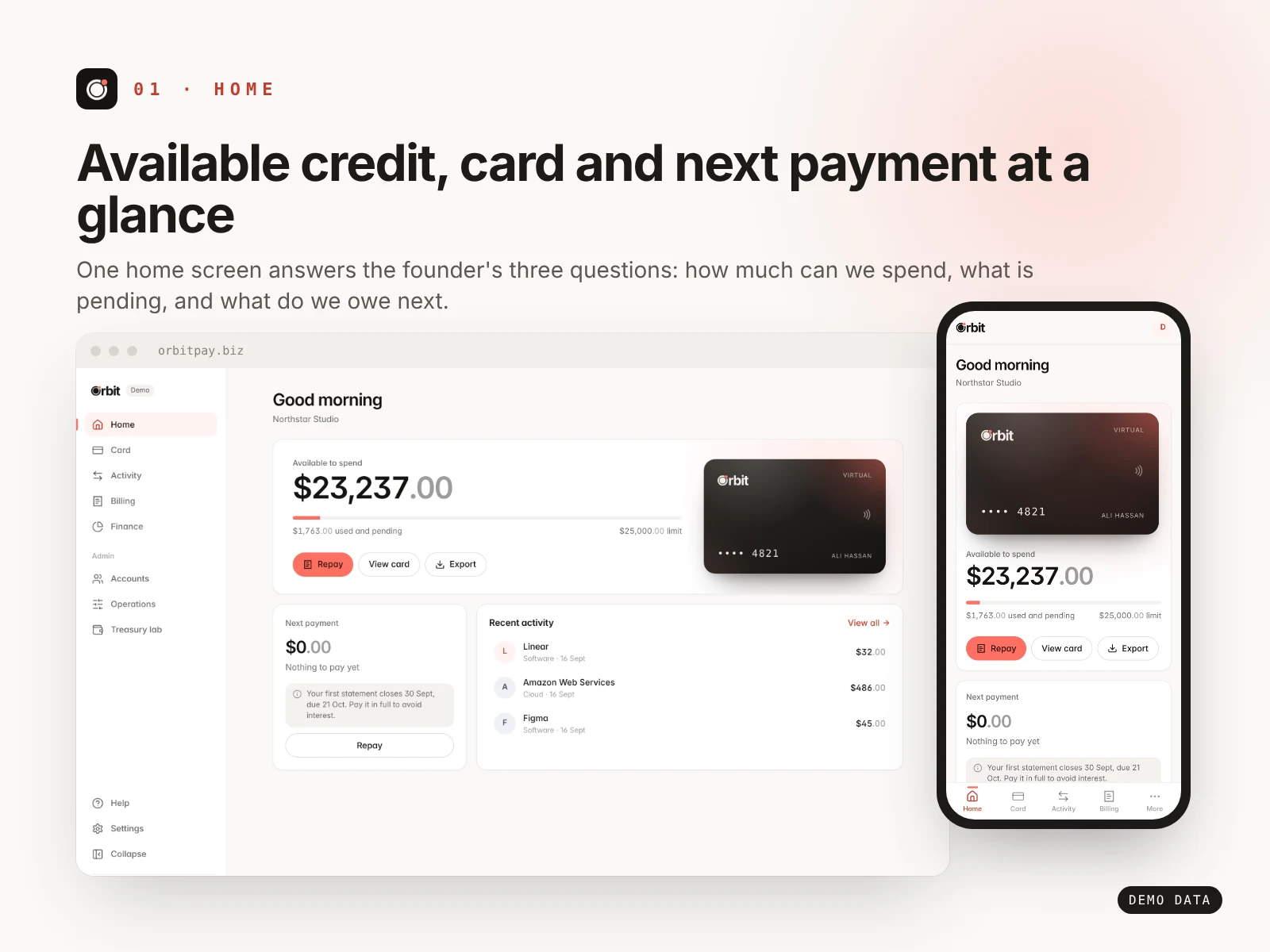
Home and card: available credit, pending holds and the next payment at a glance.
Key decisions
1. Make currency risk explicit
Debt is held in USD and repaid with a quoted PKR amount, so the customer clearly carries USD/PKR movement until repayment. Hiding FX inside a simple PKR number would sell more easily, and break trust the first time the rate moved.
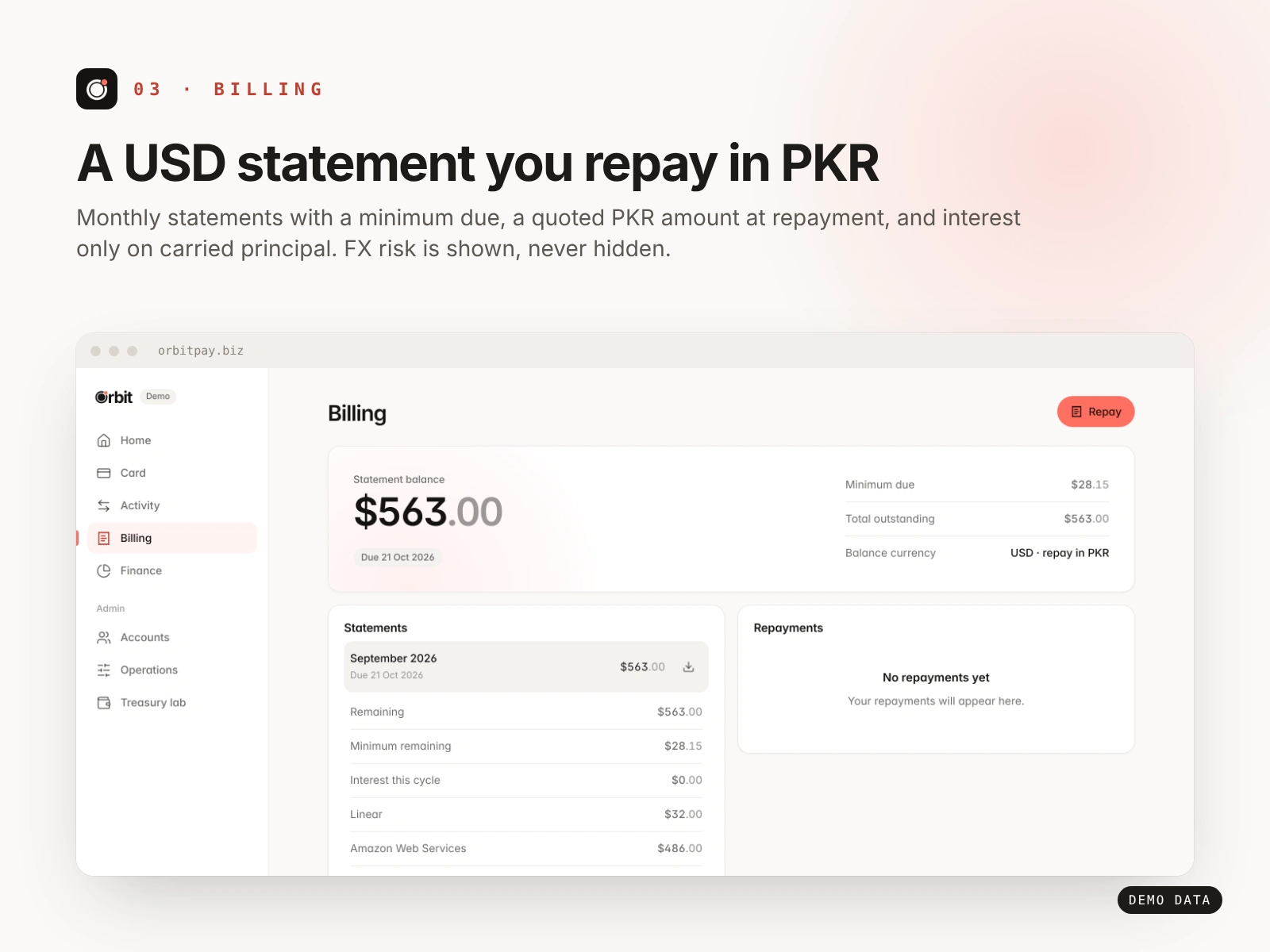
Billing: a USD statement repaid with a clearly quoted PKR amount, so FX risk is visible.
2. AI confidence comes from evidence, not from the model
Founders upload bank statements and Gemini sorts every line. I didn't trust the model's own confidence score, so Orbit runs it twice (once at temperature 0, once with categories shuffled) and only agreement counts.
Fixed scores for stronger evidence: founder rule 100, transfer pair 97, invoice match 95, AI-only 30 to 85.
The auto-sort threshold starts at 60 and tunes itself after 100 reviewed outcomes.
About 1 in 25 auto-sorted lines is re-checked, to catch drift.
After two identical answers Orbit suggests a rule, but never creates one itself.
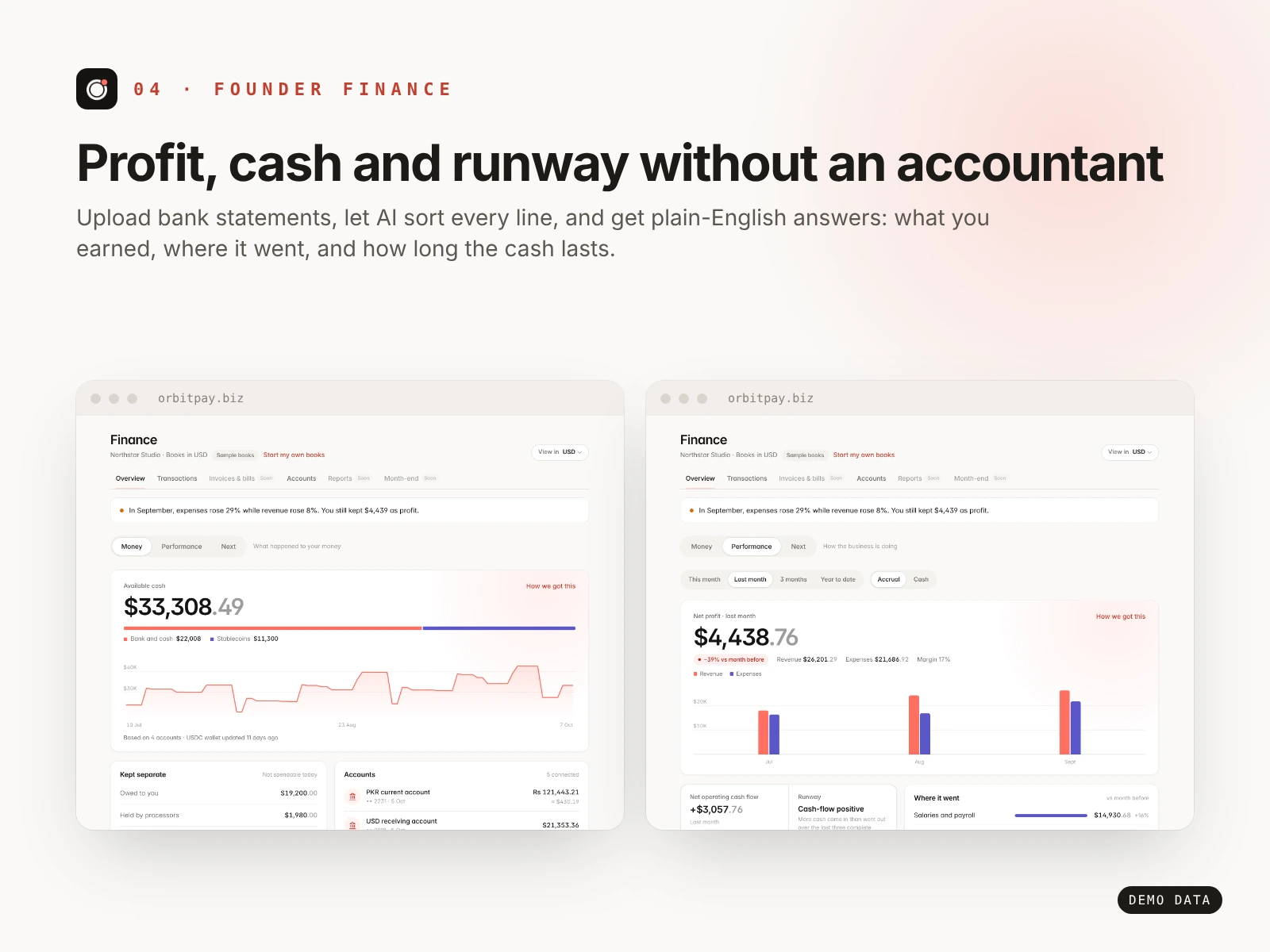
Founder finance: AI-sorted bank statements turned into profit, cash and runway.
3. Label every simulated number
No mainnet mode, no live credit, and no partner shown as committed. Demo activity never touches the testnet treasury, and the testnet lab never changes customer credit. Stakeholders always know what is real.
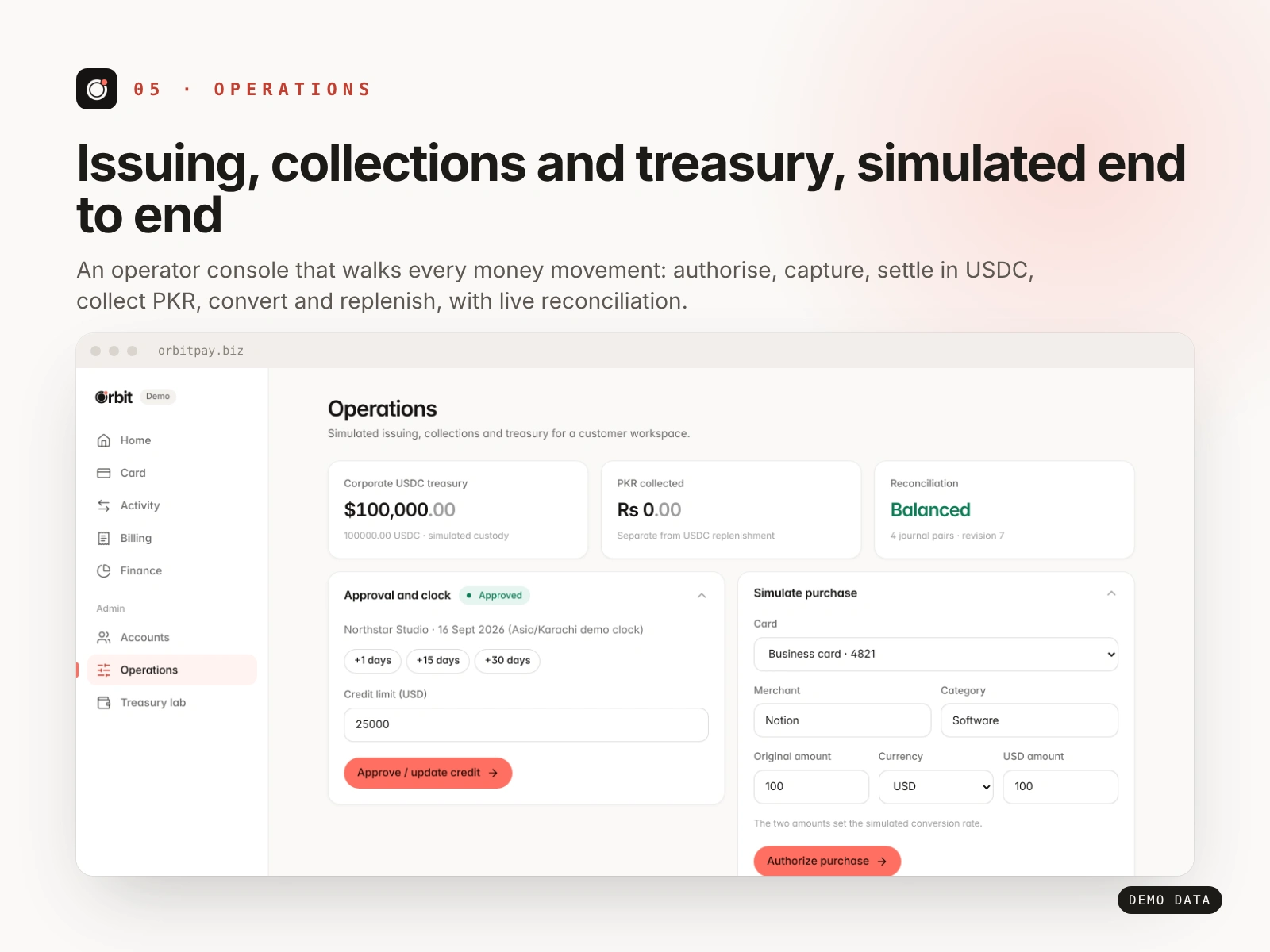
Operations console: collections, settlement and treasury, all clearly labelled as simulated.
4. Never rewrite financial records
Postings are immutable. Corrections happen through reversals and compensating entries, which is what finance teams and auditors expect.
5. Keep v1 deliberately narrow
One account, one workspace, one card and no public signup. Fewer roles means fewer ways to get money logic wrong.
Process
Pitch built on open questions: six things that still need evidence, including USD-borrow/PKR-repay demand, the issuer and lender structure, acquisition cost, cost of capital and fraud, and willingness to pay for software alone.
Partner map: 8 regulated functions (issuing, lending, funding, processing, PKR collection, FX, USDC custody, servicing), each matched to the type of partner it needs.
Unit economics: 15 inputs, all labelled illustrative. The model reports contribution, not profit, and leaves out interest revenue until it's validated.
Research plan: an 8-question interview guide for 10 founders, 10 agency finance leads and 5 design partners.
Security pass: found and removed a legacy function that trusted unsigned tokens, tightened database row-level security and added security headers.
What shipped
Account holder: home, card controls, activity, billing, finance, help and settings.
Credit engine: authorise, capture and reverse holds; month-end statements due 21 days later; interest only after the due date; PKR repayment quotes; refund and failure scenarios.
Founder finance: CSV and Excel statement upload, balance checks, matching and AI sorting into profit, cash and runway.
Operator console and treasury lab: simulated settlement plus a Base Sepolia testnet treasury with 2-of-3 Safe approvals.
Stack: React, TypeScript, Vite, Tailwind, Supabase (Postgres, Auth, Edge Functions, Cron), Vertex AI Gemini, viem and Safe, Playwright, Netlify.
By the numbers
3 weeks from first commit to live demo
About 19,700 lines of TypeScript
100+ automated tests across unit, SQL and browser
8 regulated functions mapped to partners
What's next
Run the founder interviews and collect real provider quotes. Only then decide whether Orbit should be a credit product, a spend-control product or software alone.
What this shows
I can take a regulated, high-risk idea to a working, demo-ready product, and be precise about what is proven and what isn't.
Need a PRD, an AI-built MVP or a product and UX audit? Message me here on Contra.
Like this project
Posted Oct 9, 2026
How I scoped a USD credit and spend product for Pakistani founders: explicit FX risk, labelled simulation and AI bookkeeping that earns trust.
Likes
0
Views
2
Timeline
Sep 17, 2026 - Oct 8, 2026