IntakeOS — AI Client Intake & Qualification System

Adrian Vale


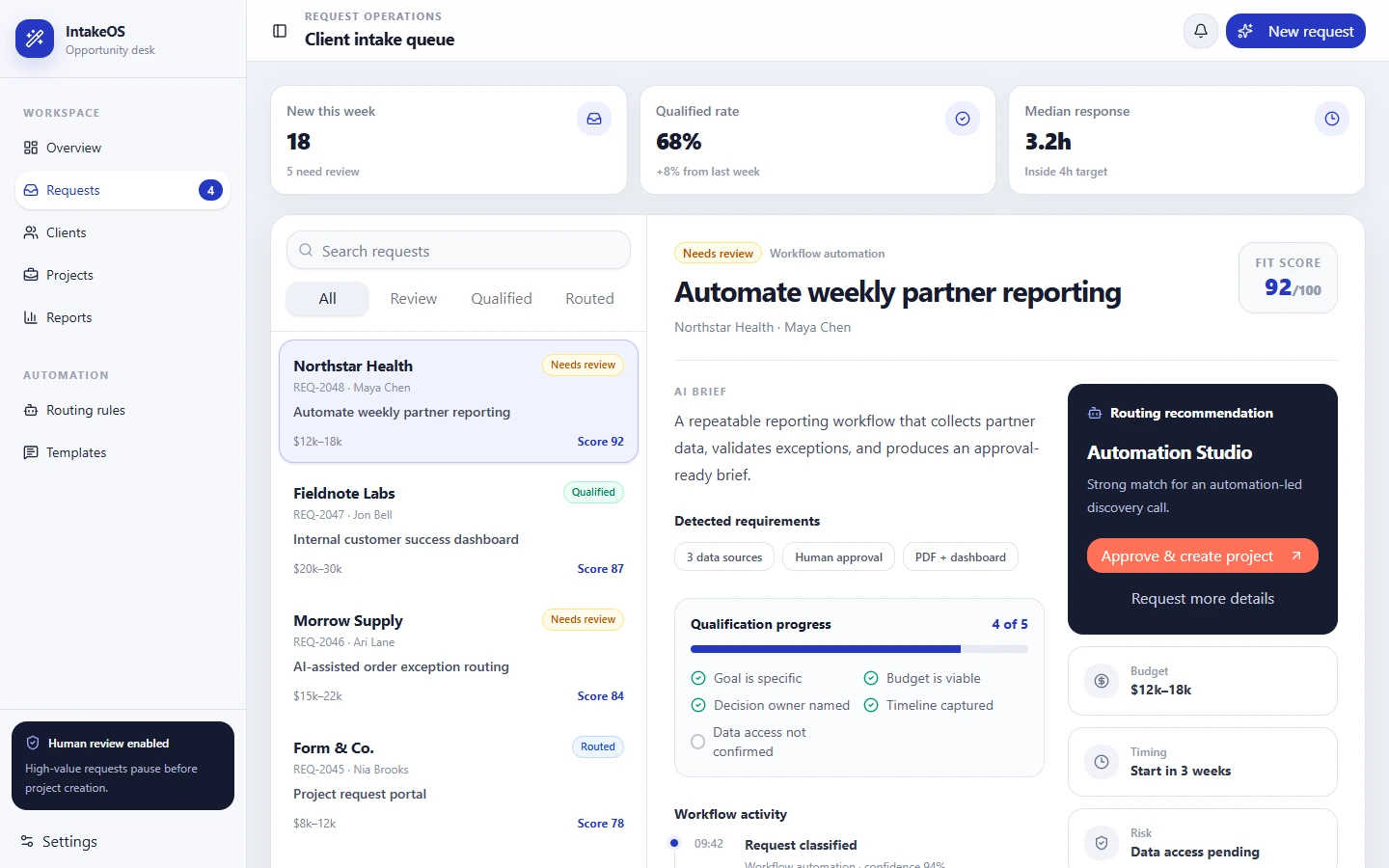
Project overview
Overview
IntakeOS is an Independent Showcase Project for service businesses that receive project requests through forms, email, and referrals. It converts an incoming request into a structured opportunity that a human can review and route with confidence.
Problem
Client intake often breaks down between the first message and the first useful decision. Important details remain buried in free text, teams evaluate fit inconsistently, high-value requests wait too long, and project creation happens before risks or missing inputs are visible.
My Role
I designed and built the complete showcase: workflow definition, information architecture, responsive interface, synthetic data model, API-backed actions, human approval behavior, structured agent tools, failure handling, automated QA, and visual assets.
Solution
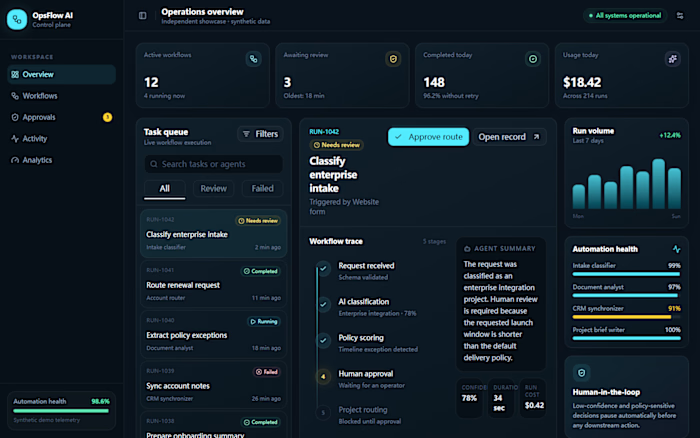
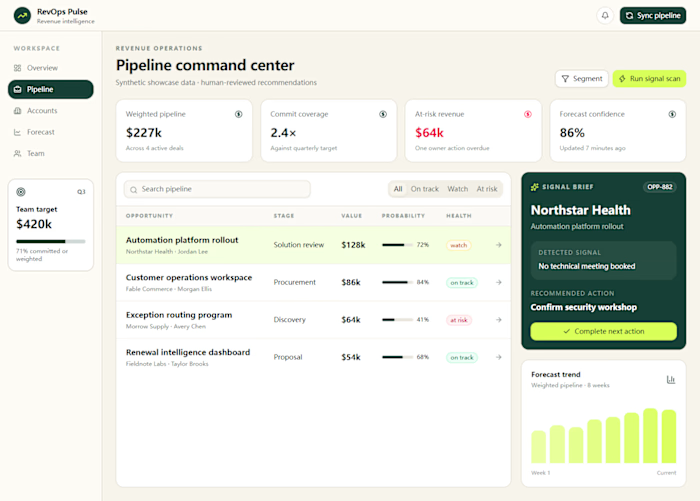
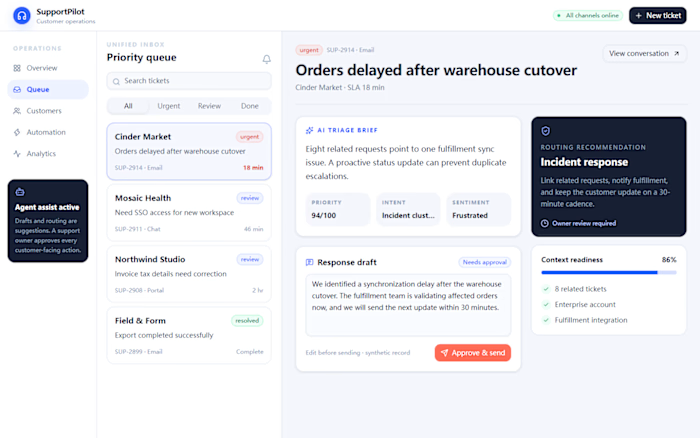
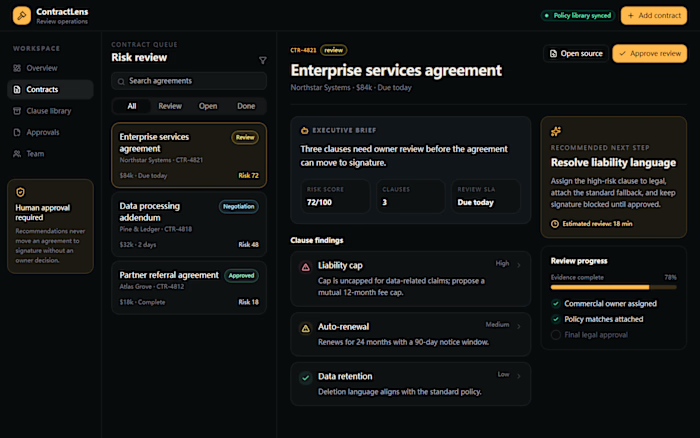
The system places every request in a shared operational queue. It presents a concise AI-style brief, detected requirements, fit score, qualification progress, risk, budget, timing, and routing recommendation. Operators can request more information or approve the opportunity and create its project state.
Client Value
For a client-services team, this pattern reduces time spent translating free-form requests, makes qualification criteria consistent, exposes missing information earlier, and keeps responsibility for the final decision with a person. It can be adapted for agencies, consultancies, implementation teams, support operations, or internal project offices.
Technical Approach
The application uses Next.js, React, TypeScript, Tailwind CSS, and accessible interface primitives. A local API route validates create, approve, and follow-up actions. Structured browser tools expose request listing and approval through the same application state. All demonstration companies, contacts, budgets, and requests are synthetic.
Key Features
Structured request capture
AI-style classification and summary
Delivery-fit scoring and qualification checklist
Budget, timing, risk, and requirement extraction
Routing recommendations
Human approval before project creation
Search, status filters, empty state, loading state, and error recovery
Responsive operations workspace
Challenges
The main product challenge was making the automation useful without implying that a score should make the final decision. The design keeps the recommendation compact, exposes the evidence behind it, and puts the irreversible-looking project action behind a clear human control.
Outcome
The local application passes lint, production build, WebMCP contract checks, and automated browser acceptance. Verified behavior includes selection, search, filters, form validation, loading, simulated API failure, successful approval, project-state creation, empty state, and desktop/mobile layout. Four upload-ready 16:10 screenshots were generated from the passing build.
Completion, QA, and Handoff Readiness
The acceptance flow checks the complete path from request review to a stable created-project state. It covers form validation, loading feedback, a simulated API failure and recovery, approval, filters, empty-state behavior, responsive layout, horizontal overflow, and browser console monitoring.
Each state-changing action provides explicit feedback and a clear terminal state. That makes unfinished behavior easier to identify, fixes easier to verify, and the final workflow easier to hand off with concrete acceptance criteria.
What This Proves
I can translate a messy operational process into a clear full-stack tool with automation, structured decision support, safe human intervention, API behavior, responsive design, and repeatable QA.
Technology
Next.js 16, React 19, TypeScript, Tailwind CSS, accessible Radix/Shadcn interface primitives, a REST-style API route, WebMCP-compatible structured tools, and Playwright browser automation.
Feature Screens
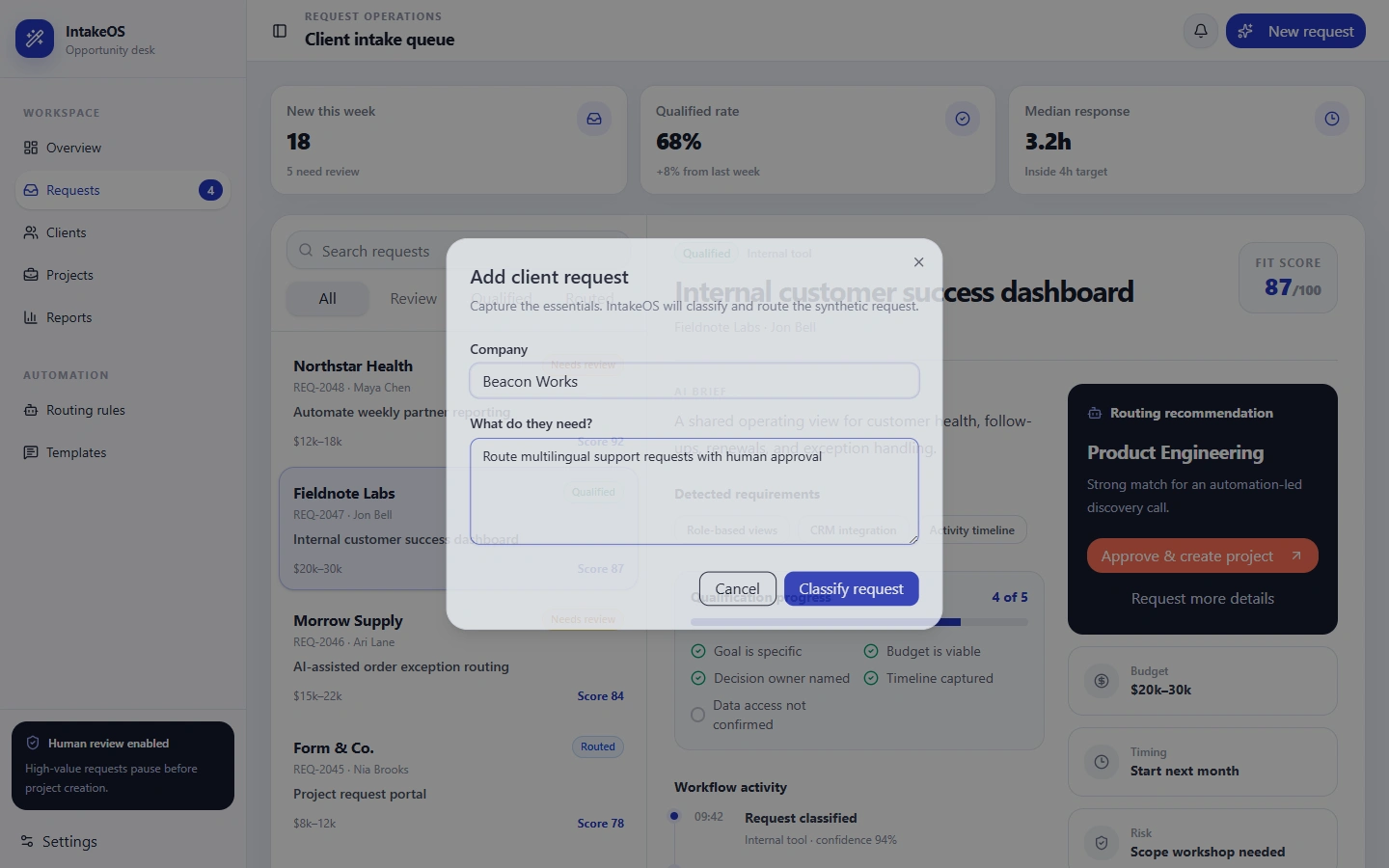
Structured client intake
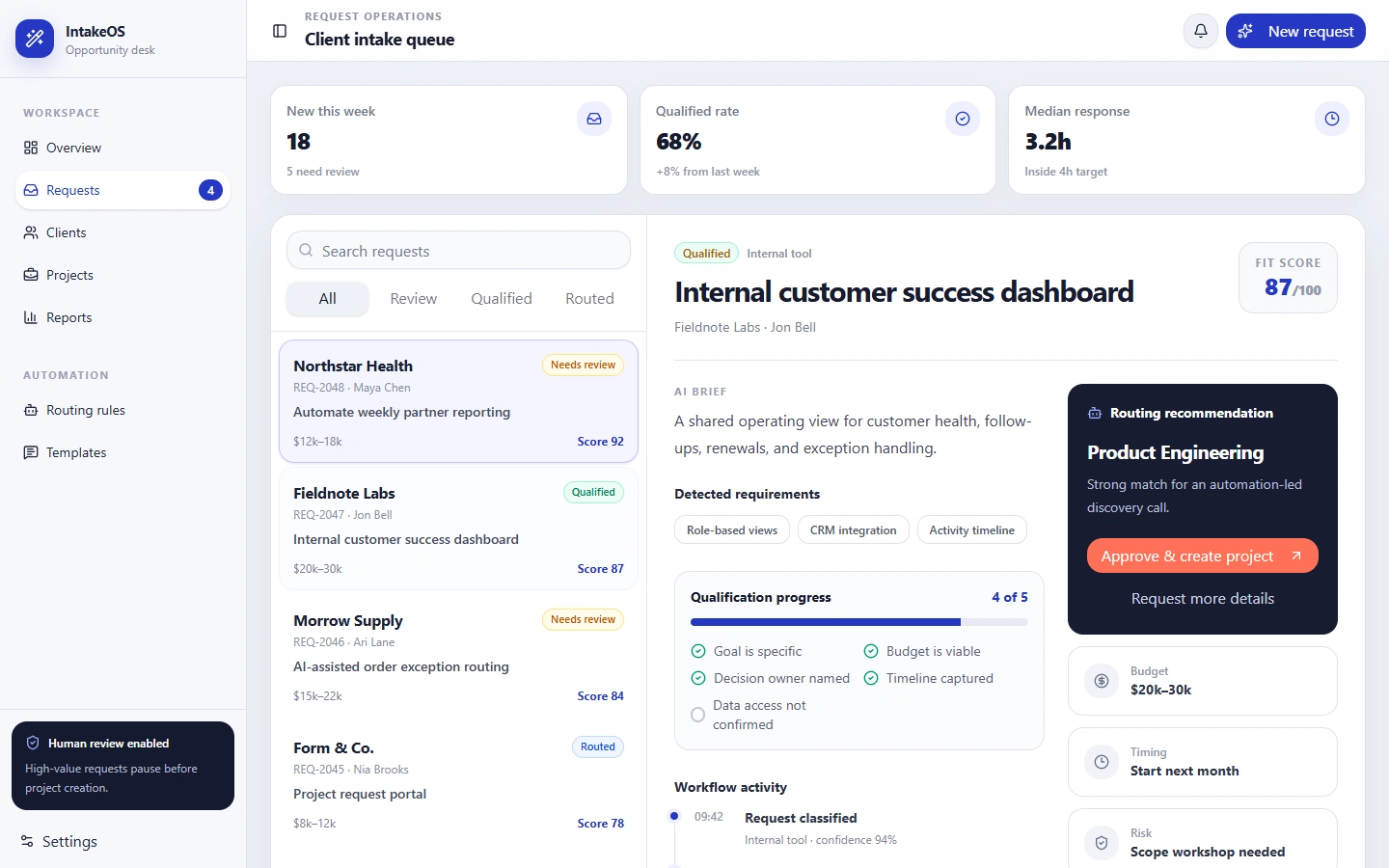
AI-assisted qualification
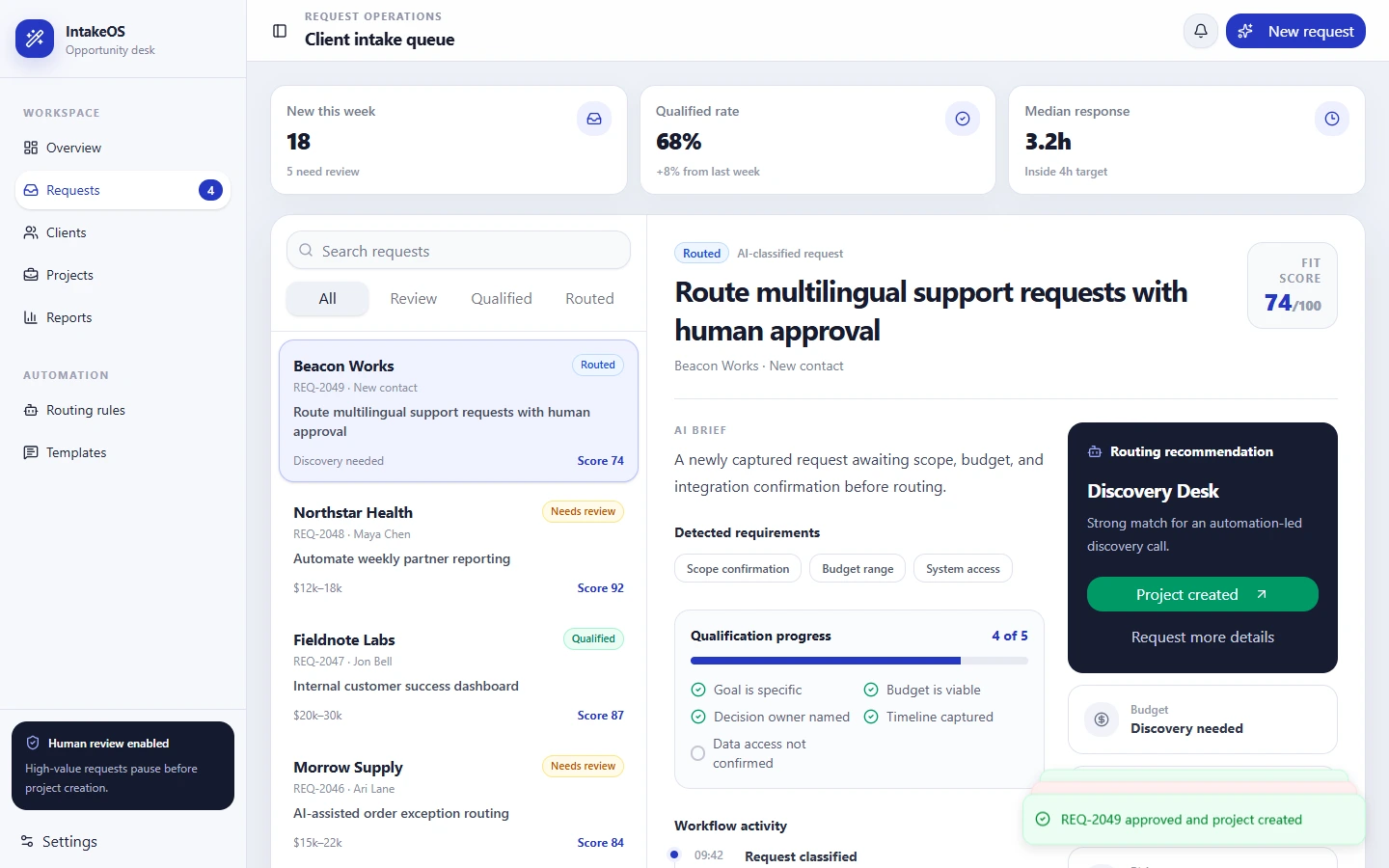
Approved project state
Like this project
Posted Sep 15, 2026
Independent showcase: a full-stack client intake workflow with structured qualification, validated API actions, failure recovery, human approval, and repeatable browser QA.