Coreloops - Construction Financial Management (B2B Saas)

Osagie Eigbe

Duration: Feb 2022 – Nov 2024
Team: Solo founding designer collaborating with CEO, engineers, and clients.
Project Overview
Coreloops started as a gig marketplace connecting construction workers with contractors and subcontractors in the UK. As the product evolved, it pivoted to become a full-fledged project and cost management platform tailored for the construction industry.
The Challenge
The UK construction industry is plagued with significant inefficiencies in hiring, project management, and cost tracking. GigBridge began by solving one part of the problem - sourcing vetted skilled workers for contractors, but the vision grew broader as we uncovered deeper operational gaps.
Cash flow issues, lack of financial visibility, and highly manual processes in the day to day of contractors prompted a pivot from being a marketplace to construction operations management and then financial management powered by artificial intelligence.
My Role
As the product evolved from GigBridge to Coreloops, my responsibility was to lead all aspects of product design, from initial research to high-fidelity designs, prototyping, and continuous iteration across all the eras and pivots, adapting to user needs and reshaping the product experience to solve these new challenges.
Design Impact (Summary)
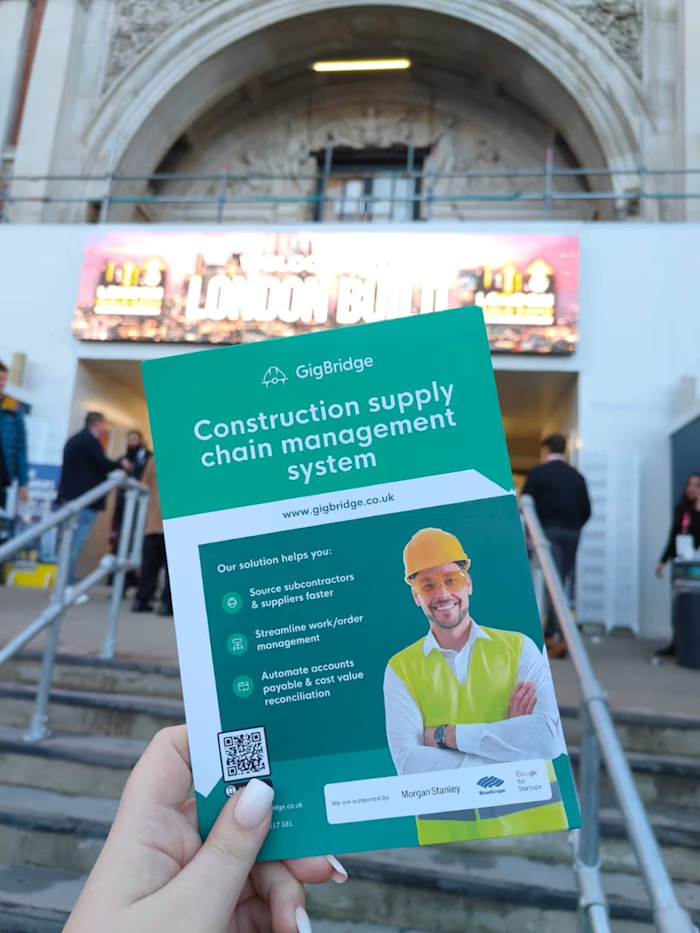
- Over $900,000 raised with the help of interactive prototypes used in accelerator pitches (BlueScope, Morgan Stanley, Google etc.)
- 10+ contractor companies signed up as paying clients before I left the company.
- Clients replaced dozens of spreadsheets with our unified, intuitive platform, saving hundreds of valuable hours weekly.
The Marketplace Era & Business Challenges (2022)
The early version of Coreloops, branded as GigBridge, operated as a two-sided marketplace connecting construction workers to short-term jobs. It supported contractors who needed to hire subcontractors and individual workers quickly.
Business Problems We Faced:
- Payment delays affected cash flow: Many contractors took up to 90 days to pay us, while we had to pay workers weekly. This exposed flaws in running the marketplace model sustainably.
- It was time consuming to source for quality workers and jobs with no guarantee of connection (and therefore commissions), with some workers not showing up after committing to jobs, thereby hurting the brand's credibility.
Marketplace UX Problems Solved
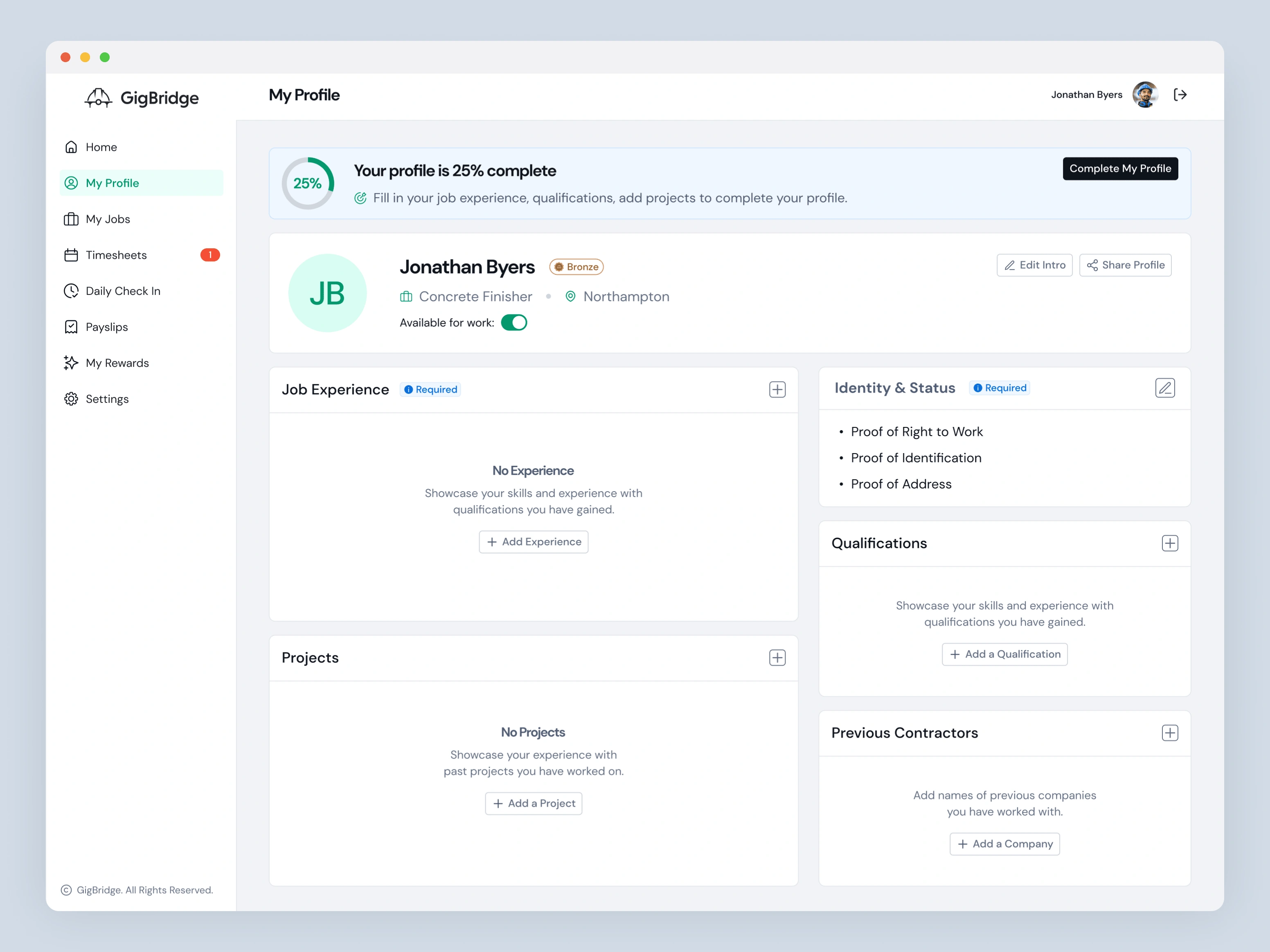
Fixing Onboarding drop-offs: The original signup flow required workers to upload right-to-work documents, certification cards, and other verifications before continuing, which caused high abandonment. We setup funnels on Mixpanel to track drop-offs and also tracked user activity on Hotjar. This revealed key drop-off pages and actions. We restructured onboarding to make it shorter, we made verifications optional and allowed users to return later. This improved the completion rate of the onboarding flow.
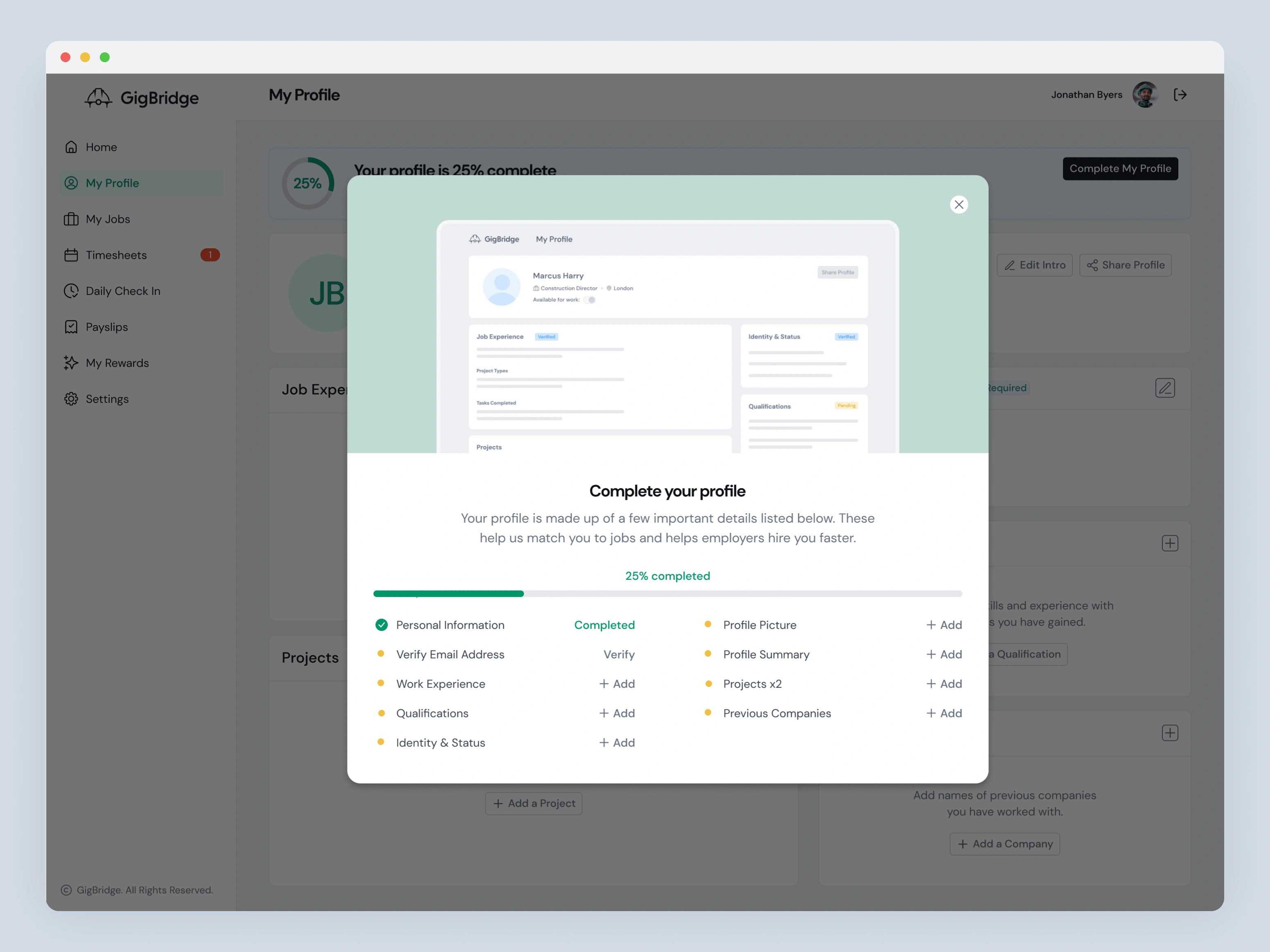
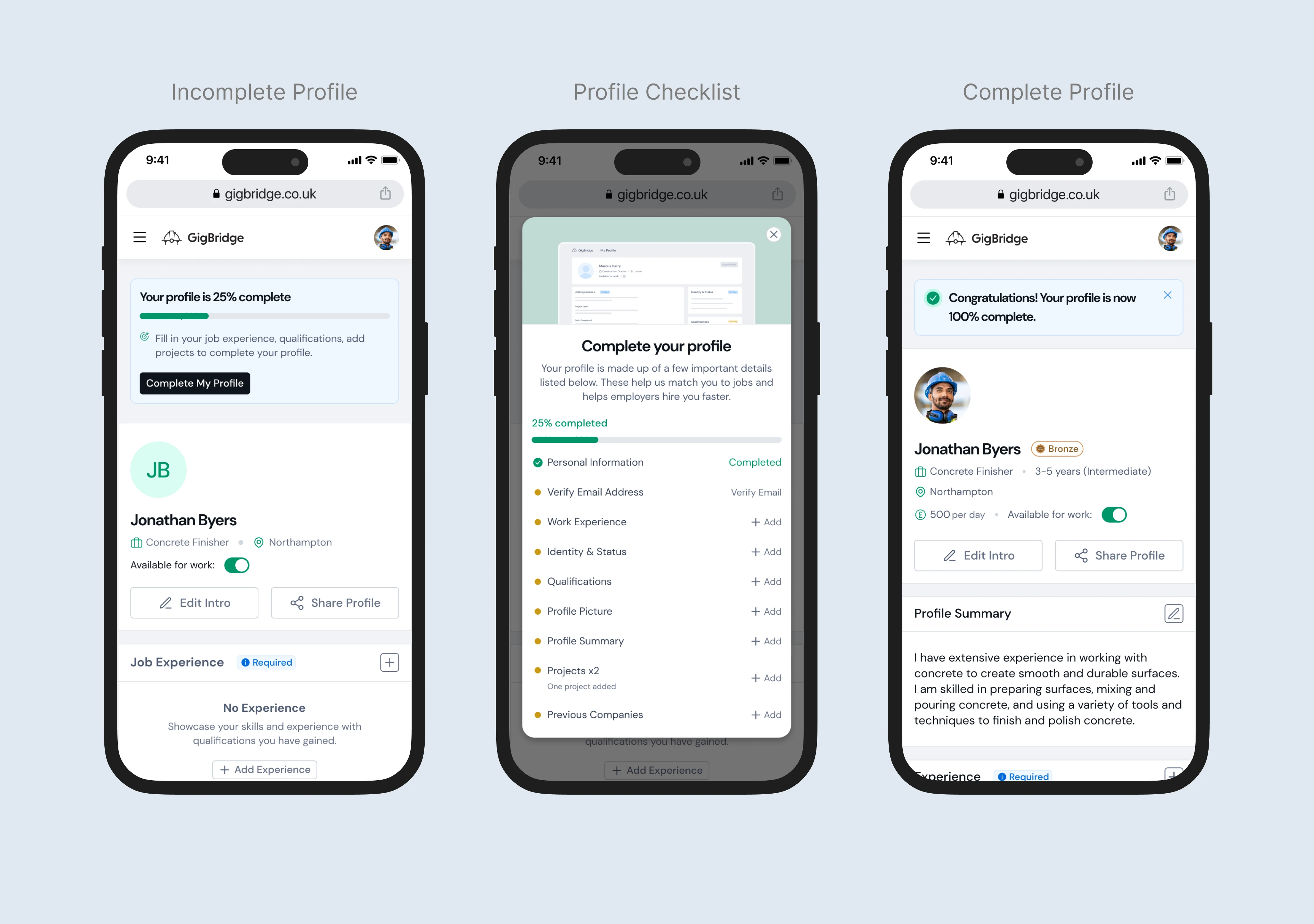
Profile Completion: We introduced a profile completion tracker after onboarding to nudge users to complete missing info.
Mobile-Responsive Design: Most workers accessed the platform via mobile devices. We designed all flows for an optimized experience on smaller screens.
Worker discoverability: Contractors needed to find relevant workers quickly. We introduced advanced filters (by trade, availability, distance, experience) and improved the card/list layouts for scannability.
Pivot From Marketplace to Construction Project Management (2023-2024)
As the marketplace model proved unsustainable, we made a strategic pivot. We moved from being just a marketplace to providing project management tools for contractors.
Initially, we had built tools like Directory, Timesheets, Payslips, Invoices & Payments to support post-hiring workflows. These tools became the foundation of the new platform.
We also introduced a central Projects hub that allowed contractors to bring their real-world projects into the system, along with their existing subcontractor relationships.
Realisation
This pivot showed us a key insight: everything in construction ends up as a cost (invoices, purchase orders, quotes, timesheets etc), and contractors were juggling all of this across multiple spreadsheets. It was manual, tedious, and they were drowning.
We phased out the marketplace entirely and focused fully on helping contractors manage and make sense of their costs. That’s how Coreloops was born.
Coreloops transformed into a platform for managing project finances, streamlining documentation, and improving cost visibility, with new tools like the Cost Reports Dashboard, Documents Manager, Progress Tracker, and improved Directory forming the core of the new product.
Adapting the Product - UX & Design Adjustments from the Pivot
The pivot to finance management brought a shift in audience, use cases, and expectations. While we didn’t overhaul the UI and experience all at once, we made continuous improvements over time. Many financial tools were already in place within GigBridge, so when we transitioned to Coreloops, we focused on refining the experience to align with our new user base and brand.
Key changes included:
User persona overhaul: Transitioned from jobseekers and site managers to commercial managers, finance teams, and directors.
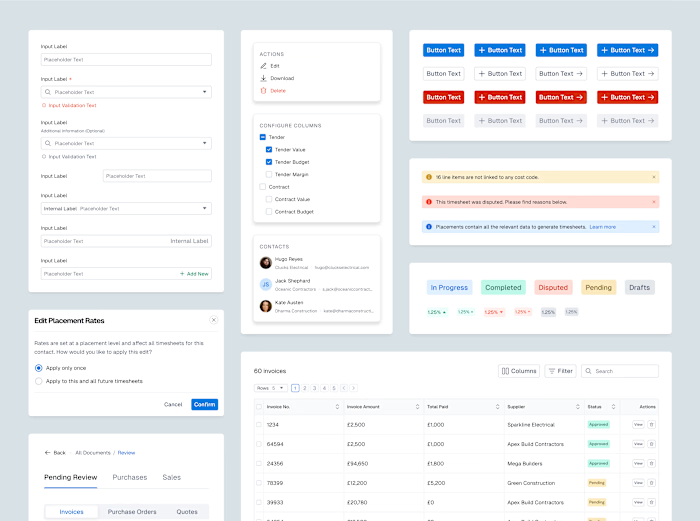
Fast rebranding using Figma variables: I had set up design tokens early on, which allowed us to swiftly update themes, colors, and typography across the product by simply switching tokens.
Navigation adjustments: Shifted focus from jobs and gigs to cost-driven project dashboards.
Design system evolution: Components were gradually updated to support more data-heavy UIs, without needing a ground-up rebuild.
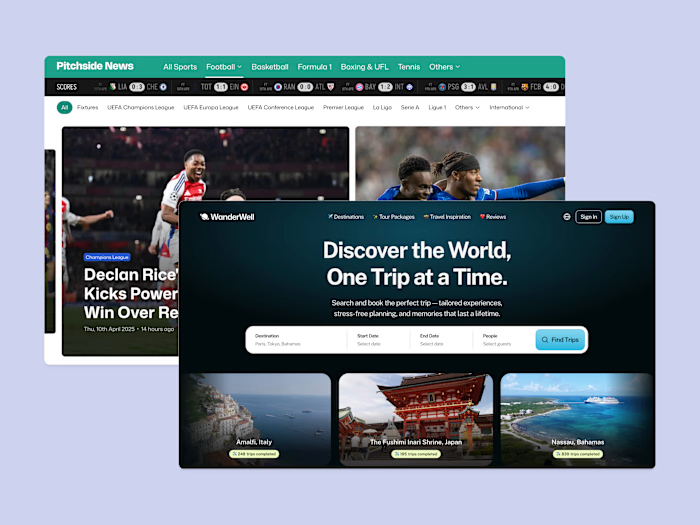
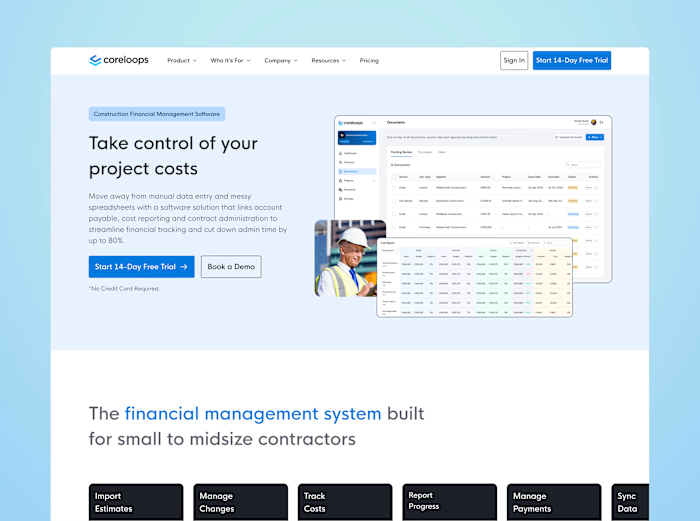
New website design: We redesigned the marketing site to match the new Coreloops brand and value proposition.
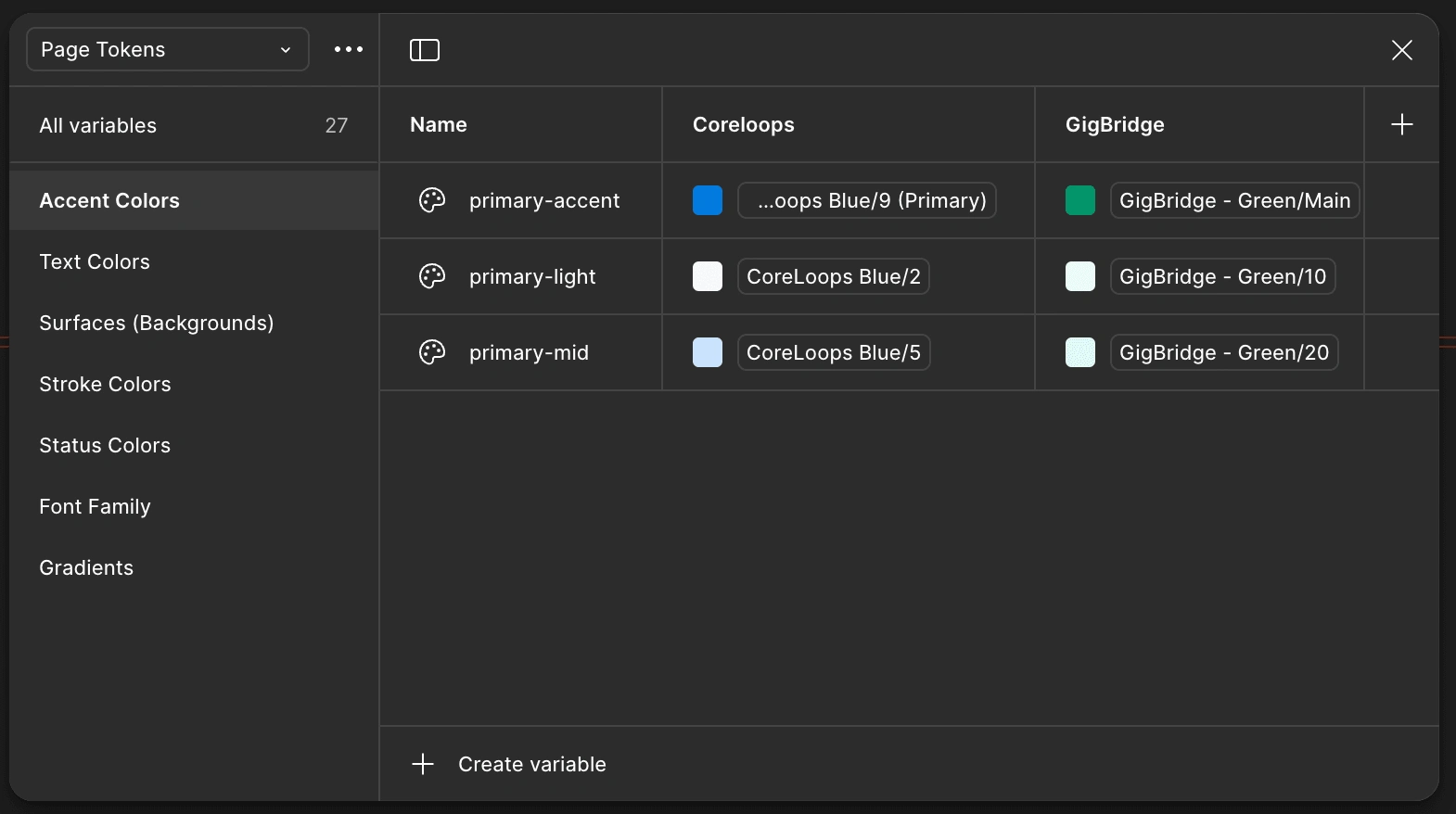
Some Design System Tokens in Figma

GigBridge/Coreloops website evolution 2022-2024
Cost Reports Dashboard
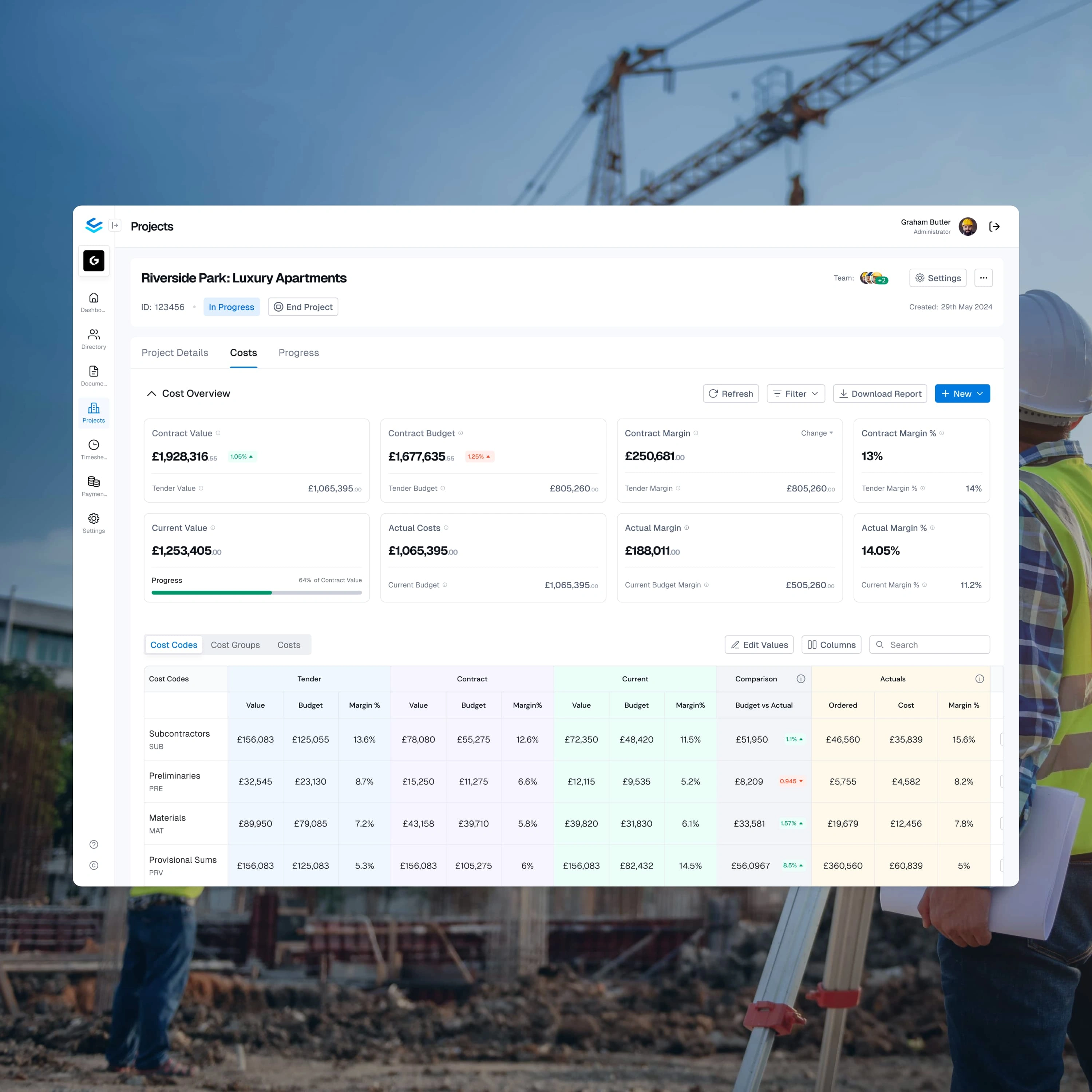
One of the most transformative features we built was the Cost Reports Dashboard. A powerful interface that gave contractors and finance teams real-time visibility into project costs. It became the central intelligence layer of Coreloops, enabling users to monitor budgets and spend at a glance, and drill deeper into their cost codes and documents.
The challenges contractors faced:
Data fragmentation: Costs were previously buried in multiple spreadsheets scattered across emails.
No cost visibility: Users lacked a way to see how much they were spending per supplier or project.
Approval bottlenecks: Managers often didn’t know which items were pending approval.
Data accuracy concerns: Clients worried about duplicates or wrong entries.
How we solved this:
We unified cost data across all documents, making it accessible via a centralised dashboard.
We introduced cost tagging to relevant cost codes (categories), allowing users to break down total spend by sections of the project. e.g Electrical, Plumbing etc.
We introduced teams, so all responsible parties could see this dashboard. e.g Finance teams.
Implemented document review mechanisms to ensure accuracy.
As a result:
Time savings: Commercial managers who spent hours weekly reconciling spreadsheets could now view insights in seconds.
Adoption driver: It became the most used feature on the platform and was directly responsible for closing multiple leads.
Trust & accountability: Contractor's internal teams gained a shared source of truth for cost performance monitoring.
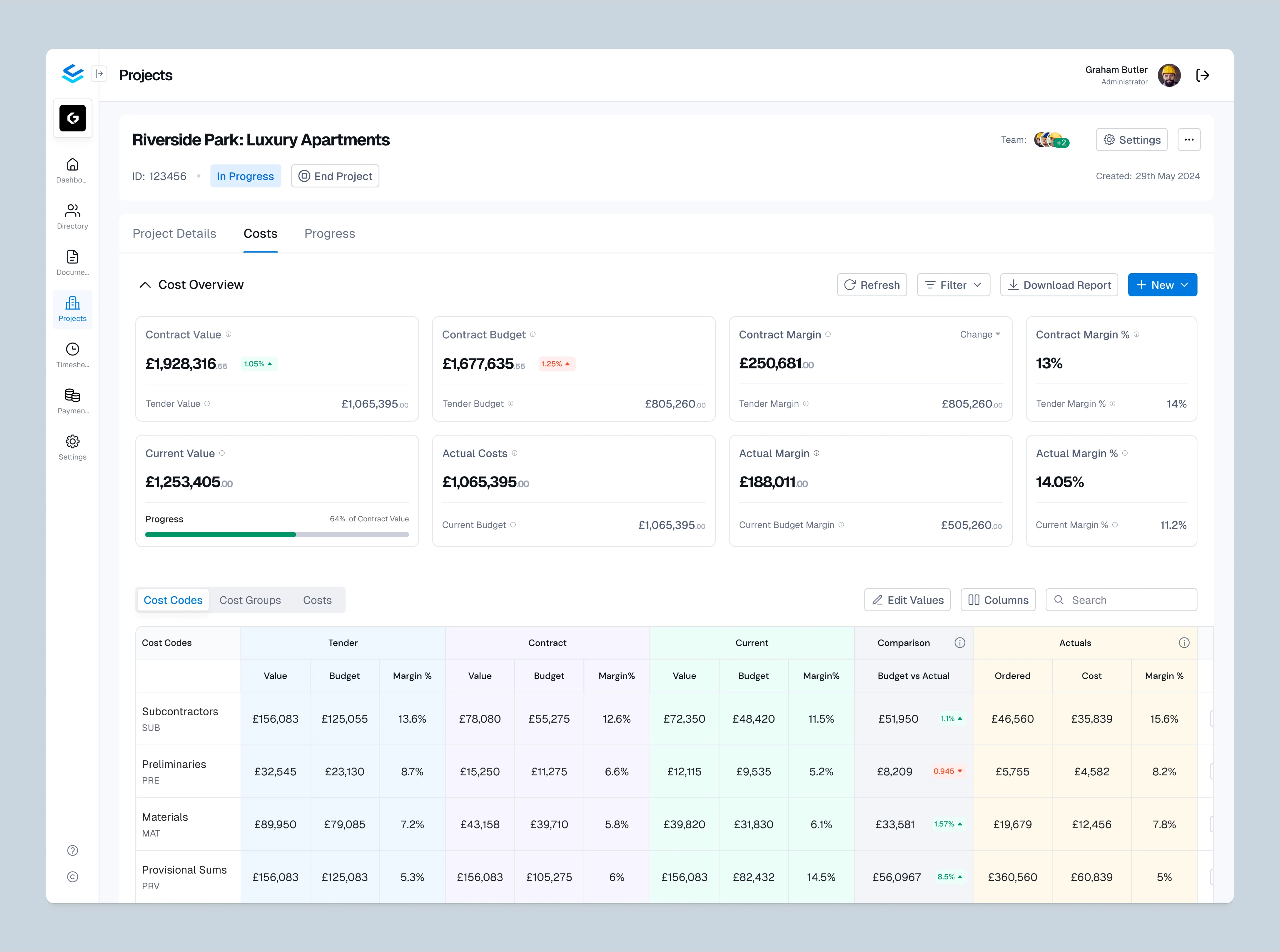
Cost Reports Dashboard showing Cost Codes table
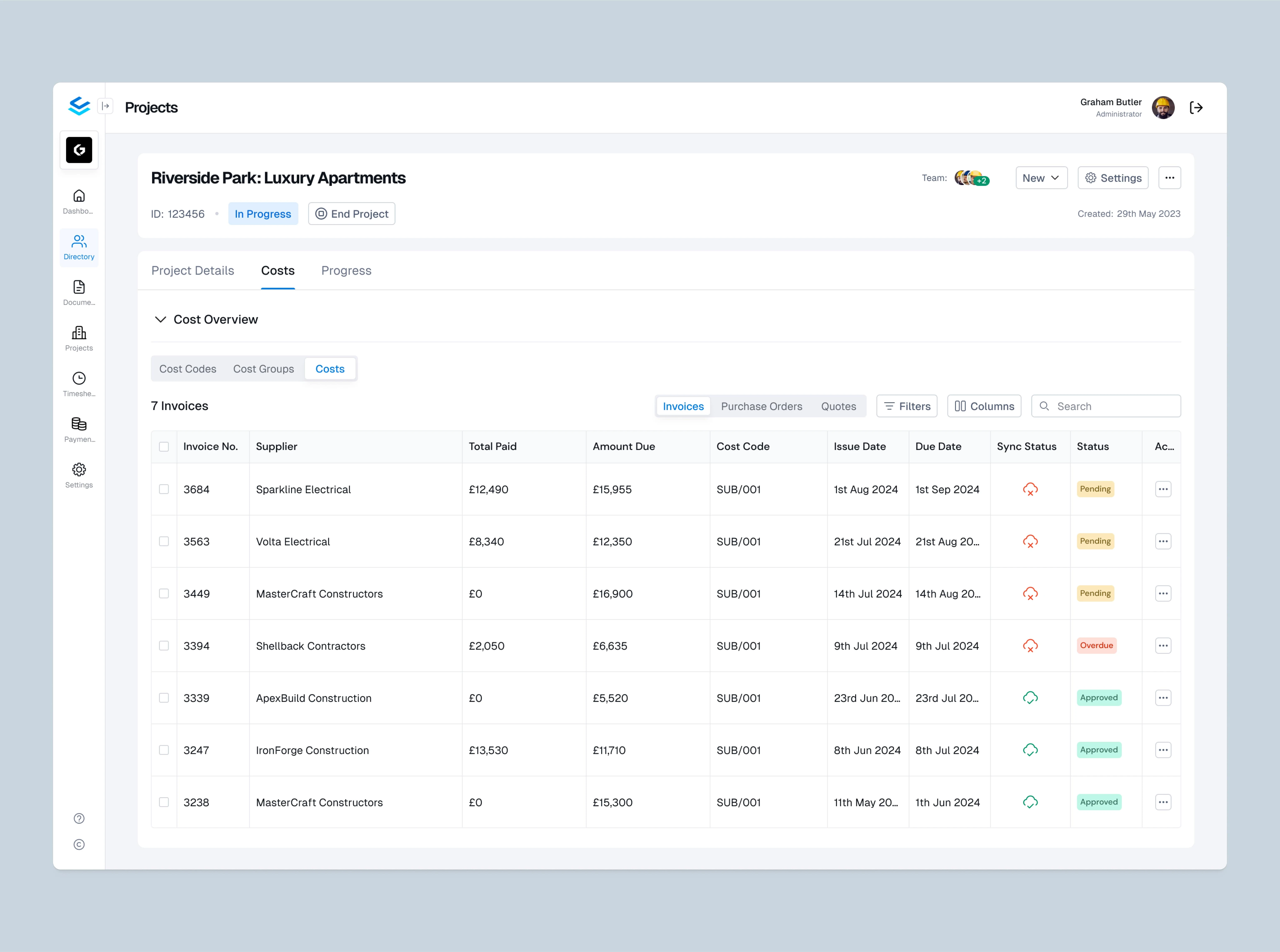
Cost Reports Dashboard showing Costs/Invoices table (with the Overview section collapsed)
Documents Manager
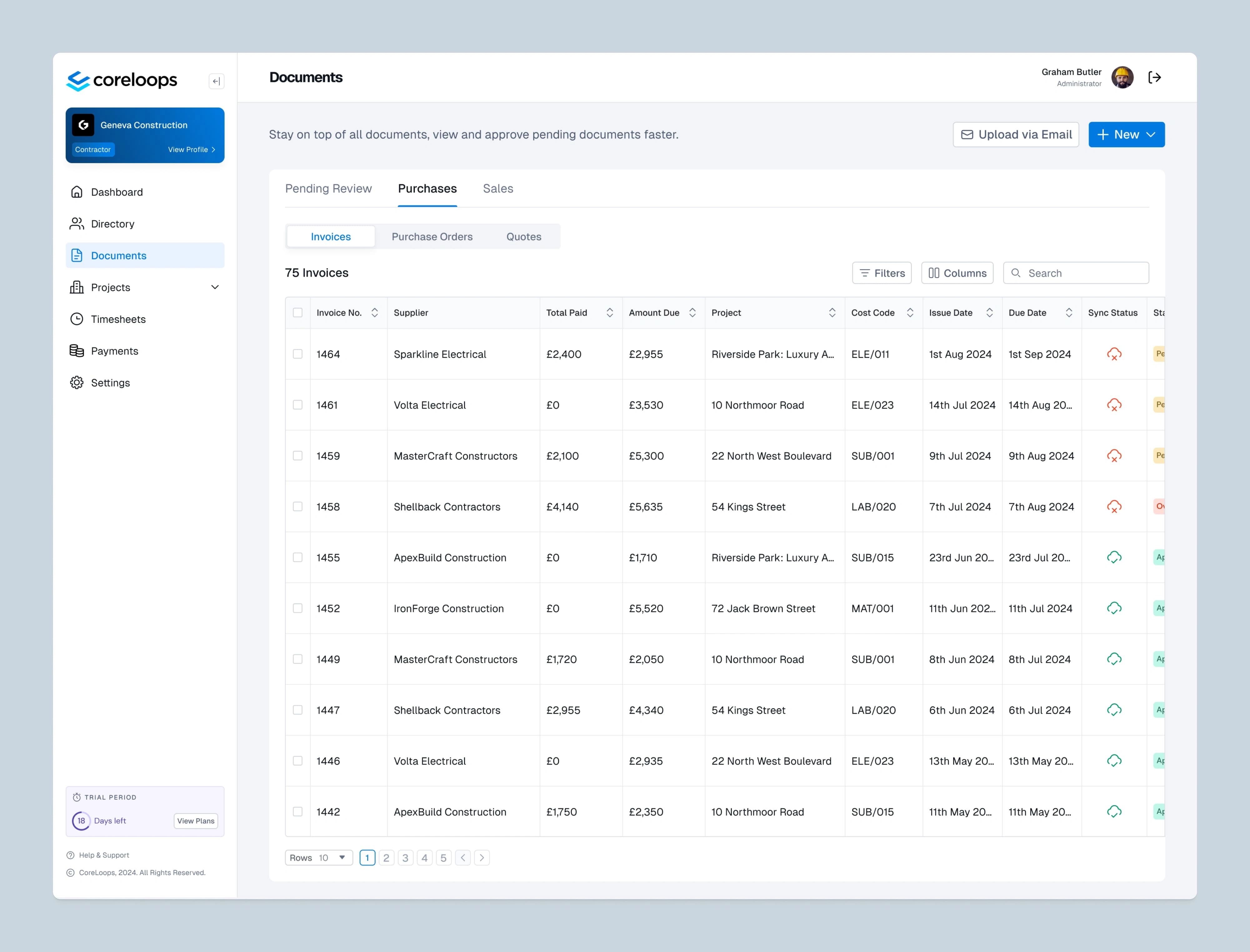
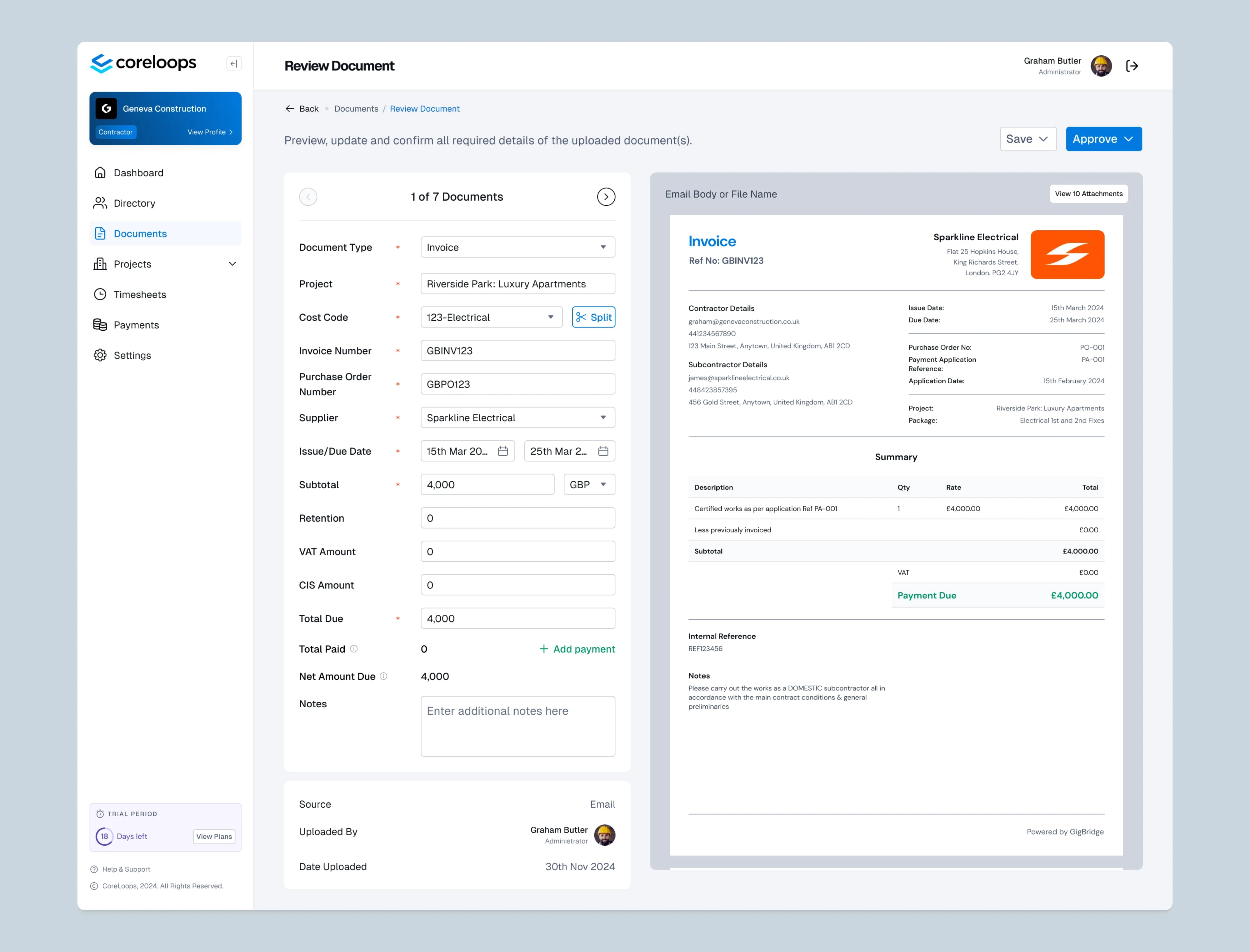
The Documents Manager was another key value driver and USP. It began as a central place for reviewing cost documents like invoices, POs, and quotes, helping contractors organize what was previously scattered across email and paper. Over time, it evolved into a powerful document processing, storage and creation tool.
The Challenges Contractors Faced:
High volume: Some clients had thousands of legacy documents to upload and process.
Manual input: Entering project, amount, and supplier data while processing was tedious and error-prone.
Scattered storage: Cost documents were typically scattered across multiple email threads.
How we solved this:
Introduced a system where users could forward documents to a dedicated email address thereby automatically uploading files into Coreloops and queuing them for review.
Implemented OCR and AI to extract metadata (e.g. supplier, amount, VAT, dates) and auto-fill fields, drastically reducing manual review time.
Enabled users to link cost documents to cost codes while reviewing, this automatically updated their cost reports dashboard.
Users could also split costs across multiple cost codes for invoices that included spend across different categories.
Implemented smart tagging based on historical patterns. For example, if a supplier was consistently linked to a specific cost code, new invoices from that supplier were automatically tagged accordingly, accelerating the review process.
Allowed users to create invoices, POs, and quotes directly within Coreloops.
Synced cost documents with external accounting systems.
As a result:
Massive time savings: Helped users process large volumes of documents with minimal friction.
Smarter organization: Reduced cognitive load by tagging and auto-categorizing files.
Adoption driver: The split-cost and AI review features, working directly with the Cost Reports Dashboard were highly requested and directly influenced client sign-ups.
Like this project
Posted Apr 16, 2025
Outcomes - Multiple clients landed - Over $800,000 in funding secured - Clients save many hours processing their financial documents and construction processes.
Likes
0
Views
15
Timeline
Jul 18, 2022 - Nov 29, 2024