SaaS Hero Copy: Translation vs Transcreation (EN/ES Sample)

Marcos Tineo

What this is
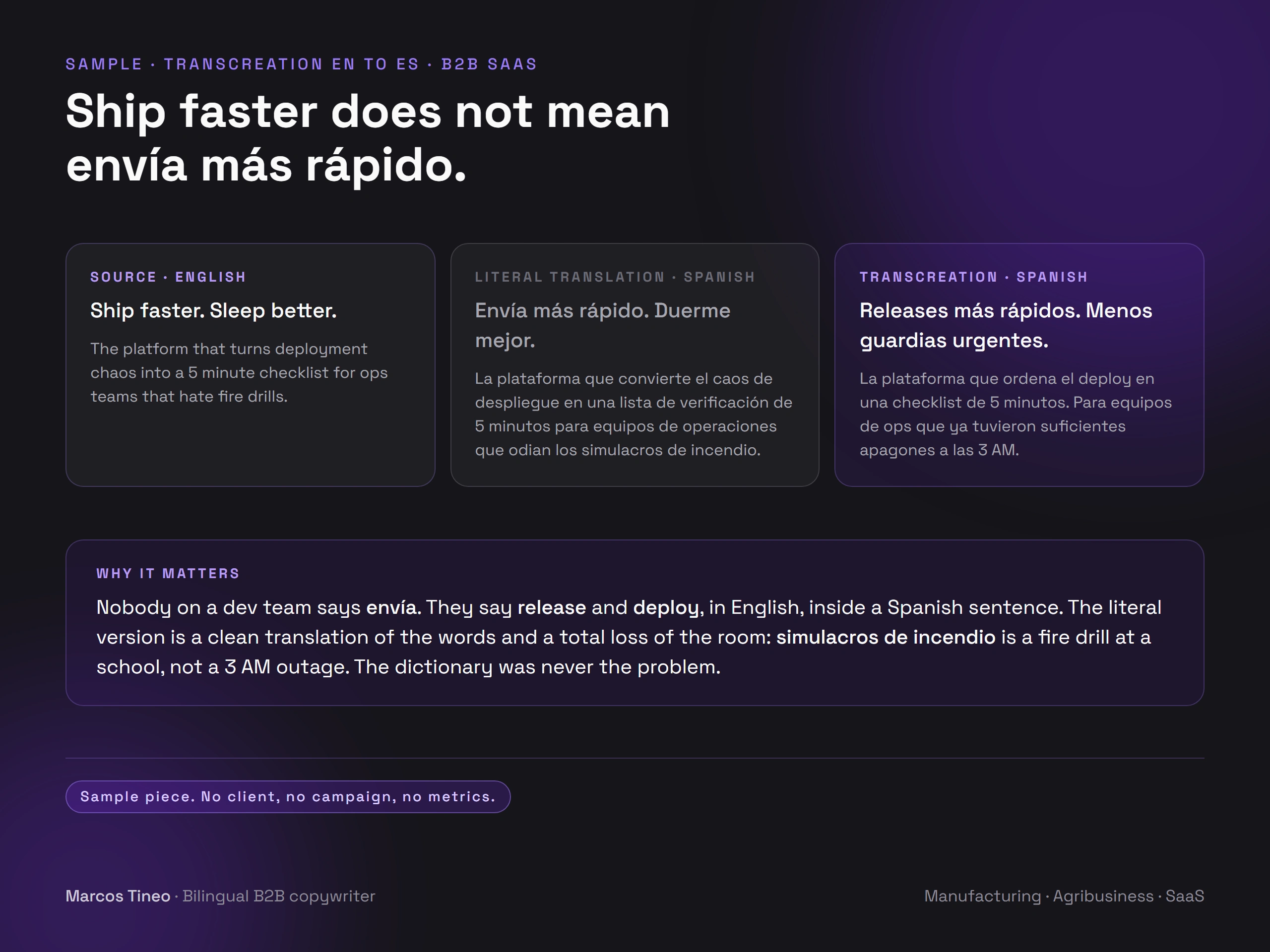
A B2B SaaS landing page hero, shown three ways: the English original, what a translator returns, and what the Spanish should have been. No client, no campaign, no metrics. A sample, built to show the method.
The original
Ship faster. Sleep better. Four words aimed at an ops team that has been paged at 3 AM often enough to hate the word deployment.
What the translator returns
Envía más rápido. Duerme mejor.
Every word is right. The sentence is grammatical. And a developer reading it knows immediately that whoever wrote it has never shipped anything.
Nobody on a dev team says envía. They say release. They say deploy. In English, inside a Spanish sentence, because that is how the room actually talks. The literal line translated the dictionary entry for ship, which is about parcels.
Where it gets worse
The subhead calls the problem simulacros de incendio. In English, fire drill is a dead metaphor: it means a false alarm that wastes everyone's afternoon. In Spanish it is not dead at all. It is a literal drill, the kind you did at school, walking single file to the playground.
So the Spanish copy promises to save your ops team from school evacuations.
The transcreation
Releases más rápidos. Menos guardias urgentes.
And the subhead: la plataforma que ordena el deploy en una checklist de 5 minutos. Para equipos de ops que ya tuvieron suficientes apagones a las 3 AM.
Same promise. Same length. It reads like it was written in Spanish, because it was.
The part that is not about language
A translator is answering: what does this sentence say? That is a real skill and it is not this one. The question here is different: what would make this buyer believe the person writing has sat in their chair at 3 AM?
The dictionary was never the problem. Nobody buys from a vendor who sounds like a tourist in their own category.
Like this project
Posted May 21, 2026
The English hero, the literal Spanish a translator returns, and the line a dev team would actually say. EN to ES transcreation sample. No client, no metrics.
Likes
0
Views
3