MyDante: Reimagining Deep Reading for the Digital Age

Stas Udotov


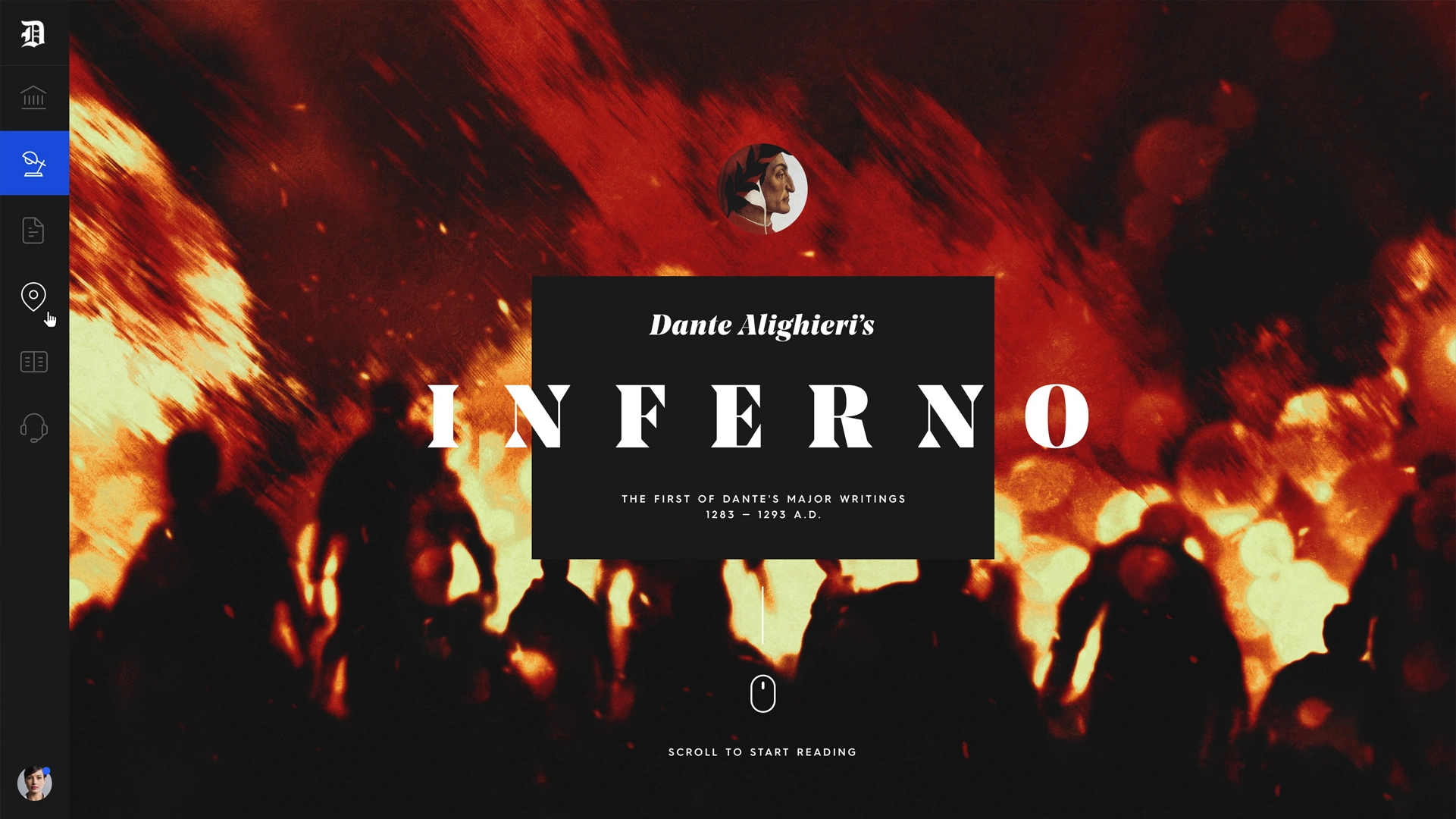
MyDante: Reimagining Deep Reading for the Digital Age
MyDante began at Georgetown University with an ambitious question: could technology help students engage more deeply with Dante's Divine Comedy rather than distract them from it?
Led by Professor Francis J. Ambrosio, the initiative drew inspiration from the reflective practices associated with medieval manuscripts. Readers of those manuscripts did not treat the page as a passive container. They added notes, interpretations, references, and personal responses in the margins, turning reading into an active conversation with the text.
Dworkz helped translate that tradition into a digital learning experience. We designed the UX and UI and contributed front-end development for a platform where students could read, listen, annotate, reflect, and exchange ideas with a learning community.
The result was not simply an online edition of a classic text. MyDante became an environment for individual interpretation and shared inquiry—a digital framework intended to support immersive, purposeful reading.
Services: UX design, UI design, interaction design, information architecture, and front-end development
Product: Digital humanities and collaborative learning platform
Primary users: University students, instructors, and readers of complex literary and philosophical texts
The motivation
Traditional digital reading products often prioritize speed, convenience, and content consumption. MyDante pursued a different goal: contemplation.
The project sought to help students slow down, spend time with difficult passages, connect ideas across the work, and develop their own interpretations. Technology needed to support that intellectual process without reducing the poem to a sequence of screens or surrounding it with distracting interface elements.
At the same time, reading was not meant to be purely solitary. A student should be able to preserve private observations, share selected ideas with classmates, encounter other interpretations, and participate in a broader discussion of the text.
The central design question became: how can a digital interface support both the intimacy of personal reflection and the energy of collaborative learning?
The challenge
The platform needed to bring several distinct experiences into one coherent environment:
Present Dante's original Italian alongside an English translation.
Include spoken Italian so students could hear the language as they read.
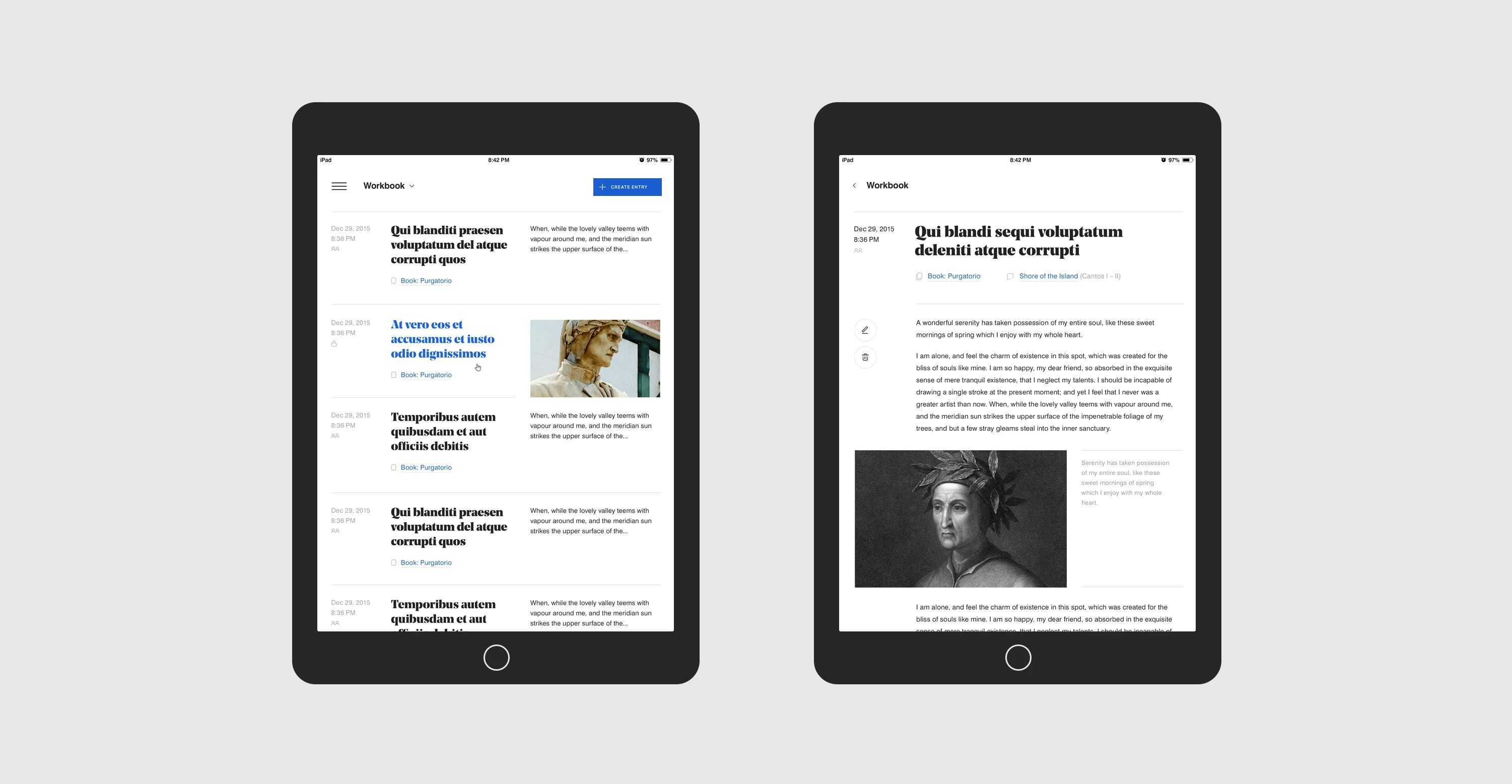
Allow readers to create bookmarks, annotations, footnotes, and journal entries.
Give students control over whether their contributions remained private or were shared.
Support discussions and the exchange of images and multimedia projects.
Keep the literary text at the center of the experience.
Create a framework that could extend beyond one work or one course.
Each feature offered educational value, but together they could easily make the interface feel busy or fragmented. The product had to offer depth without interrupting concentration. It also had to make the relationship among the text, personal interpretation, and community contributions understandable to students who were encountering the platform for the first time.
The design approach
1. Treating the text as the primary interface
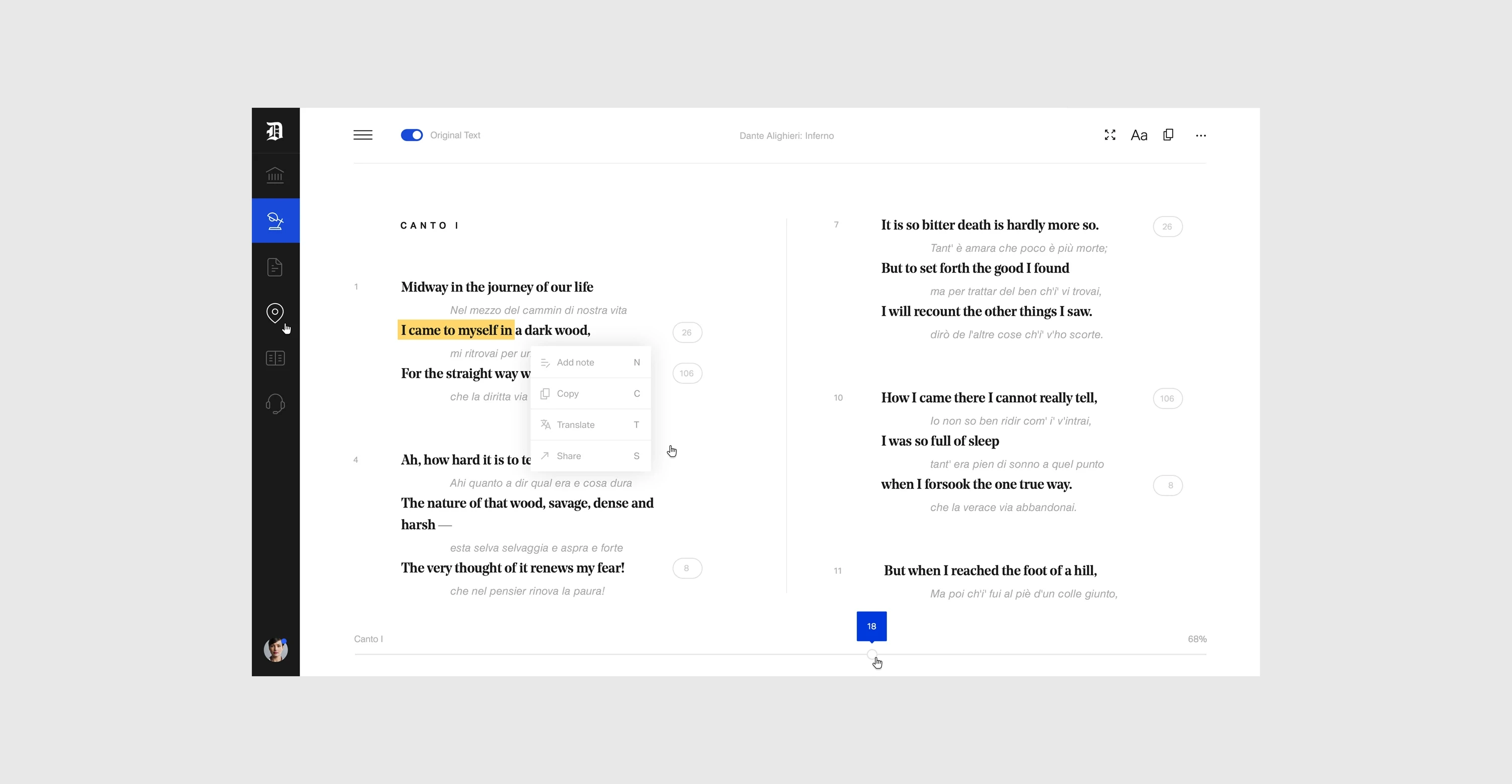
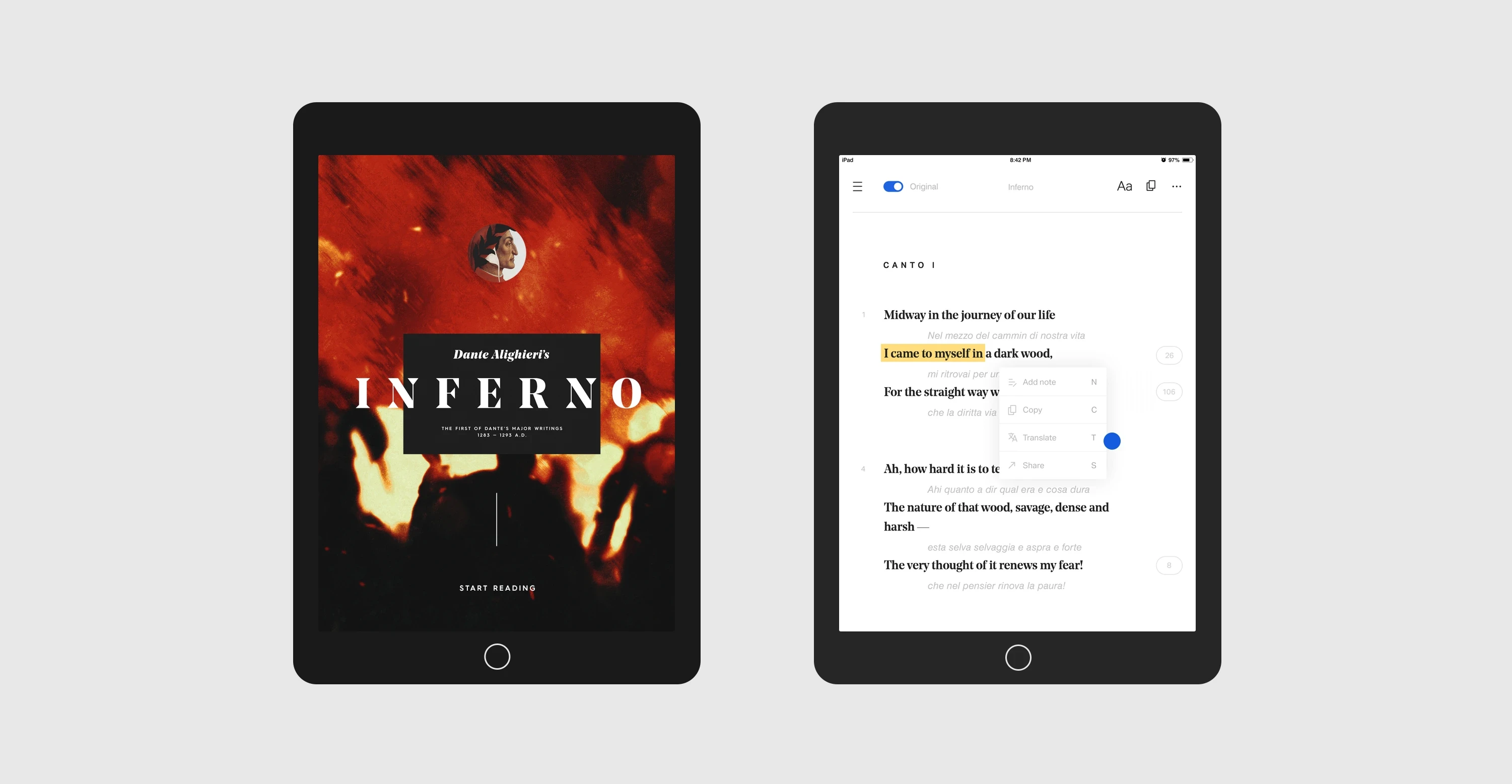
The reading experience began with the work itself. MyDante presented the original Italian text beside its English translation, allowing students to compare the two versions without losing their place or moving between separate resources.
This side-by-side structure reinforced the relationship between the source and translation. It also gave instructors and students a shared reference point for discussing specific passages, word choices, and interpretations.
The interface was designed to support the text rather than visually compete with it. Reading remained the primary activity, while related tools appeared as extensions of that activity.
2. Adding sound as another path into the poem
Students could listen to the Italian text read aloud while following it on screen. The audio component introduced rhythm, pronunciation, and tone—qualities that are difficult to communicate through translation alone.
Integrating audio into the reading environment created a richer encounter with the original work without forcing users into a separate media experience. The poem could be read, heard, and compared within the same context.
3. Recreating the tradition of marginal annotation
Annotation was central to the concept of a digital manuscript. As students read, they could add notes, bookmarks, and footnotes directly in relation to the text.
This interaction made reading active. Students could capture an immediate response, develop an interpretation, mark a passage for later study, or connect it to another idea. Their work accumulated alongside the poem, creating a personal record of how their understanding developed over time.
The design challenge was to make annotation available without constantly pulling attention away from the passage. Tools needed to feel close at hand while remaining secondary to the act of reading.
4. Balancing private reflection and public contribution
Not every idea is ready to be shared. MyDante allowed annotations, footnotes, and journal entries to remain private or become visible to the community.
This distinction supported different stages of learning. Students could use private space to question, experiment, and reflect without an audience. When they were ready, they could contribute selected ideas to a collective interpretation of the work.
Giving users explicit control over visibility was important both functionally and psychologically. It helped the platform support honest reflection while still encouraging participation.
5. Building a community around the text
MyDante extended discussion beyond the classroom. Readers could share public annotations and journal entries, start discussion-board topics, and exchange images and multimedia projects.
These features transformed the text into a shared point of departure. Students could see how others responded to the same passage, compare interpretations, and continue conversations outside scheduled class time.
The community experience was not separated from reading as an unrelated social layer. It was designed to grow from the text and return attention to it, helping readers understand their own interpretation as part of a larger conversation.
6. Supporting multiple forms of interpretation
Complex literature does not always produce a purely verbal response. MyDante therefore supported images, audio, and other multimedia contributions alongside written annotations and journal entries.
This flexibility allowed students to explore connections and communicate ideas in different forms. It also made the platform more than a digital book: it became a collection of perspectives built around a common work.
The interface needed to accommodate these varied contributions while preserving a coherent relationship to the original text.
7. Designing an extensible learning framework
Although MyDante was created around the Divine Comedy, the underlying design challenge applied to many difficult literary and philosophical works.
We approached the experience as a reusable framework rather than a one-off presentation. The essential model—primary text, translation or supporting material, personal annotation, controlled sharing, multimedia, and discussion—could be adapted to other works and learning contexts.
This extensibility increased the project's value beyond a single course. It demonstrated how the same interaction model could support focused engagement with other texts that benefit from close reading and collective interpretation.
Connecting design and development
Dworkz's contribution included both experience design and front-end development. That combination was valuable because MyDante depended on subtle relationships among the reading layout, annotation tools, media, privacy controls, and community features.
Working across design and implementation helped maintain the intended hierarchy and behavior as the experience moved from concept into a functional platform. It also allowed interaction details to be refined in the context where students would actually use them, rather than treating implementation as a separate handoff.
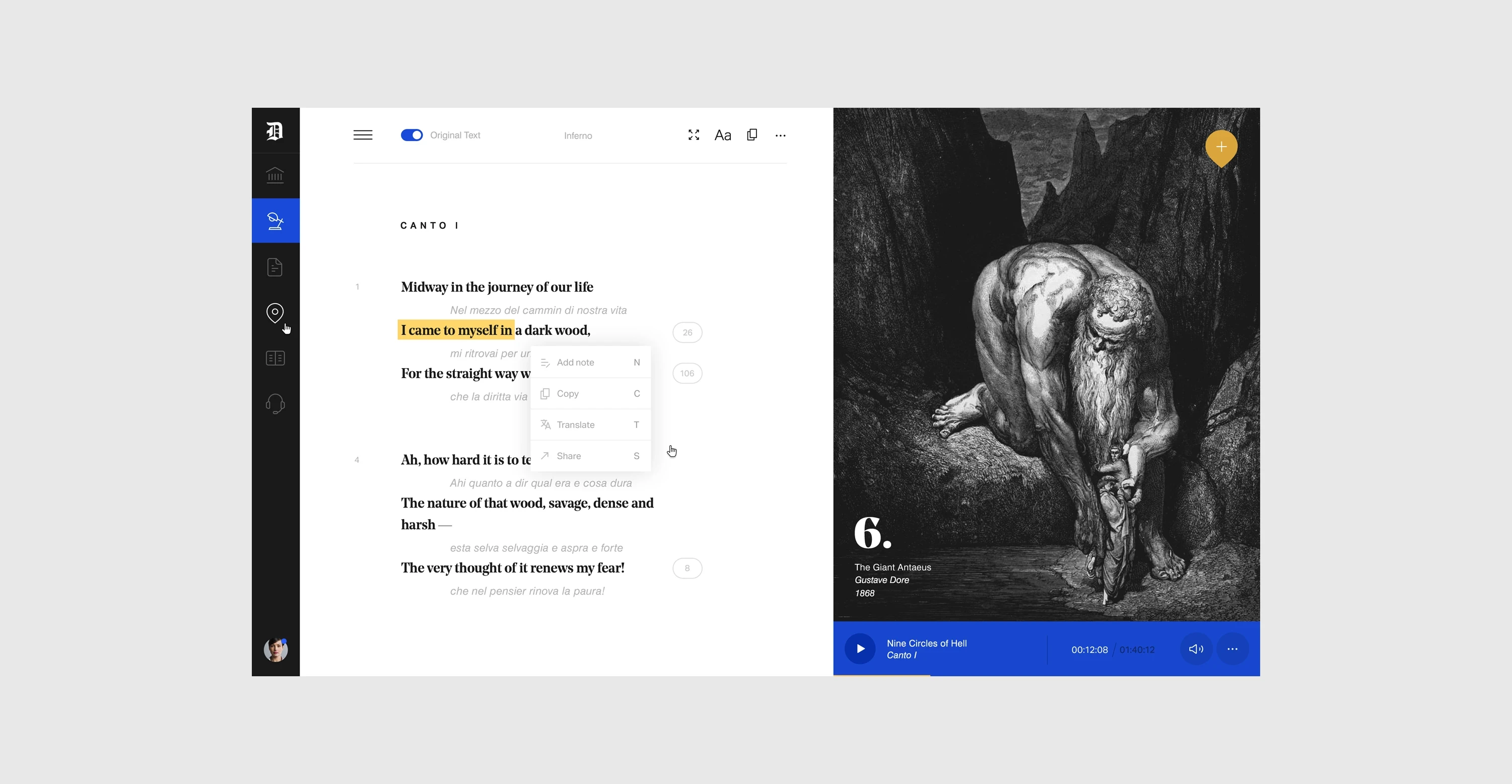
MyDante presents Dante’s original Italian text side by side with an English translation, along with an audio recording of the Italian text read aloud.
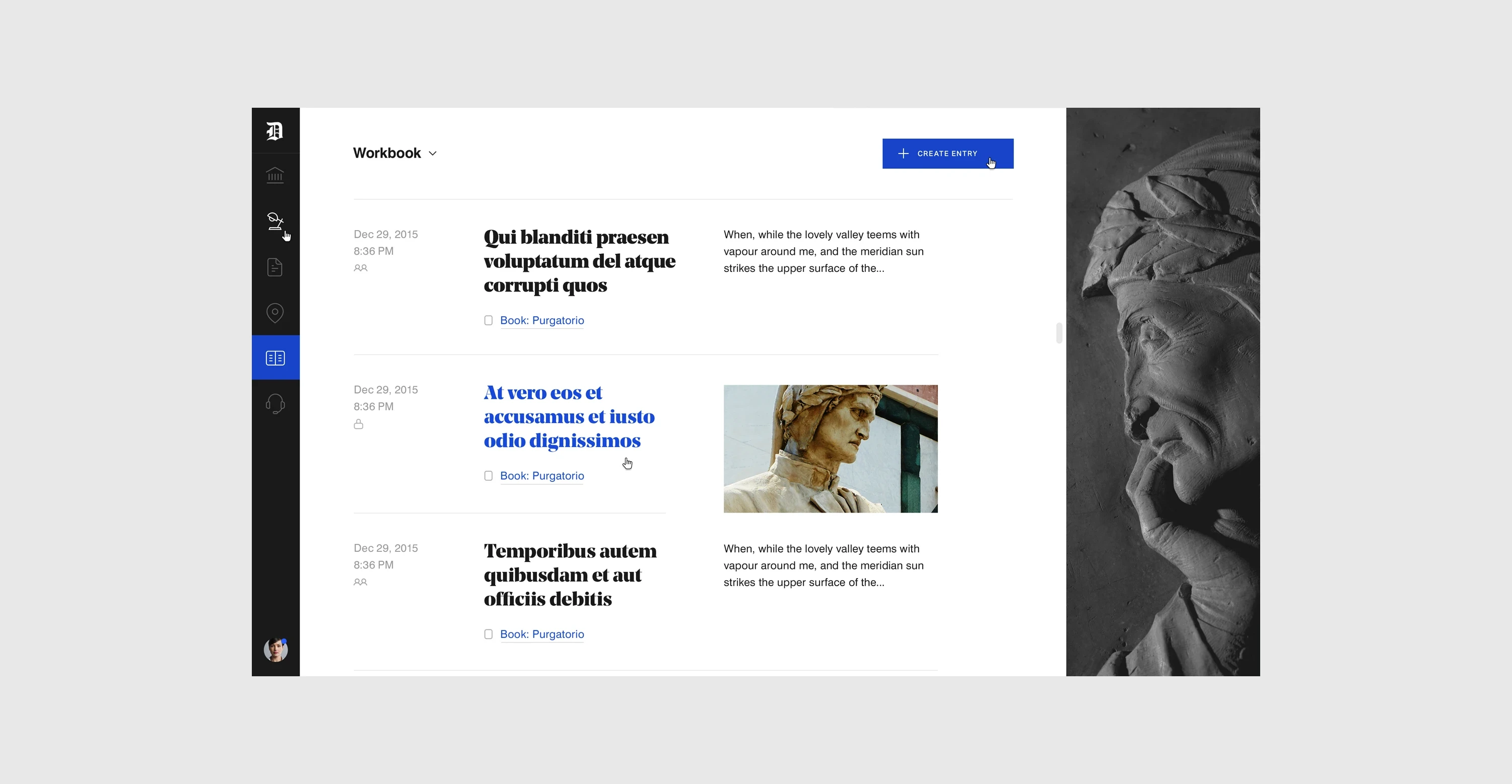
As you read, you can annotate the poem, just as medieval monks would have written notes in the margins of their texts. You can add bookmarks, annotations, and footnotes, all of which can be either private or shared.
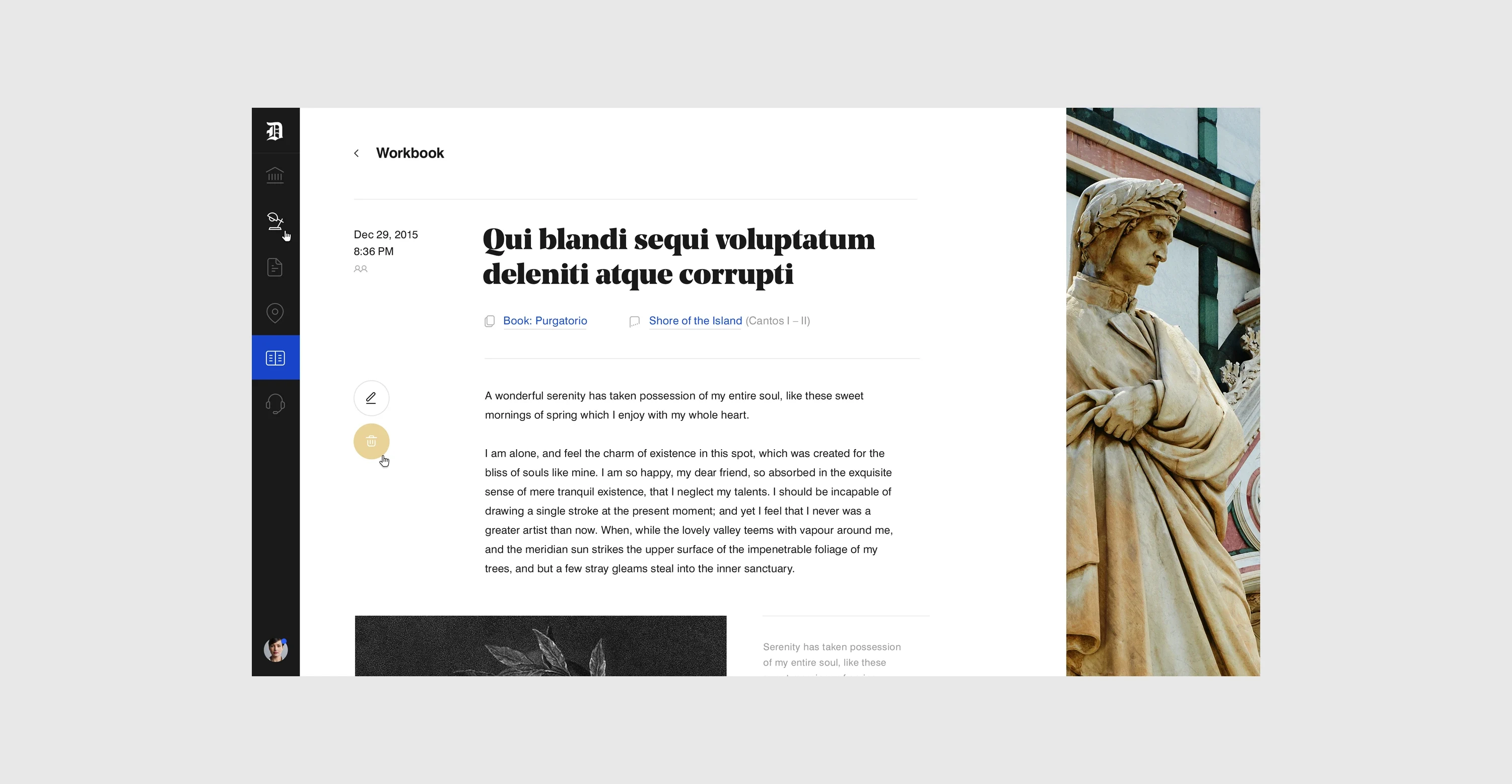
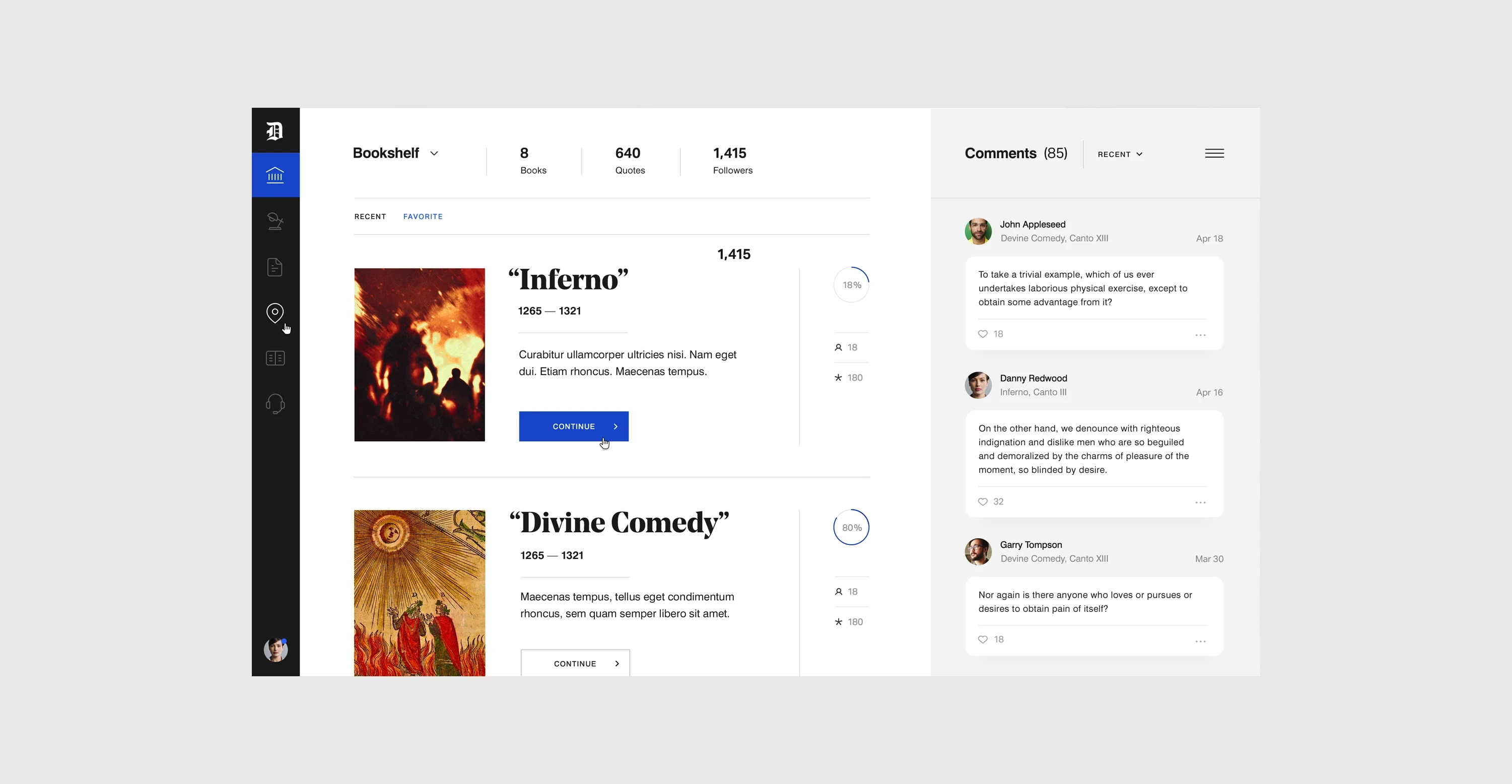
MyDante fosters a sense of community among readers by offering several ways to share ideas. Readers can choose to make their annotations and journal entries public and can start topics on the site's discussion board. Readers can share images and multimedia projects with one another.
The outcome
MyDante created a balance between individual and collaborative reading within a virtual learning community. Students could encounter Dante in Italian and English, listen to the original language, build a private layer of interpretation, and selectively contribute to a shared exploration of the work.
The platform integrated teaching and technology without treating technology as the objective. Its success was reflected in the coherence of the learning model: reading, listening, reflection, annotation, and conversation reinforced one another instead of functioning as disconnected tools.
The project also established a transferable framework for immersive digital reading. Its value extended beyond Dante by demonstrating how intentional technology could support deeper engagement with demanding literary and philosophical material.
An intentional, focused use of technology can create a deeper, more engaged interaction between students and difficult literary and philosophical texts.”
— Francis J. Ambrosio, Associate Professor of Philosophy, Georgetown University
How success was understood
Because MyDante was created as an educational and exploratory platform, success was not defined by conventional conversion metrics. The more meaningful measures were whether the experience supported the behaviors at the heart of the project:
Sustained engagement with difficult passages.
Active annotation and personal reflection.
Movement between private thinking and public contribution.
Meaningful discussion grounded in the text.
Use of audio, imagery, and multimedia to deepen interpretation.
A coherent experience across individual and collaborative learning.
Transferability of the framework to other complex texts.
These measures kept evaluation aligned with the original motivation: using technology deliberately to improve the quality of attention, interpretation, and shared learning.
Key takeaways
Translated the reflective traditions of manuscript reading into a digital experience.
Kept the primary text central while integrating multiple learning tools.
Presented original Italian, English translation, and spoken audio in one environment.
Enabled bookmarks, annotations, footnotes, and journal-based reflection.
Gave users control over private and shared contributions.
Connected community discussion and multimedia projects directly to the reading experience.
Balanced individual interpretation with collaborative learning.
Combined UX/UI design with front-end development to preserve interaction quality.
Created an extensible framework that could support other literary and philosophical works.
Like this project
Posted Sep 22, 2026
Designed and developed MyDante, a digital platform for engaging with Dante's Divine Comedy in educational settings.
Likes
1
Views
2
Clients
Georgetown University