
Every Debrand project runs inside one private portal, so you always know what's done, what's next, and what needs your yes.
Your journey at a glance
Most projects move through four stages. We add or drop stages to match your scope.
1. Stage One - GTM Foundation: Positioning, audience, unique selling points, brand overview. Answer the strategy questions, review the plan. The whole stage, once you approve the plan. Starting from 1 week.
2. Stage Two - Branding: Moodboards, logo (3 revision rounds), pitch deck, social media kit, brand identity presentation. Choose a direction, give feedback on the page. Each phase, once you tick approval. Starting from 1 week.
3. Stage Three - Website Design; Project brief, user map, landing page (3 revision rounds), final design with component documentation. A 15–30 minute kickoff, then review designs. Each design phase, once you tick approval. Starting from 1 week.
4. Stage Four - Website Development: The site in Framer or Webflow, testing and debugging rounds, launch. Review the site and report bugs. The scope contract, then the final site at launch. Starting from 1 week.
Day one: what you see in your portal
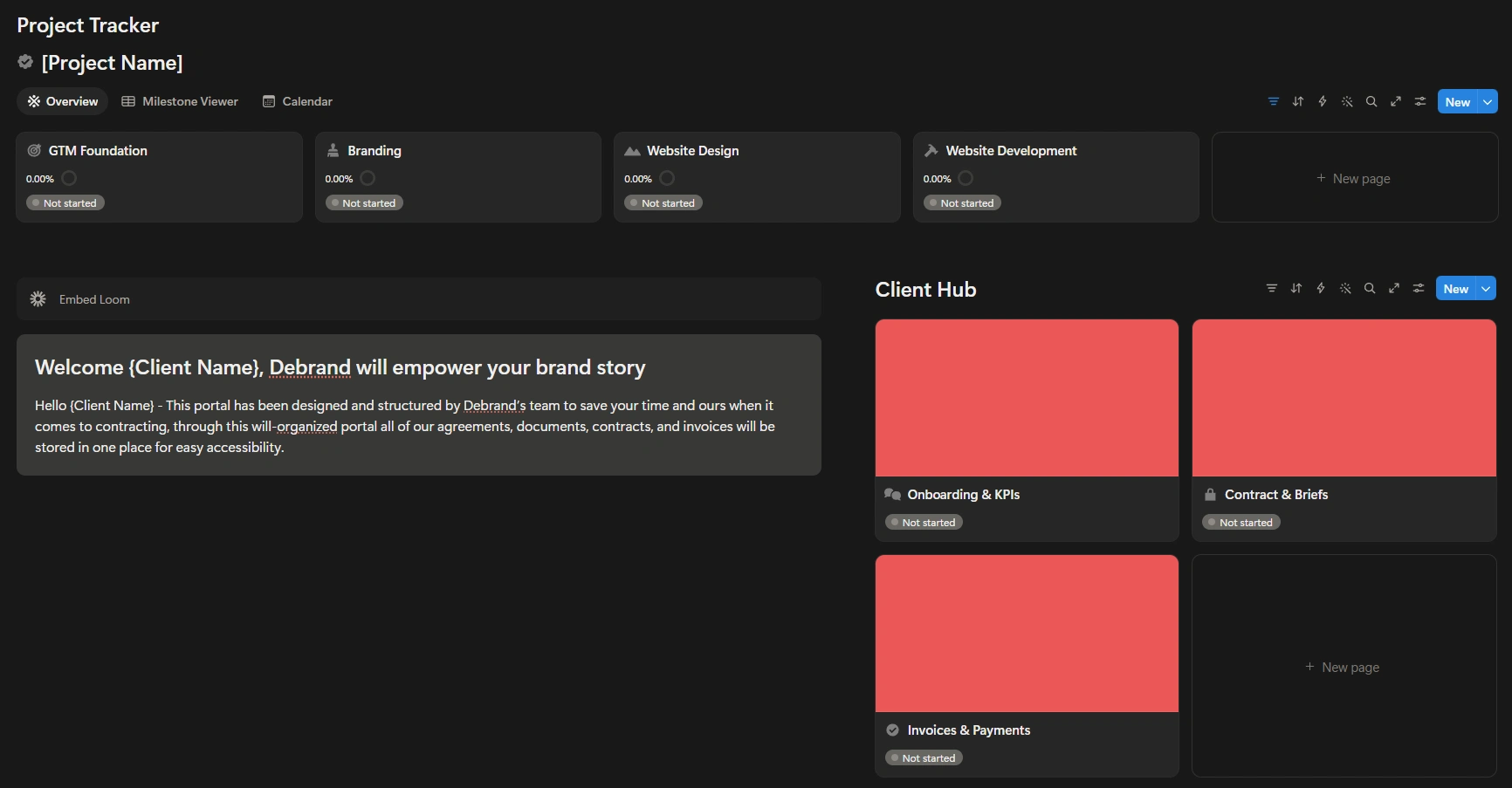
Debrand Client Portal
Debrand's Process Demo
You open one private portal with your name on it. There is nothing to set up and nothing to learn.
Project card: your package, start and end dates, who is accountable on each side, and the current status.
Client Hub: three pages, Onboarding & KPIs, Contract & Briefs, and Invoices & Payments.
Project tracker: a card for each stage, plus a milestone table with dates, owners and status for every phase.
A short Loom from me: a walkthrough of where everything lives, and a welcome note.
Take a look at our approach and methodologies here.
Approvals that lock
Each phase ends with one approval. Once you tick it, the page locks, so decisions stay decided.
One comment thread per page. Feedback on the logo never gets mixed up with feedback on the website.
Revision rounds are set upfront. Three for the logo, three for the landing page design, and as many testing and debugging rounds as the build needs.
Dates you can see. Every phase has its own start and end date, so you know what happens when.
Changes after approval are scoped as extra work. You agree to this in writing before the project starts.
Who sees what
Contracts and money stay between you and me. Only you, plus one or two people you choose, can open the Client Hub.
Onboarding & KPIs: about 20 questions on your business, your current numbers and your customer. They give me what I need to scope the work and set the roadmap.
Contract & Briefs: a brief and a scope contract drafted from your answers. When both of us tick the box, the page locks.
Invoices & Payments: invoices, receipts, upcoming payments and a record of past ones, so nobody has to dig through email.
After launch
You get 2 months of free support after launch, up to 2 hours a week. It covers the basics: SEO, Google Tag Manager, Search Console and page indexing. Brand files are handed over in an organised folder, and the site's components and design system are documented, so your team can extend it without me.
What I need from you
Your answers to the onboarding questions. Short and honest beats polished.
Your existing assets, if you have them: current logo, pitch deck, brand files.
One decision-maker who approves each phase, so nothing waits on a committee.
Your yes at each approval, which keeps the timeline moving.
How to start
If your product is working and your brand isn't keeping up, send me "MVP" on LinkedIn. I'll reply with the first question I'd ask, and we'll see if a project makes sense.
1 like · 0 views · Nov 11, 2026
Every Debrand project runs inside one private portal, so you always know what's done, what's next, and what needs your yes.


