pro
Nacho Valenz
Channel, shape, finish.



firendev: Brand Identity and Website
1
14
KITTY.
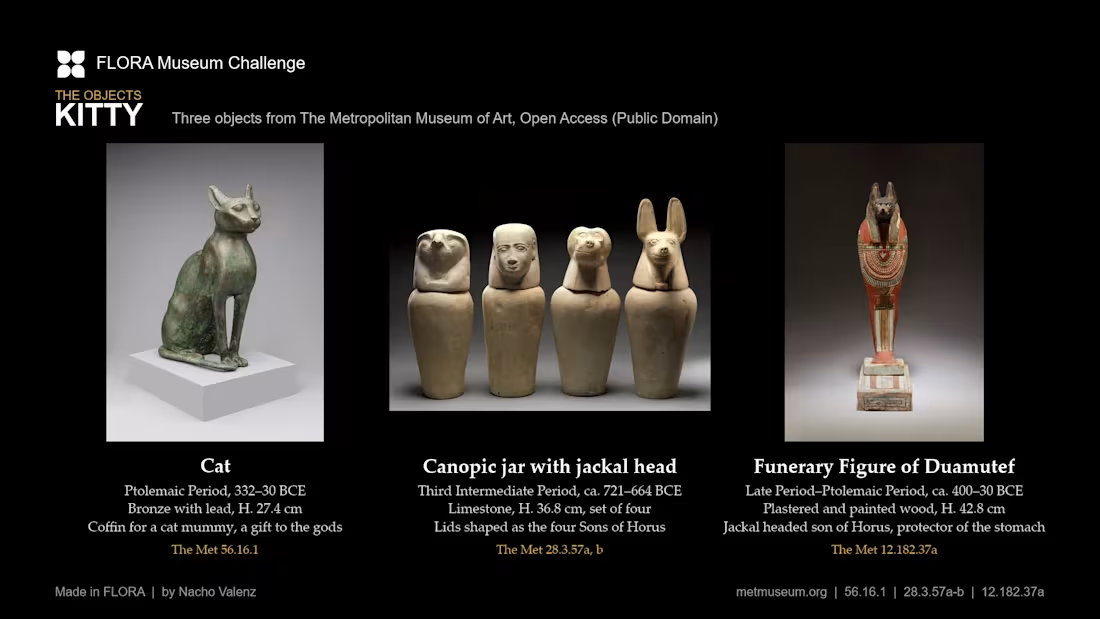
The bronze Cat at The Met (56.16.1, Ptolemaic Period, 332–30 BCE) is not a statue: it is a coffin for a cat mummy, a gift to the gods. KITTY builds the world around the object: the embalmer who made it, and the moment before the cat became sacred. It imagines that cat alive, in an embalmer's workshop, on a table shared with two more objects from the collection: a set of limestone canopic jars guarded by the four Sons of Horus (28.3.57a, b) and Duamutef, the jackal headed funerary figure (12.182.37a). Thirty nine seconds, four takes, graded like a 1940s three strip Technicolor print.
Everything was built inside FLORA. The Met's Open Access photographs became character sheets and a set plate with Nano Banana Pro; the base stills were composed from them and graded with Seedream 5 Pro as a strict LUT, so no object changed its hue. Every take was written by Claude Opus 5 running as a text node on the canvas and animated by Seedance 2.5 with native audio, one take at a time. The score is a small Ptolemaic ensemble generated with Suno; edit and museum labels in ffmpeg. The canvas was driven from Claude Code through FLORA's MCP, and every frame was approved by a human before a single credit was spent.
About the museum piece: Cat, Ptolemaic Period, 332–30 BCE. Bronze with lead, H. 27.4 cm. The Metropolitan Museum of Art, Harris Brisbane Dick Fund, 1956 (56.16.1), Gallery 134. A receptacle for a cat mummy, one of the luxurious offerings buried in temple precincts, especially those of the goddess Bastet. The gold ring in her pierced ear is now missing; the incised collar carries a medallion in the shape of a protective eye.
Original artworks at The Met (Open Access, Public Domain):
Cat, 56.16.1:
https://www.metmuseum.org/art/collection/search/544118
(https://www.metmuseum.org/art/collection/search/544118)Canopic jar with jackal head, 28.3.57a, b:
https://www.metmuseum.org/art/collection/search/559934
(https://www.metmuseum.org/art/collection/search/559934)Funerary Figure of Duamutef, 12.182.37a:
https://www.metmuseum.org/art/collection/search/551149
5
495
Title: FOLLOWER OF
FOLLOWER OF wakes a painting nobody signed. "Christ's Descent into Hell" (The Met, 26.244) is by an anonymous follower of Hieronymus Bosch, sold as a Bosch in Prague in 1926 and still unattributed. I chose it because I love Bosch, and because a painting by a follower asks the question the whole panel is about: who follows whom.
For a hundred seconds the painting comes to life without ever leaving the surface of the paint. A lantern wakes it. Light breaks the gate of hell. Adam and Eve beg with empty hands, the saved climb the stairs, Saint Christopher slips away from the devil's army with the child on his shoulders, Judas will not let go of the bag, Sisyphus keeps climbing, and the ones who stay behind keep living by the giant head. The ending comes from the Met's own technical notes: the blue corner of the sky was painted over fire. The painter changed his mind.
Every shot starts from a crop of the Met's open access image: no new figures, no new colors, only what the painter left. Each crop was upscaled with Magnific Precision Upscaler, animated with Kling 3.0 Pro, with prompts refined by Claude Opus 5 inside FLORA. The narration is Gemini TTS, the score is ElevenLabs Music: a sixteenth century Franco-Flemish consort reimagined for a painting of hell. The whole pipeline ran from Claude Code on the desktop through FLORA's MCP: the agent built the graph, ran the models and kept the production ledger, and every creative decision stayed with me. Structure, shot list and sound design follow a kishotenketsu: the turn is not a fight, it is a painter changing his mind.
Christ's Descent into Hell, Follower of Hieronymus Bosch (Netherlandish, second quarter of the 16th century). Oil on two oak planks, 53.3 x 116.8 cm. The Met, Harris Brisbane Dick Fund, 1926 (26.244), on view in Gallery 613. A panoramic hell where Christ breaks the gate to free the just: Adam and Eve, Noah, Abraham, David and the patriarchs climb a ruined tower, Sisyphus heaves his stone up the rock on the right, and Judas is dragged back. Paint analysis shows the orange of the burning sky continuing under the blue in the upper left corner: more of the sky was originally on fire. Public Domain, Open Access.
Original artwork (The Met, Open Access): https://www.metmuseum.org/art/collection/search/435725
9
31
2.2K
CCRROOAAKK!!
Another chapter from a parallel universe, a 40 second one-take AI film. The hiker returns to the toad's hollow, reaches inside and pulls out a handful of glowing matter. He breathes it in, and the trip takes him: galaxies turn inside his eyes, translucent copies of himself trail behind as he walks, his hands glitch, and his body runs through a chain of altered states, a puppet, a leather jacketed figure in colored smoke, cartoon forms, until he stops and screams inside a burning yellow aura. Then everything folds inward. He is sealed inside a transparent bubble that bursts into a cloud of multicolored particles, and the forest path is left empty.
Made in CapCut Video Studio with Seedance 2.5 (16:9, 720p). Two consecutive prompts written from the same references, the second picking up exactly where the first ends, joined into a single continuous 40 second shot with no cut. Identity, location and stage references were generated as images first, with the same man rendered in each transformed state so the model could copy him faithfully instead of inventing a new character. The forest, the light and the camera stay real throughout; only the man transforms. Audio is forest ambience, footsteps and the sounds of each transformation.
One note on the dialogue: the line the character shouts was not written by me. Seedance came up with it on its own, profanity included, and I left it in because it fits the moment better than anything I would have scripted.
5
19
4.2K