Projects using SimilarWebProjects using SimilarWebNo one really says this out loud, but paid traffic brings you sales today.
Organic traffic brings you sales tomorrow.
And businesses that want stability use both — so they never depend on just one source.
I’ve been through this myself — and you probably have too.
I believed that if I built a good website and launched a few ads, the sales would naturally follow.
I spent months working on the website.
Made it clean, modern, beautiful. I was proud of it.
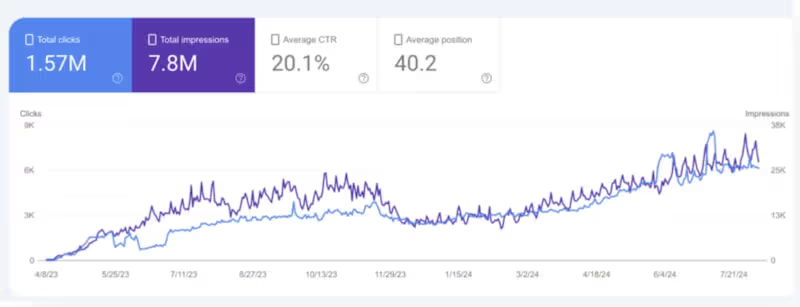
Three months later, Similarweb — one of the world’s leading analytics tools — confirmed the stagnation.
It’s very possible that your website shows the same pattern.
And the sales… came rarely, expensively, and never consistently. Sometimes not at all.
Meanwhile, I had 25,000 visitors on the days when social media drained my budget, sending me:
cheap clickers
curious people, not buyers
users who take superficial actions, not meaningful ones
That’s how social media campaigns work.
👉 You can check your own traffic here: https://www.similarweb.com/website/
On social media, ads don’t work if the pixel doesn’t receive the right signals.
At the beginning, I made the same mistake: I launched ads without data, and the pixel learned from clicks — not from real actions.
On Google, I discovered something different: platforms don’t convert because you have a budget, but because they clearly understand what you sell and who you sell it to.
And you are active — you post, you reply — but your reach keeps dropping.
Platforms are businesses. It’s “pay‑to‑play.”
If you don’t optimise correctly, they show your content to whoever they want, not to the people you need.
And if you pay without a strategy, you feed the platform — not your business.
Optimisation means clarity, consistency, and a coherent message.
It’s not personal. It’s algorithmic.
And there’s something else: people don’t buy products.
They buy from people they trust.
The truth is simple: it doesn’t matter what you sell — it matters how people find you.
And customers are already searching for what you offer.
The question is: do they find you, or your competitors?
Here’s the reality:
96.55% of pages receive no traffic from Google
Source: https://wearesocial.com/us/blog/2025/07/digital-2025-july-global-statshot-report/
Organic traffic drives 300% more than social media
Google organic = 57.8% of all web traffic
Source: https://backlinko.com/seo-stats?
If you don’t have SEO, backlinks, and optimised ads, opportunities are lost every single day.
Not because your product isn’t good — but because people can’t find you.
And because the algorithms don’t favour you.
And here’s another truth:
Too many options block decisions.
Websites are full of menus, pop‑ups, buttons, links, chats.
The brain doesn’t know where to go.
It chooses the easiest option: to leave.
This is the truth no one tells entrepreneurs:
A business doesn’t grow from ads alone.
It grows from the way all the pieces — traffic, messaging, website, content, authority — work together.
This is a system. And in 90% of businesses, this system is exactly what’s missing.
A system means the complete journey through which a customer reaches you:
Who finds you.
How they find you.
What they see first.
What they understand.
What they feel.
And what makes them stay.
If this journey isn’t clear, neither ads, nor posts, nor the website can perform properly.
It’s not a budget problem.
It’s that the message reaches the wrong people, at the wrong time, through the wrong channel.
This was the lesson that changed my direction.
I stopped running campaigns without strategy and without optimisation.
Because they brought a lot of traffic — but irrelevant, expensive, unstable traffic.
Exactly what happens when ads are launched quickly, without data, without structure, and without a clear plan to attract the right people.
And over the past 7+ years, I’ve learned how to grow with patience and small, consistent steps.
Results appear when there is clear direction, solid strategy, proper execution, and correct optimisation.
For over 7 years, I’ve been helping businesses become discoverable, understood, and capable of turning traffic — paid or organic — into real customers.
Ads. SEO. Content. Authority. Strategy.
All integrated, never chaotic.
We collaborate based on clear objectives, public website data, measurable steps, and repeatable results.
The key is simple: activity, clarity, and patience.
I help — I don’t complicate.
I guide you so we can grow together — with a complete system, not isolated tactics.
If you want to see exactly where you can grow, I’ll prepare a free audit.
And if you want to test the collaboration, I accept retainers based on dedicated time, expertise, and continuous involvement — the best way to see results first and decide afterwards.
From the very first conversation, you receive practical recommendations, and I stay close throughout the process:
constant communication, full transparency, and real‑time updates — with screenshots sent via WhatsApp or email at every important step.
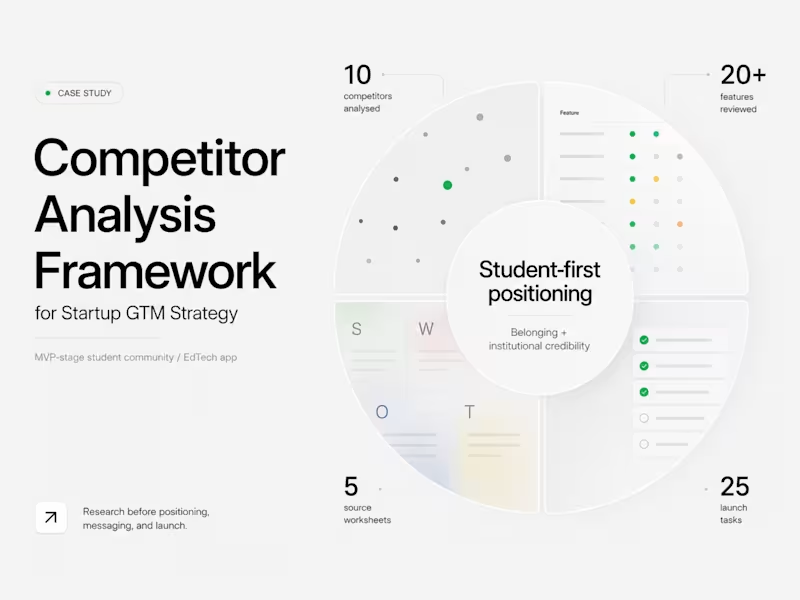
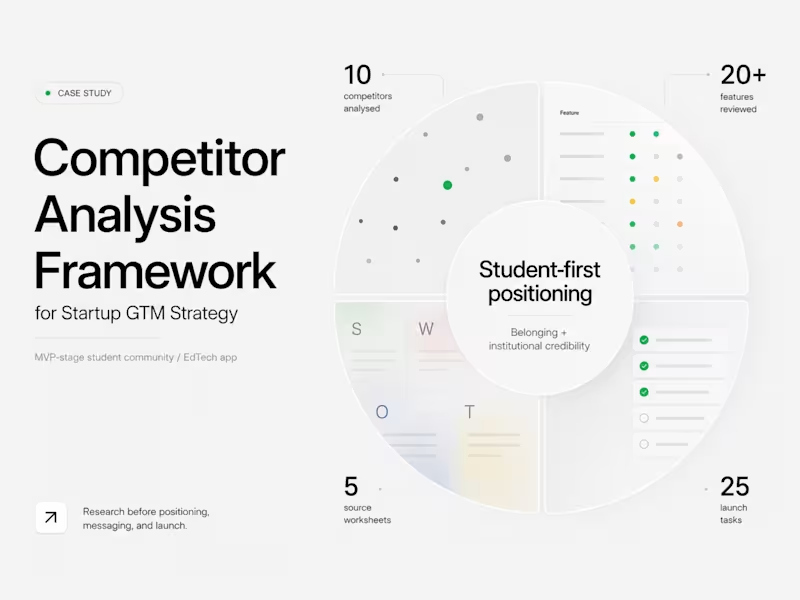
Let the results speak for themselves: Competitor Analysis Framework for Startup GTM Strategy
I created a competitor intelligence framework for an MVP-stage edtech app to help define its market position, sharpen its go-to-market direction, and identify where the product could stand apart in a crowded student-tech category.
The project focused on turning scattered competitor data into a clear strategic foundation for positioning, messaging, launch planning, and early-stage growth.
The Challenge
The student-tech market is crowded with platforms focused on engagement, peer connection, study support, university communication, recruitment, and campus communities.
For a new product entering this space, the risk was clear:
Without sharper positioning, the app could easily sound like another student platform.
The goal was to identify a stronger market angle before moving into messaging, campaigns, or launch execution.
I led the strategic research and competitor analysis behind the GTM foundation.
My work covered:
Competitor mapping
Market positioning review
Audience and channel analysis
Feature gap review
SWOT synthesis
Launch checklist planning
Strategic positioning recommendation
This gave the product a clearer direction before execution started.
The Approach
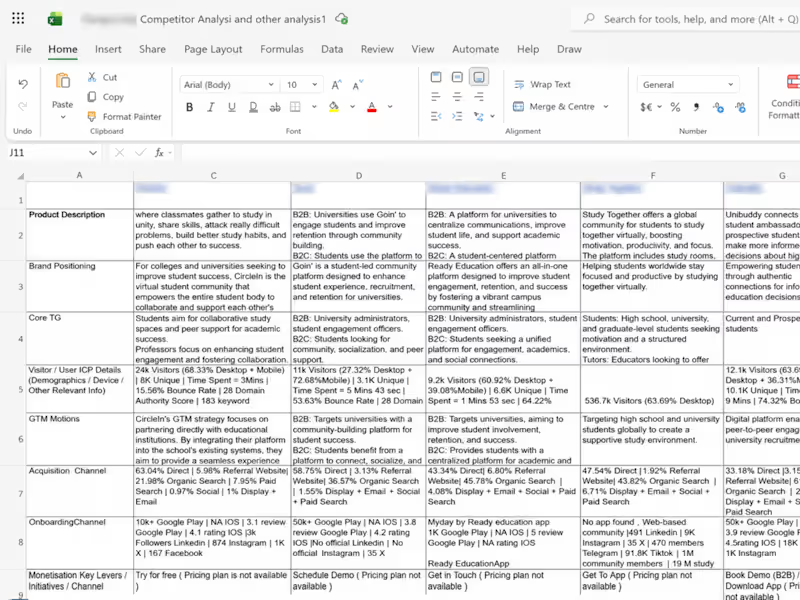
I analysed 10 student engagement, community, and edtech platforms across positioning, target audience, acquisition signals, onboarding, monetisation, feature coverage, market strengths, weaknesses, and GTM patterns.
The purpose was not to copy what competitors were doing.
It was to understand the category clearly enough to find white space.
Key Insight
The research showed that many competitors were strong in one lane but weaker across the full student-life experience.
Some were institution-first.
Some focused mainly on academic support.
Some leaned into student connection.
Others relied heavily on community, search visibility, or university partnerships.
The opportunity was to position the app as a student-first platform that could connect belonging, campus discovery, community, and institutional credibility.
That insight helped move the product away from generic “student engagement app” messaging and toward a more differentiated GTM direction.
Strategic Output
The final framework helped define:
A clearer category position
A stronger student-first narrative
Priority competitor gaps
Core messaging direction
Feature-led differentiation
Launch and acquisition priorities
A practical GTM checklist
This research became part of the strategic foundation behind the product’s early growth approach.
Result
The strategic foundation contributed to a 0-budget growth approach that helped drive:
2,000+ account signups
+1,200% month-over-month install growth
70% referral rate
27% average conversion rate This is my framework for competitor analysis for any brand, startup, or product before I build a marketing strategy.
For The Campus App, this framework became the strategic foundation for positioning, GTM direction, and a 0-budget growth approach. Before building the strategy, I studied the student-tech landscape in detail to understand where the product stood, what competitors were owning, where they were weak, and which opportunities could help the app stand apart.
The analysis looked at competitor positioning, audience, messaging, acquisition channels, onboarding, monetisation, community signals, GTM motion, and visible traction. It helped move the strategy away from assumptions and towards a clearer understanding of the market.
The research revealed a strong gap. Many student platforms were either institution-led, academically focused, or too broad in their community positioning. This created an opportunity for The Campus App to build a more student-first strategy centred on belonging, peer connection, campus discovery, and community-led growth.
The overall strategy was organic, student-native, and built around community behaviour rather than paid acquisition. Competitor intelligence shaped the messaging, launch channels, referral loops, and content direction, helping the product move with more clarity in a crowded market.
The 0-budget growth approach helped drive 2,000+ account signups, +1,200% month-over-month install growth, a 70% referral rate, and a 27% average conversion rate through community-led acquisition and organic marketing