Freelance Digital Marketers in NigeriaFreelance Digital Marketers in Nigeria
Facebook(Meta) & Google Ads Expert | AI Automation
5.0
Rating
13
Followers
Facebook(Meta) & Google Ads Expert | AI Automation
Cover image for Okay so I need to
Okay so I need to talk about how I'm making UGC ads now, because it's honestly kind of ridiculous how easy this has gotten. If you've ever tried to get UGC ads made, you know the pain. Booking actors, briefing agencies, waiting days, paying way more than you wanted to. I used to think that was just... the cost of doing business. Turns out it's not anymore. Here's what I've been doing instead, the whole thing runs inside one Claude conversation. No creative tools, agency, or ten tabs open at once. Just two connections: Meta and Arcads. Let me break down how it works. Step 1: Research first, always Before generating a single ad, I use Claude and other Premium tools to pull my top performing ads from the last 30 days, then search the web for what's currently working best in my product category. What creative formats are getting impressions, what hooks are driving engagement, and what patterns keep showing up in winning ads. And this is the step almost everyone skips. It's exactly why so many AI-generated ads flop, people jump straight to generation with zero signal on what actually converts. Research first means your first test isn't a guess. It's informed. Step 2: Turn research into scripts Once I've got the research, I hand it to Claude with a specific brief: act as a senior performance marketer, here's my product, here's who it's for, here's the platform. Then I ask for scripts built around real pain points, hook, problem, solution, proof, CTA, all timed out. And I get Claude to score each one and only keep the ones that actually hit. This part used to take me hours of back and forth with a copywriter. Now it's minutes. Step 3: Generate the actual creative So this is where Arcads comes in, it's basically got every major AI video/image model in one place, so I'm not paying for five different subscriptions. I generate an actor image first (with my product reference attached so nothing gets weird or off-brand), approve it, then turn it into a video with the script from step 2 dropped straight in. Small tip that saved me a lot of wasted spend: always fix issues at the image stage, before it becomes a video. It's way cheaper, and way faster. Step 4: Launch without leaving the chat Once the videos are ready, I'll upload them straight to my Meta account through the same conversation. Then I just tell Claude what I want, campaign objective, budget, targeting, in plain language. No Ads Manager or manual setup. And here's the part that actually changes how you test: after a few days, I just ask Claude which ad is performing best and to show me why. It pulls the live data and explains it in plain English. No exporting reports, no spreadsheets. Step 5: Double down Once I know the winner, I ask for more variations of it, same actor, new scripts and the loop just keeps going. Every single round gets a little smarter than the last. The honest truth is this doesn't just save time, it changes the economics entirely. You're not paying agency rates, you're not waiting on turnaround times, and you're testing with actual data. If you're not at a scale where an agency makes sense yet, this is genuinely one of the best ways to get high output without needing a big team or a big budget. Don't forget to hit follow, I'm breaking down a new ad strategy or workflow every week, and you don't want this to be the last one you catch. šŸ‘€
1
202
Cover image for I'll change the way you
I'll change the way you think about Google Ads... Don't be GOLD FISH, read it through!!! A friend called me recently in a total panic. He'd just spent $3,000 on Google Ads and got absolutely nothing back. Zero leads. Zero sales. Just gone. And of course, his conclusion was "Google Ads is dead." I hear this a lot. And honestly, I get why people believe it. But let's actually talk about what's true here, because there's a real difference between "Google Ads doesn't work" and "MY Google Ads didn't work", and almost everyone mixes those two up. Here's the honest part first: Google Ads has genuinely gotten harder. More competition, higher costs per click, way more automation, less manual control than it used to have. If you're running it the same way you did 5 years ago, you will lose money. That part is real, not made up. But here's what actually happened when I looked into his account, and it's the same pattern I see over and over: → No conversion tracking set up at all. Google was spending completely blind, no idea what was actually working. → Broad match keywords on a tiny budget, so ads were showing to people with barely any relevant intent. → Generic ad copy, the kind that could describe literally any business in any industry. → Zero negative keywords, zero ad extensions. → The campaign ran for 6 weeks and nobody had looked at the search terms report once. None of that is Google's fault. That's a setup problem, and setup problems are fixable. Here's the thing that really gets me: most people who say "Google Ads doesn't work" tested one bad setup, once, for a few weeks, and quit. That's like going to the gym twice, not seeing abs, and telling everyone fitness is a scam. Nobody thinks that way about fitness, everyone accepts it takes skill and consistency. Google Ads is exactly the same. It's a skill. It can be learned. It just LOOKS deceptively simple from the outside, and that's exactly what traps people. And honestly, some of what Google's automated over the years is genuinely good, smart bidding can process signals no human could ever track manually. The automation isn't the problem. The problem is people hand control over to the algorithm before giving it anything useful to actually learn from. Like hiring a great chef and handing them an empty fridge. Here's what we actually did to fix my friend's account, none of it cost extra: āœ“ Set up proper conversion tracking for the first time āœ“ Went through the search terms report and built a real negative keyword list āœ“ Rewrote the ad copy to speak to an actual specific problem, not generic fluff āœ“ Tightened match types āœ“ Added sitelinks, callouts, a location extension Same budget. Same platform. Within 6 weeks, more leads than the previous 6 months combined. The platform didn't change. The approach did. Here's the real takeaway: if you tried Google Ads once and it flopped, don't write off the platform, write off the version of yourself that ran it that first time. You know more now. Most competitors are still stuck obsessing over match types and bid tweaks while ignoring whether their offer or landing page is even any good. If you're willing to actually understand this at a strategic level instead of just clicking buttons, you're already ahead of most people running ads right now. Follow along, more real breakdowns like this coming. šŸ‘€
1
58
Cover image for Running Meta Ads is EASY
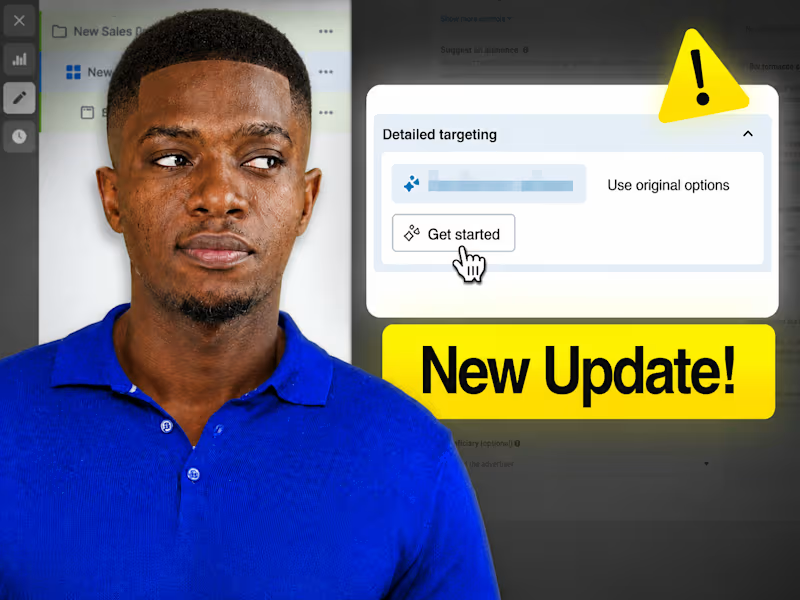
Running Meta Ads is EASY Once You Understand This With everyone's feed getting flooded with obvious AI-generated content, there's one strategy that's actually working better than ever right now, and it's the exact opposite of AI slop: using real creators in your ads. Here's why this matters. Nobody's favorite creator is AI-generated. People trust real humans they already follow, not generic content. So instead of fighting that, you lean into it, you partner with creators who already have your audience's attention and trust, and you use that in your ads. The ad format for this is called Partnership Ads. It's when a creator's profile and your business's profile are both tied to the ad, so you're tapping directly into their audience, the people who are already primed to pay attention because it's coming from someone they follow. And the data backs this up hard: partnership ads see a 13% higher click-through rate and a 71% higher brand lift compared to regular ads. That's not a small bump, that's a meaningfully different result. Here's how to actually find the right creator and make this work: 1. Know your audience first, then match the creator to them Don't just pick whoever has the biggest following. Pick someone your specific target audience already follows and trusts for that topic. A creator can have millions of followers and still be the wrong fit if their audience doesn't overlap with your buyers. Relevance beats reach every time here. 2. Use the Creator Marketplace to shortcut the search It analyzes your business account and suggests relevant creators automatically. Start with the ones already actively doing partnership ads with other brands, they're more likely to respond, and if brands are already spending budget with them, there's a good chance it's working. 3. Send outreach through the platform, not cold DMs Generic "we'd love to work with you" messages get ignored, especially by bigger creators drowning in inbound. Messaging through the Creator Marketplace routes into a separate inbox that creators actually check for business inquiries, way better response rate. 4. Get usage rights, not just a post This is the part people skip. A creator posting once to their own audience gets you a short burst of visibility, most of the value disappears within 24 hours. But if you negotiate permission to run their content as paid ads, you can keep leveraging their trust and face for months, sometimes years. Often costs little to nothing extra to add this in. 5. Work with a few creators, not just one Results can vary creator to creator. Start with 2-4 rather than betting everything on a single partnership. Increases your odds that at least one significantly outperforms your standard ads. 6. Be specific about some things, flexible on others Be crystal clear on the call-to-action and the hook structure (ask for multiple different openings/hooks so you get more usable creative variations). But let the creator write their own script and delivery, they know how to talk to their own audience better than you do. Don't over-direct the creative itself. One more thing worth checking before you partner with anyone do your due diligence. Have they talked about your product category before? Was it positive? Any past controversy that could reflect on your brand? Worth a quick check before committing. Bottom line: in a feed full of obviously-AI content, a real trusted face recommending your product is one of the strongest scroll-stoppers left. Worth testing even with a modest budget. Follow along, more of these breakdowns coming. šŸ‘€
1
75
Shopify Store Design | Marketing Systems & AI Automation
8
Followers
Shopify Store Design | Marketing Systems & AI Automation
I’m like a movie writer for online entrepreneurs.

5.0
Rating
1
Followers
I’m like a movie writer for online entrepreneurs.