
Financial Accountant, Bookkeeper, IFRS, Tax Consultant
- 5.0
- Rating
- 26
- Followers
Financial Accountant, Bookkeeper, IFRS, Tax Consultant
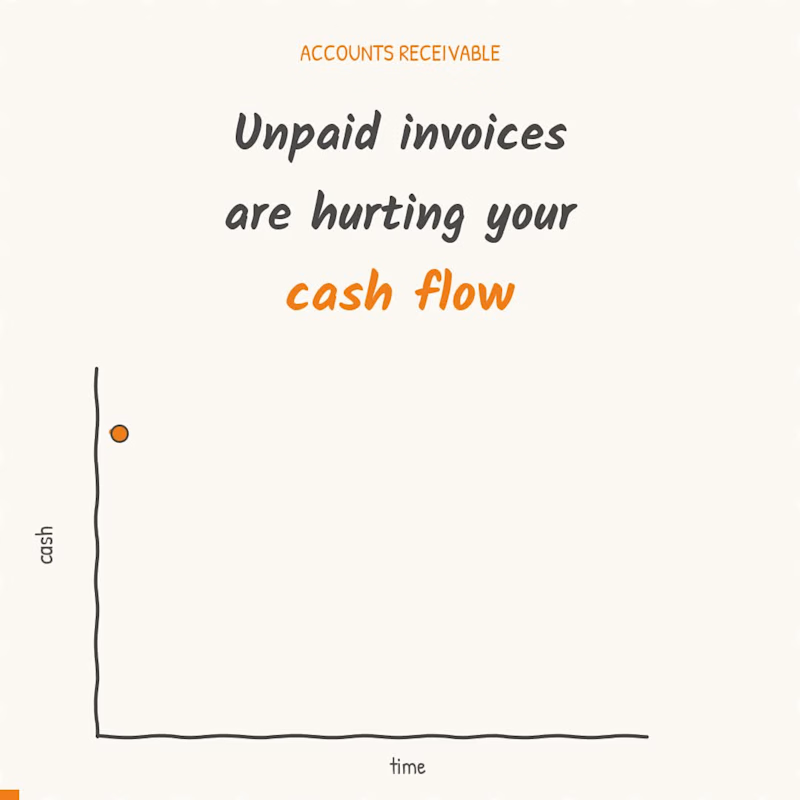
Unpaid invoices are hurting your cash flow
You delivered the service. You sent the invoice. So why haven't you been paid?
Late customer payments can put pressure on even a profitable business.
When invoices remain unpaid:
Cash becomes harder to manage.
Supplier payments may be delayed.
Business owners spend time chasing customers.
Financial planning becomes less reliable.
Here are three practical steps:
Review your accounts receivable regularly.
Set clear payment terms and send timely reminders.
Track overdue invoices and follow up consistently.
Accurate accounts receivable records help you understand what's outstanding and where action is needed.
Your sales are important. Collecting the money you're owed is just as important.
📩 Need help tracking invoices and managing your bookkeeping? Let's connect.
#AccountsReceivable #CashFlow #BookkeepingServices #BusinessFinance
3
3
481

Your business is making sales. So why does your bank account still feel empty? 💰
This is a challenge many business owners face.
Revenue is growing, customers are paying, and the business looks successful from the outside.
But behind the scenes:
Expenses are increasing.
Customer payments are delayed.
Tax obligations are approaching.
Cash flow is becoming unpredictable.
Here's the truth: Revenue is not the same as profit, and profit is not the same as cash.
Without accurate bookkeeping and regular financial reporting, you may not know where your money is going until it's too late.
As an accounting professional, I help businesses bring clarity to their numbers so they can make better financial decisions.
📩 Want a clearer picture of your business finances? Send me a message to discuss your accounting needs.
#Accounting #Bookkeeping #CashFlowManagement #SmallBusiness #BusinessGrowth
2
3
309


Accurate Books. Clear Financial Insights. Stress-Free Tax
- 5.0
- Rating
- 66
- Followers
Accurate Books. Clear Financial Insights. Stress-Free Tax
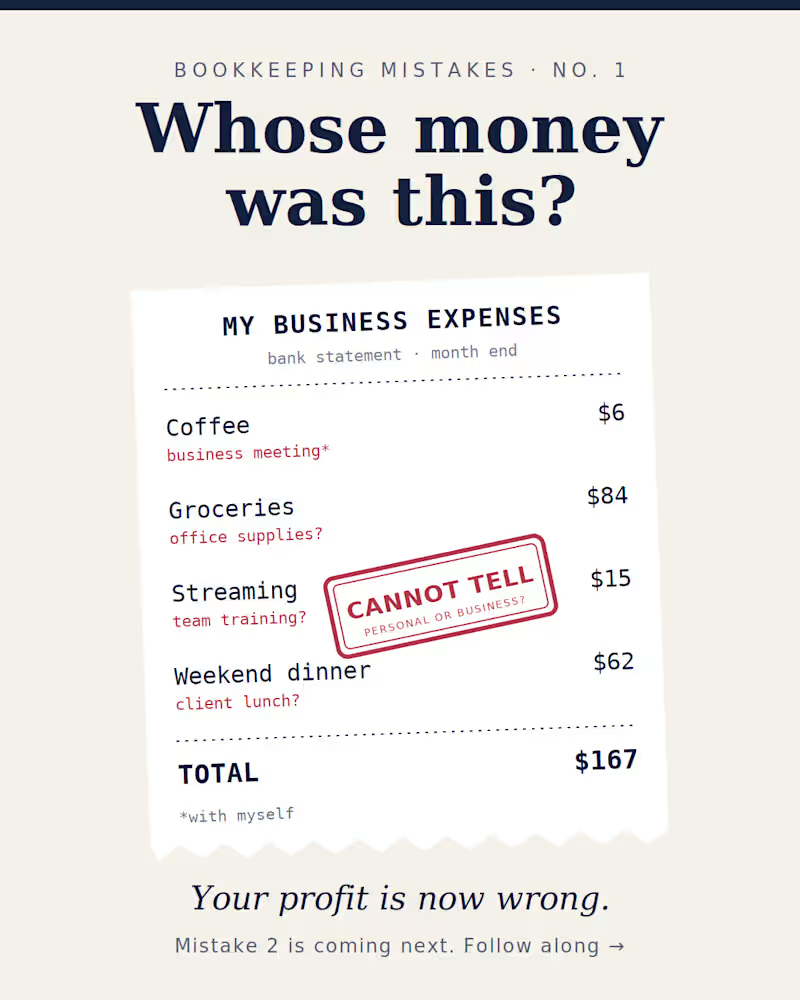
I am calling this the "Mistake post".
Wait. Did I post this by mistake?....
No, I promise. This is a bookkeeping post about the mistakes that quietly cost business owners money. There are many, so I will take one mistake at a time. This post is only about Mistake 1.
Mistake 1: Mixing personal and business spending One coffee here, one grocery bill there, and by the end of the month nobody knows whose money was spent. Yes, that coffee was a "business meeting". With yourself.
It looks small. It is not. Here is what it quietly does to your business:
Your profit becomes wrong. Personal costs sit inside business expenses, so the numbers do not show how the business is really performing.
Your bank reconciliation becomes slow. Every personal payment needs an explanation before your books can match the bank statement.
Your tax work becomes harder. When costs are mixed, it is difficult to prove which expenses truly belong to the business.
You lose clarity. You cannot tell how much the business earned and how much you took out for yourself.
Check your statement once a week. Small habit. Clean books. Much less stress at year end.
Mistake 2 is coming in the next post, so follow along so you do not miss it.
1
3
356
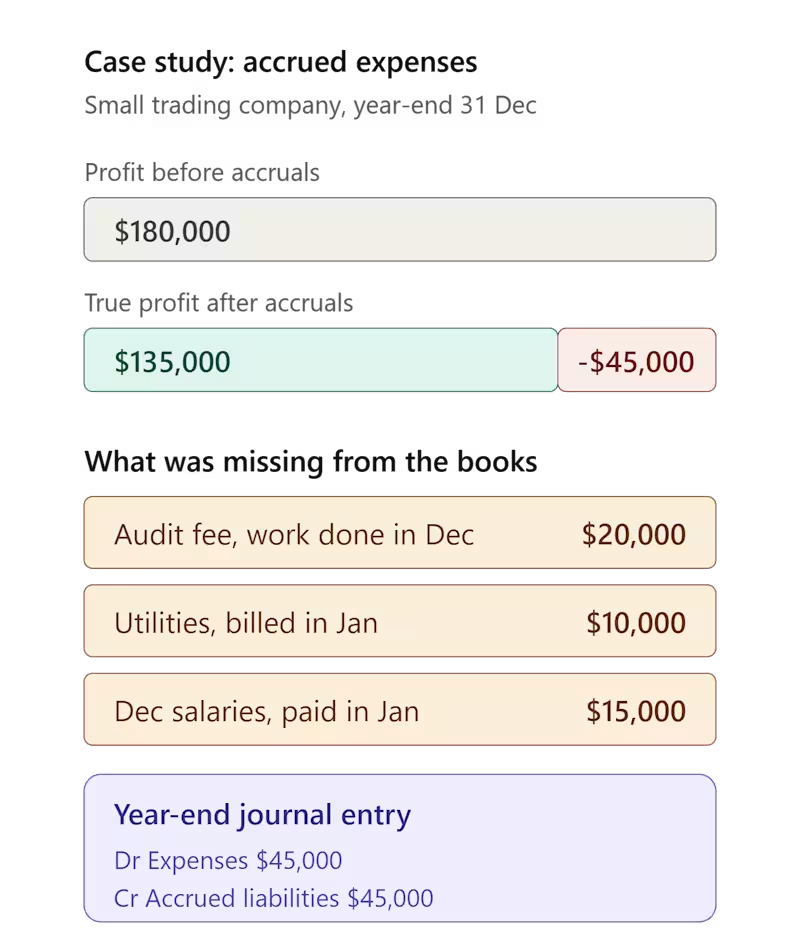
Your books say $180,000 profit. Reality says $135,000. 😬
Episode on accrual expenses 👇
The case: A small trading company came to us at year-end. Their profit looked great, but they had only recorded bills they had already paid.
What was missing:
✅ Audit fee: work done in December, invoice not yet received ($20,000)
✅ Utilities: December usage, bill arrives in January ($10,000)
✅ December salaries: paid in January ($15,000)
That is $45,000 of expenses that belong to this year but never touched the bank account, so they never hit the P&L.
The fix:
Dr Expenses $45,000
Cr Accrued liabilities $45,000
The lesson: Accrual accounting records an expense when you incur it, not when you pay it. If you only look at your bank, your profit is overstated, your tax is wrong, and your decisions are built on a number that isn’t real.
💬 Comment “ACCRUAL” and I’ll send you a simple month-end accruals checklist.
Follow for the next contra episode 🎬
Hashtags:
#Accounting #AccrualAccounting #AccrualExpenses #Bookkeeping #AccountingTips #FinancialLiteracy #SmallBusiness #Entrepreneur #Startup #Founders #Finance #CFO #Accountant #ACCA #LearnAccounting #BusinessTips #AccountingCaseStudy #contra #CountingCrux
3
324
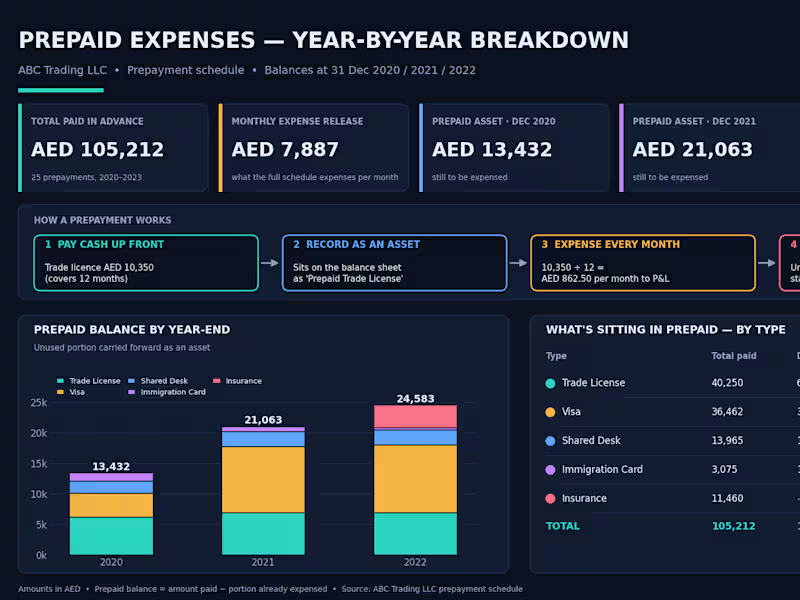
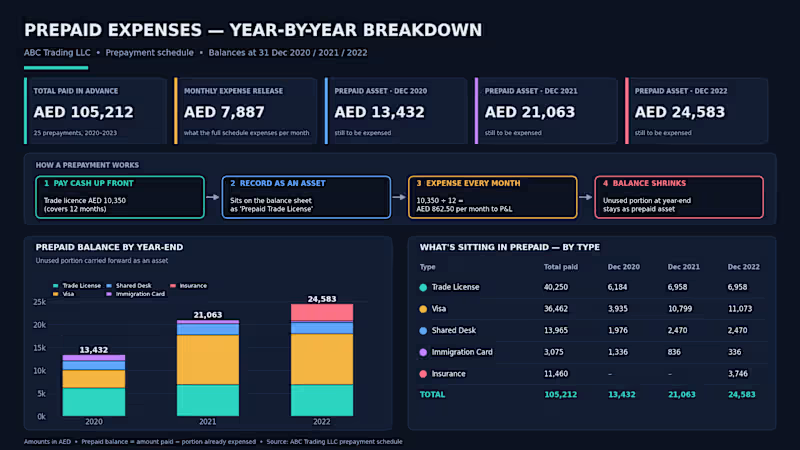
A client asked me last week: “Why is there still a balance sitting in prepaid? I already paid all of it.”
Fair question. Honestly, it’s one of the most common things business owners get confused about.
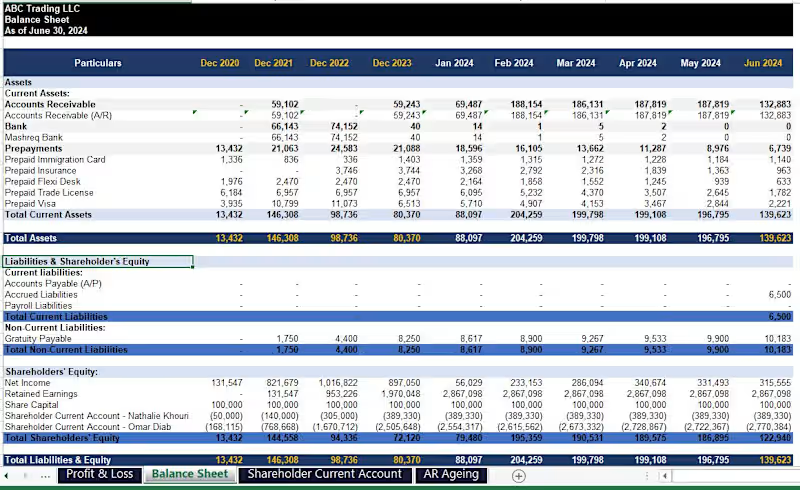
Here’s how I explained it. When you pay your trade licence for the year, that money has left your bank. But you haven’t used the whole year yet. So the unused part isn’t an expense yet. It’s something you’ve paid for and still own, like a credit waiting to be used.
Say you pay 10,350 for a 12 month licence. Each month, 862.50 moves into expenses. Whatever hasn’t been used by 31 December stays on the balance sheet as prepaid.
The client still wasn’t fully getting it from the schedule alone, so I broke it down year by year. 2020, 2021, 2022. Same prepayments, just showing how much was used and how much was still left at each year end.
That’s when it clicked for them.
The visa, shared desk, insurance and licence costs all work the same way. Pay now, use over time, expense a little each month.
If your accountant keeps saying “prepaid” and you nod along, ask them to show you a schedule like this. It’s your money, you should be able to see where it is.
This is part of my contra series, where I explain accounting without the jargon.
#accounting #prepaidexpenses #smallbusiness #UAE
Check it out (https://contra.com/p/N2MscqgY-prepaid-expenses-explained-the-way-i-explained-it-to-my-client)
2
6
679

CPA | Streamlining Your Finance |QuickBooks | XERO
CPA | Streamlining Your Finance |QuickBooks | XERO


View more →

Data Analyst | Power BI & SQL Dashboard Expert
Data Analyst | Power BI & SQL Dashboard Expert


Expert Data Analyst specializing in Excel & SQL
Expert Data Analyst specializing in Excel & SQL


Senior Accountant for US, UK & Australian Businesses
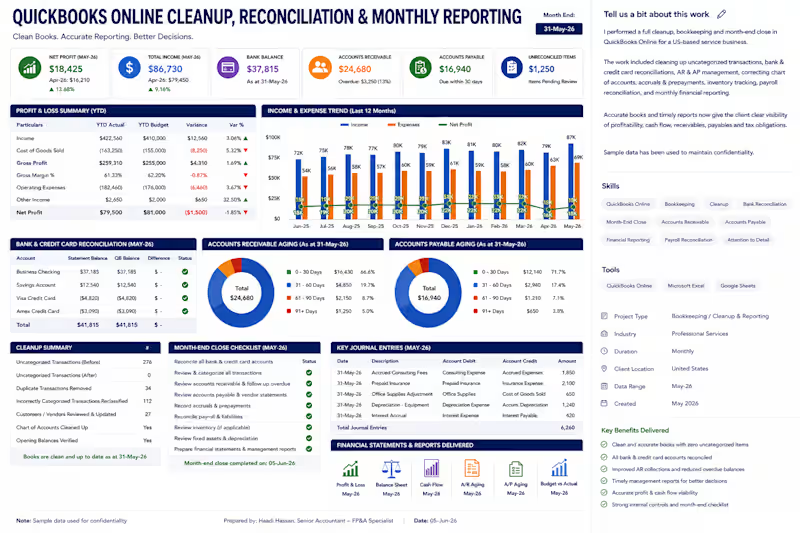
I performed a full QuickBooks Online cleanup, reconciliation, and month-end close for a US-based service business.
The work included reviewing and correcting transaction classifications, cleaning up uncategorized and duplicate entries, reconciling bank and credit-card accounts, reviewing accounts receivable and payable, updating the chart of accounts, and recording accruals, prepayments, depreciation, and other adjusting journal entries.
I also prepared monthly Profit and Loss, Balance Sheet, cash-flow, AR aging, AP aging, and budget-versus-actual reports. The completed cleanup gave management more reliable financial information, clearer visibility into cash flow and profitability, and a structured process for future monthly reporting.
Sample data has been used to maintain confidentiality.
1
122
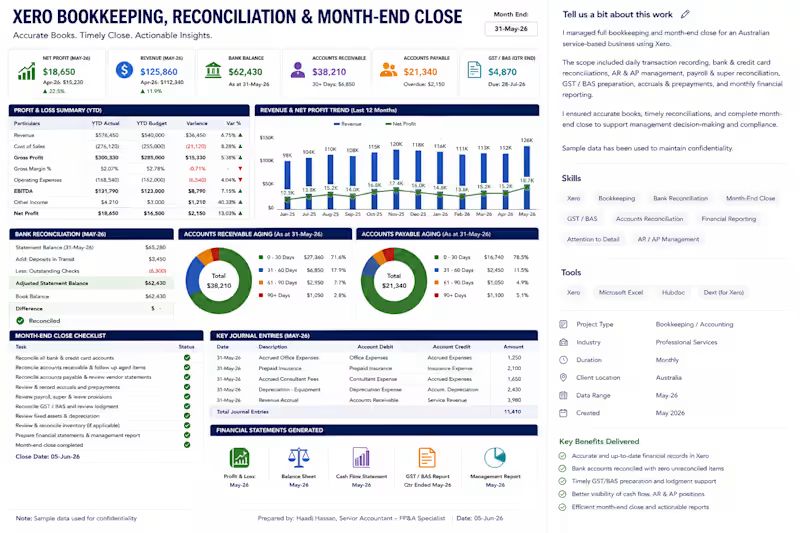
I managed the complete monthly bookkeeping and month-end close process in Xero for Australian service-based businesses.
The work included bank and credit-card reconciliations, accounts receivable and payable reviews, payroll and superannuation checks, accruals and prepayments, GST/BAS review, intercompany reconciliations, and investigation of outstanding or incorrectly classified transactions.
I also prepared Profit and Loss, Balance Sheet, cash-flow reports, and management summaries to give clients clear visibility into profitability, cash position, receivables, payables, and compliance obligations. A structured close checklist was used to ensure accurate records, timely reporting, and completion of all month-end activities.
Sample data has been used to maintain confidentiality.
0
64
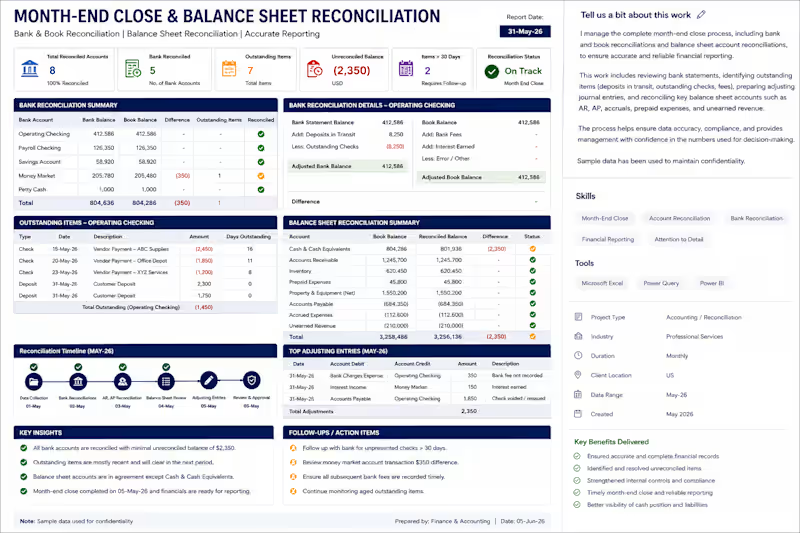
I managed a structured month-end close and balance-sheet reconciliation process to ensure the financial records were complete, accurate, and ready for management reporting.
The work included bank and credit-card reconciliations, accounts receivable and payable reviews, accrual and prepayment entries, fixed-asset and depreciation updates, deferred-revenue analysis, intercompany reconciliations, and investigation of unusual general-ledger balances. These activities align with my experience directing close processes and maintaining supporting accounting schedules.
I also maintained a reconciliation tracker to monitor account balances, supporting documents, unresolved differences, review status, ownership, and completion deadlines. This helped identify outstanding issues, strengthen financial controls, and support accurate and timely reporting.
Sample data has been used to maintain confidentiality.
0
115
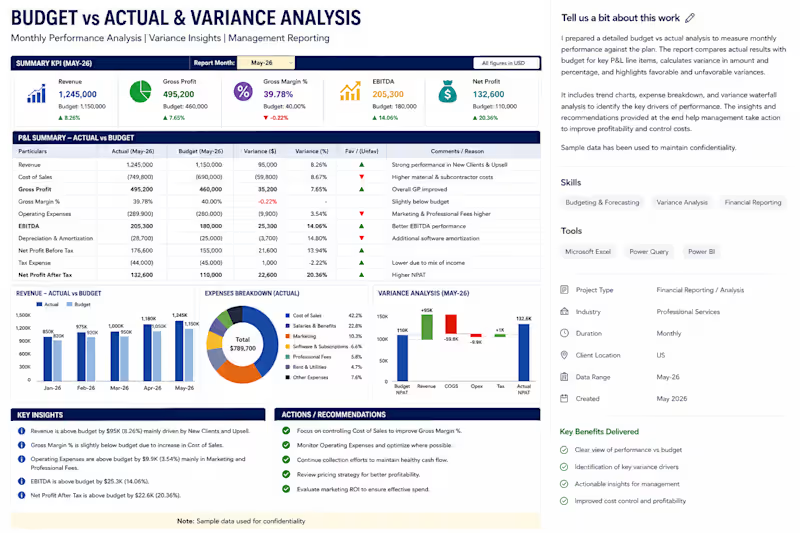
I prepared a detailed budget-versus-actual analysis to help management evaluate monthly and year-to-date financial performance against plan.
The report compares actual results with budget across revenue, cost of sales, gross profit, operating expenses, EBITDA, and net profit. It calculates both value and percentage variances, identifies favorable and unfavorable movements, and explains the main drivers behind each significant variance.
I also included trend analysis, visual summaries, management commentary, and recommended actions to support cost control, profitability improvement, and better financial decision-making. The model was designed as a reusable monthly reporting tool that can be updated after each accounting period is closed.
Sample data has been used to maintain confidentiality.
0
101

Precision-Driven Data Analyst & Assistant
Precision-Driven Data Analyst & Assistant


Strategist by training, builder by instinct


