Projects in SonnewaldeProjects in SonnewaldeRawform — a Framer template for architecture practices
Most architecture templates are a photo grid with a contact form bolted on. That works until a client asks where the case studies go.
So I built the whole practice site.
Twelve pages. A filterable project archive with proper case-study pages — client, location, year, area, typology, status, and separate Brief / Approach / Outcome narratives. A journal with author references. A team roster. A services page that publishes its stages and fees instead of hiding them. Contact, a custom 404, and the legal pages you actually need before launch.
Four CMS collections, populated. Thirteen components with real interaction states. Nav and footer in a shared Layout Template, so you edit them once.
The design is a printed studio monograph: paper tones, concrete greys, hairline rules on a visible grid, oversized grotesk against monospaced metadata. It gets out of the way of the photography, which is the only thing that should be selling the work.
Three breakpoints, tested to 320px. No fixed widths, no horizontal scroll, no code, no plugins.
https://noelmarketing.gumroad.com/l/rawform-framer-architecture-template Introducing PropertyPeak
Most estate templates are built for volume — endless grids, filter panels, cards that all look the same because nothing about them was ever looked at.
PropertyPeak assumes the opposite. It is designed for a brokerage carrying seven or eight properties at a time, where each one deserves its own room on the page.
Three things I spent the most time on:
The stack. Featured listings stack on scroll with the title and price row pinned to the top of each card, so the ones underneath stay readable instead of becoming a sliver of roof.
The numbers. Every price, floor area and yield uses tabular figures. Set two listings side by side and the digits line up. It sounds small until you see a column that doesn't.
One motion system. A single easing curve runs through every scroll reveal, with offsets staggered by role — heading, rule, body, figure, button. Nothing was tuned per section, which is exactly why it feels tuned.
Six CMS collections, ten pages, three breakpoints, five components. A district filter that actually filters. A contact form with real states.
Demo content is a fictional Copenhagen agency, written at real sentence lengths so you can see how the layouts hold before you fill them.
Fonts are Erode and Archivo, both free. Nothing is locked behind code components — remix it and go.
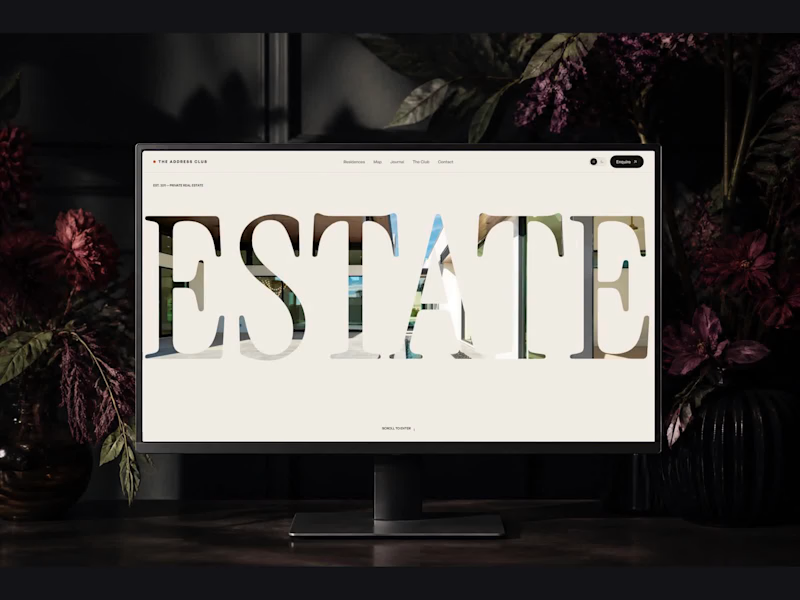
https://noelmarketing.gumroad.com/l/propertypeak-framer-template Most property templates are built like search portals: filter sidebars, dense result grids, everything optimised for volume. That works for a portal. It does not work for a six-person agency whose entire pitch is that they take on forty homes a year and know every street they sell on.
So I built the opposite. Editorial typography, generous whitespace, and copy written the way a good agent actually talks — no lorem ipsum, no "unlock your dream home".
Fourteen pages, including listings with live filtering, neighbourhood guides, a services page with a fee comparison, and three CMS-driven detail templates. Seven connected collections behind it: properties reference their neighbourhood and their agent, so one edit updates everything downstream.
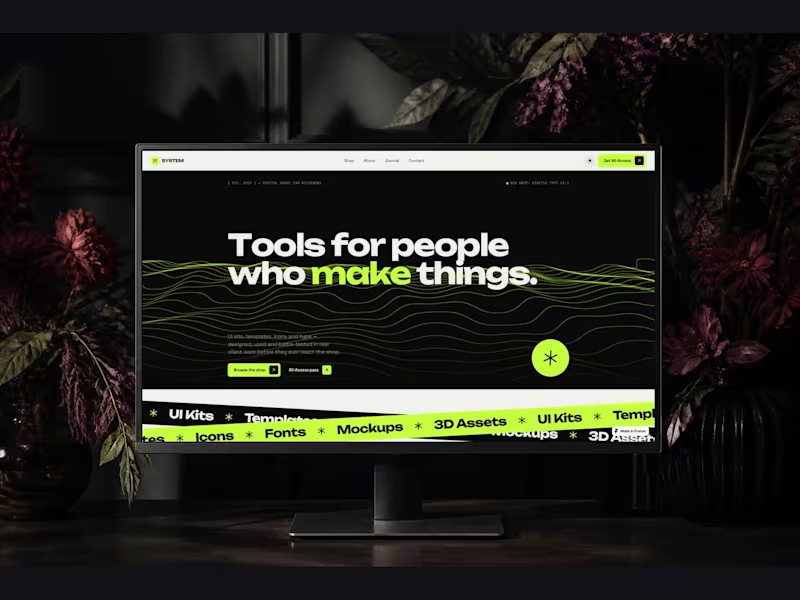
The part I am most pleased with is the design system. Thirteen colour tokens, fifteen text styles, and a type scale that carries its own responsive breakpoints — headlines move from 84px to 46px without anyone editing a single layer. Swap the tokens and it stops looking like my template and starts looking like your brand.
https://noelmarketing.gumroad.com/l/urbanlane
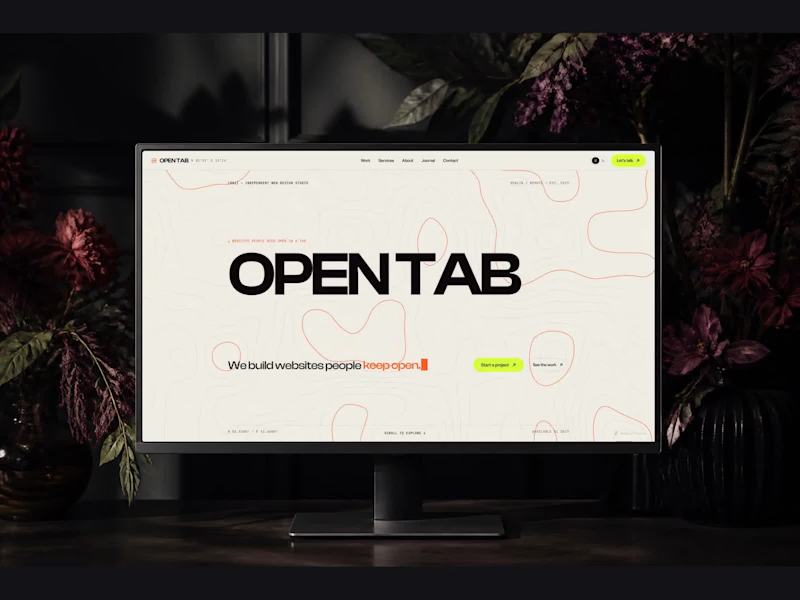
#Framer (https://www.linkedin.com/feed/hashtag/?keywords=Framer) #Webdesign (https://www.linkedin.com/feed/hashtag/?keywords=Webdesign) #Website (https://www.linkedin.com/feed/hashtag/?keywords=Website) Introducing LuxHotel — a premium Framer template designed for luxury hotels, boutique resorts, private retreats, and destination properties.
LuxHotel combines cinematic hospitality imagery with refined editorial layouts, elegant typography, and a calm, sophisticated visual direction. It includes everything needed for a complete hotel website:
• 10+ responsive pages
• Room and experience layouts
• Wellness and dining pages
• Framer CMS-powered Journal
• Reusable components
• Responsive mobile navigation
• Desktop, tablet, and mobile breakpoints
Every page comes with polished fictional content and can be easily customized for your own property or client project.
Built for hospitality brands that want to feel distinctive, immersive, and quietly luxurious.
Explore LuxHotel and create a memorable digital destination.
https://noelmarketing.lemonsqueezy.com/checkout/buy/6870a841-74b4-41e4-b118-41bf1267c5a9 I built an automated German AI publication with Astro — here are the early results
Over the past few months, I’ve been working on a German-language publication focused on artificial intelligence, large language models, AI software, technical explanations, and industry developments.
The project is built with
Astro (https://noel.marketing/astro-themes/) and supported by a largely automated content and publishing workflow.
I wanted to share some of the early performance data because the differences between Google Search, Bing, and AI-powered search have been especially interesting.
Google Search Console
Across the analyzed period, the website generated:
-109 organic clicks
-20,233 Google Search impressions
-an average CTR of approximately 0.54%
The monthly development looked like this:
February: 7 clicks and 399 impressions
March: 12 clicks and 1,662 impressions
April: 16 clicks and 2,088 impressions
May: 18 clicks and 4,039 impressions
June: 41 clicks and 9,151 impressions
July, partial month: 15 clicks and 2,894 impressions
The most encouraging signal is the growth in visibility.
Google impressions increased from 399 in February to 9,151 in June, which represents growth of more than 22 times within a few months.
Clicks also increased from 7 in February to 41 in June.
The CTR is still relatively low, but this appears to be mainly connected to ranking positions. Many pages are currently receiving impressions while ranking outside the top results, often between the lower first page and the following pages.
That means the next major opportunity is not simply publishing more content. It is improving how existing pages perform.
The most important areas are currently:
-titles and search snippets
-internal linking
-search-intent alignment
-topical authority
-content differentiation
-ranking positions
-click-through rate
Bing organic search
Bing generated:
-39 clicks
-2,347 impressions
-an average CTR of approximately 1.66%
Bing currently provides much less total visibility than Google, but the click-through rate is noticeably higher.
Google offers the larger traffic opportunity, while Bing already appears to send comparatively qualified visitors from a smaller number of impressions.
Microsoft Copilot and Bing AI citations
The most surprising part of the experiment has been the performance in Bing AI and Microsoft Copilot.
AI citations developed as follows:
March: 57 citations
April: 165 citations
May: 212 citations
June: 384 citations
July, partial month: 113 citations
The number of pages cited by Bing AI also increased:
March: 36 cited pages
April: 72 cited pages
May: 82 cited pages
June: 115 cited pages
By June, content from more than 100 pages had already been used as a source by Microsoft’s AI systems.
This is especially interesting because some pages appear to receive AI citations before they achieve strong positions in traditional search.
That suggests AI visibility may develop on a different timeline from classic organic rankings.
Several individual pages also accumulated dozens or even hundreds of citations, particularly content with a strong practical or educational angle.
The formats that currently appear to perform best include:
-tutorials
-technical explanations
-glossary-style content
-implementation guides
-comparison-focused content
-practical problem-solving articles
I am intentionally not sharing the exact topic clusters yet, as part of the project is still experimental.
The “Crawled — currently not indexed” category is the main area I am monitoring. These pages may need more time, stronger internal links, clearer differentiation, or better alignment with search demand.
The 404 pages also need to be reviewed individually to ensure that removed URLs are handled correctly and are no longer referenced internally or included in the sitemap.
Lighthouse and technical performance
The Lighthouse results were:
Performance: 98
Accessibility: 93
Best Practices: 100
SEO: 100
The measured performance metrics included:
First Contentful Paint: 1.2 seconds
Largest Contentful Paint: 1.5 seconds
Total Blocking Time: 0 milliseconds
Cumulative Layout Shift: 0
Speed Index: 4.0 seconds
Astro has been a very strong fit for this type of content platform.
The combination of static rendering, lightweight pages, and limited client-side JavaScript provides an excellent technical foundation.
At this point, site speed is not the main bottleneck. The more important challenges are authority, rankings, CTR, content quality, and distribution.
What I have learned so far
The biggest lesson is that content volume alone is not enough.
A scalable publishing system can create a large number of pages, but that does not automatically lead to traffic.
The real work starts after publication.
Another important observation is that traditional search and AI search do not behave in exactly the same way.
Google appears to test many pages gradually before giving them stronger visibility.
Microsoft Copilot, by contrast, has already cited a surprisingly broad selection of content.
This may indicate that AI search visibility can emerge earlier than meaningful organic traffic.
The project is still early, but the direction is encouraging.
The strongest signals so far are:
Google impressions increased more than 22 times from February to June
Google clicks increased from 7 to 41 per month
Bing organic CTR reached approximately 1.66%
Bing AI citations increased from 57 in March to 384 in June
the number of pages cited by Bing AI increased from 36 to 115
several individual pages accumulated a high number of AI citations
Lighthouse Performance reached 98
SEO and Best Practices both reached 100
the technical foundation remains fast despite the growing amount of content
The main question now is whether growing visibility and AI citations will translate into stronger rankings, more clicks, and sustainable revenue over the coming months.
Would you like to see more insights into Astro, SEO, automated publishing, and AI search visibility?
Follow me for future updates.
You can also find high-quality Astro themes here:
https://noel.marketing/astro-themes/ New Framer Component: Bamora 💥
I just created Bamora, a premium comic-style hotspot component for Framer.
Bamora lets you place bold plus-shaped hotspots on top of an image and reveal playful pop-art speech bubbles with product details, CMS content, image callouts, or editorial notes.
It is made for websites that should feel more expressive, colorful, and memorable — not just another clean minimal UI.
Features:
• Comic / pop-art hotspot design
• Plus-shaped interactive markers
• Bold speech-bubble popups
• Hover preview and click-to-keep-open behavior
• Movable X/Y hotspot positions
• Floating or bottom popup mode
• Popups with title, kicker, description, price, sticker label, preview image, and buttons
• Optional halftone overlay
• Optional burst shapes behind hotspots
• Custom colors, outlines, typography, pins, panels, and shadows
• CMS-friendly structure
• Fully customizable in Framer Property Controls
Perfect for playful product showcases, creative e-commerce pages, shoppable images, comic-inspired portfolios, kids brands, creator websites, editorial image callouts, and CMS galleries.
Get it here: https://www.framer.com/community/marketplace/components/bamora/