
Debarun Bhattacharya
SEO Content Writer & Editor



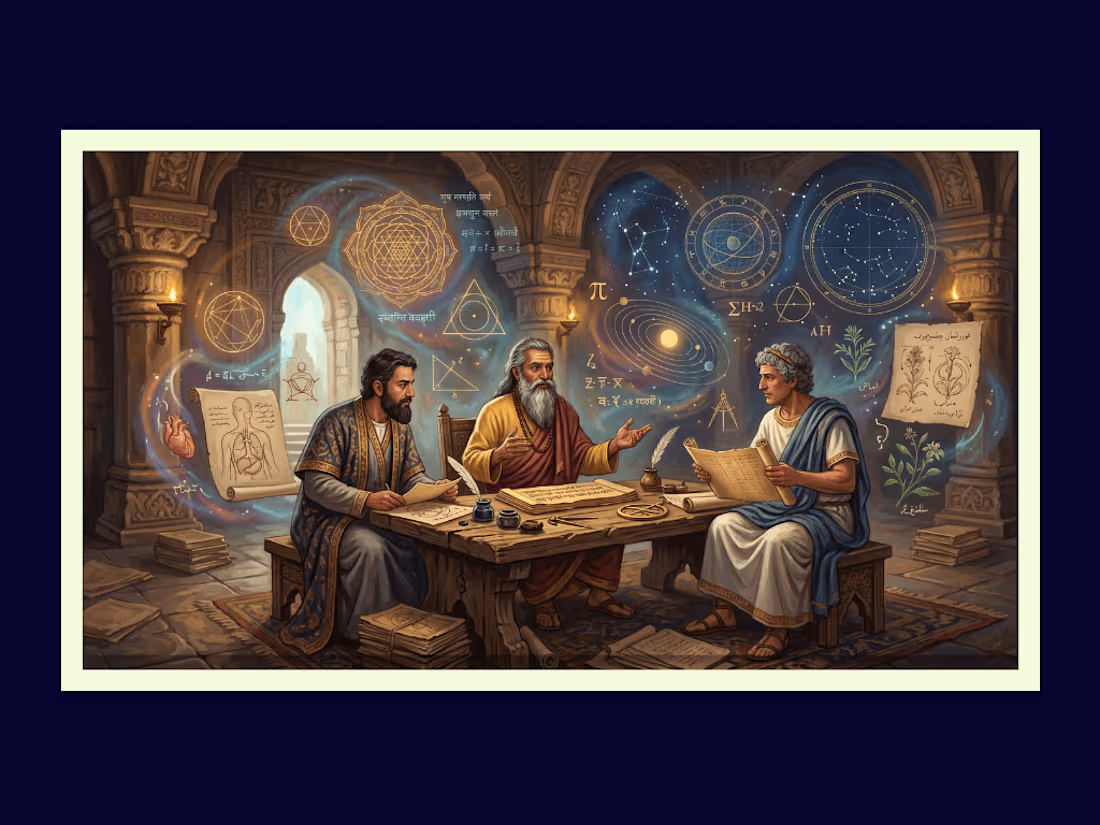
Most people think of ancient civilizations as separate worlds that occasionally bumped into each other. The reality was far more interesting.
Between the Vedic period and the Kushan Era, India was one of the most connected intellectual hubs on the planet. Indian astronomers were exchanging ideas with Babylonian stargazers. Indian physicians were comparing notes with Greek doctors trained in humoral medicine. The Kushans were carrying Buddhist texts, along with Indian medicine and astronomy, deep into China.
None of this happened in isolation. It happened because India sat at the intersection of the Indian Ocean trade network, the Central Asian corridors, and the overland routes into Persia and the Mediterranean, and the people moving through those routes carried ideas, not just goods.
My latest post on The Indic Scholar traces this exchange across six civilizations: Babylonians, Egyptians, Persians, Greeks, Śakas, Kushans, and Romans. It covers how these interactions shaped astronomy, medicine, philosophy, art, and administration on both sides.
It's part of an ongoing series on ancient Indian history of science.
You can read it here: [ https://theindicscholar.com/ancient-indian-trade-exchange-of-ideas-with-the-world/ ]
0
38
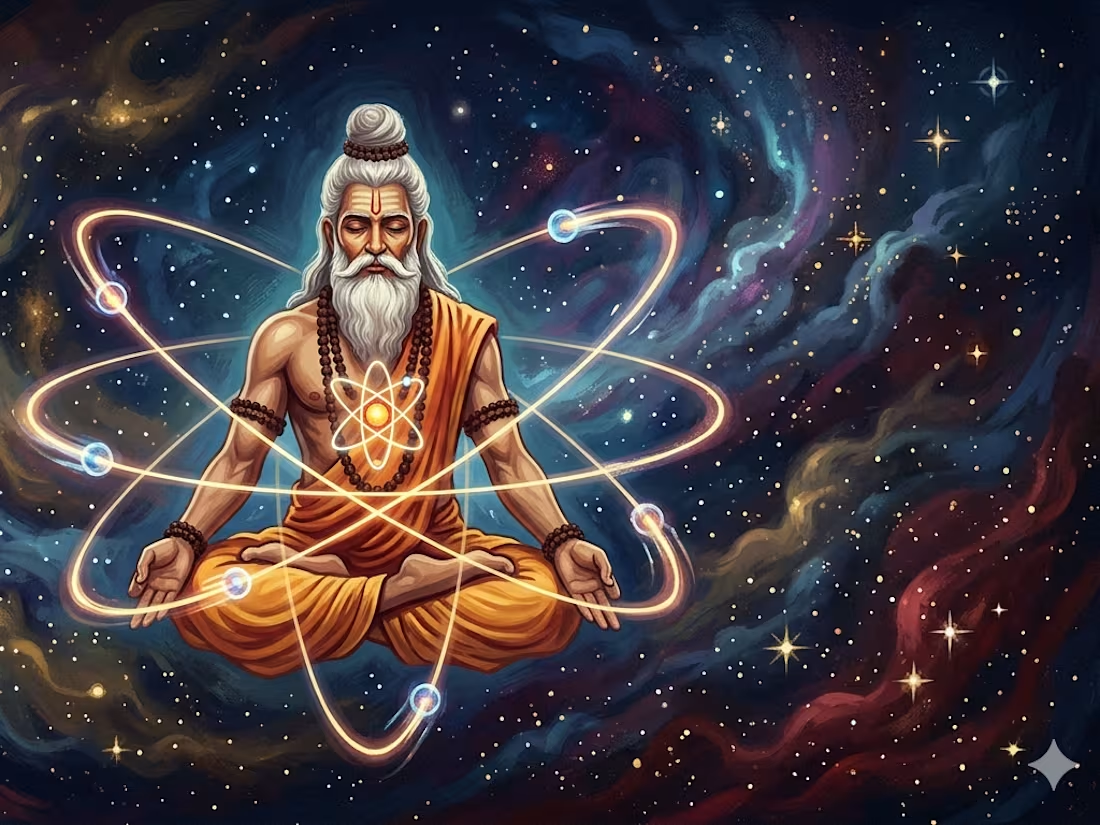
Most people know ancient India contributed the zero and Ayurveda. Fewer know that an Indian philosopher named Kaṇāda proposed an atomic theory of matter, centuries before Democritus did in Greece.
That's one of the things covered in my latest post on The History of Indian Science.
The Iron Age in India (roughly 700–1 BCE) was a turning point. The spread of iron technology triggered the Second Urbanization, which created cities, specialized professions, and the intellectual space for serious inquiry. Out of this came the Vaiśeṣika school's atomic model, early Āyurvedic hospitals, Pāṇini's systematic grammar that influenced mathematical thinking, and an astronomy that moved beyond ritual into real computation.
It's part of an ongoing series where I trace the full arc of scientific thought in India: from the Vedic age through the Classical period and beyond.
If you're interested in the history of science, philosophy, or just underappreciated chapters of world history, this one's worth a read.
Read the full post here: [ https://theindicscholar.com/science-in-iron-age-india-atomism-ayurveda-and-more/ ]
2
189

Most people associate ancient India with spirituality. But between roughly 1000 and 500 BCE, something else was happening: a quiet scientific revolution.
The later Vedic thinkers were building frameworks to understand matter. The Vaiśeṣika school proposed that the universe is made of eternal, indivisible atoms that combine into larger structures, centuries before Democritus. The Sāṃkhya school was mapping the fundamental constituents of nature. Botanical catalogues were being compiled. Surgical procedures like cataract removal were being documented.
This wasn't mysticism dressed up as science. These were genuine attempts to systematize observations about the natural world, using the tools and language available at the time.
My latest post on The Indic Scholar traces this transition: from Vedic ritual astronomy to proto-physics, proto-botany, and proto-medicine, and shows how it laid the foundation for the classical Indian scientific tradition.
If you're interested in the history of science beyond the usual Western canon, this one's worth your time.
Read it here: [ https://theindicscholar.com/into-the-later-vedic-sciences-rise-of-natural-enquiries/ ]
0
83
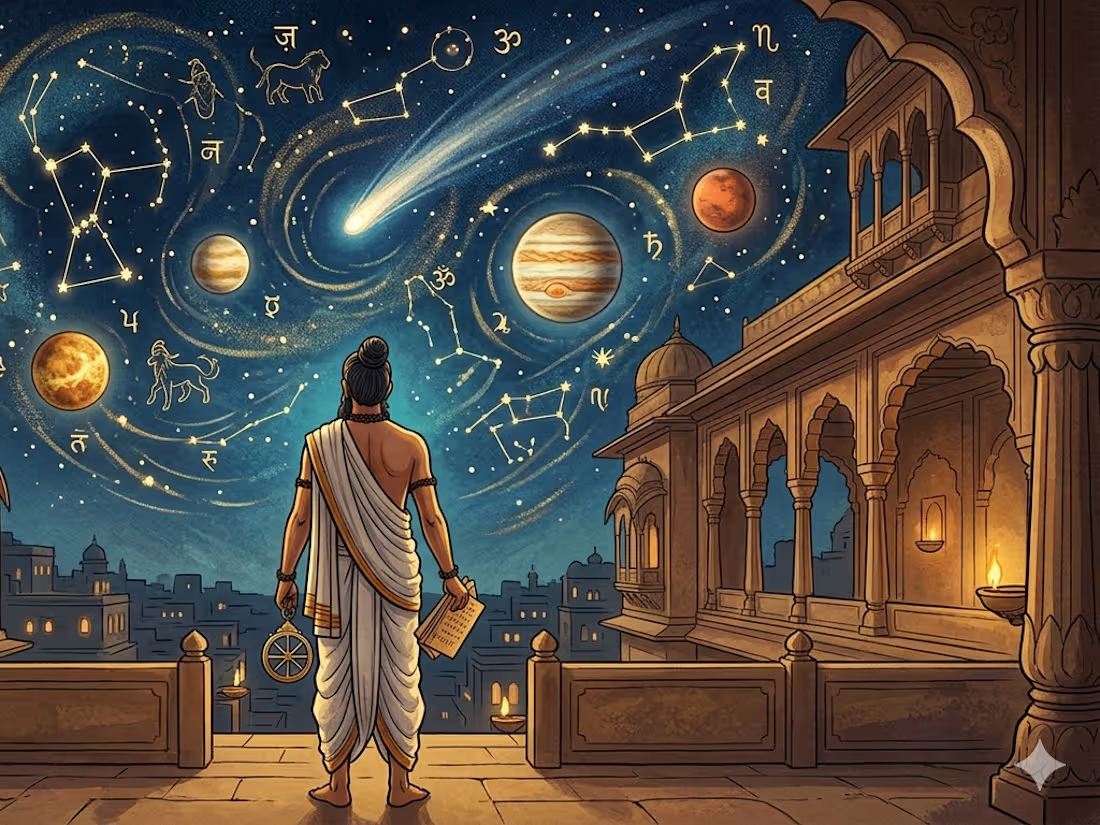
Did you know that ancient Indian astronomers had mapped the entire lunar path into 27 precise sky coordinates as far back as 1500 BCE?
In my latest blog, Ancient Indian Astronomy: Timekeeping in the Vedic Age, I explore how Vedic astronomers studied the skies not merely for spiritual reasons, but with remarkable scientific rigour. From the Nakṣatra system that tracked the Moon's position against fixed stars, to sophisticated timekeeping units like yugas, tithis, and muhūrttas, the Vedic people had developed a surprisingly systematic understanding of celestial patterns.
What fascinates me most is how astronomy, mathematics, and ritual were deeply intertwined: brick altars geometrically aligned to celestial positions, time units precise to 3.2 minutes, and a five-year calendar cycle reconciling the solar and lunar years.
This is part of my ongoing series on the History of Indian Science. Would love to hear your thoughts in the comments!
You can read it here: [ https://theindicscholar.com/ancient-indian-astronomy-time-keeping-in-the-vedic-age/ ]
3
156