The network for creativity
Join 1.25M professional creatives like you
Connect with clients, get discovered, and run your business 100% commission-free
Creatives on Contra have earned over $150M and we are just getting started
Back to feedPost

Server-Side Tracking & Conversion APIs are no longer optional.
Browser-based tracking is losing data due to privacy updates, ad blockers, and cookie restrictions leading to broken attribution and underperforming campaigns.
Server-side tracking solves this by sending events securely from your server, not the browser. Combined with Conversion APIs (Meta, Google Ads), it delivers:
More accurate conversions
Better attribution
Stronger ad optimization signals
If you’re scaling paid media or eCommerce, cleaner data directly impacts ROAS.
Future-proof analytics starts with server-side tracking.


The network for creativity
Join 1.25M professional creatives like you
Connect with clients, get discovered, and run your business 100% commission-free
Creatives on Contra have earned over $150M and we are just getting started





Related posts

Your website analytics may have stopped counting patients weeks ago, and nobody told you.
On a recent project for a spine surgeon, the site was sending data to one Google Analytics account while he was checking a different one. The numbers simply stopped in early October.
No error message. No warning. Just a quiet gap in the data he uses to make decisions.
If you are a physician or specialist, log in to your analytics today and check that the last 30 days actually have traffic in them. If it looks flat, it may not be your marketing. It may be your setup.
Would you want a free 2-minute checklist to assess your practice website? Get it here: https://www.berniceebenezer.com/resources/practitioner-website-checklist
#PhysicianMarketing #MedicalPracticeGrowth #GoogleAnalytics #HealthcareWebsite

berniceebenezer.com
Free Practitioner Website Checklist | Bernice Ebenezer
A free two-minute website self-audit for therapists, herbalists, and solo practitioners. Spot the quiet mistakes costing you clients, including one privacy risk.

Sending data to one GA property while the client checks another is such a sneaky issue. Good reminder to verify the measurement ID after every handoff.

The challenge:
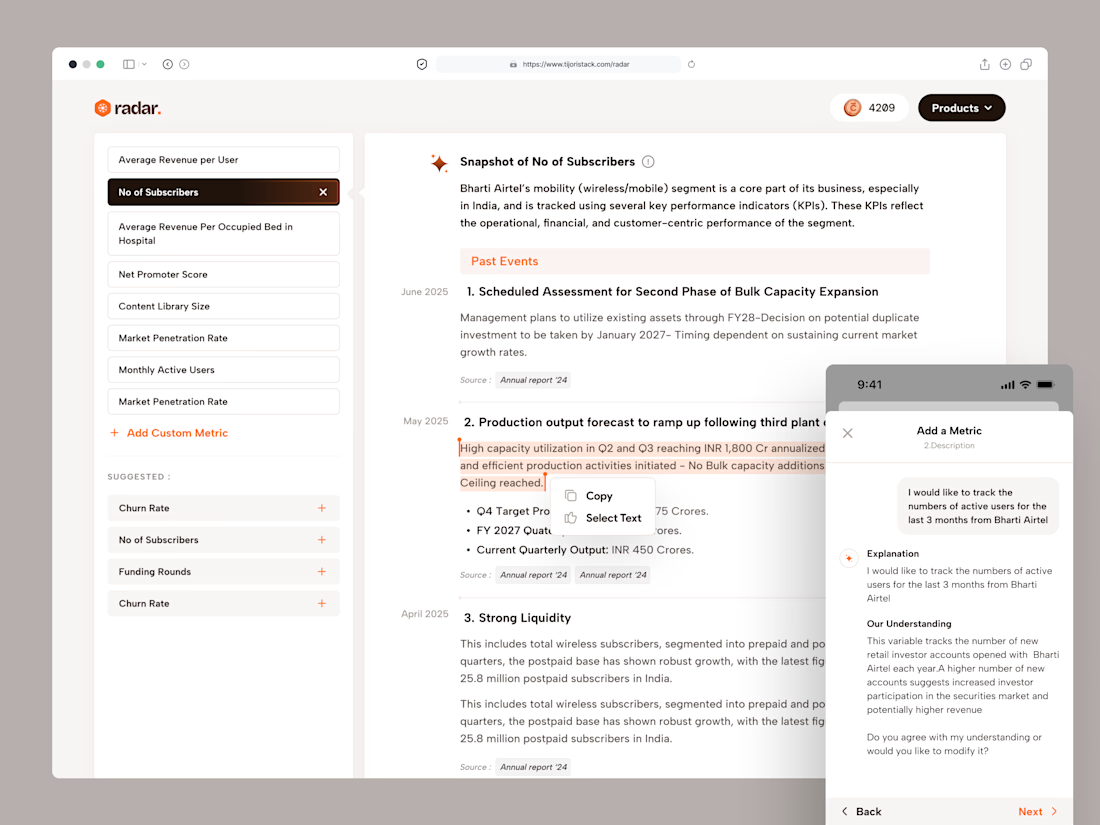
The KPIs that move a stock — subscribers, ARPU, capacity utilisation — are buried in annual reports and earnings calls. Screeners only show generic ratios. Tijoristack wanted investors to ask for any metric and get it back with dates and sources.
What I did:
As lead product designer, I ran research with investors, analysts and the founders, mapped the "add a metric" and "read a snapshot" journeys, and designed the web and mobile experience. I then worked with Tijoristack's developers through the build.
Key decisions:
• The AI restates its understanding of a new metric before tracking it, so one misread doesn't spoil every snapshot after it.
• Snapshots read as a dated timeline of events, not a lone number.
• A source chip on every claim, because investors won't act on what they can't trace.
Result
Shipped and live at tijoristack.ai/radar.
Building an AI or fintech product? I design complex workflows people actually get. Book a 30-min call
Check it out


The AI restating its understanding before tracking a metric is such a smart trust move. I design a GenAI analytics assistant and we hit the same problem: one silent misread and users stop trusting every answer after it. Did investors ever edit that restatement, or mostly just confirm it?

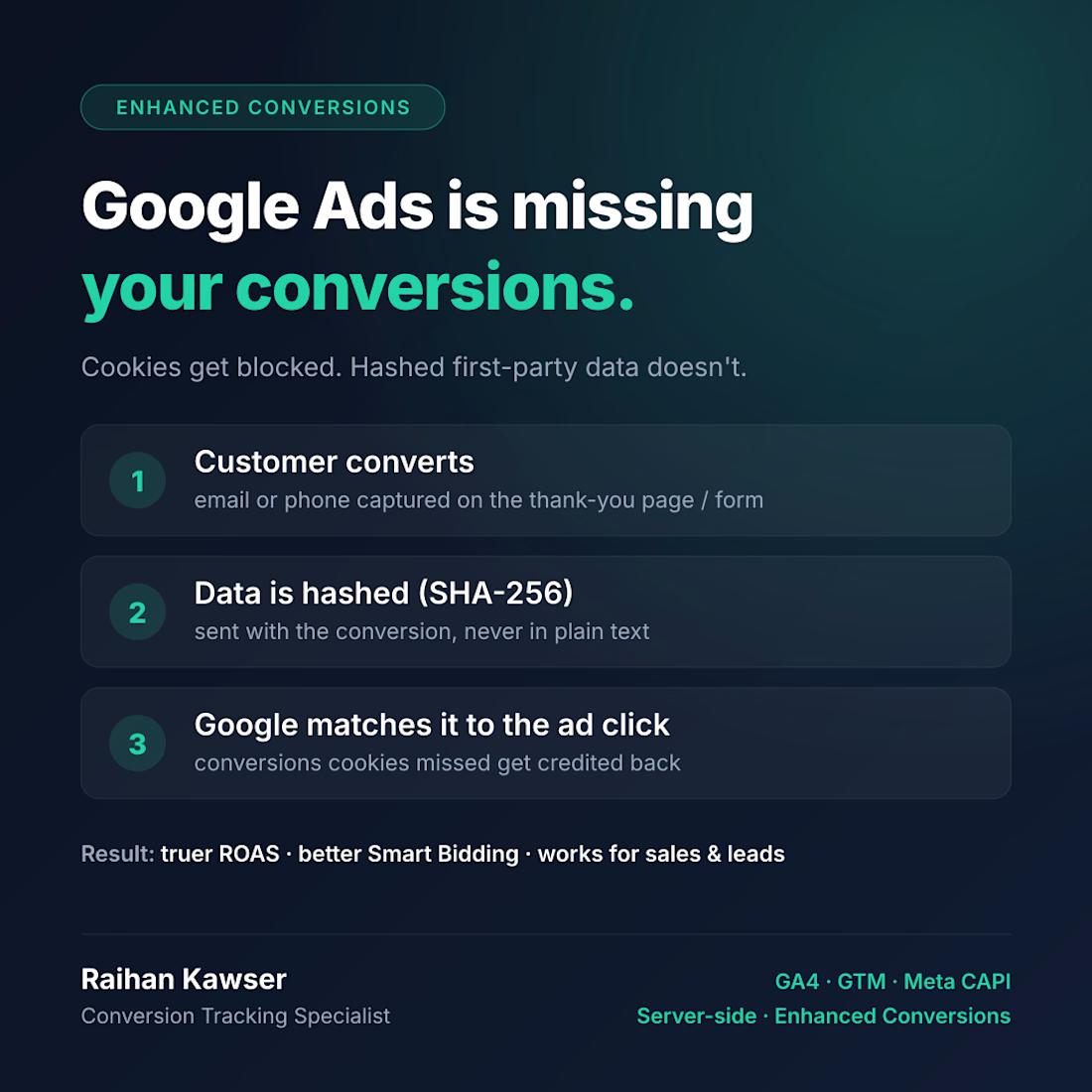
Google Ads is probably undercounting your conversions.
Not because your ads are bad. Because cookies get blocked, cleared or expire before people buy.
That's exactly what Enhanced Conversions fixes 👇
🔐 When someone converts, their email or phone is hashed (SHA-256) and sent with the conversion
🔗 Google matches it to the signed-in user who clicked your ad
📈 Conversions the cookie missed get credited back to the right campaign
Why it matters 👇
✅ Truer ROAS, so you stop cutting campaigns that actually work
✅ Smart Bidding gets more signals to learn from
✅ Works for both purchases and leads
The catch? It only works if it's set up right. Wrong field mapping, badly formatted emails or missing consent, and it quietly does nothing.
Want Enhanced Conversions set up properly through GTM or server-side? Message me. Fixed-price, right here on Contra.