Numenist: Nine Traditions, One Reading

Jordan Atkins


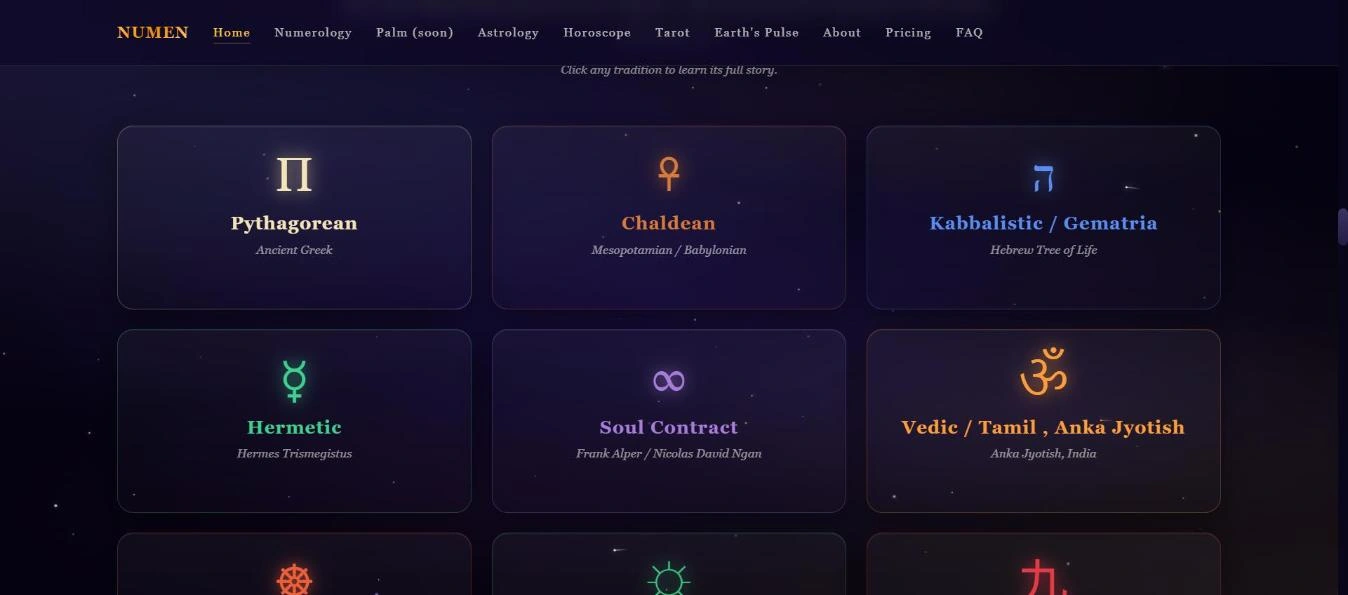
Numenist started with a question I could not stop asking. Nine numerology traditions, from Pythagorean Greece to the Mayan Tzolk'in to China's Lo Shu Grid, have each spent centuries finding meaning in a name and a birth date. What happens when you hold all nine up to the same person at once, and let them speak to each other?
The law it answers to
Before writing any code, I wrote the Master Prompt, a specification of all nine systems, their lineages, their letter mappings, and the rules a reader must keep. It opens with one law. Every interpretation must serve the elevation, empowerment, and authentic spiritual development of the person being read. No doom, no fear. Karmic numbers are tools for growth, and every number is read with both its light and its shadow.
The same document carries a Lineage Honesty Protocol. Each tradition is described in its own terms and never blended with another's rules. Some traditions are left out on purpose. Ifá is accessed through divination by an initiated Babaláwo, not through an algorithm, so Numenist points seekers to one rather than imitating it. Dreamspell is excluded because it presents itself as Mayan when it is not; only the authentic Tzolk'in is used.
How a reading is made
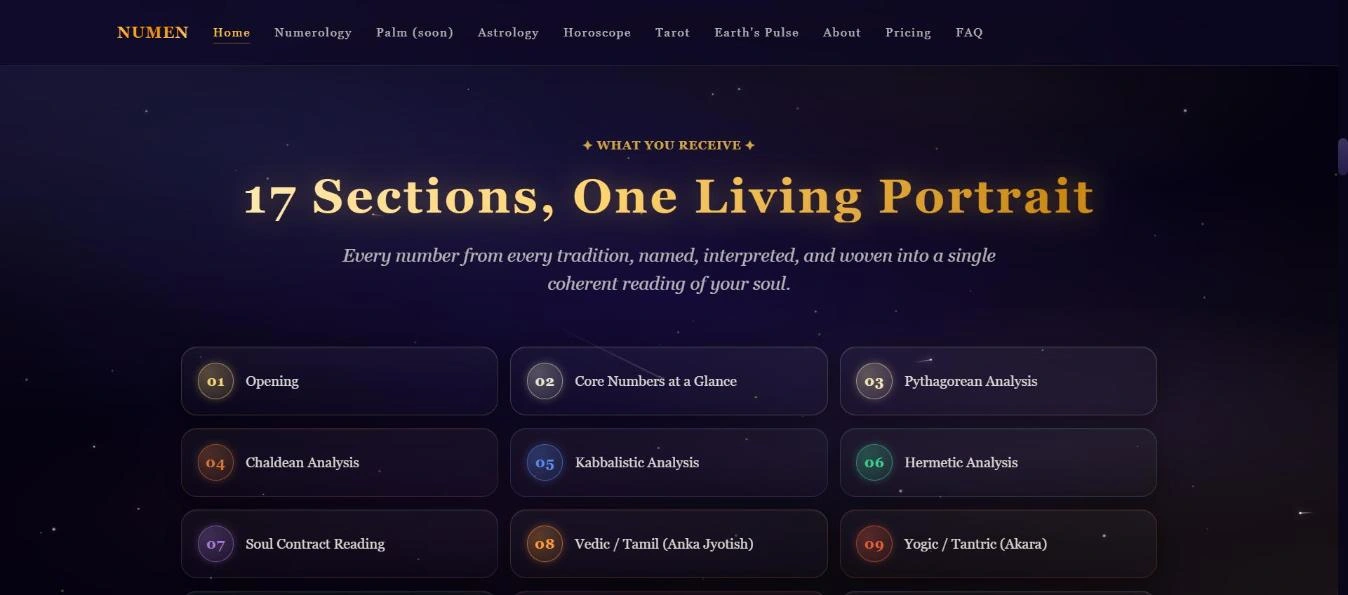
The engine works in two layers, and the order matters. First comes the math. All nine systems and the natal chart are calculated deterministically, each in its own tested module, leaving an audit trail you could check by hand. Then comes the interpretation. Seventeen chapters are written in parallel, one call per chapter, each carrying the full Master Prompt and its own room to think before it writes. Claude interprets the chart; it never recalculates it. Where a meaning is missing from a tradition's own lexicon, the reading says so instead of inventing one.
Between the two layers sits a convergence detector, and it only speaks when two traditions independently agree. If the Vedic Psychic number matches the Pythagorean Life Path, or a digit missing from the Lo Shu Grid is the same one the Pythagorean name marks as a karmic lesson, the reading names it. When Indian, Greek, and Chinese lineages arrive at the same digit on their own, the Master Prompt treats that finding as structural to the soul itself.
The finished reading runs to seventeen chapters and 8,000 to 15,000 words, and it closes the way every reading is asked to close: the numbers describe the instrument, and the seeker chooses the music.
Tarot, card by card
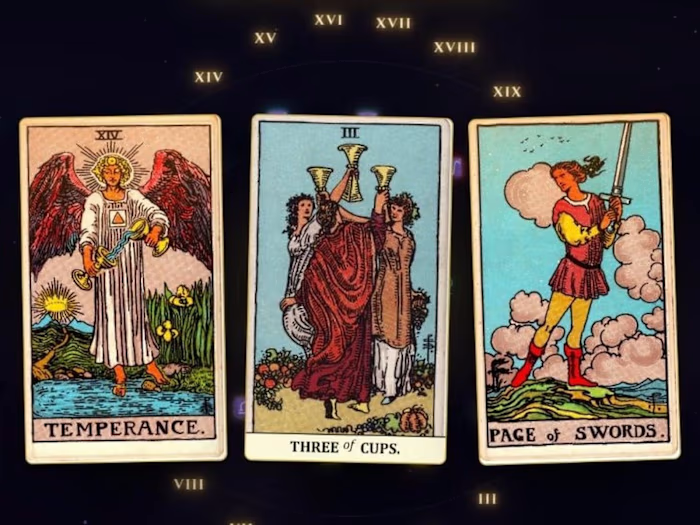
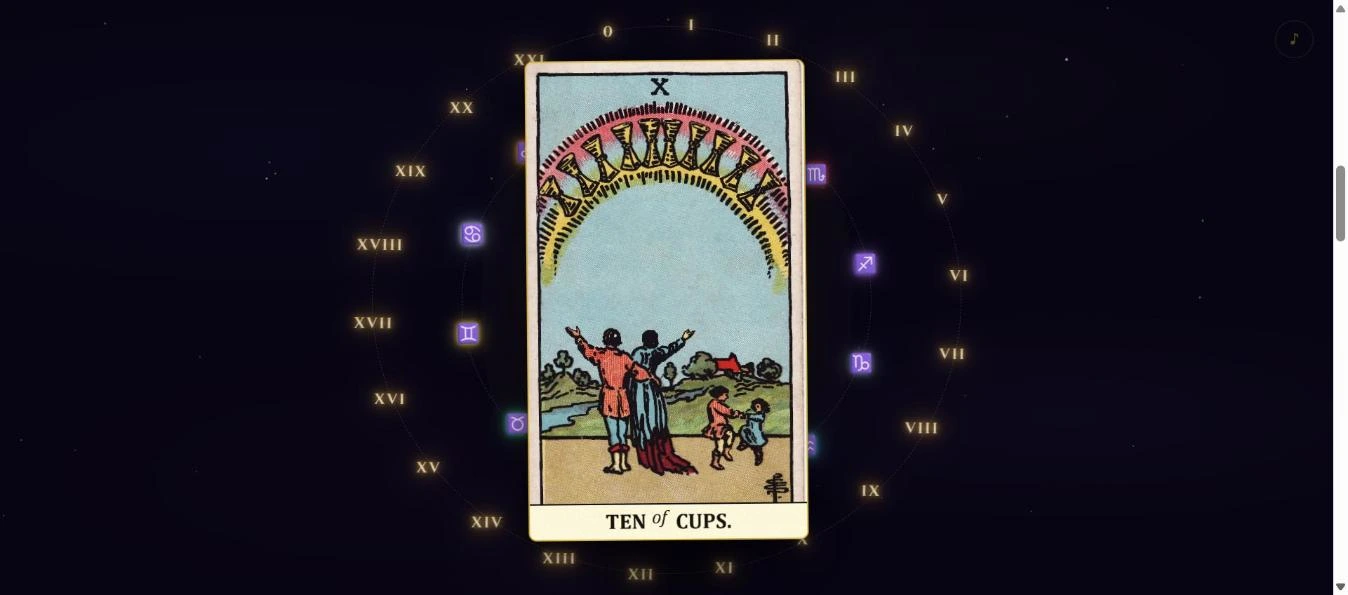
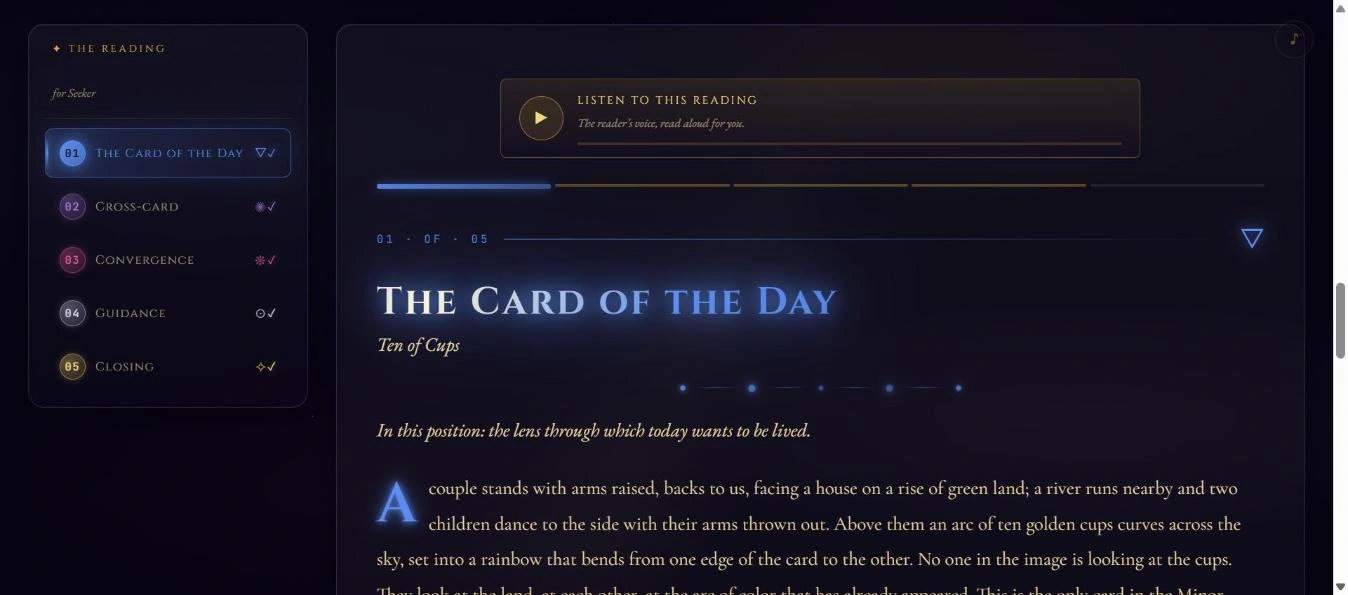
The tarot uses Pamela Colman Smith's deck, and each of the 78 cards carries its own narration in five layers: what the image actually shows, what the card means in its lineage beginning with Waite's Pictorial Key of 1910, what it is asking of you now, its shadow, and a concrete practice for the week. Each spread has a ritual the reader speaks before the cards turn: the deck is shuffled, held until the room settles, and cut to the left with the left hand. A free daily card is read against your Life Path, Personal Year, and Personal Day, and every reading can be heard in the reader's voice. The Tower, the Devil, and Death are read for what they reveal, never as bad omens.
The sky
Western and Chinese astrology are offered as equals, each with its own reading: Western with your choice of framing and house system, Chinese through BaZi Four Pillars and Zi Wei Dou Shu, or both woven together with an East-West synthesis. Each lineage is told properly, from Babylonian sky-priests to the modern psychological revival, and from Shang oracle bones to Xu Ziping and Chen Tuan.
The daily horoscope
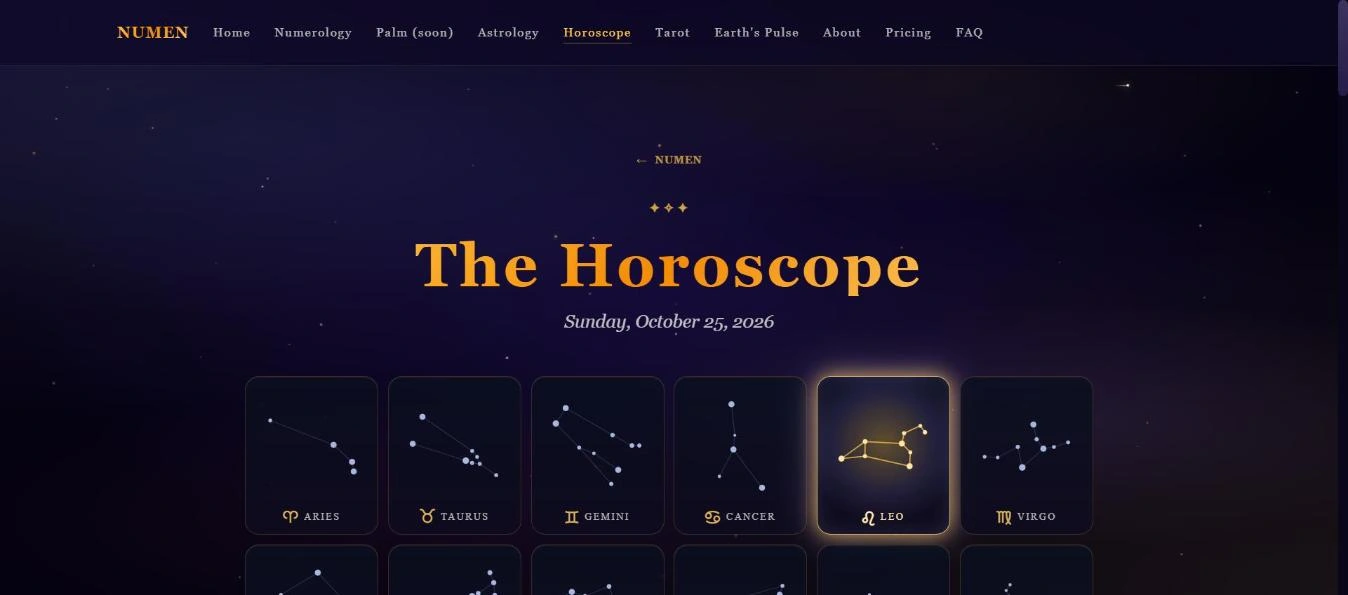
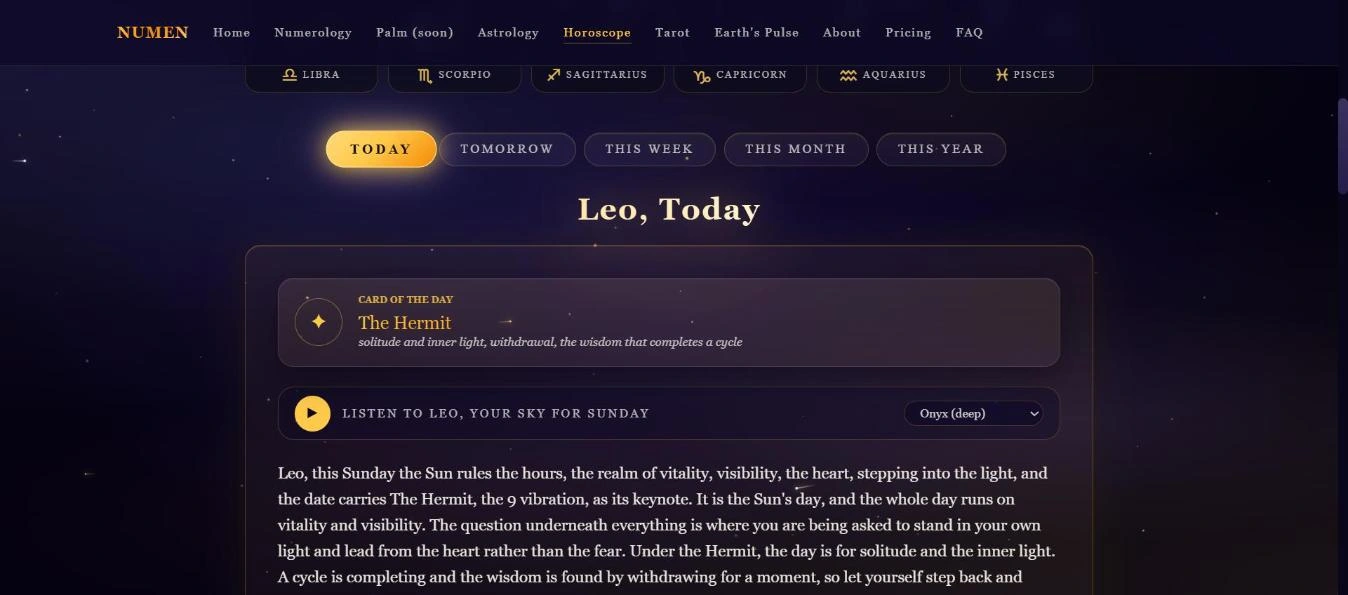
Free for all twelve signs, every day, with no signup. It reads the planet that rules the day, the Moon moving through your house, and your Personal Day number, pairs each day with a card, and looks ahead by the day, week, month, and year. Every forecast can be read aloud in one of six voices.
Earth's Pulse
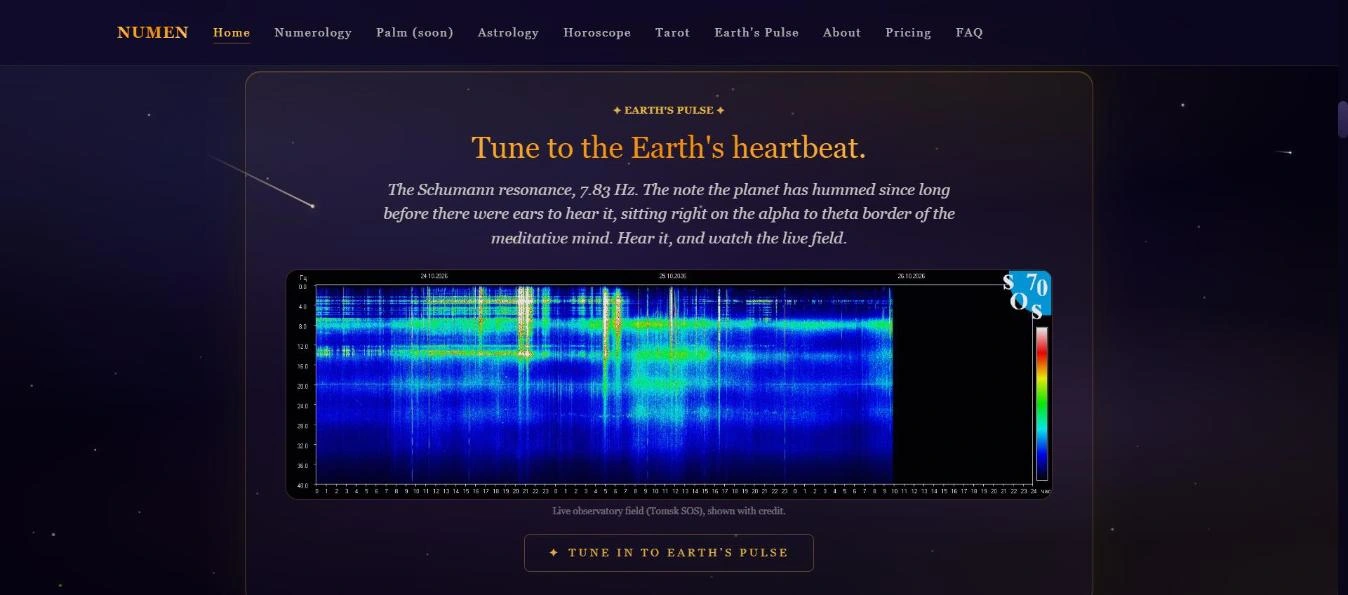
The quietest corner of the site. It generates the Schumann resonance, the 7.83 Hz hum of the Earth's electromagnetic field, live in the browser for speakers or headphones, beside a live spectrogram from the Tomsk State University observatory.
Built to be trusted
Every system shows its work, and the systems talk to each other. Payments run through Stripe, accounts through Supabase, and every reading carries a fourteen-day guarantee.
Built with Next.js, TypeScript, Supabase, Stripe, and the Anthropic API, with more than 500 automated tests. I wrote about 90 percent of the commits, and a collaborator joined in May to help with brand, conversion, and sign-in.
Like this project
Posted Oct 25, 2026
A full-stack reading platform I built that cross-references nine numerology traditions and astrology, then composes a 17-chapter reading for one person.