Numen Palm: Three Traditions, One Hand

Jordan Atkins


Palm reading asks something no other Numenist reading does: the reader has to see. The palm engine is built around looking carefully before saying anything, and around being honest about what a photograph can and cannot show.
Capturing the hand
Instead of a plain upload box, a guided camera walks the seeker through four or five angles: the full palm flat, tilted toward the thumb, tilted toward the little finger, a close view of the major lines, and the back of the hand. Live hand tracking lays a silhouette over the frame, coaches in real time with prompts like move closer and hold steady, and confirms every fingertip is inside the frame before a photo is taken. Computers without a camera fall back to a simple upload.
Three traditions, one hand
The Master Palmistry Prompt reads in three traditions: Western chirology in the line of Cheiro and Benham, Indian Hast Samudrika, and Chinese palmistry in the Ma Yi and Wu Xing line, alongside modern hand analysis and fingerprint research. It honors each tradition's own conventions, down to which hand is read first. The West reads the dominant hand; Hast Samudrika reads the right hand for men and the left for women; the Chinese tradition reverses it.
How the reading is made
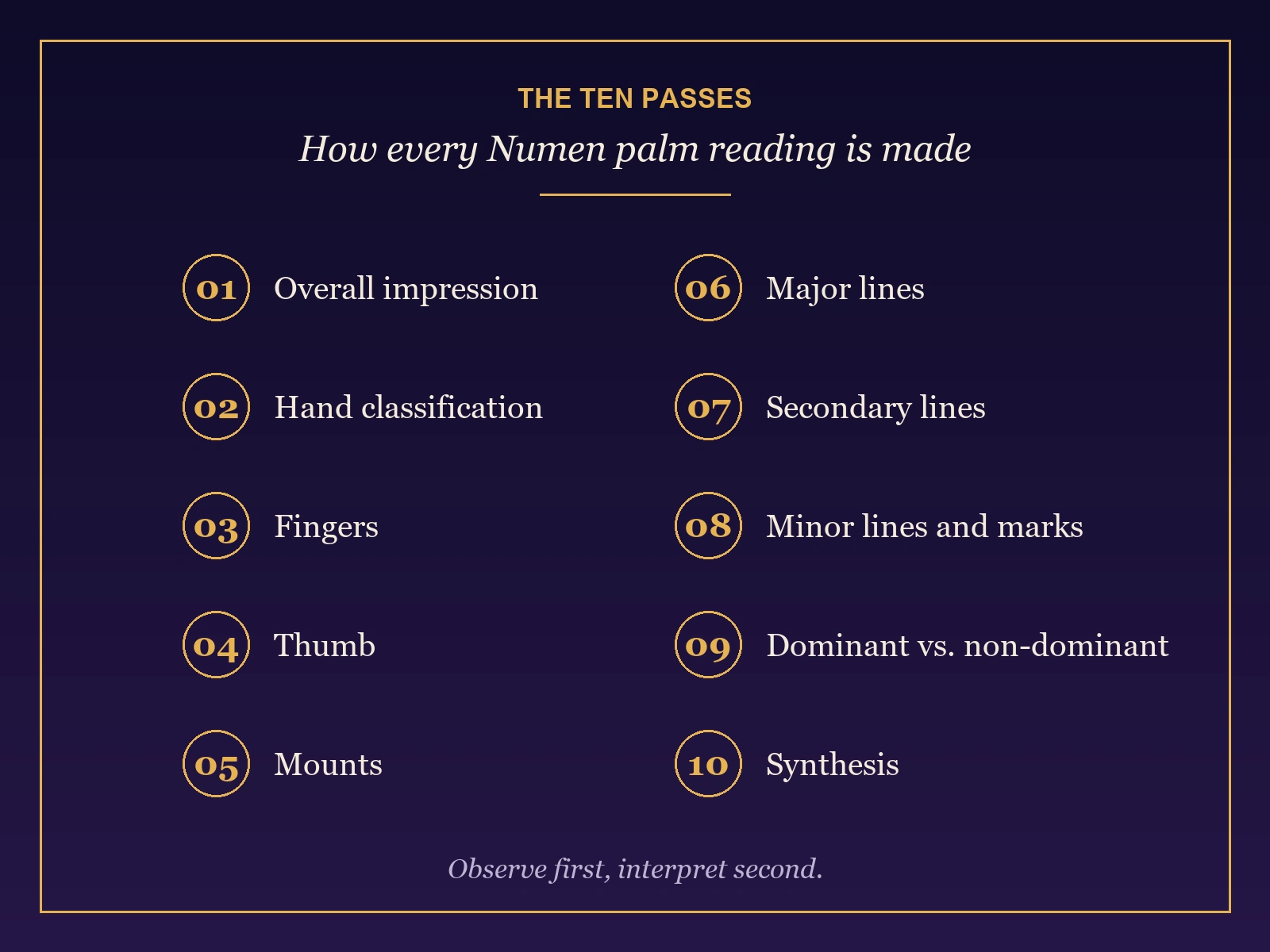
Every reading follows ten passes in a fixed order, from the first impression of the hand through its shape, fingers, thumb, mounts, and lines, to a comparison of the two hands (the inherited self against the one being built) and a closing synthesis. Claude studies up to two photographs and writes ten chapters in parallel. Each chapter is checked for depth when it returns and rewritten if it comes back thin. If the vision path fails entirely, a written library of about 31,000 words, organized by hand type, finger, mount, line, scope, and tradition, still delivers a complete reading.
Care built in
Much of the engine is about what the reader refuses to do. If a photo is blurry or a line cannot be traced, it asks for a better picture instead of guessing, which the prompt names as the single biggest risk in AI palm reading. It never predicts death, and it treats the life line as a measure of vitality rather than length of life. It never diagnoses illness, refuses predictive readings of children's hands, cross-checks every mark against a second feature before naming it, gives timing only in ranges, and bans vague statements that would fit anyone. If a seeker is in crisis, the reading stops and points them to real help.
Where it stands
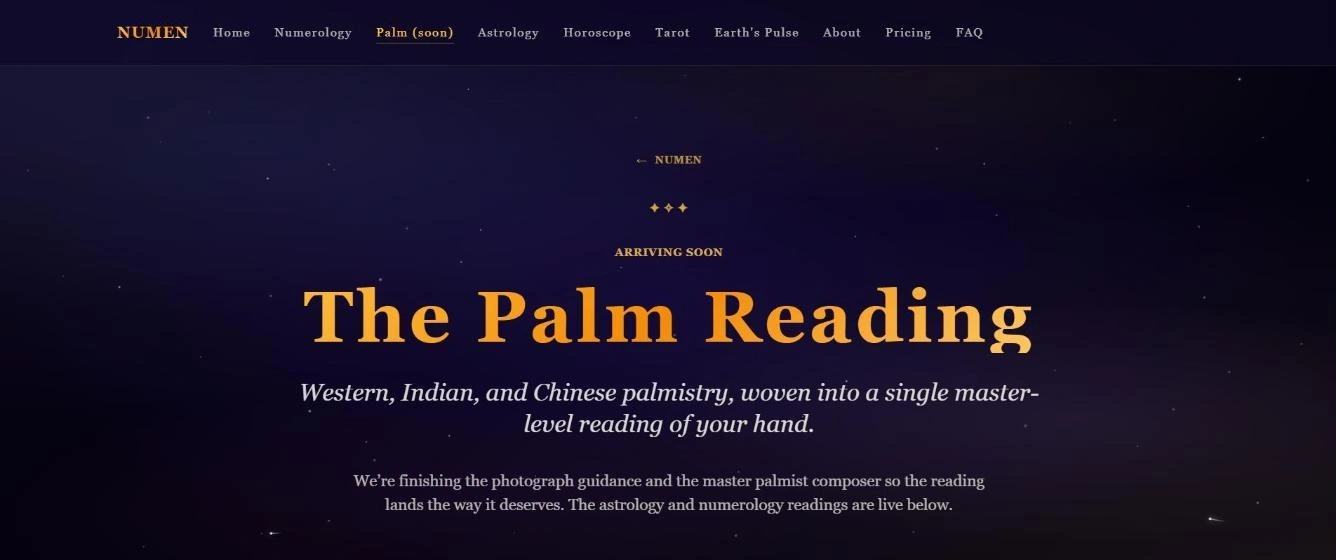
The engine is built, and its page is already up on Numenist marked Arriving soon, beside the numerology, astrology, and tarot readings that are open today.
Like this project
Posted Oct 26, 2026
A vision-based palm reading engine I built, with guided photo capture, three palmistry traditions, ten parallel chapters, and firm ethics.