Designing digital healthcare beyond the consultation

Jenna Patrick

Designing digital healthcare beyond the consultation
Leading product design across one of the UK’s fastest-growing digital healthcare services, balancing clinical responsibility, commercial growth and long-term behaviour change.
Healthcare doesn’t end when someone receives a prescription. In many ways, that’s where the real product experience begins.
As Lead Product Designer, I led design across multiple squads responsible for improving the treatment experience beyond the consultation. Working closely with product, engineering, clinicians, legal and commercial teams, my role extended beyond individual features, helping shape the strategy for how patients discovered, understood and stayed engaged with treatment over time.
Rather than optimising isolated moments, the focus was on creating a connected healthcare experience that supported patients throughout their treatment while balancing medical safety, business goals and meaningful health outcomes.
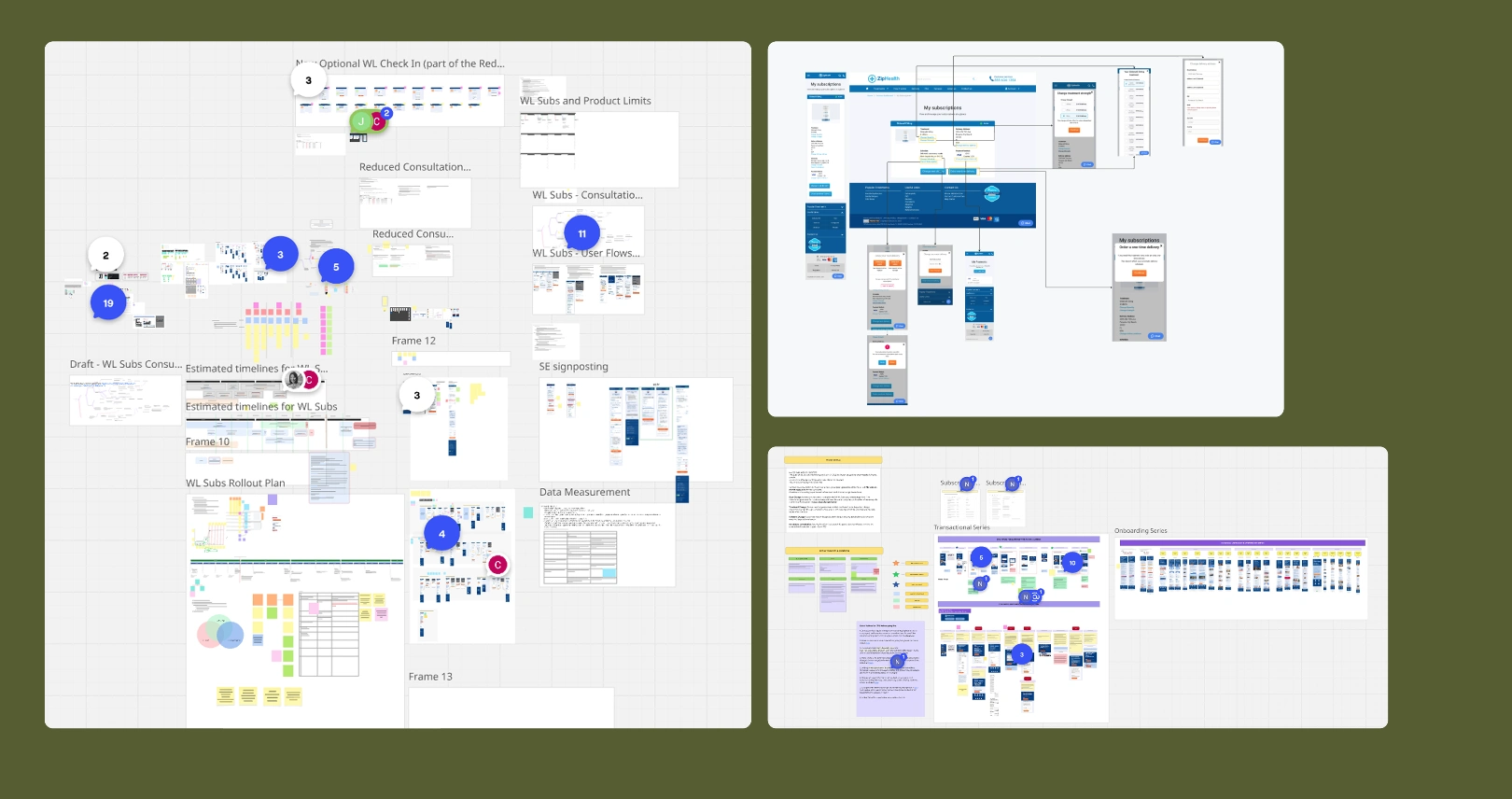
Mapping the treatment journey beyond consultation, identifying opportunities across onboarding, subscriptions, lifecycle communications and patient support.
Designing for behaviour, not just transactions
One of the biggest mindset shifts was recognising that success wasn’t measured by a completed checkout.
Unlike traditional ecommerce, digital healthcare succeeds when patients understand their treatment, feel confident making decisions and remain engaged over time. Designing for that meant looking beyond individual screens to consider how every interaction contributed to the overall treatment experience.
Every product decision needed to balance three equally important priorities:
Patient confidence and outcomes
Clinical safety and governance
Commercial sustainability
This shifted the role of design from improving individual interactions to shaping how the entire service worked together.
Leading strategy across a connected service
The work extended well beyond interface design.
Alongside leading product strategy across multiple squads, I partnered closely with clinicians, researchers, engineers, legal and commercial stakeholders to understand how treatment should evolve throughout the patient journey.
Rather than treating onboarding, subscriptions, dashboards and patient support as separate initiatives, we worked to create a single connected service where each experience reinforced the next.
The challenge wasn’t simply designing interfaces, it was aligning multiple disciplines around a shared vision of long-term patient care.
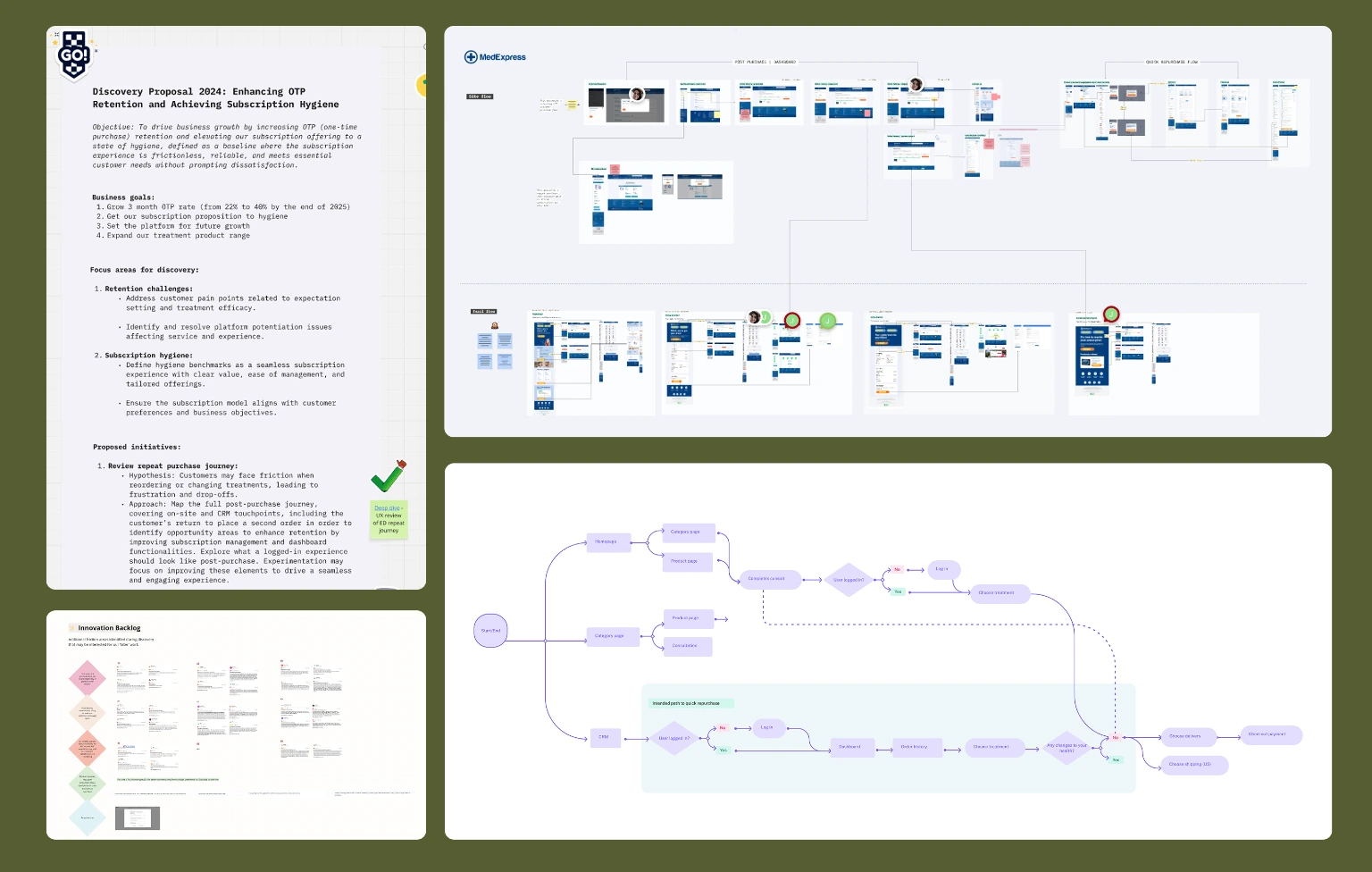
Discovery workshops, service blueprints and prioritisation frameworks used to align across clinical, commercial and product
Balancing convenience with clinical safety
Healthcare products require a different definition of simplicity.
Every opportunity to reduce friction was considered alongside clinical governance, safeguarding requirements and operational constraints. Working closely with Clinical Operations, we identified where automation could improve the experience and where human intervention remained essential.
Rather than removing every step, the goal was to remove the unnecessary ones while preserving the safeguards that protected patients.
This thinking shaped decision-making across subscriptions, treatment progression, check-ins and repeat prescribing.
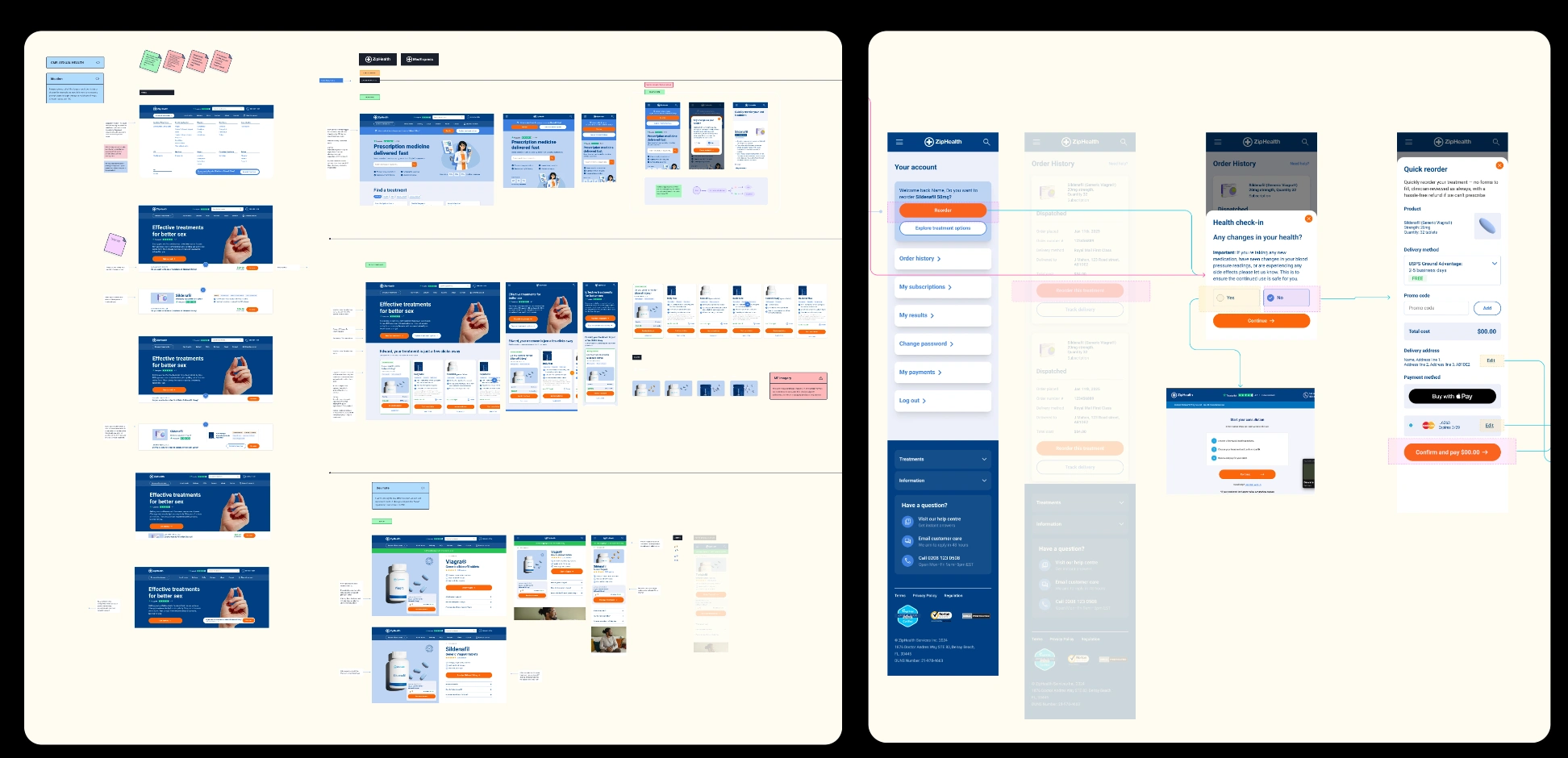
Designing a clinically safe repurchase pathway by reducing unnecessary friction while maintaining appropriate clinical oversight.
Bringing the experience together
The result wasn’t a single feature. It was a connected healthcare service.
Across multiple releases we introduced reusable patterns for onboarding, subscriptions, treatment management, patient dashboards, order tracking and ongoing support that could scale across different treatments and brands.
By thinking beyond individual projects, the work established foundations that reduced future design effort while creating a more predictable experience for patients throughout treatment.
Impact
The final solution transformed repurchasing from a fragmented, high-friction experience into a streamlined, clinically appropriate pathway for eligible returning patients. By combining behavioural insight, product thinking and close collaboration with Clinical Operations, we reduced unnecessary effort while maintaining patient safety and regulatory compliance.
Redesigned the repurchase experience from a fragmented 10-screen journey into a streamlined two-click flow for clinically eligible patients.
+3.98% Repurchase completion
A clearer route back into treatment increased successful repurchases for eligible returning patients.
+16.3% Checkout progression
Reducing friction within the reorder flow helped more patients complete their purchase without compromising clinical safeguards.
≈ £200k annual contribution
The improvement delivered measurable commercial value while establishing reusable patterns that informed future treatment journeys.
0 clinical escalations
The redesigned pathway maintained appropriate clinical oversight throughout the experiment, demonstrating that convenience and patient safety can successfully coexist.
Reflection
One of the biggest lessons from leading this work was that designing for healthcare means designing relationships, not transactions.
The most valuable products aren’t simply those that help people complete a task they’re the ones that build confidence, support better decisions and help patients stay engaged over time.
Leading across multiple squads reinforced that great healthcare products emerge through collaboration. Every decision required balancing patient needs, clinical safety and commercial objectives, often with competing priorities and incomplete information.
More than anything, it changed how I think about product design. The greatest opportunities often aren’t found in launching new features, but in creating connected services that help people achieve better outcomes over the long term.
You can find a more detailed case study here
Role: Lead Product Designer // Focus: Product Strategy, Behaviour Change, Healthcare UX, UX Research, Service Design & Cross-functional Leadership
Like this project
Posted Jan 5, 2024
Role: Lead Product Designer // Focus: Product Strategy, Service Design, Behaviour Change, Clinical Collaboration & Design Leadership