
Client: Nemat (Startup)
Product: Food, groceries and salon bookings from places on your street
Market: Pakistan
Role: Brand identity, product design for six surfaces, design system in code
Scope: 186 screens planned, 171 designed, one component package
Year: 2026
Status (19 Nov 2026): Web apps coded and working · iOS build in progress
The Setup
Nemat is a local commerce start-up launching in Jhelum, Pakistan. It sells food, groceries and appointments at salons and parlours, from places a customer could walk to. The name means "a blessing", and the brand rests on two lines: rates shops can see, and pay riders can see.
Nemat started as a plan, and a thorough one. The implementation specification runs to 45 documents, an OpenAPI file with 697 operations, 22 database migrations and a 309-screen inventory, plus founder decisions on everything from commission to how a rider gets paid. When the design work began, its own status page was blunt: no app built, nothing deployed. The plan described a whole company. Nobody could yet see it, tap it or build from it.
The Tension
The plan was complete. The product didn't exist.
The brand story puts the brief in one sentence: every order passes through three hands. The shop makes it, the rider carries it, the customer receives it. If any one of them is short-changed, the order is not a blessing for anyone.
A specification can say that. Only screens can prove it. The promises that make Nemat different live in four separate apps: riders keep 100% of the delivery fee and tip, cash on delivery is first-class, the platform fee is never hidden, and every rate, timer and limit is set by admins rather than hard-coded. A customer app on its own would look like a product while hiding all of that.
The risk was a polished customer prototype sitting on top of an operation nobody had designed. Engineers would then invent the rider, merchant and admin flows themselves, and the fairness the brand is built on would leak out in the gaps.
The Decision
The obvious move was to design the customer app first and leave the rest for later. I went a different direction: turn the plan into a screen plan for every user, ship the screens in waves where each wave covers all four sides of an order, and put the design system into code before the apps exist.
One plan, one library. The first board is a screen plan, not a screen. Every artboard after it is built only from one component library and one rules board. Anything new is proposed as a component first. That kept 171 screens across six surfaces looking like one product.
Waves by business stage, not by app. Wave 0 is foundations. Wave 1 is "Jhelum food + cash", end to end. Wave 2 adds grocery, salons, Car hop and Nemat Pro. Wave 3 is growth. Wave 4 is new cities. Every wave carries screens for every user it touches, so no wave ships a customer feature that ops can't support.
Exit criteria on every wave. Wave 1 is done only when a first-time customer can order and pay cash in Jhelum with no help, a rider can sign up, deliver and deposit cash that reconciles to the rupee, a restaurant can onboard itself, and ops can see every live order, reassign a rider and refund from one admin.
The plan's rules written into every screen. The platform fee always has its own line. Rider pay is fee plus tip, with "Nemat takes Rs 0". Cash to collect is the loudest line on a job offer. No delivery-time promise outside the live ETA. Removals use bin and Undo, never "Are you sure?". These are hard rules on the plan board, so they hold on every screen.
Benchmark, then differ on purpose. I studied 26 screenshots from DoorDash, foodpanda, talabat and Snoonu. Where all four agree on structure, Nemat follows. Where they hide fees or rider pay, Nemat shows them. talabat's orange and brown sit close to Nemat's palette, so Neel and the "never Neel on orange" rule keep the two apart.
Design system as a package, not a PDF.
@nemat/ui is one token source that generates CSS, SwiftUI and Jetpack Compose values, 56 React component exports, and 16 JSON Schema contracts with example payloads, so front-end, mobile and backend engineers start from the same parts.The brief I wrote for myself: the rider and the shop should be able to read the same rupee the customer pays.
The MVP, surface by surface
Wave 1 is the MVP: 109 screens, 102 of them designed. The seven still open are all public website pages, which stay parked until the apps are ready. Waves 2 to 4 are designed ahead, so engineering can see where each Wave 1 decision leads.
The screens didn't stay on the canvas. As of 19 November 2026 the web apps are coded and working, built from these designs and the
@nemat/ui parts, and the iOS app is being built now.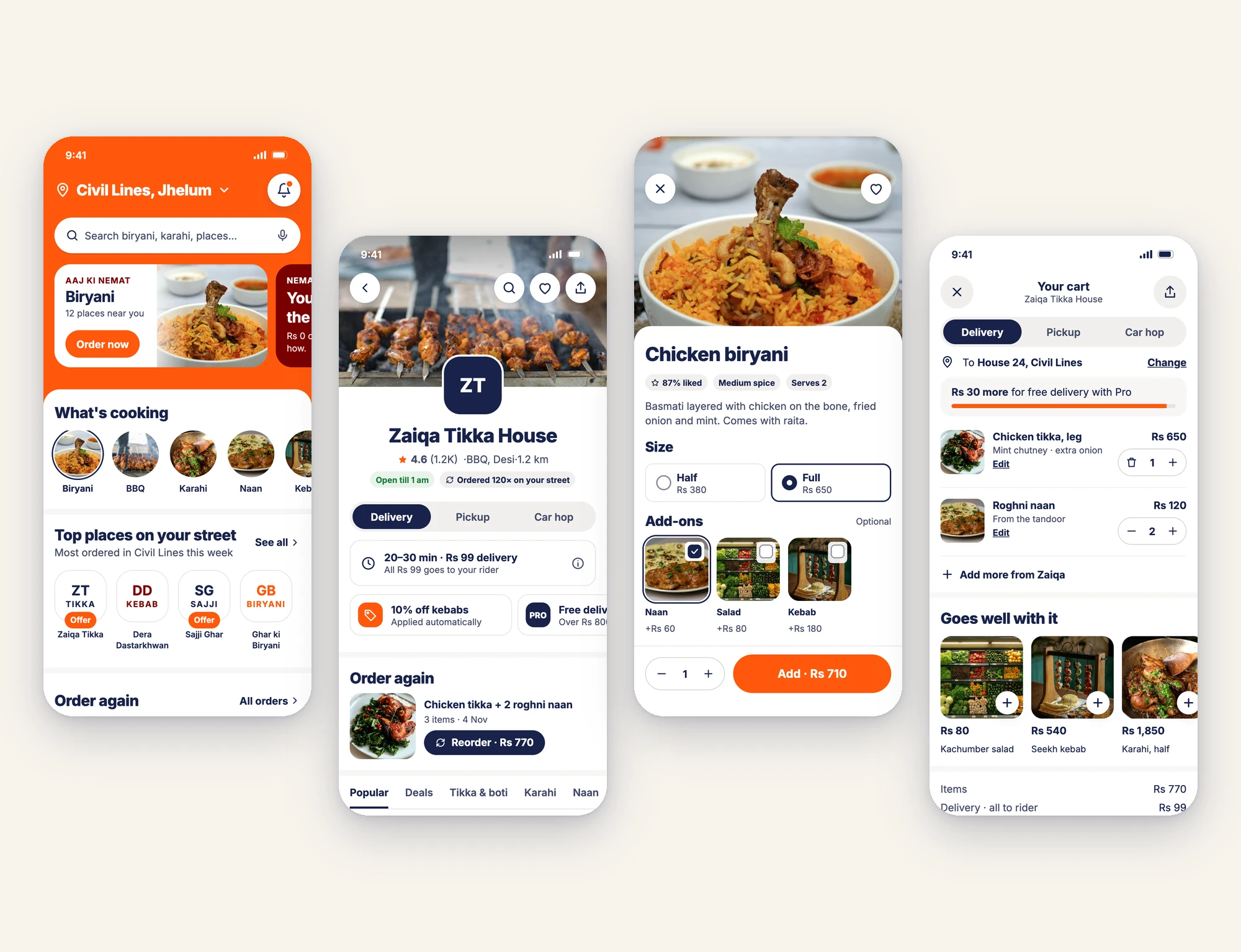
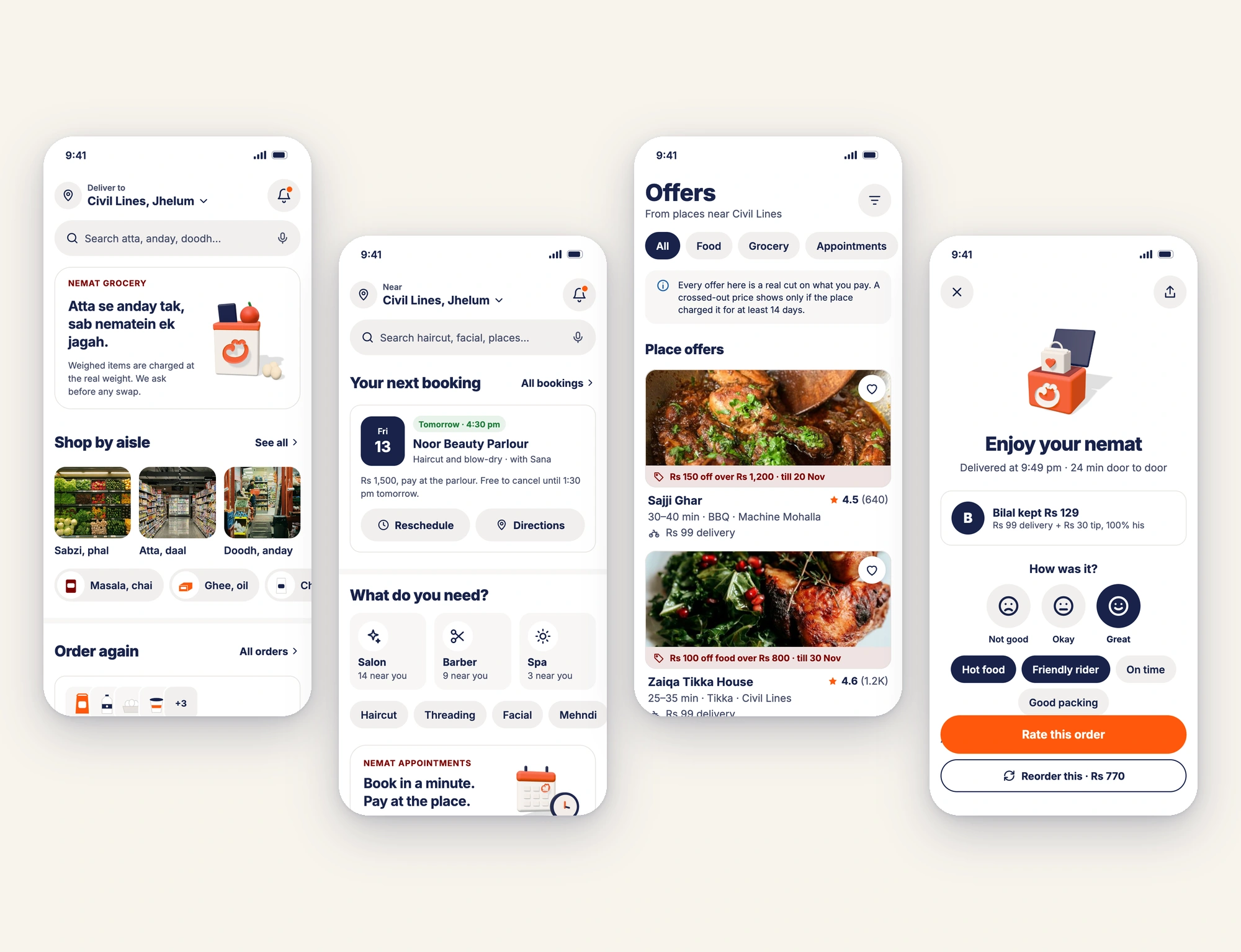
Customer app · iOS · 70 screens
The full ordering path: splash, delivery address, food home, a place's menu, item sheet, cart, checkout, a calm five-second final check, live tracking and "delivered". Around it sit the screens that make an MVP real rather than a demo: phone sign-in only at checkout, wallet pending, payment failed, order changed, report a problem, refund status, support chat, language, accessibility and account deletion for the app stores. Later waves add grocery aisles with live substitution approval, salon booking, reschedule and no-show, Car hop, Raast payments, Nemat Pro, vouchers, referrals, favourites, scheduled reorders, family profiles and a city switcher.
Customer app · Android · 12 screens
The same flows in Material 3, plus what Android does differently: sign-in with SMS code autofill, switching out to a JazzCash or Easypaisa wallet app and back, live update notifications, a data-saver mode, a home-screen widget, app shortcuts, and a pass at small 360×640 screens.
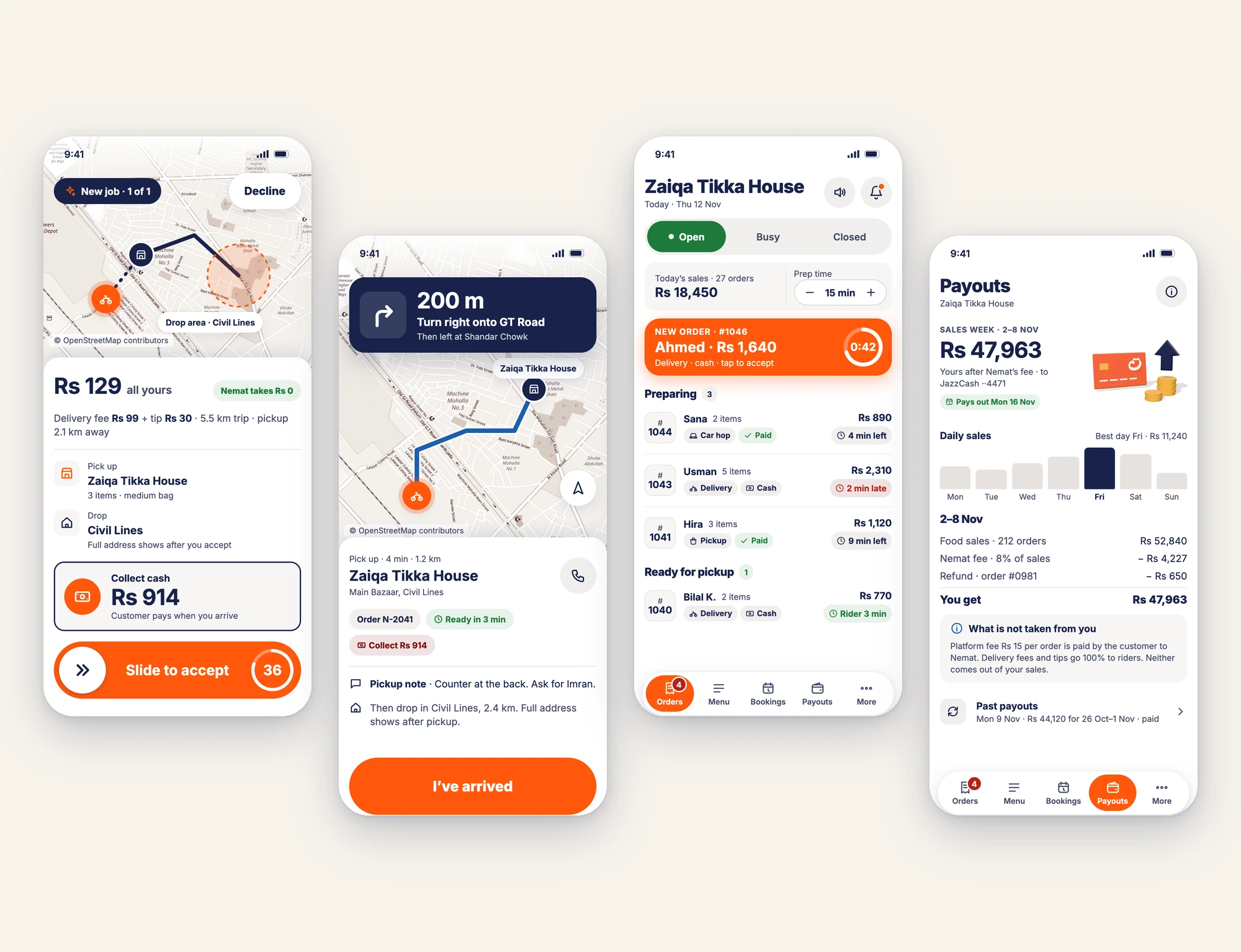
Rider app · 29 screens
Android first, on a white ground with 88px glove-sized buttons. Sign-up, documents and KYC, application status and kit training lead into the working day: go online, a job offer you slide to accept, navigation to the place, a pickup checklist with proof, navigation to the customer, collect cash, "cannot deliver", and delivery done with pay shown as fee plus tip. A cash-in-hand meter tracks each rider against a Rs 15,000 limit, with deposits, earnings, payouts, SOS, support, shifts, busy zones, incentives and ratings around it.
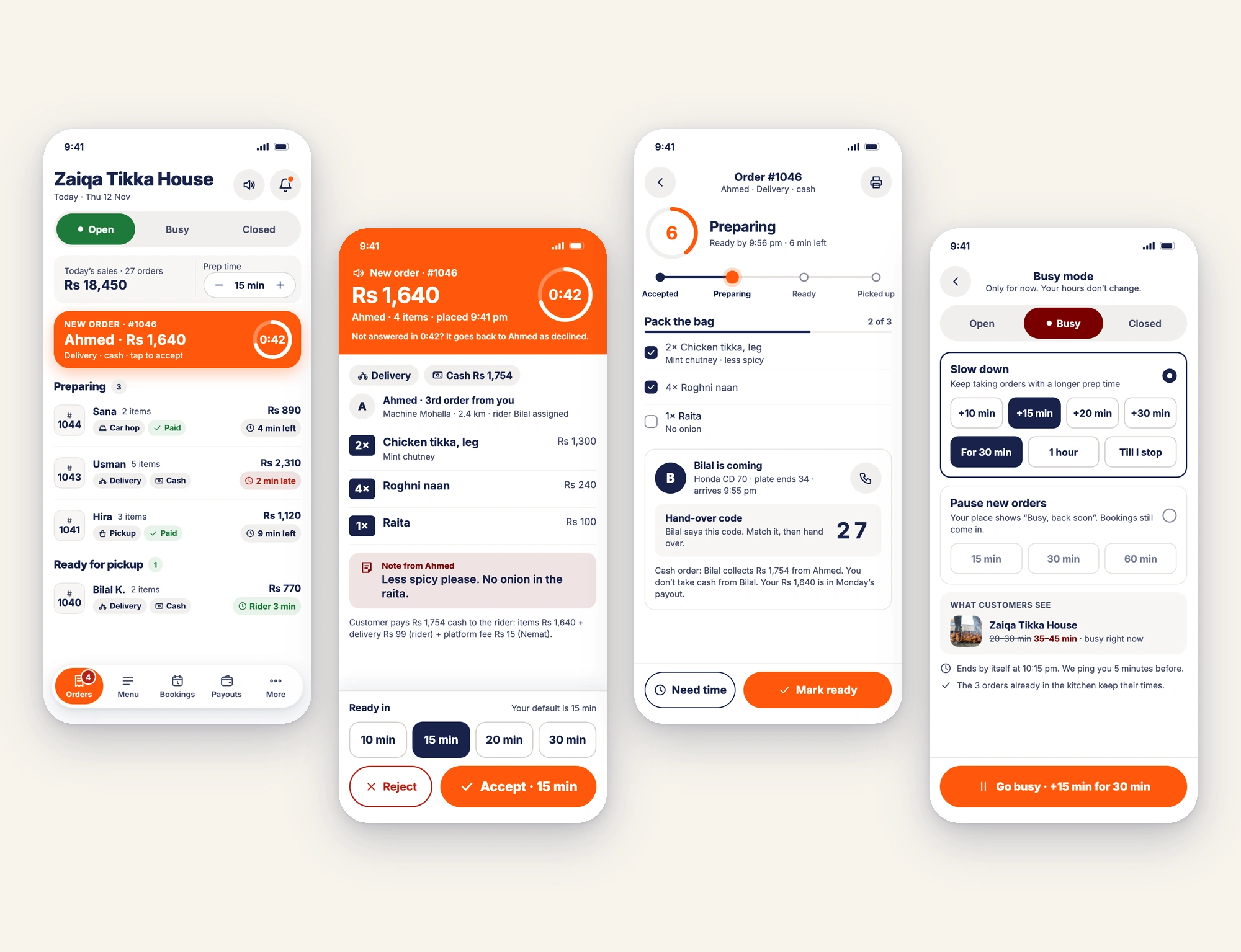
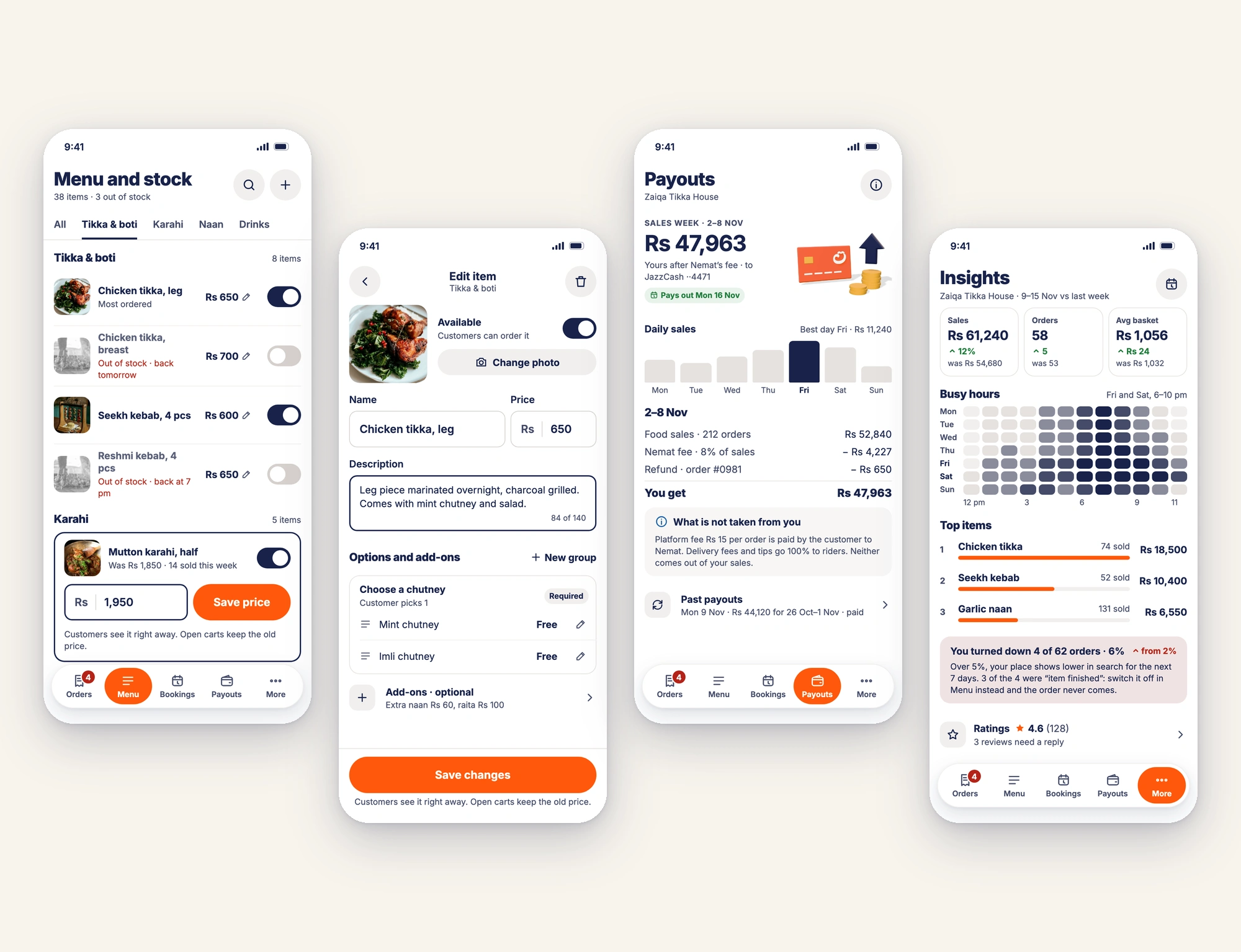
Merchant app · 32 screens
"Nemat for places", on phone and tablet. A place signs itself up, adds business details and KYC, builds its menu and hours, then runs the day: a live queue, accept with a prep time or reject with a reason, preparing to ready with a hand-over code, busy mode and out-of-stock. A tablet kitchen board shows New, Preparing and Ready columns with timers and customer notes. Later waves add grocery catalogue import, picking lists and substitutions, salon services and staff schedules, Car hop handover, reviews, promotions, insights, branches, POS and printer setup, and tax invoices.
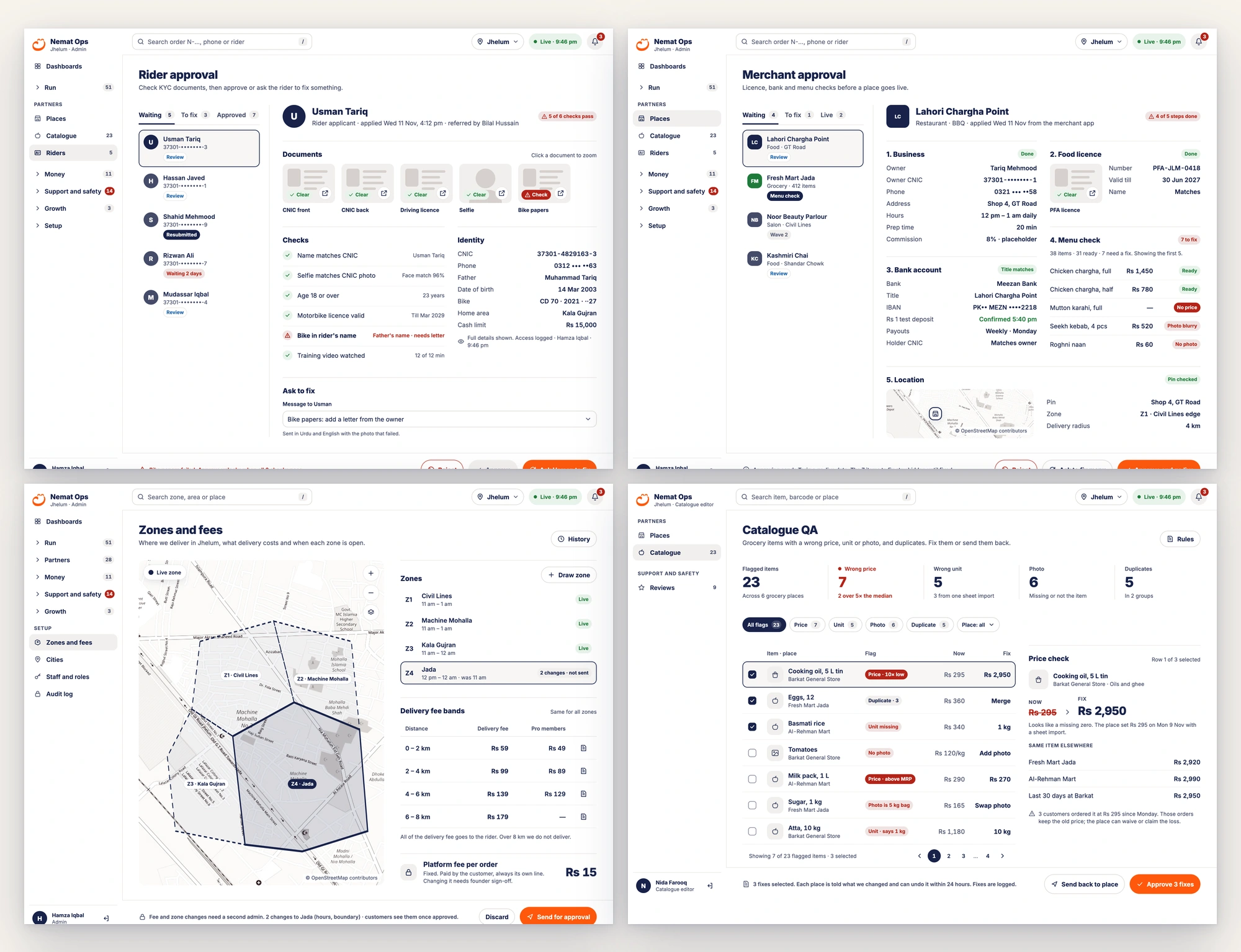
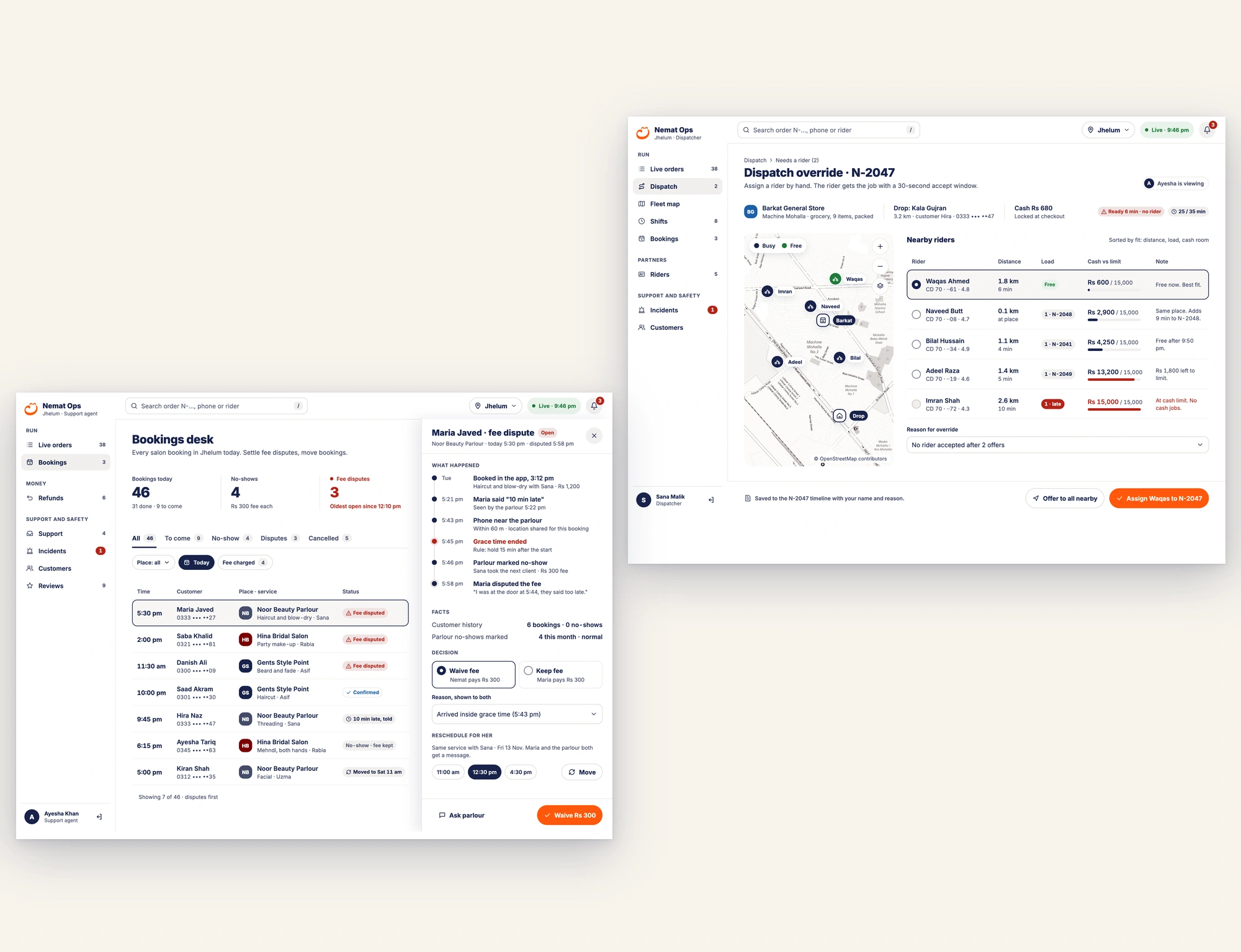
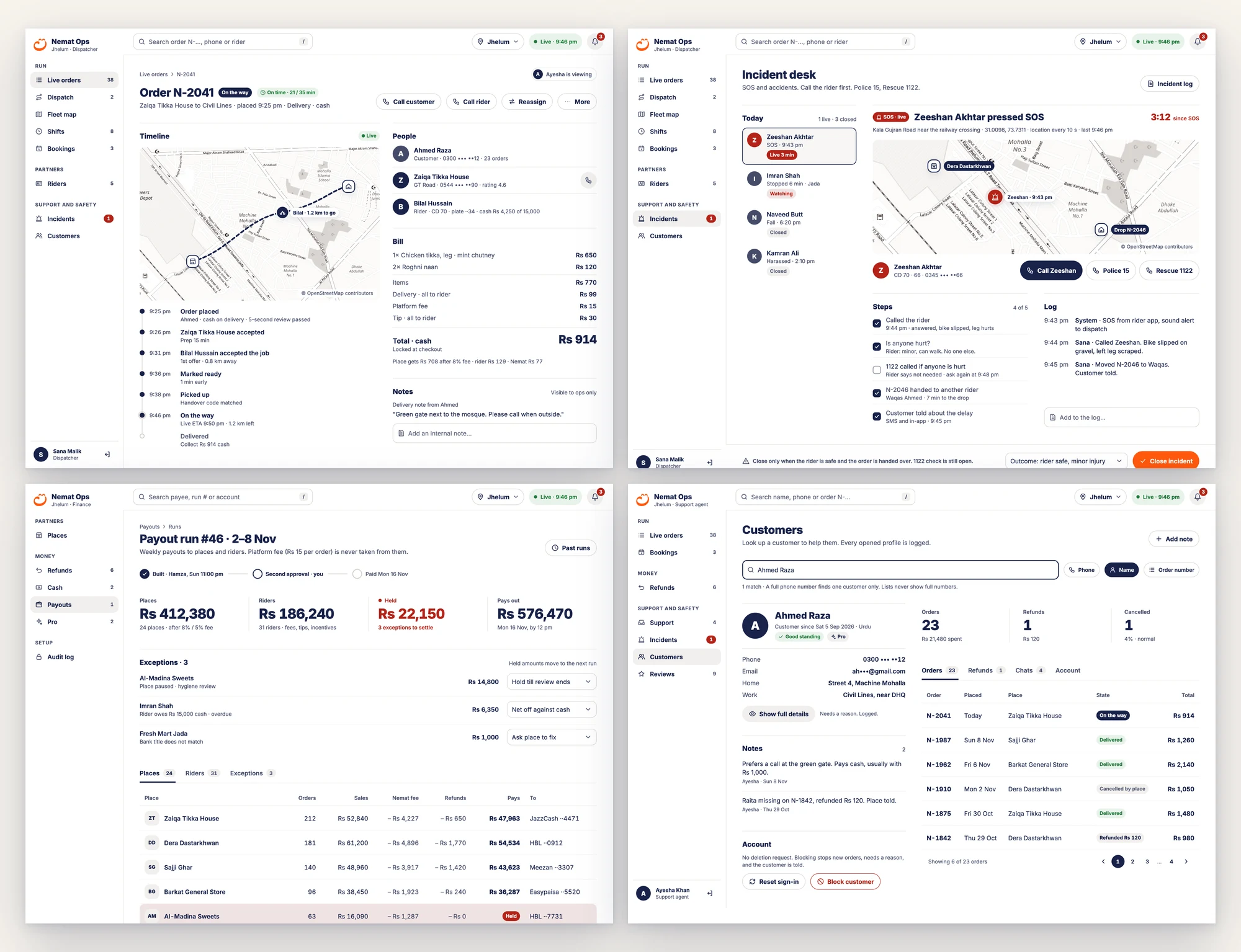
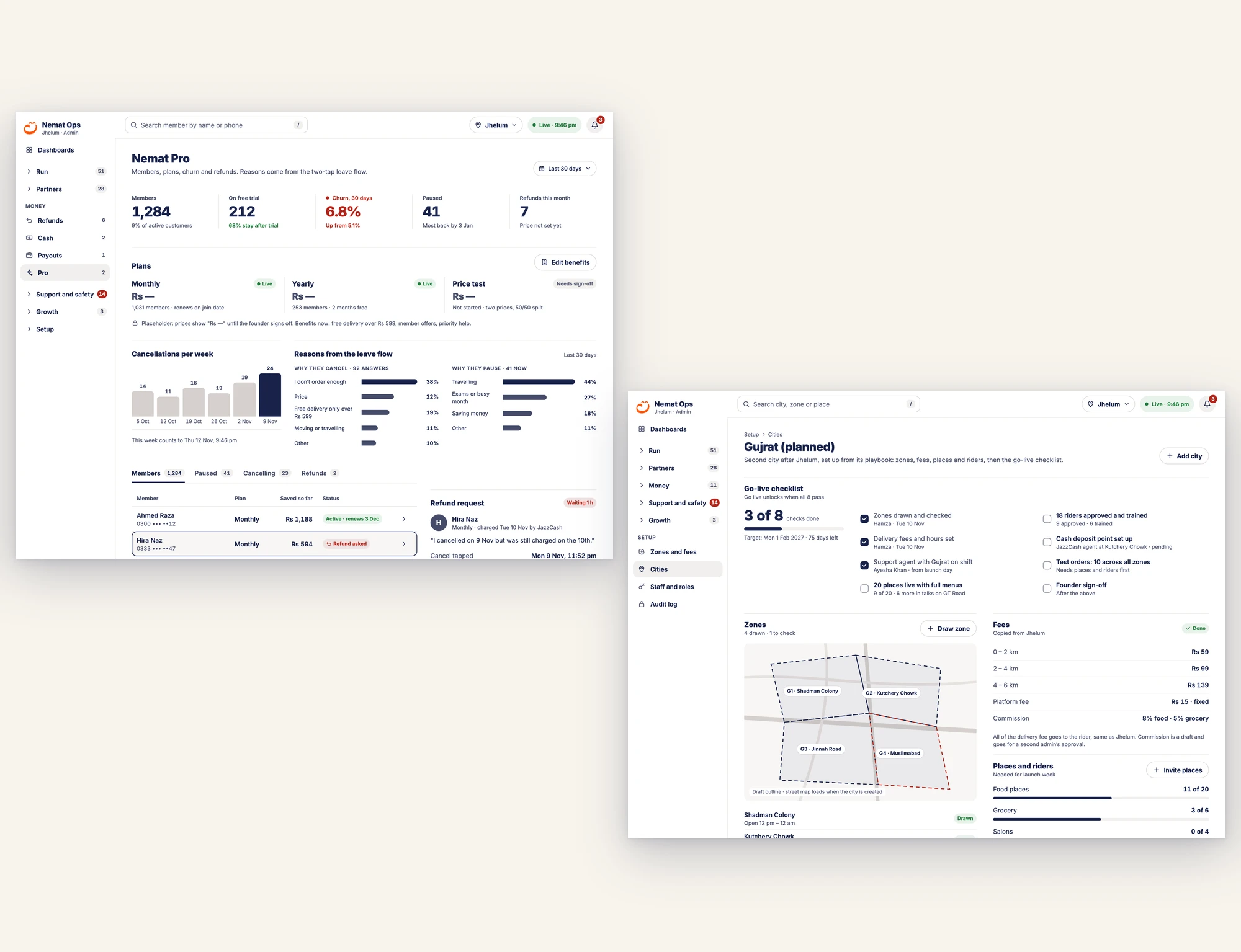
Nemat Ops · admin web app · 26 screens
The internal desktop tool at 1440px, where the business actually runs. Sign-in uses a work email, a 6-digit code and an authenticator. Each role sees only what it needs: Agent, Dispatcher, Finance or Admin. Phones and CNIC numbers are masked in every list, opening full details is logged, and nobody can approve their own payout run.
Live operations | Live orders, with late orders floating to the top · order detail with timeline · dispatch override with a 30-second accept window · fleet map with zones and rider cash in hand · incident desk for SOS and accidents
Partners | Rider approval with KYC checks · merchant approval with licence, bank and menu checks · places directory
Money | Refunds queue with evidence and who pays · cash reconciliation of rider cash against deposits · weekly payout runs that need two approvals · zones and delivery fees
Customers and support | Support inbox across customers, riders and places · customer lookup where every opened profile is logged
Verticals | Bookings desk for salon no-show disputes · catalogue QA for wrong prices, units, photos and duplicates · Nemat Pro membership admin
Growth | Rider shift planner against forecast demand · vouchers with budgets and caps · referral fraud clusters · a two-language push composer with quiet hours · review moderation
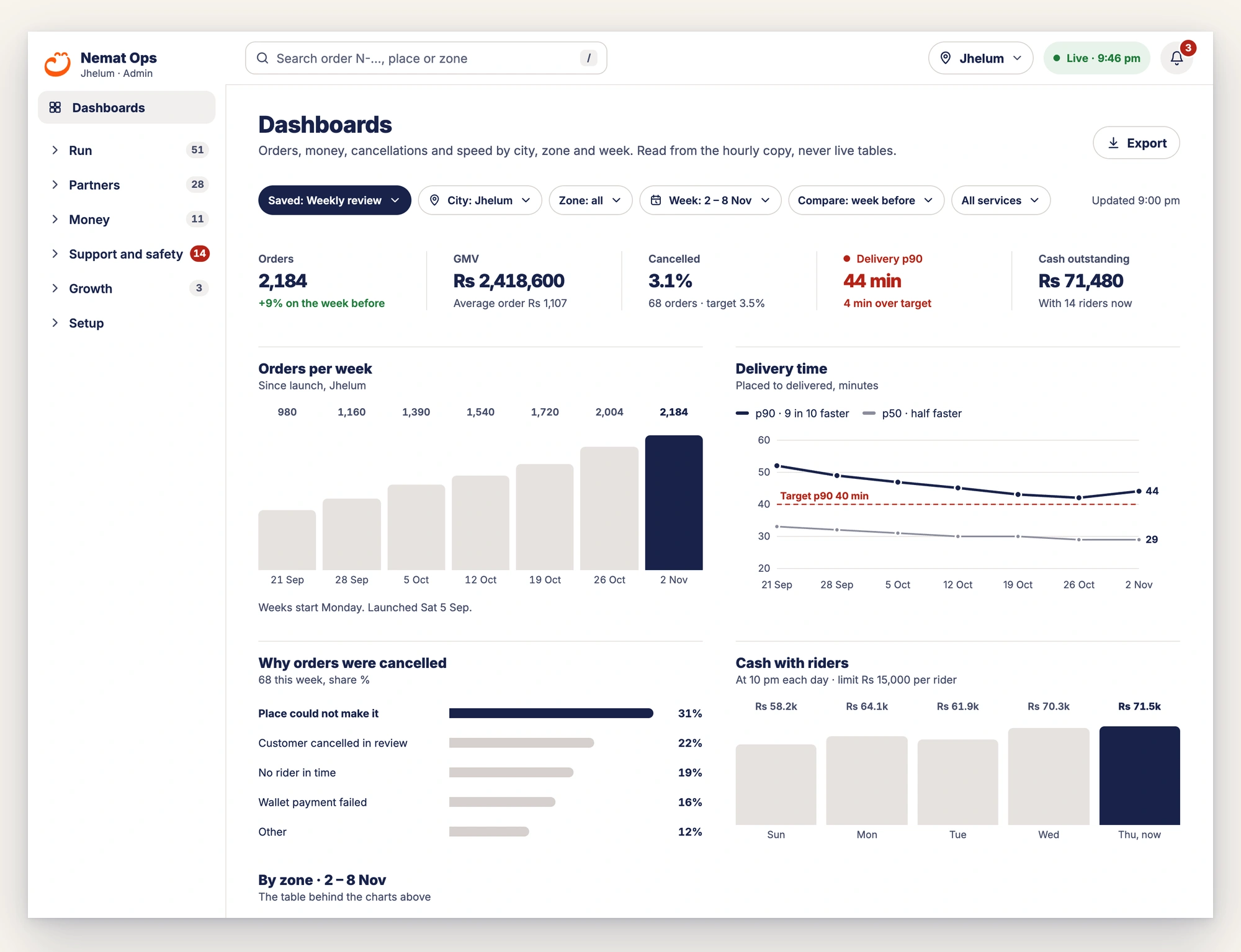
Scale | City setup that opens a new city from the Jhelum playbook · dashboards by city, zone and week · audit log and permissions
The tour walks through six of these: live orders, dispatch override, fleet map, bookings desk, order detail and dashboards.
The website exists to send people to the apps. The home page leads with "Sab nematein, ek jagah" and an area check. A place page shows the menu with a QR code and an "Open in app" button, because ordering stays in the app, where the rider, the total and the order status live together. The other 15 website pages are planned, not designed.
The Build
Status | Web apps coded and working · iOS build in progress (19 Nov 2026)
Screens | 186 planned, 171 designed (92%)
By surface | iOS 70 · Android 12 · Rider 29 · Merchant 32 · Ops admin 26 · Website 2 of 17
By wave | Wave 0 foundations 2 of 2 · Wave 1 launch 102 of 109 · Wave 2 verticals 34 of 37 · Wave 3 growth 21 of 24 · Wave 4 scale 12 of 14
System boards | 13: screen plan, component library, rules, handoff, benchmark, 3D illustration language (24 scenes), screen waves, overlays, menus, navigation and forms, rider and merchant parts, ops admin parts, states
Code |
@nemat/ui 1.0: 56 React component exports, one token file generating CSS, NematTokens.swift and NematTokens.kt, 16 JSON Schema contracts with example payloads and a validatorDevices | iOS 390×844, Android 412×915 and 360×640, tablet 1280×800, desktop 1440
Rules | 4-pt spacing · radii 6 / 12 / 16 / 24 / full · type from 34 to 12, nothing smaller · one primary action per screen, in thumb reach · never Neel on orange
Brand | Nemat Orange #FF580D · Neel #18224A · Anaar #7A0000 · Roti Cream #F3EDE3 · a wordmark whose two dots are smiling eyes
Plan it serves | 45 specification documents · 697 API operations · 22 database migrations · 309-screen inventory across every release
The Impact
Before this project, Nemat was a specification and a brand story. After it, Nemat is a working MVP. The web apps run, the iOS app is in build, and every screen a customer, rider, place and staff member needs to run one order in Jhelum with cash is designed, with three more waves ready behind it. Engineering built from a finished screen plan and a component package, not from a brief.
Engineering doesn't have to guess any part of the operation. Every Wave 1 order state has a screen, including the unhappy ones: failed payment, cancelled, delayed and refunded. Every money action in the customer app has a matching screen in ops, so the refund a customer asks for is the refund an agent decides in the queue. The designs also fed back into the plan: the specification adopted the brand and component library as its source of truth, and took on five features that first appeared on the canvas, including family profiles, a tip after delivery and a Pro free trial.
The hardest part wasn't the number of screens. It was keeping one promise identical on every side of the order. A rider's "Nemat takes Rs 0", a shop's commission line and a customer's separate platform fee all describe the same rupees, so they had to come from one rule, not from six apps remembering it differently.
As of 19 November 2026 the web apps are coded and working and the iOS build is in progress, so there are no launch metrics yet. The screens in this case study use sample data: order counts, sales and member numbers on screen are placeholders, not results. Commission figures in the designs are drafts that still need to match the founder's rate card, and the Nemat Pro price is not set. Once Wave 1 ships, the numbers to track are first orders completed without help, cash reconciled to the rupee each day, time from a place signing up to going live, and how often ops has to step into a live order.
The Takeaway
An MVP is not the smallest customer app. It is the smallest version of the whole operation.
Design every side of one order before polishing any one of them.
0 likes · 0 views · Nov 18, 2026
Nemat was a specification and a brand story. After it, Nemat is a working MVP. The web apps run, the iOS app is in build, and every screen a customer, rider nee


