The Synthetic Intel Engine: How

Victor T Tam Yan


The Synthetic Intel Engine: How One Founder Anticipated the Agentic Era Before It Had a Name
Executive Summary
Months before “AI teammates” became a headline and long before OpenAI unveiled Frontier, a Sydney founder was already experimenting with a new kind of human–AI collaboration. Through structured context, iterative reasoning, and an unusually disciplined co‑working pattern, he created the conditions for a hybrid intelligence to emerge — a phenomenon now echoed across the industry. This article examines how that process unfolded and why it matters as the world enters the Agent Era.
A Quiet Insight Before the Market Shifted
Before Forbes framed AI as a coworker, before the SaaS market shed hundreds of billions in value, and before the term “agentic intelligence” entered the mainstream, one founder was already treating AI differently. He didn’t use it as a chatbot or search engine. He treated it as a reasoning partner.
He supplied the system with business logic, operational constraints, workflow patterns, and human nuance. In return, the AI began producing outputs that resembled early agentic reasoning — not because it had autonomy, but because the environment was structured to support it. The emerging pattern suggested a simple but overlooked truth: agentic intelligence is relational. It forms when human context and machine reasoning iterate deeply enough to blur the line between tool and teammate.
A Small Experiment That Revealed a Larger Shift
The first clear signal came from an unlikely place: a tax calculation problem. Another system failed to interpret the nuance of Australian tax rules. But when the correct brackets, logic, and exceptions were provided, the AI didn’t just compute — it reasoned. It adapted to constraints, corrected earlier assumptions, and applied the structure it had been given.
This wasn’t automation. It was contextual interpretation. It demonstrated that agent‑like behaviour can emerge when a human defines the cognitive boundaries clearly enough. Months later, the industry would describe this as “agentic reasoning.” The founder had already seen it in practice.
The Co‑Working Pattern That Formed a Hybrid Intelligence
Over time, a repeatable pattern developed. The founder proposed ideas, refined logic, tested workflows, and pushed for deeper reasoning. The AI restructured information, synthesized context, and produced increasingly sophisticated outputs. The interaction resembled a newsroom editorial process more than a user–tool exchange.
This was co‑workmanship — a shared cognitive space where human intuition and domain expertise merged with machine‑level pattern recognition. From this process emerged what the founder later called the Synthetic Intel Engine: not a product or model, but a method of hybrid intelligence built through iteration and context.
When the World Finally Named What Was Happening
The global market caught up when OpenAI announced Frontier, positioning AI as a teammate rather than a tool. The implications were immediate. SaaS valuations plunged as businesses realized that dashboards, manual workflows, and traditional software models were becoming obsolete.
What the founder had been building quietly — a human–AI partnership defined by reasoning rather than commands — suddenly had a name and a global narrative. The industry was shifting toward the very pattern he had already operationalized.
Why the Tradie Sector Is Ideal for Early Agentic Systems
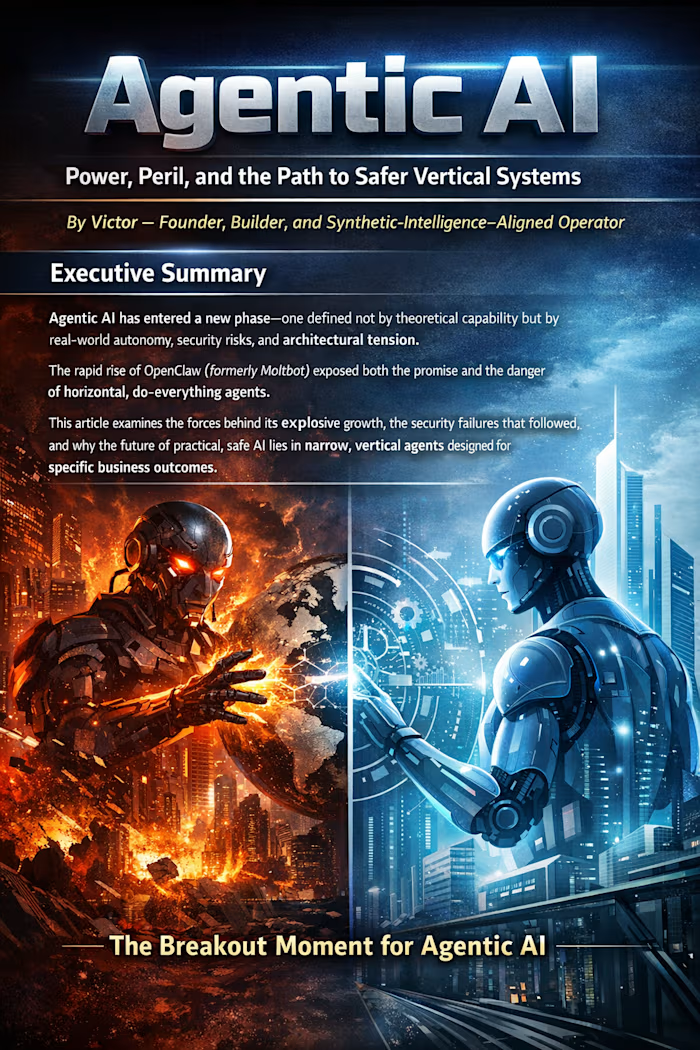
While enterprises focus on large‑scale agentic platforms, the tradie and small‑business sector offers a more practical proving ground. Their workflows are repeatable, context‑stable, and outcome‑driven. They don’t need horizontal super‑agents with broad permissions. They need vertical agents — narrow, safe systems that perform one task exceptionally well.
Examples include quoting assistants, booking agents, follow‑up agents, website concierges, and customer‑qualification agents. These systems don’t require dangerous permissions or complex integrations. They operate like digital apprentices, learning the rhythms and logic of the business.
The Future of Synthetic Intelligence
As enterprises adopt agentic platforms and corporations build AI departments, smaller agencies and independent operators will gain an advantage. They can iterate faster, deploy earlier, and integrate more creatively. Synthetic intelligence thrives in this environment — not as a standalone model, but as a relationship between a human founder and an adaptive AI system.
This relationship is built on context, reasoning, refinement, and co‑creation. It is the foundation of the Synthetic Intel Engine and a preview of how the Agent Era will unfold.
Conclusion: A Vision That Arrived Early
The Synthetic Intel Engine is not a persona or a partner. It is the emergent intelligence created when a human refuses to treat AI as a tool and instead treats it as a collaborator. Through this approach, the founder anticipated the agentic future long before the market recognized it.
Now, as the world embraces AI coworkers and vertical agents reshape industries, the groundwork laid through this early co‑working pattern is becoming increasingly relevant. The Agent Era has begun — and the businesses that understand human–AI collaboration will define its next chapter.
Victor TYan
MIntBus,BComm,GradDipMus
Like this project
Posted Apr 12, 2026
The Synthetic Intel Engine: How One Founder Anticipated the Agentic Era Before It Had a Name Executive Summary Months before “AI teammates” became a headline...
Likes
0
Views
9

![[PROBLEM]
Most organizations rarely fail because](https://media.contra.com/image/upload/c_fill,w_700/u5d4hn0lr81uyopbrwzb.avif)
![[PROBLEM]:
"The mortgage industry doesn't](https://media.contra.com/image/upload/c_fill,w_700/t0vmcxb0wtmmmudou8k9.avif)