
Content and compliance chain, sample data
The situation
A casino affiliate site in a regulated market, with about 600 pages: casino reviews, bonus pages, payment method guides and "best casinos" lists. The site earns money when readers sign up at a casino through its links, so every lost position in Google costs money directly. Traffic had been flat for a year while two competitors kept growing. The team publishes a lot, but nobody could say what was holding the site back or what to do first.
What they needed
One person who could look at the whole site and answer three questions: why aren't we growing, what should we fix first, and how do we keep it running? Then the plan carried out, with the team able to keep going afterwards.
What I did, step by step
1. Site analysis: where are we now?
I started with the data: which pages bring visitors and sign-ups, which searches they rank for, and how that changed over the last 12 months (Google Search Console plus the rank tracker). That shows where the site is strong, where it's slipping, and which pages are worth the most money.
2. Technical audit: can Google read the site properly?
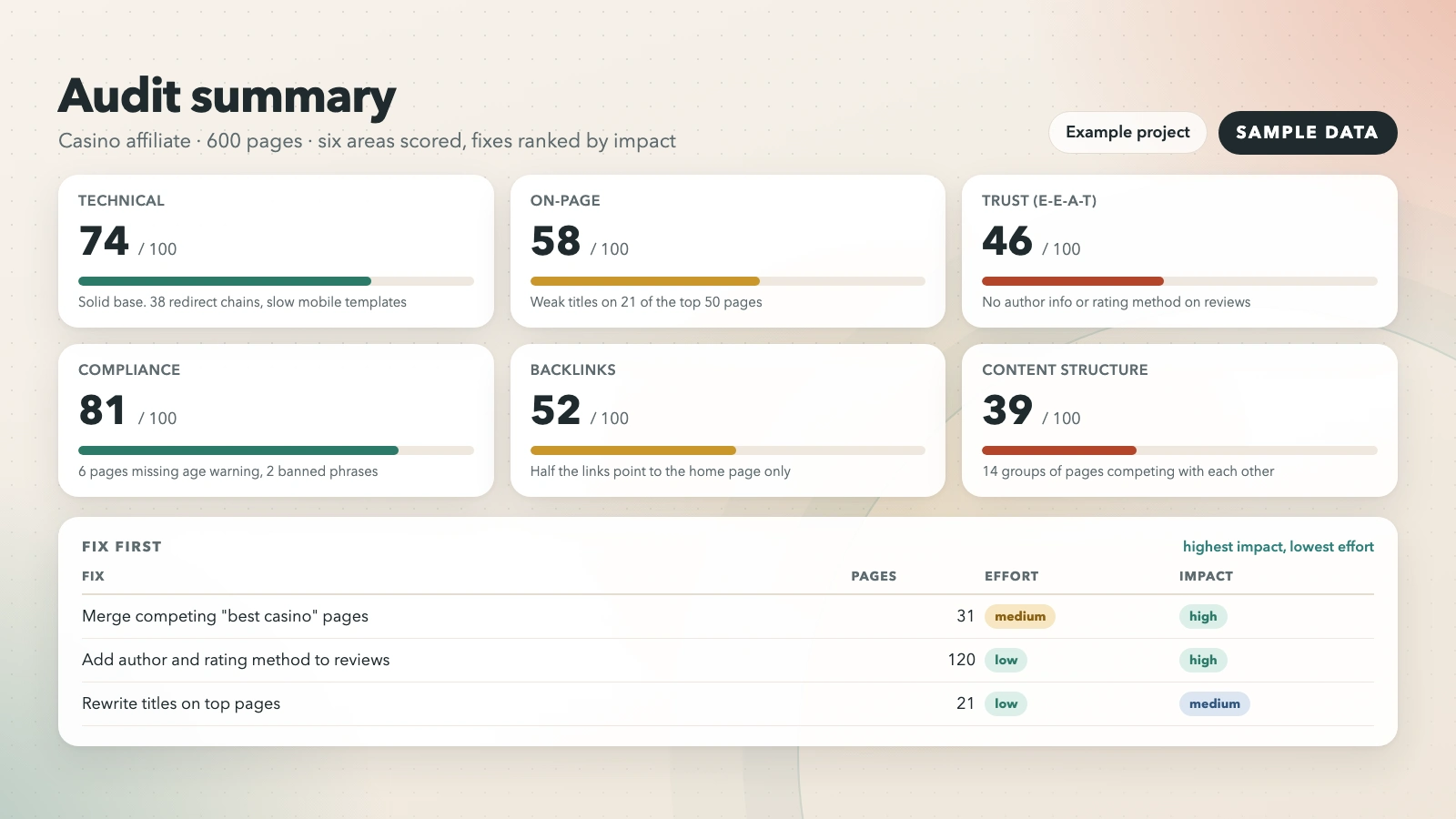
I had Claude crawl every page the way Google does. It checked for pages Google can't reach or isn't storing, broken links and redirect chains, duplicate pages, slow pages on mobile, and errors in the structured data (the code that gives results star ratings). Each problem got a priority based on how many valuable pages it affects.
3. On-page audit: does each page answer the search well?
For the 50 most valuable pages: is the title strong and the right length, does the page answer the question in its first lines, are the headings clear, is the information complete, is it up to date? Pages are scored and get a short fix list each.
4. Trust and expertise check (E-E-A-T)
Google is strict about gambling content. I checked whether reviews show real testing, name an author with relevant experience, explain how casinos are rated, and back up claims with sources. These are the signals Google uses to decide whether a gambling site can be trusted.
5. Compliance check
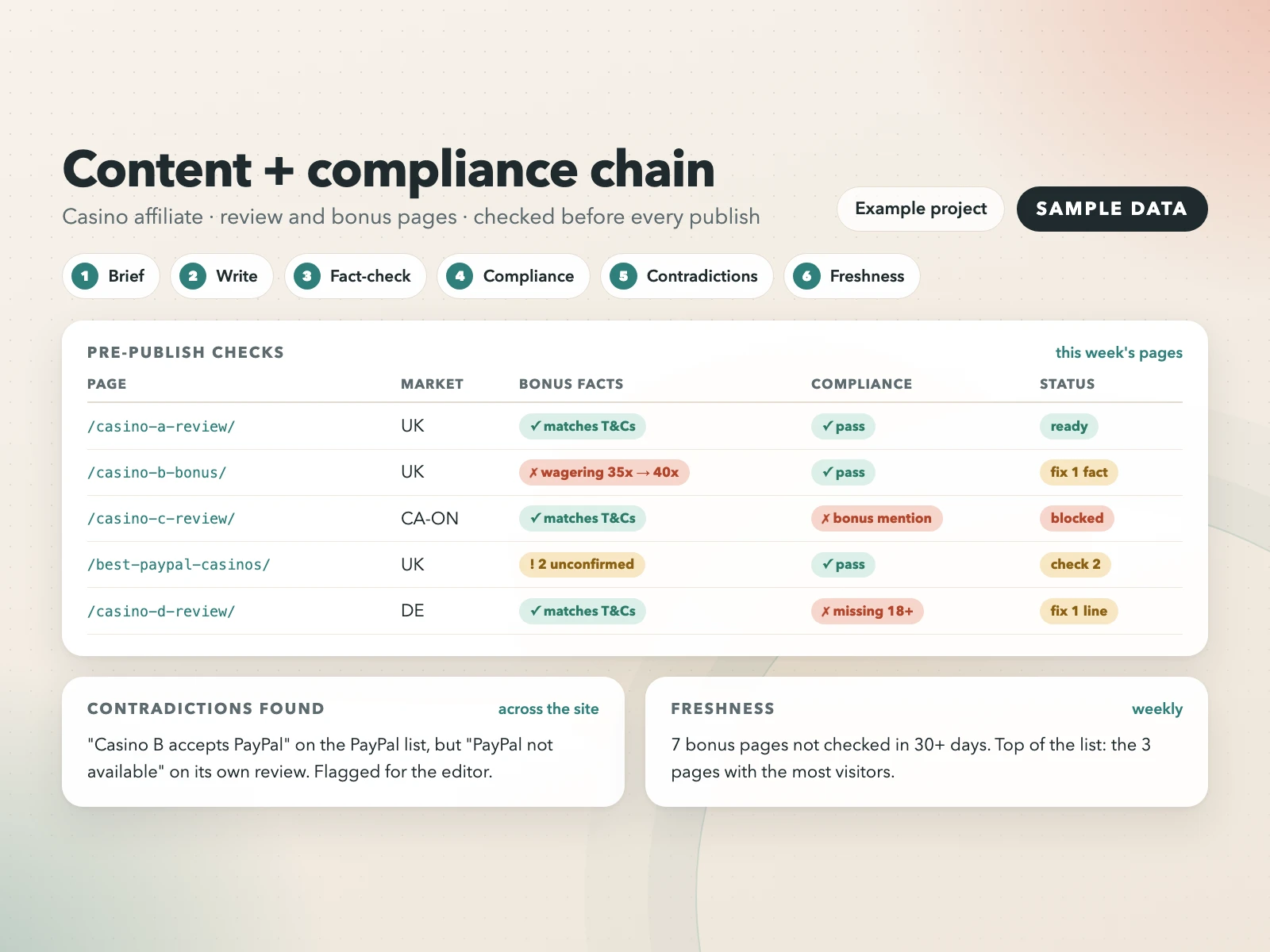
Every market has its own advertising rules for gambling. Claude checked each page for forbidden phrases ("risk-free", "guaranteed win"), missing age and responsible gambling warnings, and bonus mentions where they aren't allowed. One compliance mistake can cost a partnership with a casino, so this runs before anything else gets published.
Audit summary, sample data
6. Off-page audit: who links to the site?
Links from other websites are still one of Google's strongest signals. I analyzed the site's backlink profile: how many sites link to it, how trustworthy they are, which pages they point to, and whether there are risky links that could hurt. Then I compared it with the competitors.
7. Competitor benchmark: what are the winners doing differently?
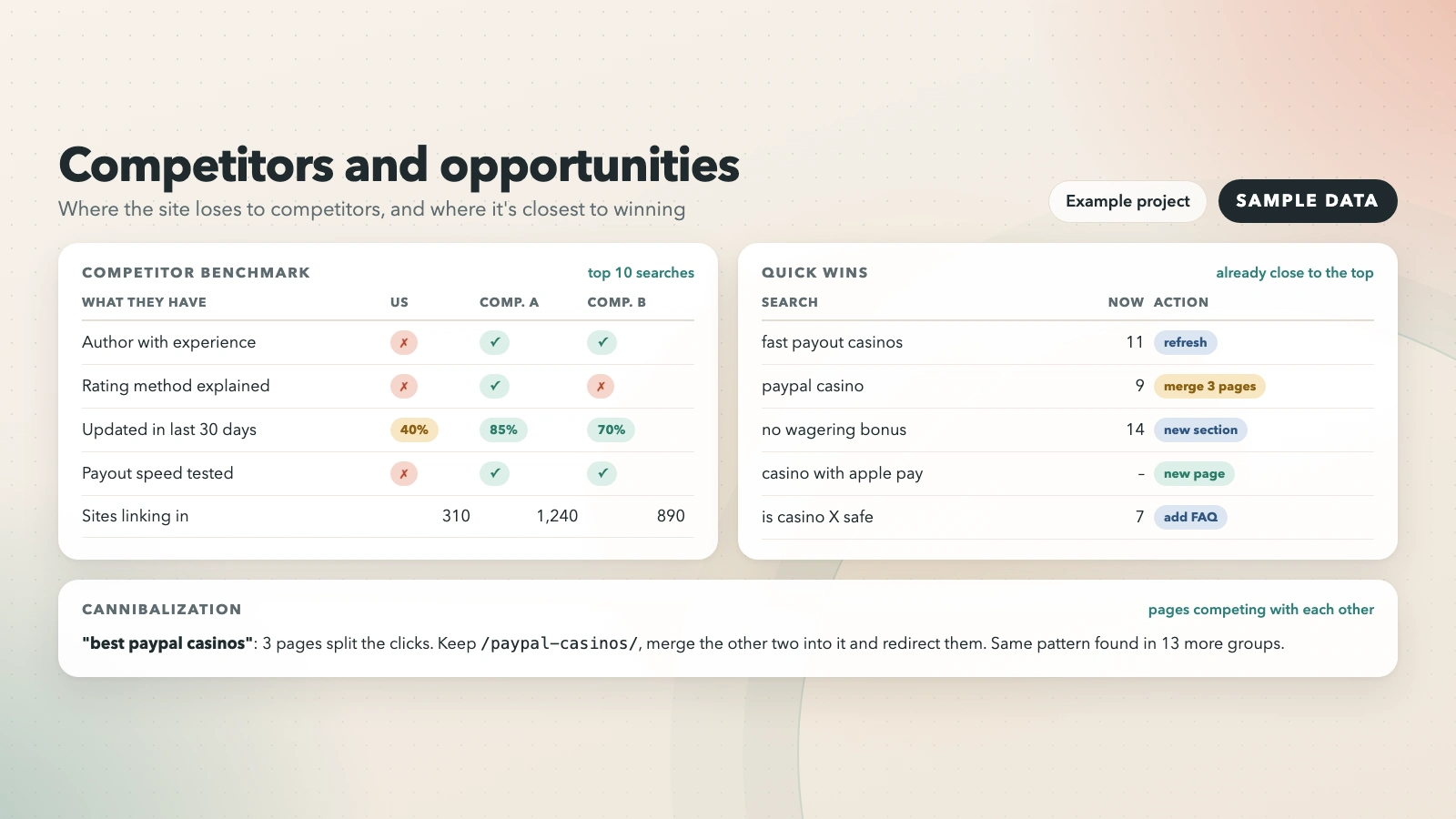
For the site's most important searches, I compared its pages with the pages ranking above it: what they cover that we don't, how they're structured, how fresh they are and how many links point to them. That turns "they rank better" into a concrete list of differences.
8. Ranking opportunities: where is the quickest win?
I looked for searches where the site already ranks on page 2 or at the bottom of page 1. A small improvement there gives the biggest jump in visitors. I also used "People also ask" and related searches to find questions the site doesn't answer yet.
9. Cannibalization and site structure: are we competing with ourselves?
Affiliate sites often have several pages chasing the same search, for example three different "best PayPal casinos" pages. Google then doesn't know which one to show. I found these clusters and decided per cluster which page stays, which gets merged into it, and which gets redirected.
Competitors and opportunities, sample data
10. Refresh plan: which existing pages to update, in what order?
Not every page needs work. I ranked existing pages by value and decline: high-value pages that are slipping come first. Each one gets a refresh brief: what to add, what to remove, which facts to re-check.
11. New page plan
From the gaps found in steps 7 and 8, a list of new pages worth creating, each with a brief: the search it targets, what the reader wants, what it must cover and what it must not claim.
12. Content production with built-in checks
The refreshes and new pages run through a Claude content chain: brief → draft in house style → remove AI tells → fact-check every bonus and casino detail against the casino's own terms → compliance check → a check that pages don't contradict each other → final QA. An editor approves each page before it goes live.
13. Internal linking
I mapped how pages link to each other and fixed the gaps: valuable pages with too few links pointing to them, pages with no links at all, and links with vague anchor text. Reviews link to the matching bonus and payment pages, and the other way round.
14. Link plan
Based on the off-page audit and competitor gap, a monthly plan for earning new links: which pages need them most, what kind of sites to approach and what anchor text to use, so the profile grows naturally.
15. Monitoring
A weekly report written by Claude in plain language: what moved in Google, the likely cause and what to do this week. A monthly health check flags new technical problems, new cannibalization and bonus pages that haven't been checked in 30 days.
The 90-day roadmap, sample data
What they get
A full audit report, ranked by impact, explained in plain language
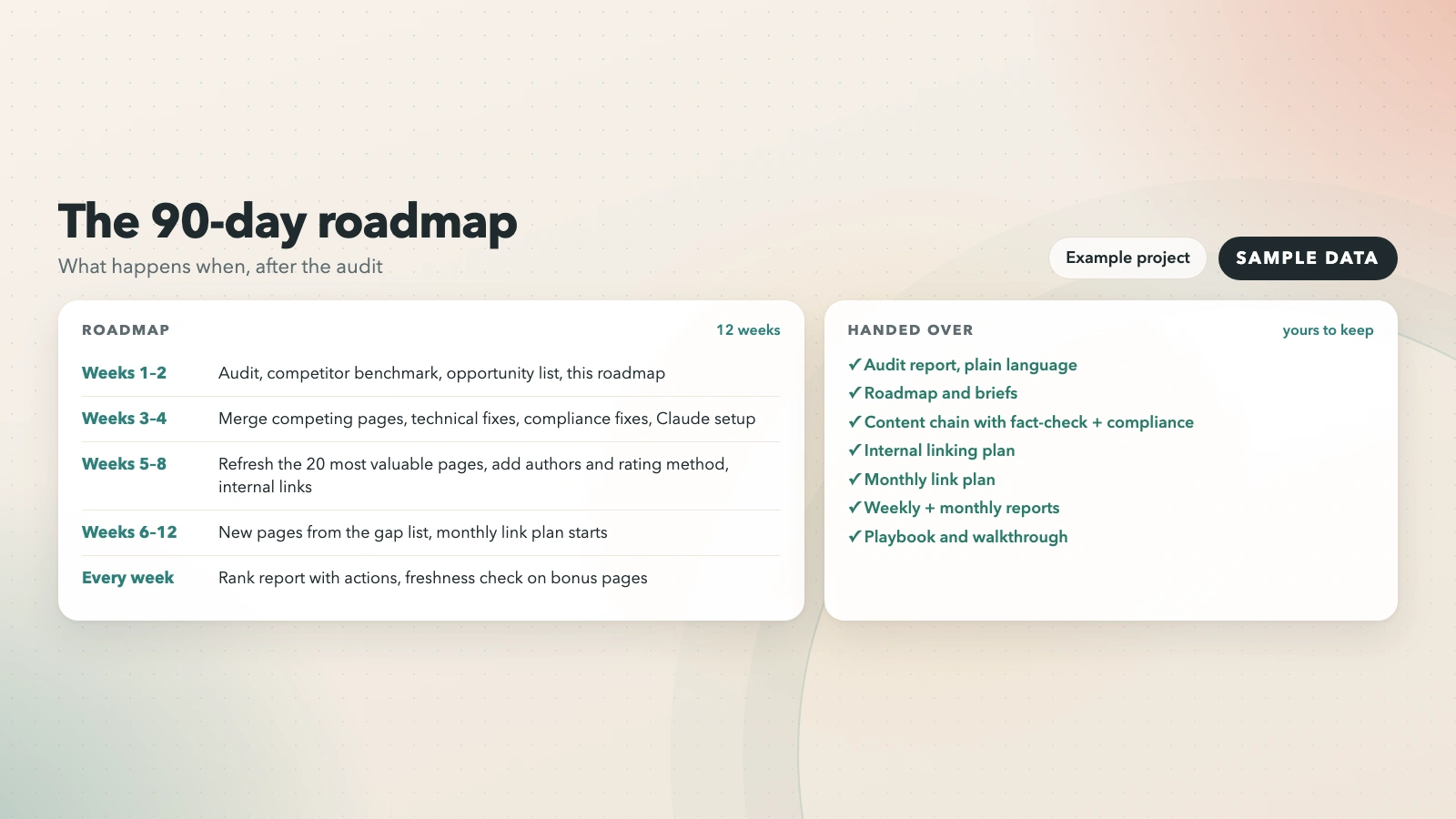
A 90-day roadmap: what to fix, refresh and create, week by week
Refresh and new-page briefs, ready to use
A content process with fact-checks and compliance built in
An internal linking and link-building plan
Weekly and monthly reports that keep the team on track
All of it set up in Claude Code as skills, with a playbook and walkthrough, so the team can run it themselves
How long it takes: About 2 weeks for the full analysis and roadmap (steps 1–11). The content process, linking and monitoring are set up in week 3 and run from then on. Rankings in competitive gambling markets usually take 3–6 months to move meaningfully; the weekly reports show progress before that.
Example project: based on the SEO, content and compliance work I do for affiliate sites. Client details are illustrative.
0 likes · 0 views · Nov 8, 2026
Example project: every step of a full SEO program for a casino affiliate site. Technical, on-page, off-page, competitors, cannibalization, refresh plan, content, links and monitoring.

