VOLLENT: Operational Acknowledgment Interlock

Faadil Boussari


A critical operational update can be delivered to every person involved and still remain unsafe.
An email may arrive without being read. A message may be opened without being understood. A recipient may acknowledge an outdated version. Yet many operational systems still treat transmission as completion.
VOLLENT separates message delivery from permission to execute.
The product keeps a change physically open until every required recipient acknowledges the exact active version. Only then does the circuit close, authorization become available and a version-bound receipt record the evidence.
The problem
A venue load-in time changes from 2:00 PM to 3:00 PM because the loading dock is unavailable.
Four operational recipients must adjust:
Maya Torres, Venue Manager
Theo Grant, Caterer
Lena Ortiz, Security Lead
Andre Bell, Production Lead
Maya, Theo and Lena have acknowledged the update. Andre's message has been delivered, but he has not acknowledged it.
Most communication tools would show the update as successfully sent.
VOLLENT treats it as unresolved.
Delivered does not mean acknowledged.
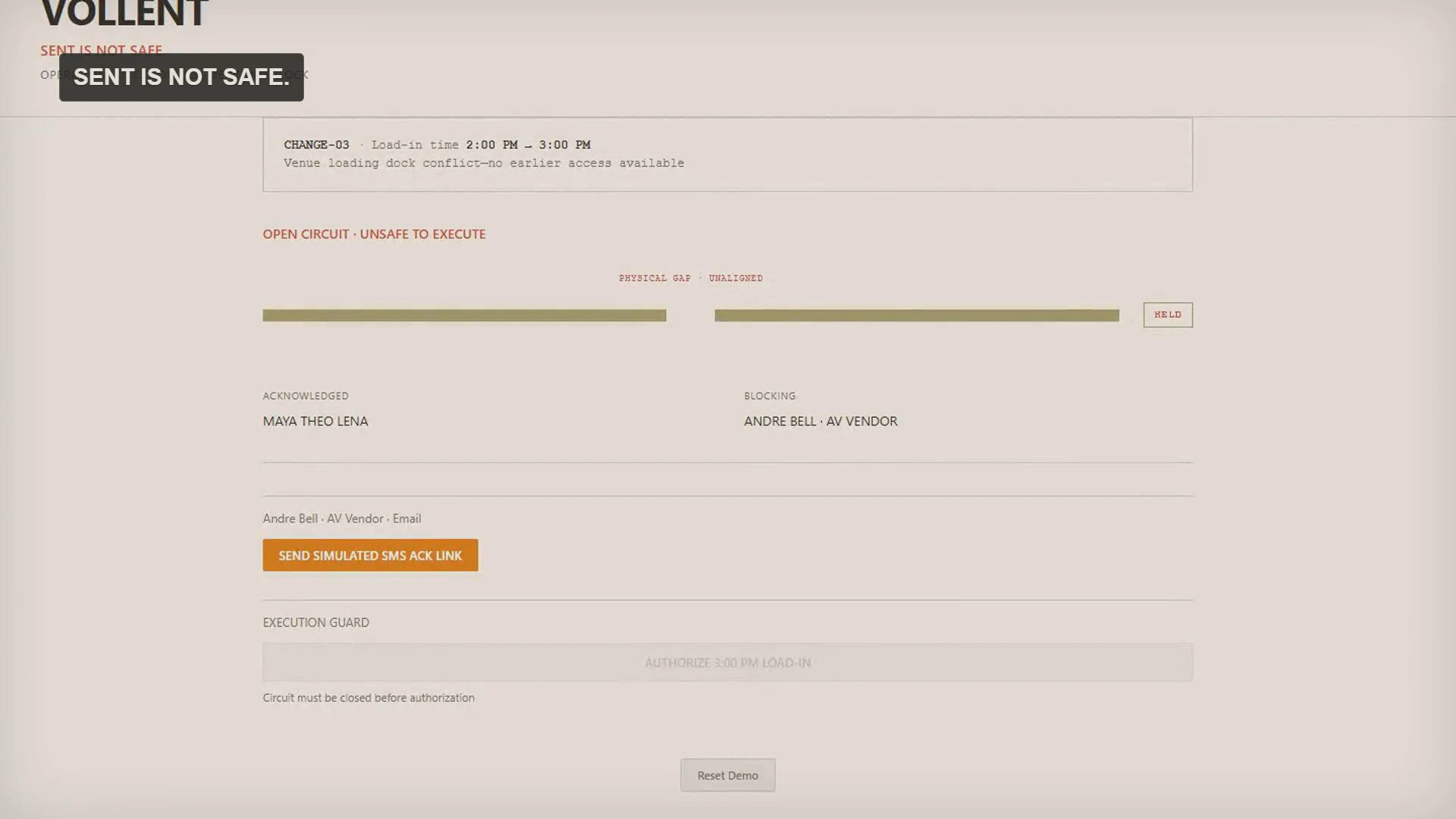
A critical operational change remains physically open while one required acknowledgment is missing
The core product decision
I avoided designing another notification dashboard.
Instead, the acknowledgment state became a physical interlock.
The interface contains two rail endpoints separated by a visible gap. The gap represents the missing operational agreement.
While Andre remains unacknowledged:
the rails stay separated
the change remains unsafe
authorization is unavailable
execution is held
This turns an abstract communication failure into a visible operational constraint.
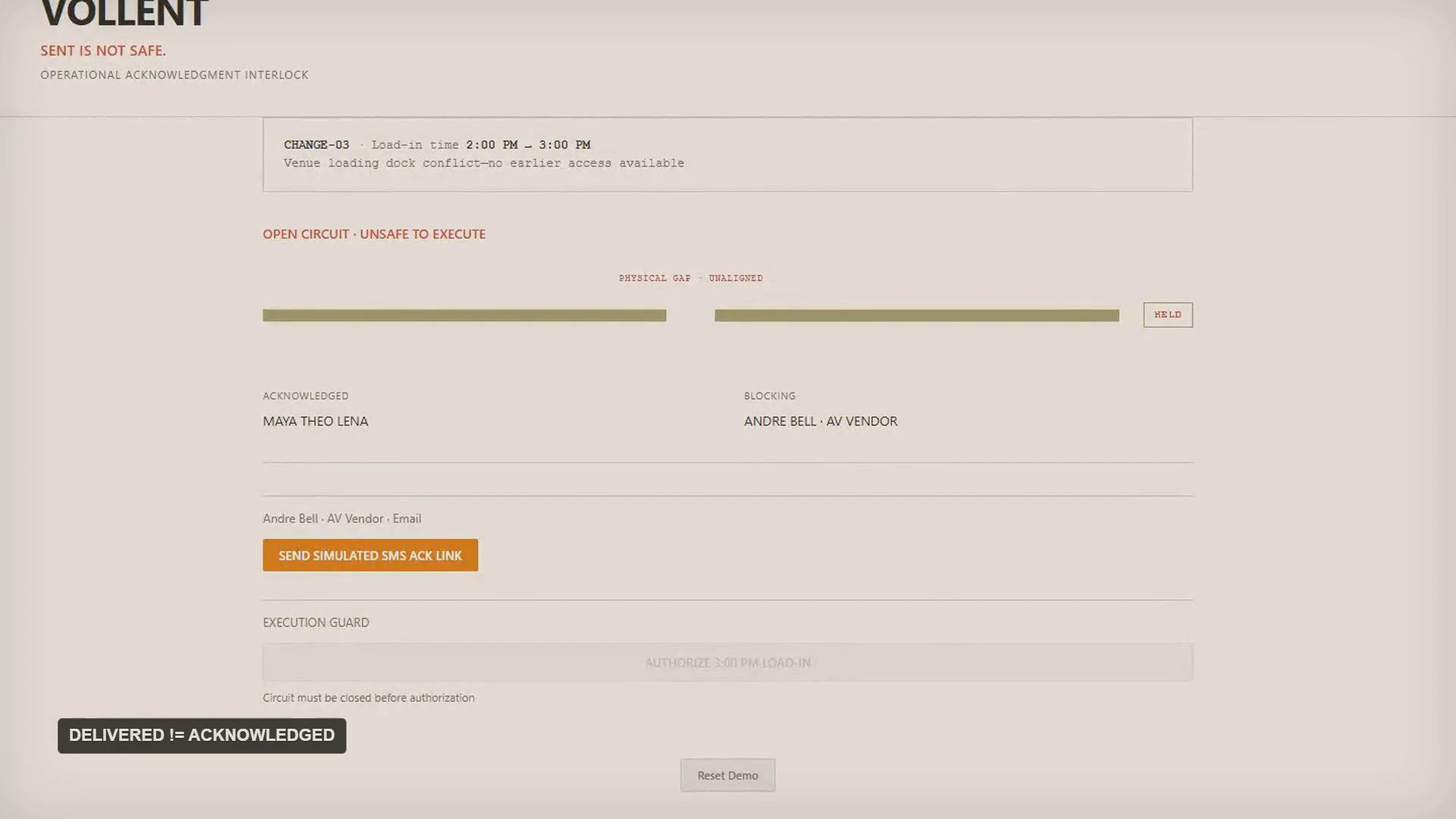
Three recipients acknowledged the change. One delivered-but-unacknowledged recipient blocks execution
The acknowledgment interaction
VOLLENT escalates Andre from email delivery to a simulated SMS acknowledgment link.
The recipient interface presents the exact change being acknowledged:
CHANGE-03
Load-in time: 2:00 PM → 3:00 PM
Reason: Loading dock conflict
Andre can decline or acknowledge the active version.
The interaction is intentionally explicit. A generic "Got it" response would not provide enough confidence that the recipient understood the operational change.
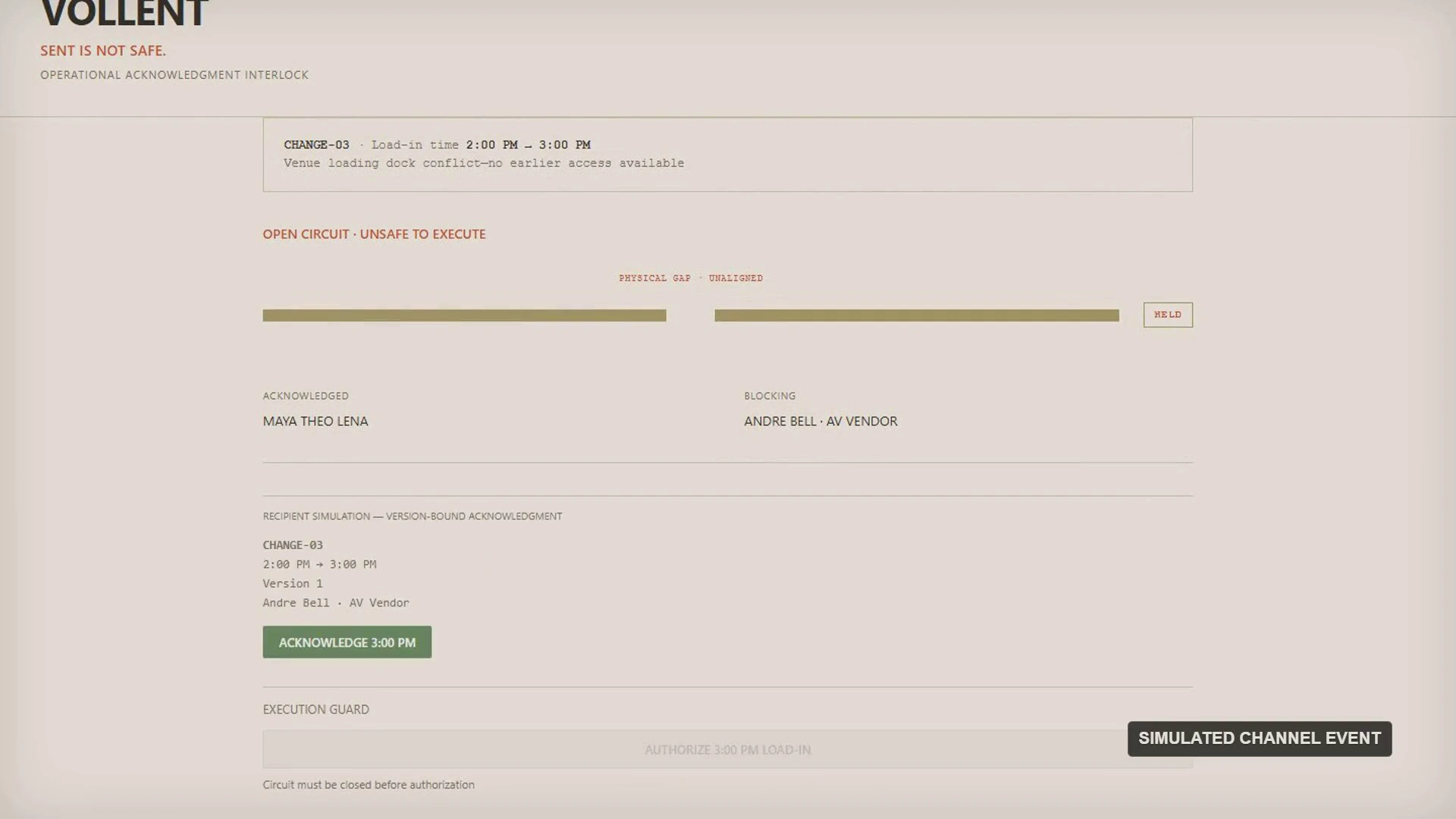
Andre acknowledges the exact active version rather than confirming a generic message
The signature moment
When Andre acknowledges the change, the rail endpoints move toward each other and seat into a single center seam.
The motion is not decorative. It communicates the product's governing rule:
Execution remains physically open until acknowledgment is complete.
Only after the final acknowledgment does the interface display:
CIRCUIT CLOSED — SAFE TO EXECUTE
Authorization then becomes available to the operations lead.
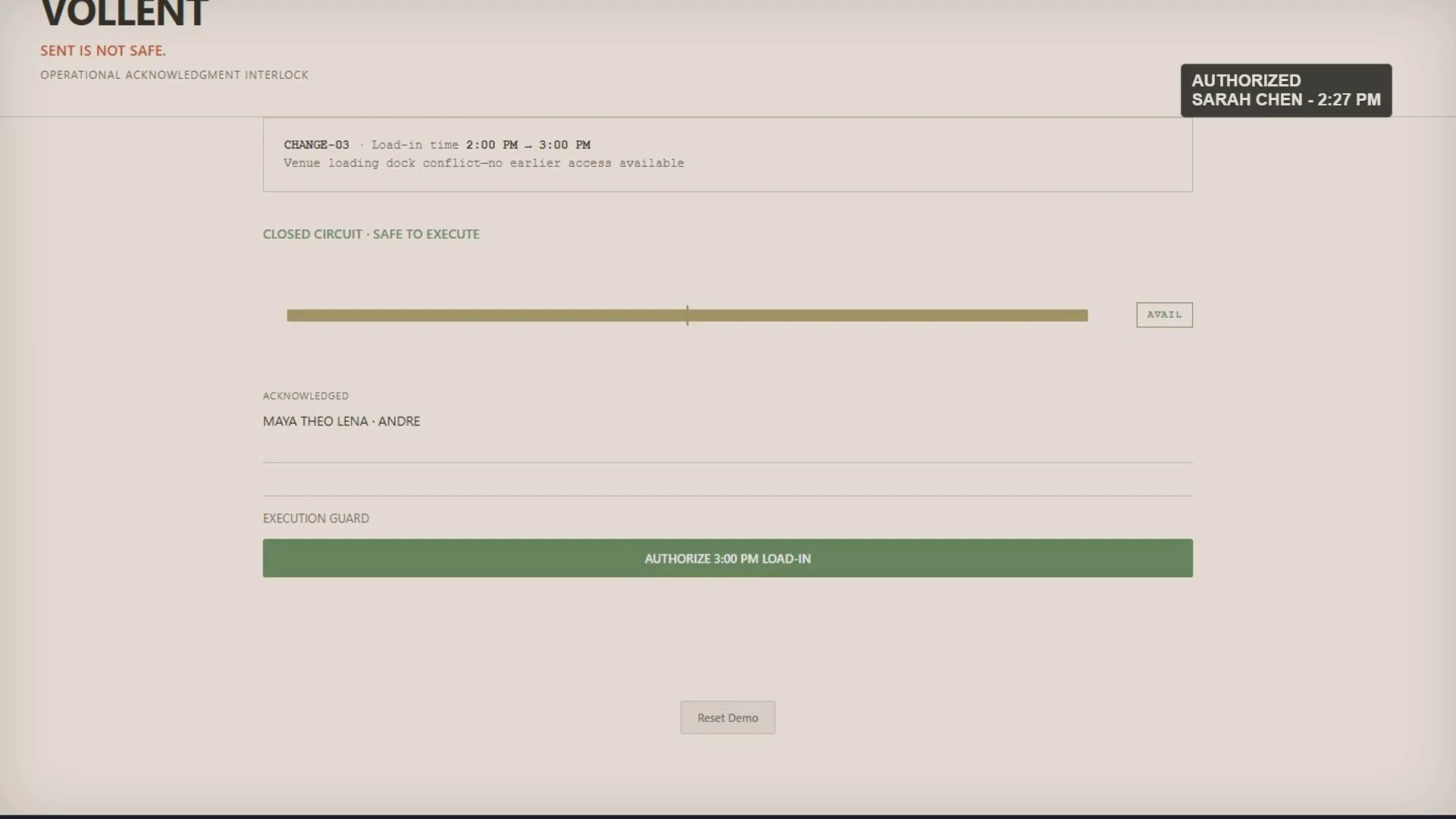
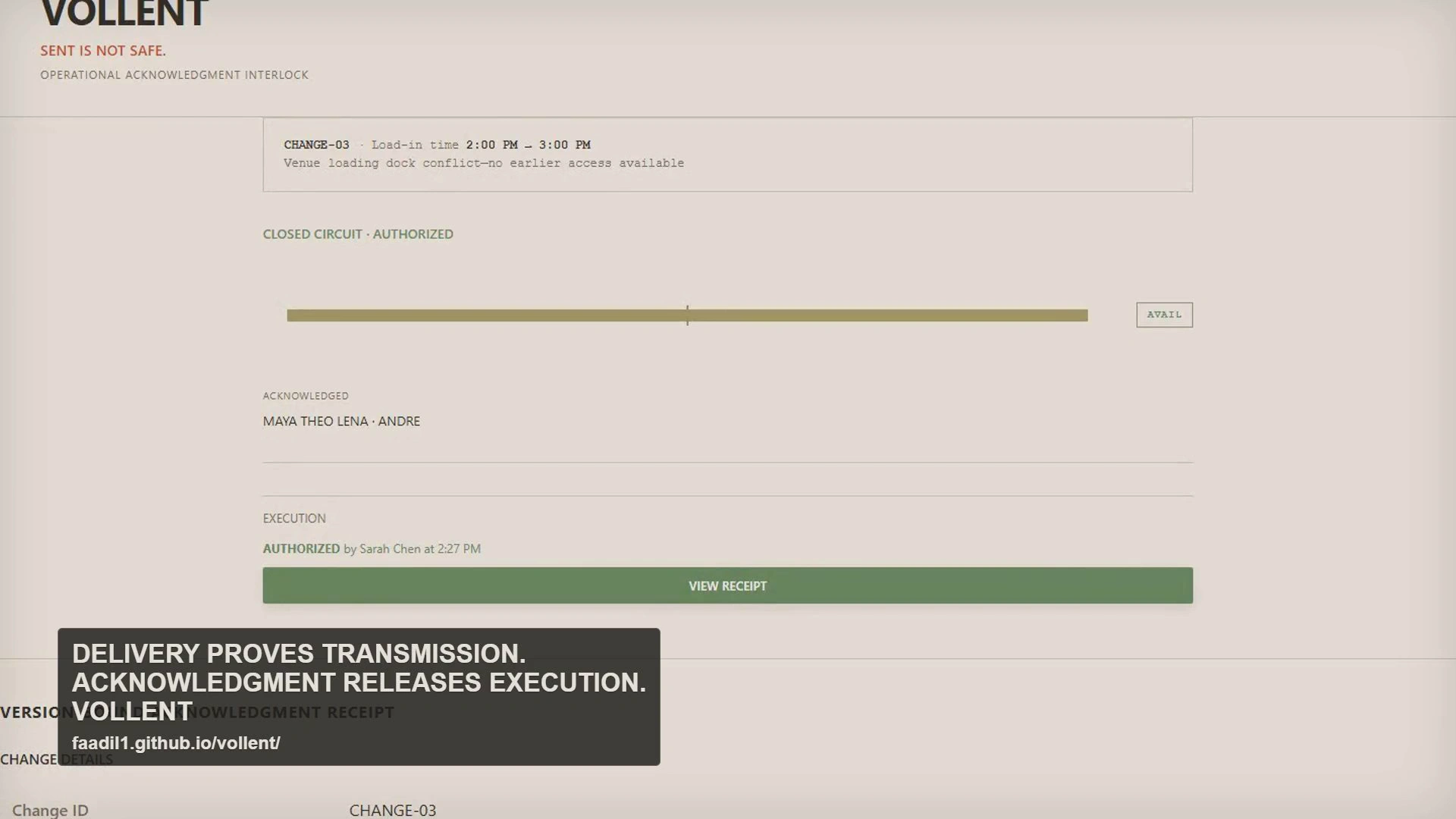
The final acknowledgment closes the physical circuit and releases authorization
Authorization
Acknowledgment alone does not automatically execute the change.
Once the circuit closes, Sarah Chen, the Operations Lead, can authorize the new 3:00 PM load-in.
This creates two separate controls:
Acknowledgment proves that the required recipients received and accepted the active version.
Authorization records the accountable operational decision to proceed.
The sequence is therefore: Delivery → acknowledgment → circuit closure → authorization.
Evidence receipt
After authorization, VOLLENT generates a version-bound receipt containing:
the change ID and version
the previous and updated time
all required recipients
acknowledgment channels and timestamps
the email-to-SMS escalation event
the authorization owner and timestamp
the circuit-closure timestamp
deterministic demonstration tokens
the simulation and non-cryptographic-proof disclosures
The receipt provides a readable operational history without overstating the prototype's technical guarantees.
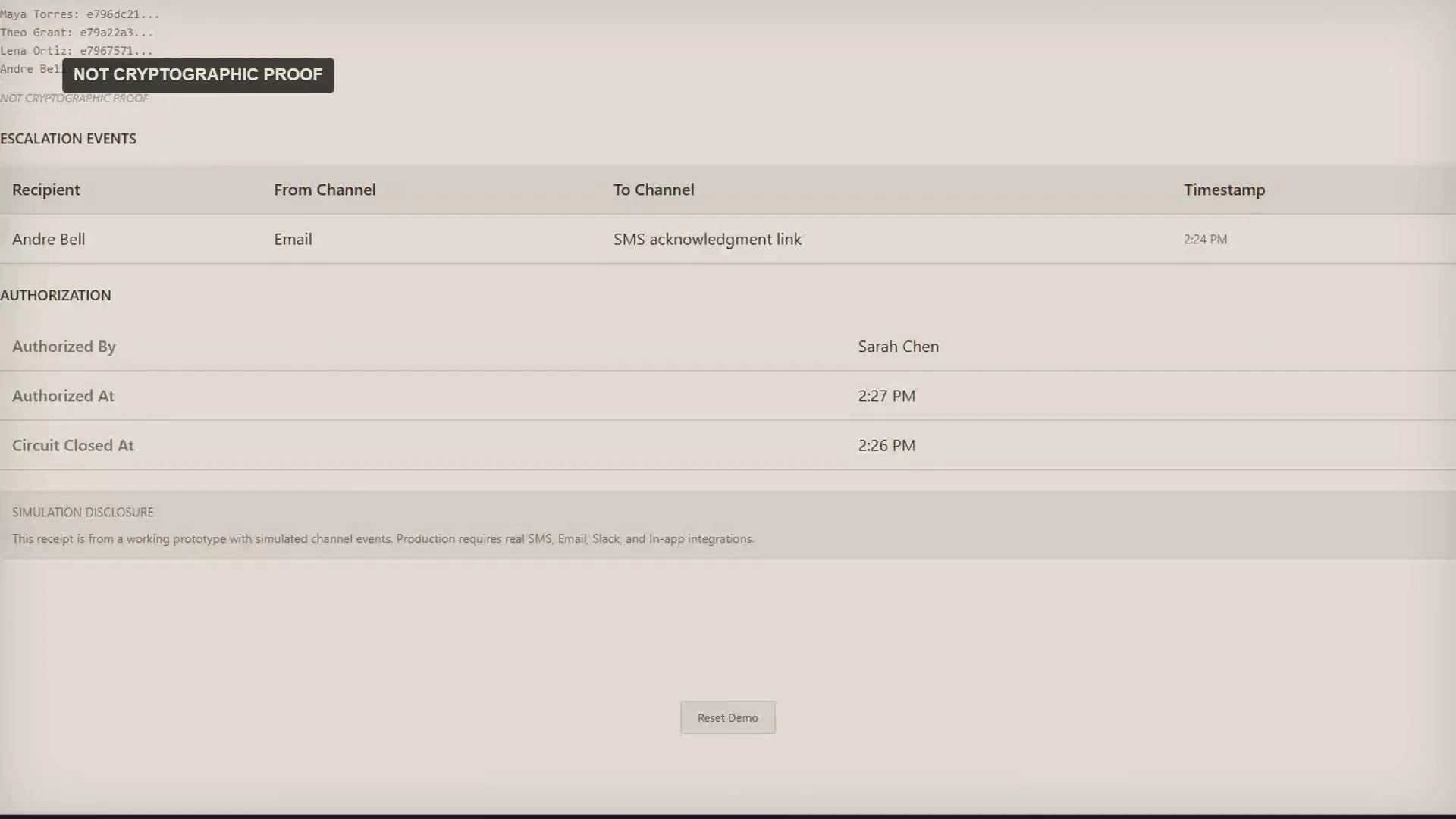
A version-bound receipt records acknowledgment, escalation, circuit closure and authorization evidence
Product boundaries
VOLLENT is a working client-side prototype.
SMS, email, Slack and in-app interactions are simulated. The deterministic receipt tokens demonstrate stable evidence formatting, but they are not cryptographic proof.
A production implementation would require authenticated recipients, real communication-provider integrations, server-side state enforcement, tamper-resistant audit storage, permission and identity controls, and verified timestamping.
These limitations are disclosed directly inside the product rather than hidden from the demonstration.
Design direction
VOLLENT belongs to the first visual chapter of the 30 Days of Real Business Problems challenge.
The system uses a warm ivory editorial surface, dark operational typography, oxide accents for unsafe conditions, neutral tan mechanical rails, and restrained sage accents for closure and safe states.
The design avoids conventional dashboard patterns, status pills and celebratory success animations. The central rail mechanism carries the meaning of the product.
Outcome
VOLLENT demonstrates a different way to design operational communication.
Instead of asking whether a message was sent, it asks whether the system has enough evidence to safely release execution.
Delivery proves transmission. Acknowledgment releases execution.
VOLLENT is a self-initiated speculative concept developed for Day 9 of the 30 Days of Real Business Problems challenge.
Like this project
Posted Jul 24, 2026
A working product prototype that prevents critical operational changes from becoming executable until every required recipient acknowledges the exact active version.