
Constraining what becomes real
Most AI governance today is focused on decisions:
→ what systems are allowed to do
→ how actions are validated
→ how outcomes are explained
But there’s a deeper layer most frameworks don’t touch:
What the system is allowed to become over time
Systems don’t just act.
They learn.
And every learning event:
→ reshapes future decisions
→ redefines boundaries
→ shifts authority implicitly
Yet:
Learning is almost always unconstrained
This creates a system that can remain:
→ compliant
→ auditable
→ aligned on paper
…while gradually drifting away from a valid basis for action.
Not because a decision failed.
But because the system evolved beyond what was ever admissible.
The shift is simple, but structural:
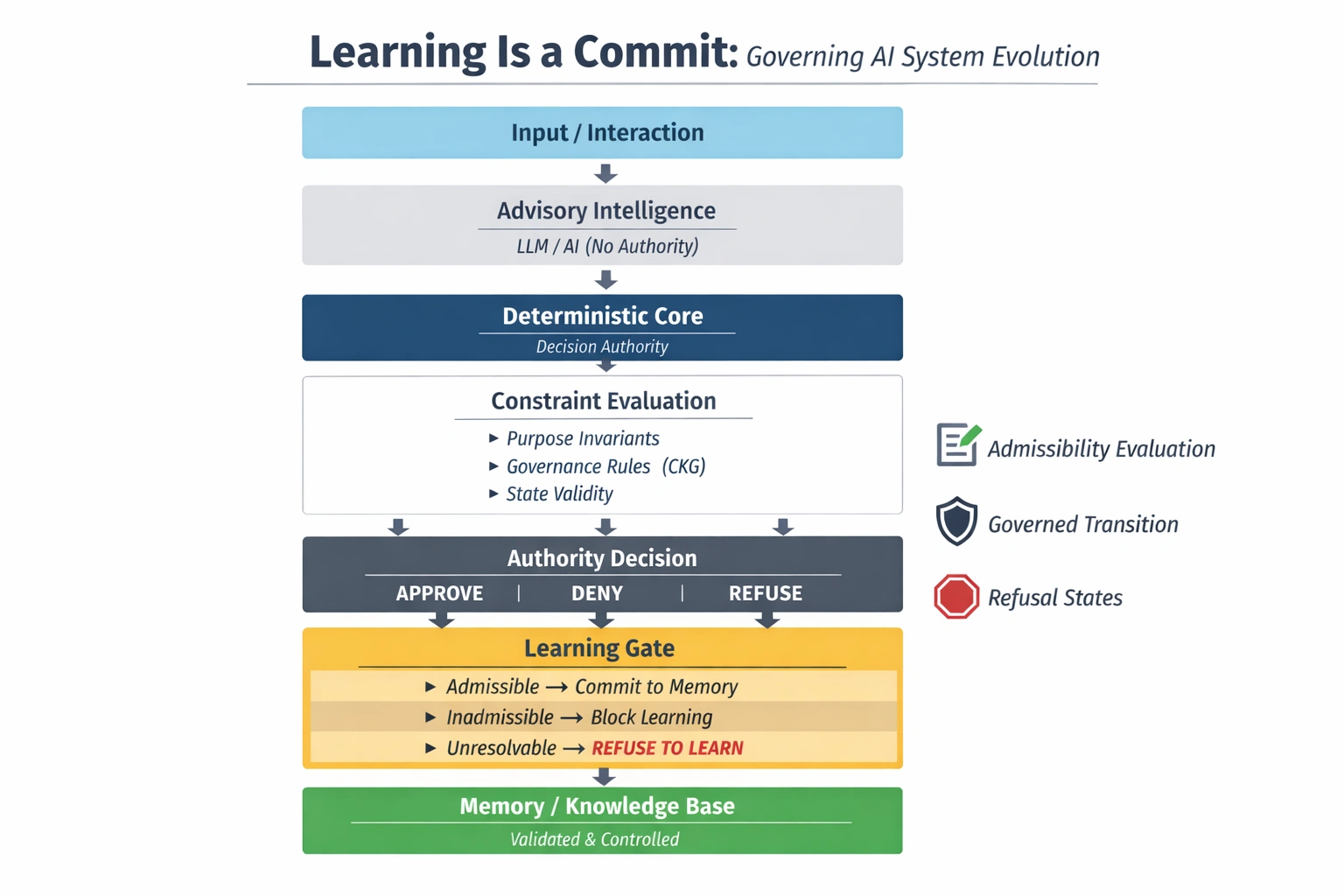
Learning must be treated as a governed state transition
Not something that happens automatically.
Something that is:
→ evaluated
→ admitted
→ or refused
Before a system learns, it must resolve:
→ Is this grounded in a valid state?
→ Is the source admissible?
→ Does this fall within its mandate?
→ Can this be justified at the moment of incorporation?
If not:
The system should not learn.
We already ask:
“Is this decision valid at execution?”
But we don’t ask:
“Was the system allowed to learn what led to it?”
That’s the gap.
And that’s where governance breaks.
This is the first layer of something deeper:
Moving from:
→ governing decisions
to:
→ governing system evolution itself
I’ll be exploring this further:
→ execution boundaries
→ admissibility
→ authority layers
→ and now: learning control
Governance doesn’t end at execution.
It extends to what systems are allowed to become.
#AIGovernance #AIArchitecture #DecisionIntegrity #GovernedAI #AIControl
0 likes · 0 views · Apr 15, 2026
Constraining what becomes real Most AI governance today is focused on decisions: → what systems are allowed to do → how actions are validated → how outcomes ...


