1 | Empathize

Paige Mariucci


INTRODUCTION
PRODUCT | A responsive web app which allows users to search, save, message, and book planners for their events.
PROJECT ROLE | My role was to develop the product design including preliminary research, problem definition, prototype development, usability testing, & refinement of the visual design.
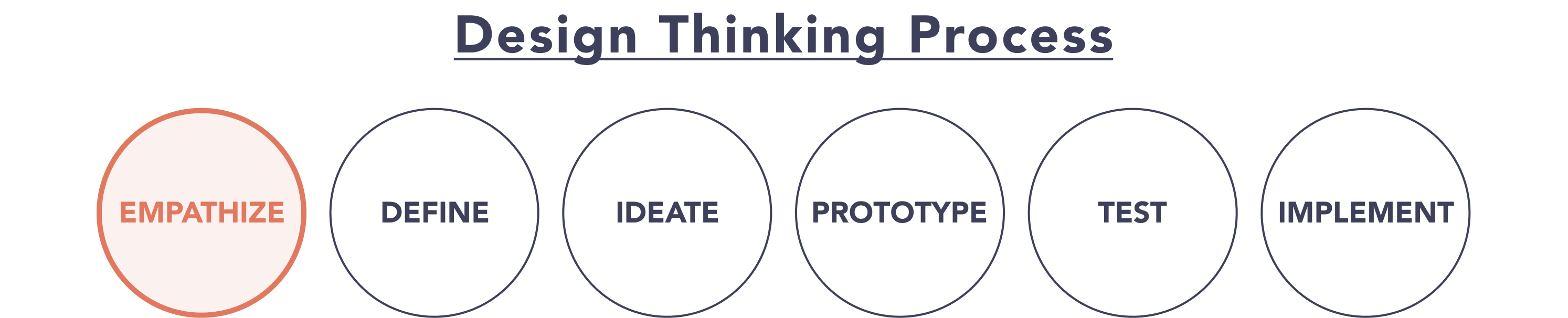
CASE STUDY | The below case study is focused on the process I used to empathize with the user and better understand the problem via competitive analysis, developing user stories, and conducting user interviews.
Case Study Contents:
1.1 / 🤔 Preliminary Problem Statement
1.2 / 🧐 Competitive Analysis
1.3 / 😀 User Stories
1.4 / 🤓 Research Goals
1.5 / 🤗 User Interviews & Analysis
1.6 / 👍 Learnings
1.1 / 🤔 Preliminary Problem Statement
The design process for The Vision app started by brainstorming possible problems in the event planning space.
Planning events demands many skills.
Event planning requires one to be budget & schedule conscious, an excellent communicator, detail-oriented, adaptable, and connected with service vendors.
Event planners are expensive.
Planners are commonly hired for big events with large budgets and significant guest lists.
Planning during the pandemic is complex.
It’s challenging to know when and how to plan for an in-person, remote, or hybrid event.
Event planners are hard to find.
Those looking for an event planner need a reference or recommendation from a friend, family member, or coworker.
With these possible problems in mind, I crafted a preliminary problem statement for The Vision app.
👇
People tasked with organizing an event need a way to compare & hire professional event planners to help them coordinate their functions because event planning is not only time-consuming but also requires skills, connections, knowledge, and adaptability.
1.2 / 🧐 Competitive Analysis
To further familiarize myself with the problem I identified two existing apps which allow users to find event planners: Thumbtack & Upwork.

I studied how each company has already attempted to solve the users problem in their product and created a competitor profile for each.
THUMBTACK:
KEY OBJECTIVE | Matches customers with local professionals. End-to-end booking experience for services. Encourages any type of professional/company to promote themselves to attract clients and grow their business.
OVERALL STRATEGY | Free sign-up for customers & professionals. Any category of service offered in every region of the US. Professionals pay a fee for each customer lead created through the service.
MARKET ADVANTAGE | 1,100+ types of services with over 150,000 active professionals. Users find compatible professionals for their project via personalized search filters. App Score: 4.9 stars (165K ratings).
MARKETING PROFILE | Breadth of services increase likelihood of repeat customers. Prominent position on Google search increases exposure. Limited advertisement on social media platforms.
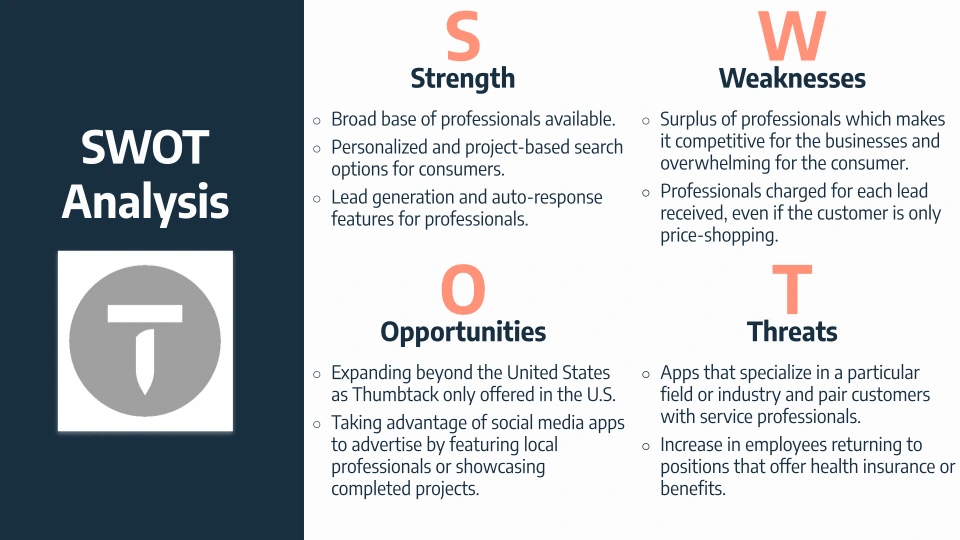
Thumbtack SWOT Analysis
UPWORK:
KEY OBJECTIVE | Work marketplace that aligns client goal’s with professional’s goals. Provides users with a workforce of independent talent. Allow freelancers to become an instrumental part of someone’s team.
OVERALL STRATEGY | Free sign-up for clients & freelancers. International presence with freelancers from around the world. Percentage service fee charged for each successful transaction between client and professional.
MARKET ADVANTAGE | Over 12 million registered freelancers and 5 million registered clients. Subscription available for businesses with access to quality talent and options to interact with freelancers. App Score: 4.8 stars (15K ratings).
MARKETING PROFILE | Target companies that hire freelancers for tech focused, remote-work. Advertises itself as the “world’s work marketplace”. Promotes mission & brand within multiple media outlets.
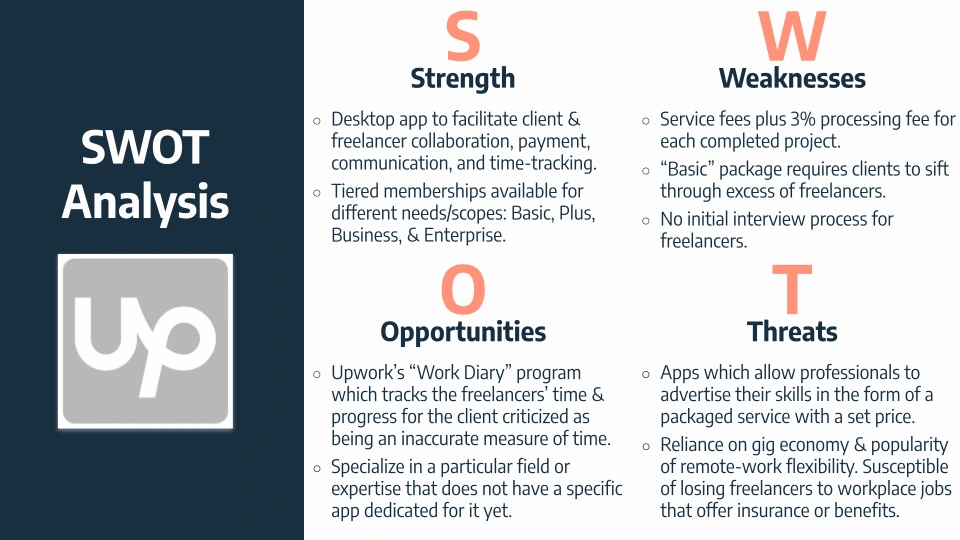
Upwork SWOT Analysis
One of my take-aways from the competitive analysis was that both products had event planners as one of their many available services. Few focused solely on events which could be an opportunity.
1.3 / 😀 User Stories
With a list of problems and perspective gained from competitive research I generated a list of executable user stories. This helped me to start conceptualizing the needs of the user into possible features that could be incorporated in the development of the product.
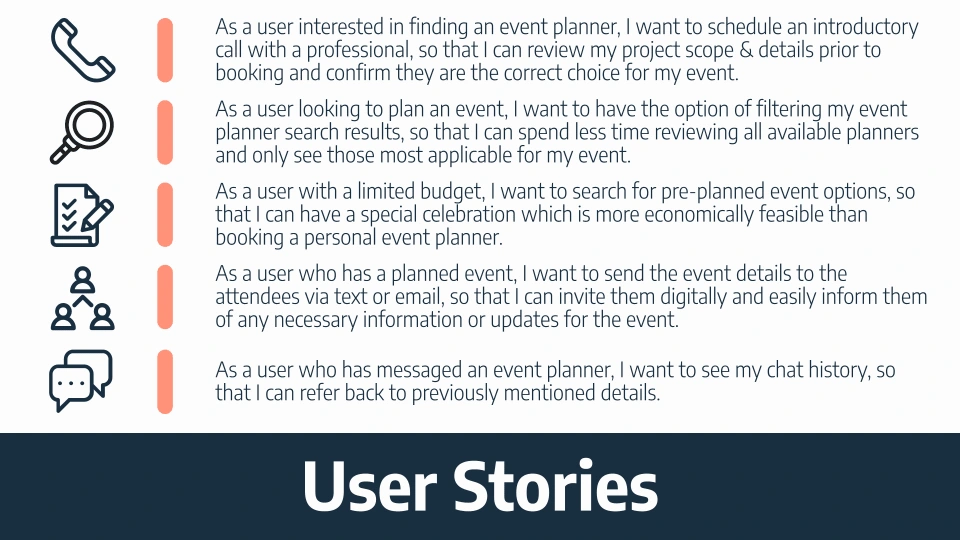
Example User Stories
1.4 / 🤓 Research Goals
Now that I had explored the existing problem space around event planning, my next step was to conduct user interviews which provided me the opportunity to directly learn about the needs, motivations, and frustrations from those that could potentially be my future users.
Prior to drafting my script and recruiting participants I identified three primary research goals that I wanted to achieve in the interviews.
👇
Uncover common challenges of planning an event or finding a planner.
Determine ways in which people find & evaluate planners.
Explore how the pandemic has impacted how people approach event planning.
1.5 / 🤗 User Interviews & Analysis
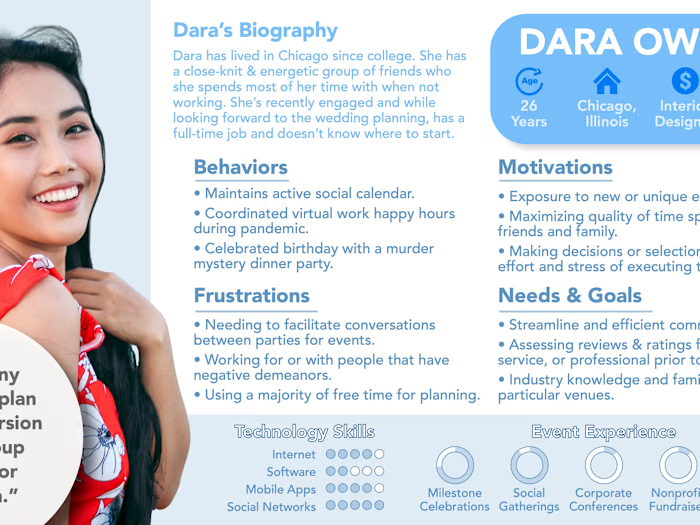
Three individuals were selected for interviews given their specific experience and knowledge within various areas of event planning.
Participant #1 | Corporate Conference Experience
Participant #2 | Personal Wedding Experience
Participant #3 | Non-Profit Event Experience
The interviews were helpful in identifying methods of finding planners as well as hearing about expectations in client-planner relationships. To understand overall themes and connections in the data, I collected my notes and studied them via an affinity mapping exercise.
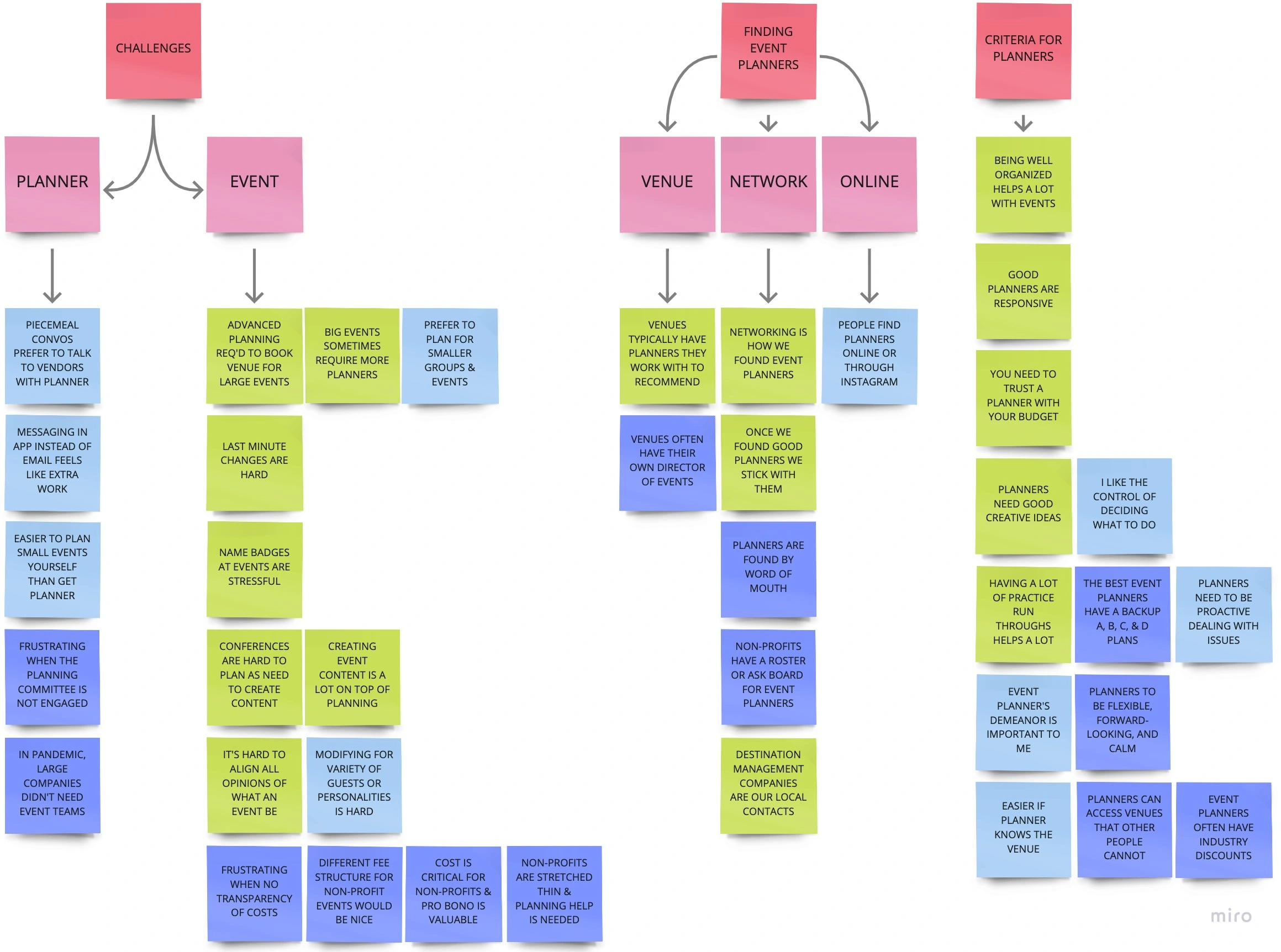
User Interview Affinity Mapping
INSIGHTS:
Most participants said they find event planners through contacts in existing networks.
It can be challenging to plan events in destination cities which results in people relying on referrals by the venue.
Interviewees commonly referred to finding planners via Instagram or Yelp though that is not the primary purpose of those apps.
Reading reviews or receiving a referral is important to people when considering or evaluating planners for an event.
Hosts/clients expect a lot from their event planners while still wanting to be involved in the decision making & planning process themselves.
In today’s world virtual events can be more financially feasible than in-person events.
The energy and community of in-person events is still better than virtual events.
With this user insight I was able to refine my preliminary problem statement for The Vision app.
👇
Individuals tasked with organizing events need to find & hire planners to help execute their events because planning is time consuming and requires skills and connections
1.6 / 👍 Learnings
Problem statement to be refined.
To establish the product my preliminary problem statement had to undergo a root cause analysis to identify a core problem. This was important as I wanted to design a solution for an actual need of the user. The early stages of the UX process fortunately encourages the refinement of the problem statement via competitive analysis and user interviews.
---
Planners are personal.
The Vision app will need to include sufficient information about the planner’s past experience and skills as well as ratings or reviews to make the user feel confident booking them for their event. That said, as discovered in my interviews the act of finding an event planner can also be personality driven and visual references are very important.
---
Let the user explain the problem.
Preparing questions was essential for my user interviews as it provided structure to the sessions. However, I learned to leave space for participants to offer feedback even when their responses weren't directly related to a prewritten prompt. These additional observations helped me to better understand their natural behaviors and motivations.
Like this project
Posted Oct 2, 2022
Empathizing with the user for The Vision.
Likes
0
Views
70
Tags