DAZN Fight Night Agent

Devowise Studios


DAZN Fight Night Agent Project
Building an AI-Powered Fight Night Intelligence System
Project Type: AI Agents · Workflow Automation · Sports Media Intelligence
Workflow Platform: BuildShip
Core Components: Recap Agent · Q&A Agent · Stats Agent · Social Coverage Agent · Highlight Agent
1. Project Overview
Live combat sports generate large volumes of information across fight results, athlete statistics, event coverage, social conversations, and highlight moments. Turning this information into useful, timely, and accessible content can be a complex operational task.
We developed the DAZN Fight Night Agent Project, an AI-powered system designed to organize fight-night intelligence through five specialized AI agents. Each agent addresses a distinct content or information task, while BuildShip serves as the workflow automation layer connecting the underlying processes.
The goal was to explore how specialized AI agents and automated workflows could support sports media operations, making fight information easier to process, retrieve, summarize, and distribute.
2. The Challenge
Fight-night content requires different types of intelligence, each with its own requirements:
Content generation: Converting fight information into concise, readable recaps.
Information retrieval: Answering questions about fighters, matchups, and event outcomes.
Statistical analysis: Presenting fight statistics in a structured, understandable format.
Social monitoring: Organizing coverage and conversations surrounding an event.
Highlight discovery: Identifying notable moments that deserve attention and further review.
Handling these tasks through separate manual processes can create fragmented workflows and inconsistent outputs. We approached the problem by separating responsibilities into focused agents and coordinating their execution through automated workflows.
3. Solution Architecture
We designed the system around five specialized agents, supported by BuildShip for workflow orchestration and automation.
High-level architecture
Event and fight-related data
→ BuildShip workflow layer
→ Specialized AI agents
→ Structured outputs and content responses
→ Downstream review and use
BuildShip provided the workflow foundation for connecting processing steps, managing automation logic, and coordinating the interactions required by each agent.
The architecture follows a modular approach: each agent has a defined responsibility, allowing individual workflows to be refined without treating the entire system as one monolithic AI application.
4. The Five AI Agents
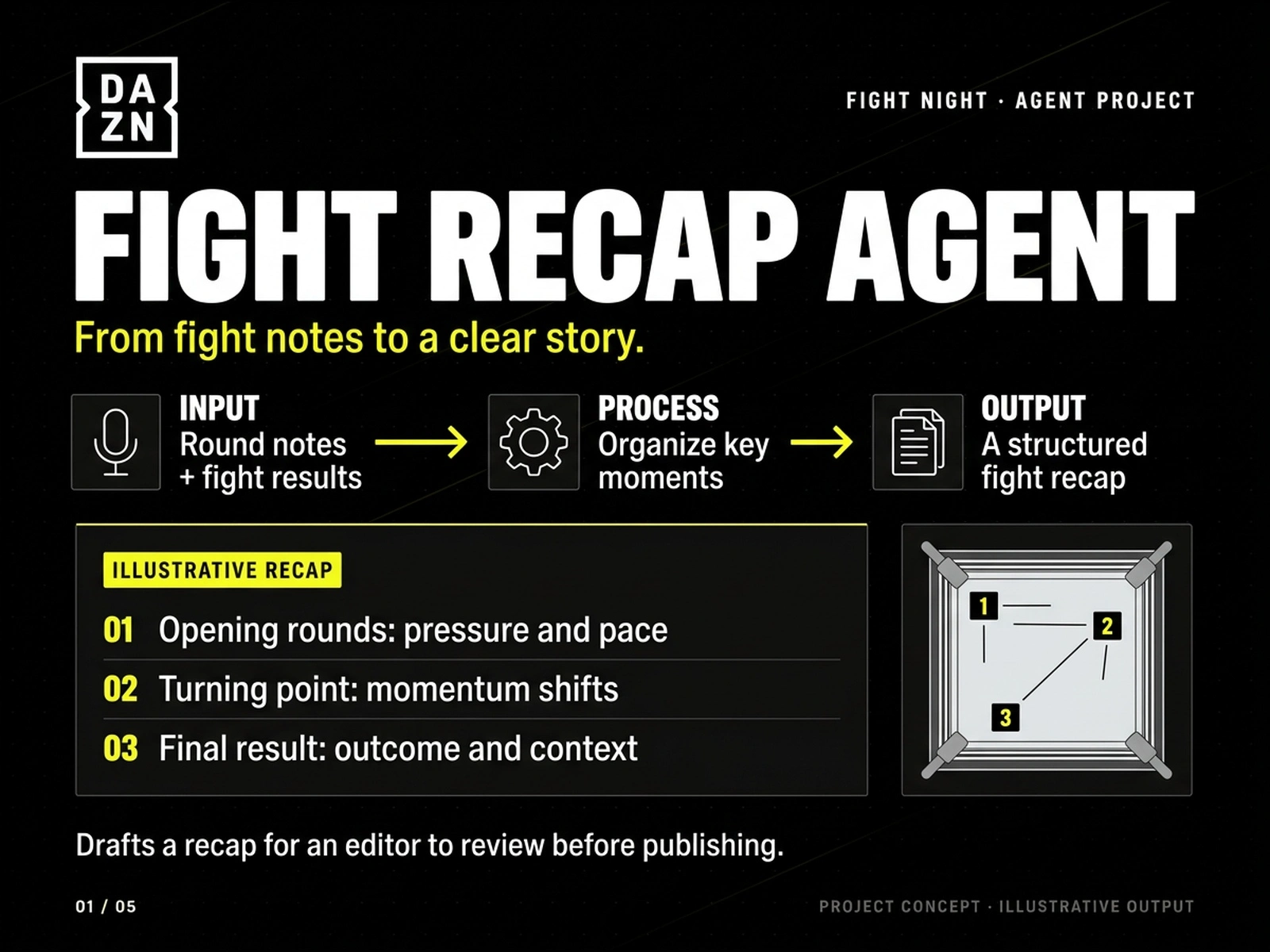
01 — Recap Agent
Purpose: Turn fight-related information into concise, structured event recaps.
The Recap Agent focuses on transforming available fight information into readable summaries. Its intended role is to help produce post-fight coverage that communicates key outcomes and notable developments without requiring audiences to process every underlying detail.
Core capabilities
Summarize fight outcomes and event developments.
Organize information into a coherent narrative.
Produce concise, audience-friendly recap content.
Support repeatable content-generation workflows.
Technical focus: Context preparation, summarization prompts, structured workflow inputs, and consistent output formatting.
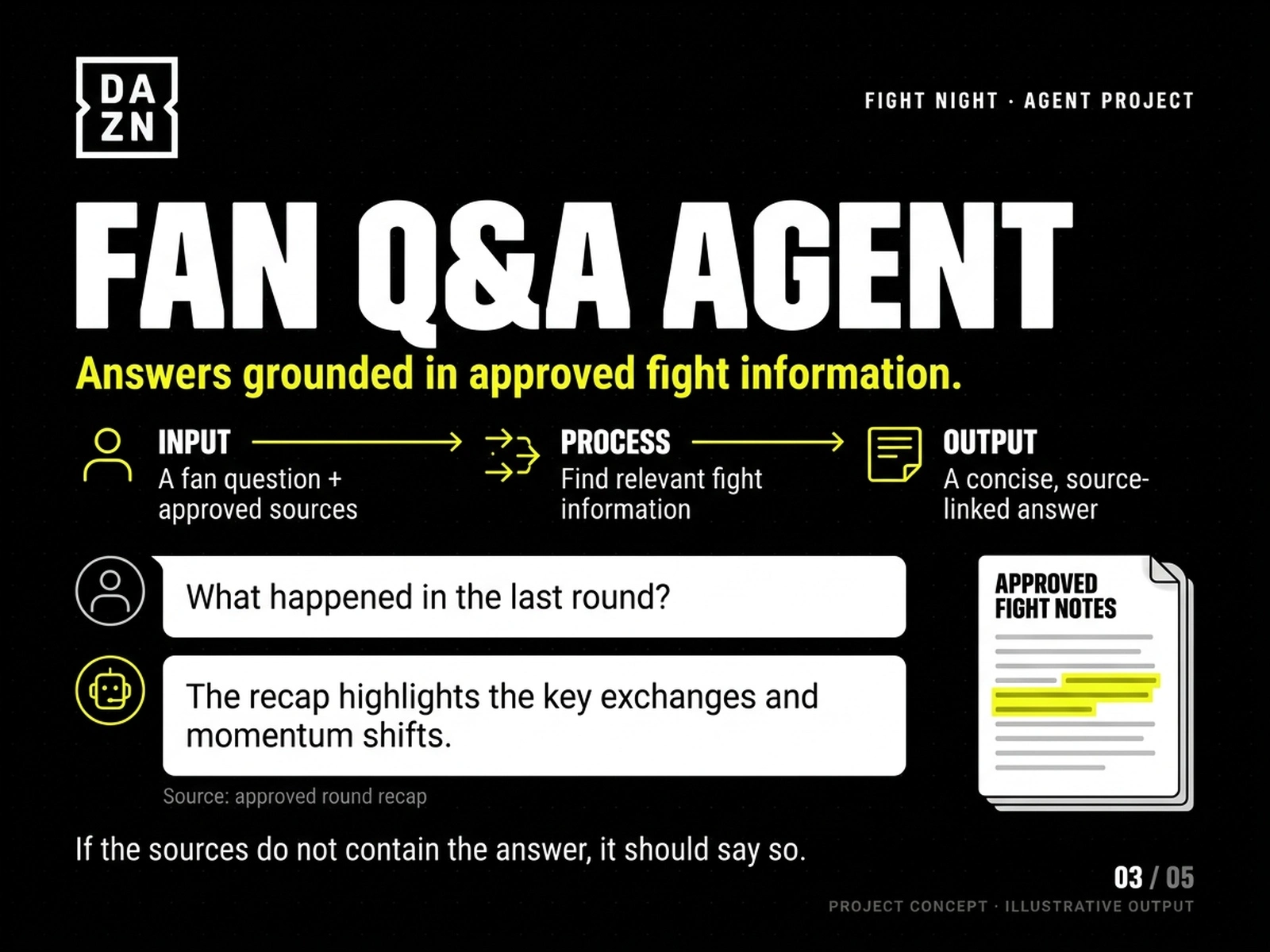
02 — Q&A Agent
Purpose: Provide conversational access to fight-night information.
The Q&A Agent is designed to answer questions about relevant event information, helping users retrieve specific details through natural-language queries rather than manually searching through multiple sources.
Core capabilities
Interpret natural-language questions.
Retrieve or use relevant information available to the workflow.
Generate direct, contextual responses.
Support follow-up questions where the underlying context allows.
Technical focus: Query handling, context grounding, response generation, and appropriate handling of missing information.
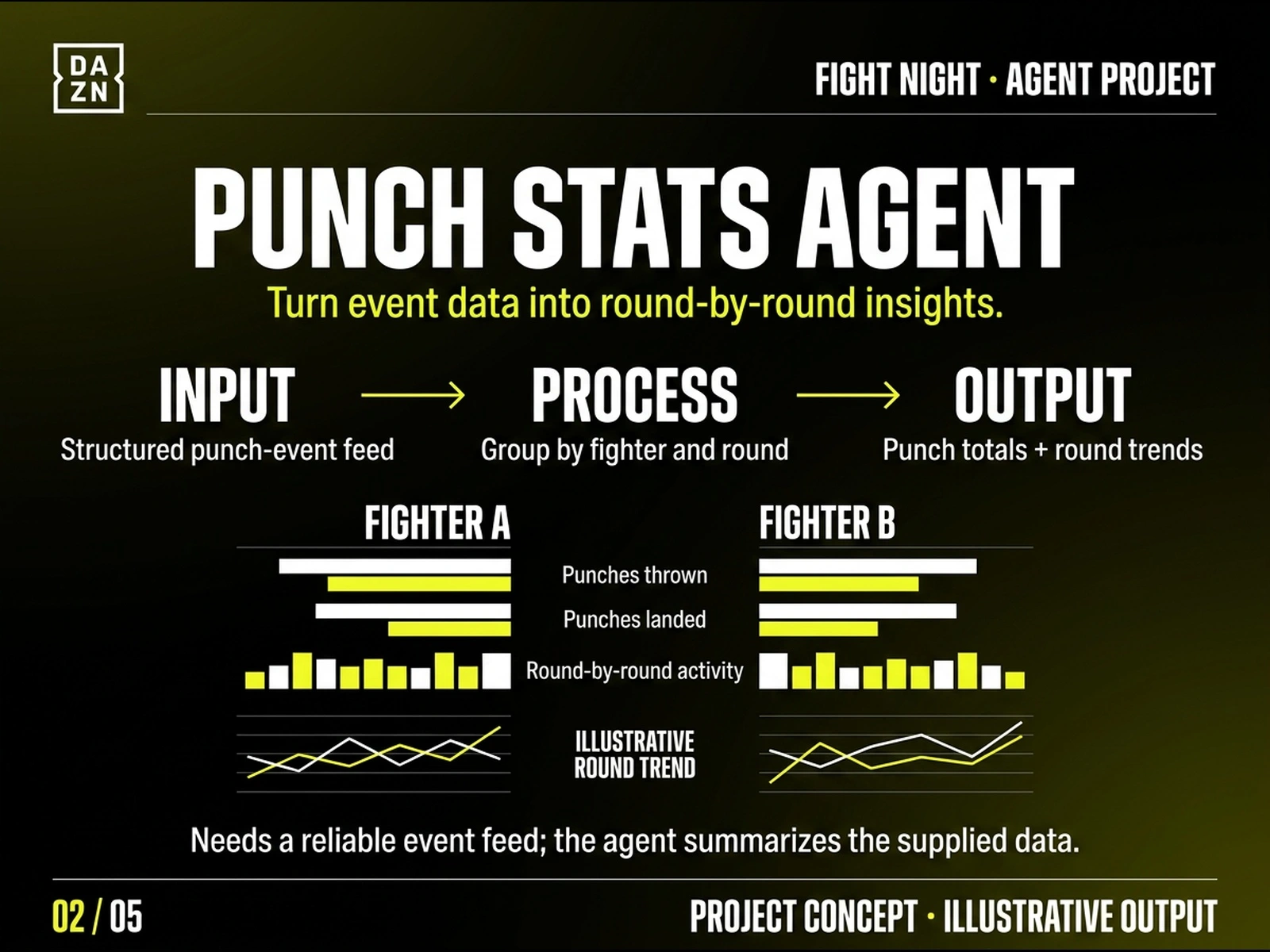
03 — Stats Agent
Purpose: Make fight statistics easier to understand and explore.
The Stats Agent focuses on presenting relevant statistical information in a more accessible format. Rather than treating statistics as isolated numbers, the agent is intended to help users understand the data associated with fighters, matchups, and fight outcomes.
Core capabilities
Organize available fight statistics.
Respond to statistical questions.
Summarize relevant numerical information.
Support data-driven comparisons when the required data is available.
Technical focus: Structured data handling, numerical accuracy, field mapping, and separating source statistics from AI-generated explanations.
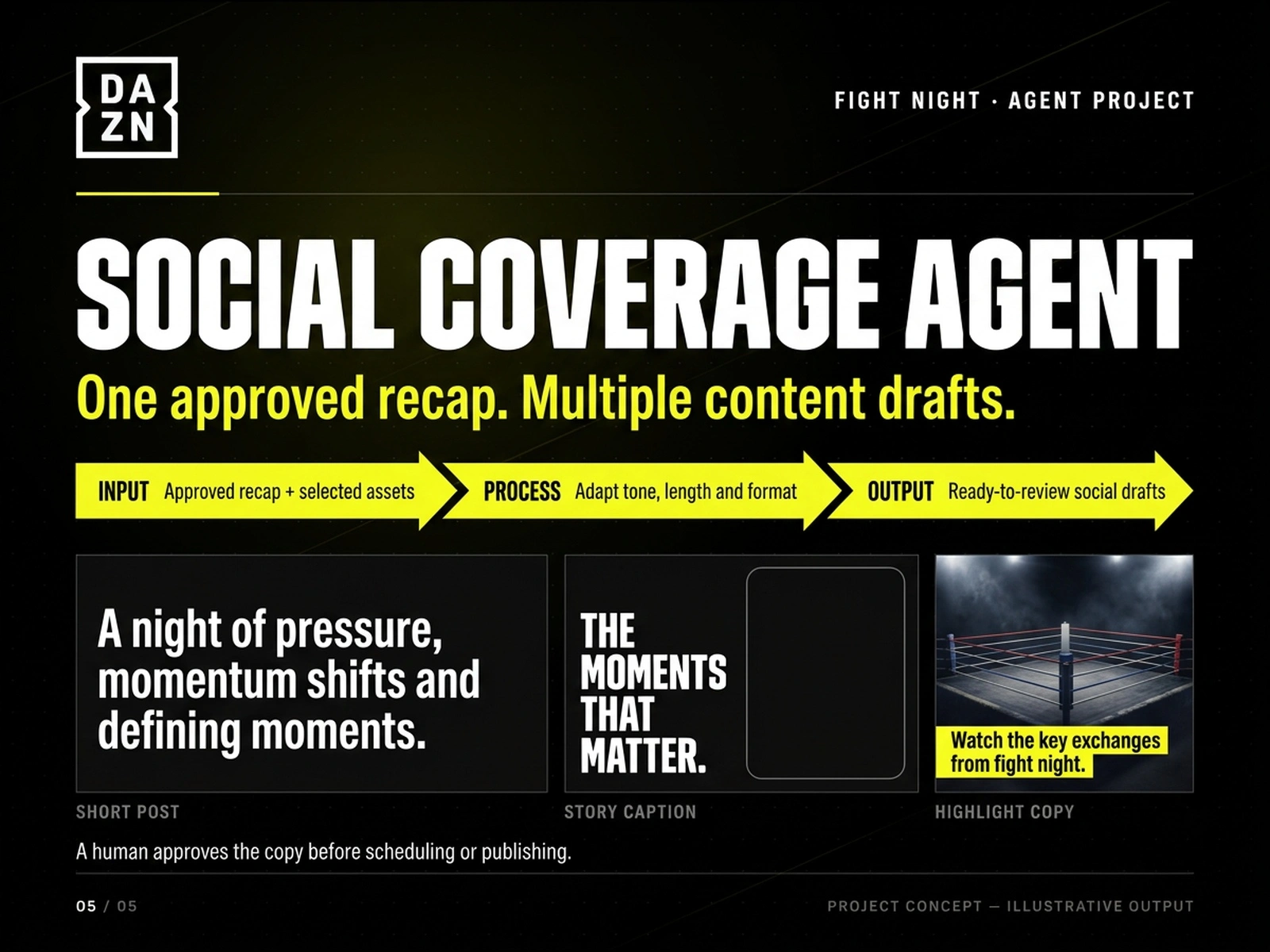
04 — Social Coverage Agent
Purpose: Organize social coverage around fight-night events.
The Social Coverage Agent addresses the social content layer surrounding an event. Its intended role is to help process available posts, commentary, and coverage into more useful summaries of the wider conversation.
Core capabilities
Process available social coverage.
Summarize relevant conversations and reactions.
Identify recurring themes across collected content.
Support the preparation of social coverage summaries.
Technical focus: Content ingestion where configured, text processing, relevance filtering, summarization, and workflow automation.
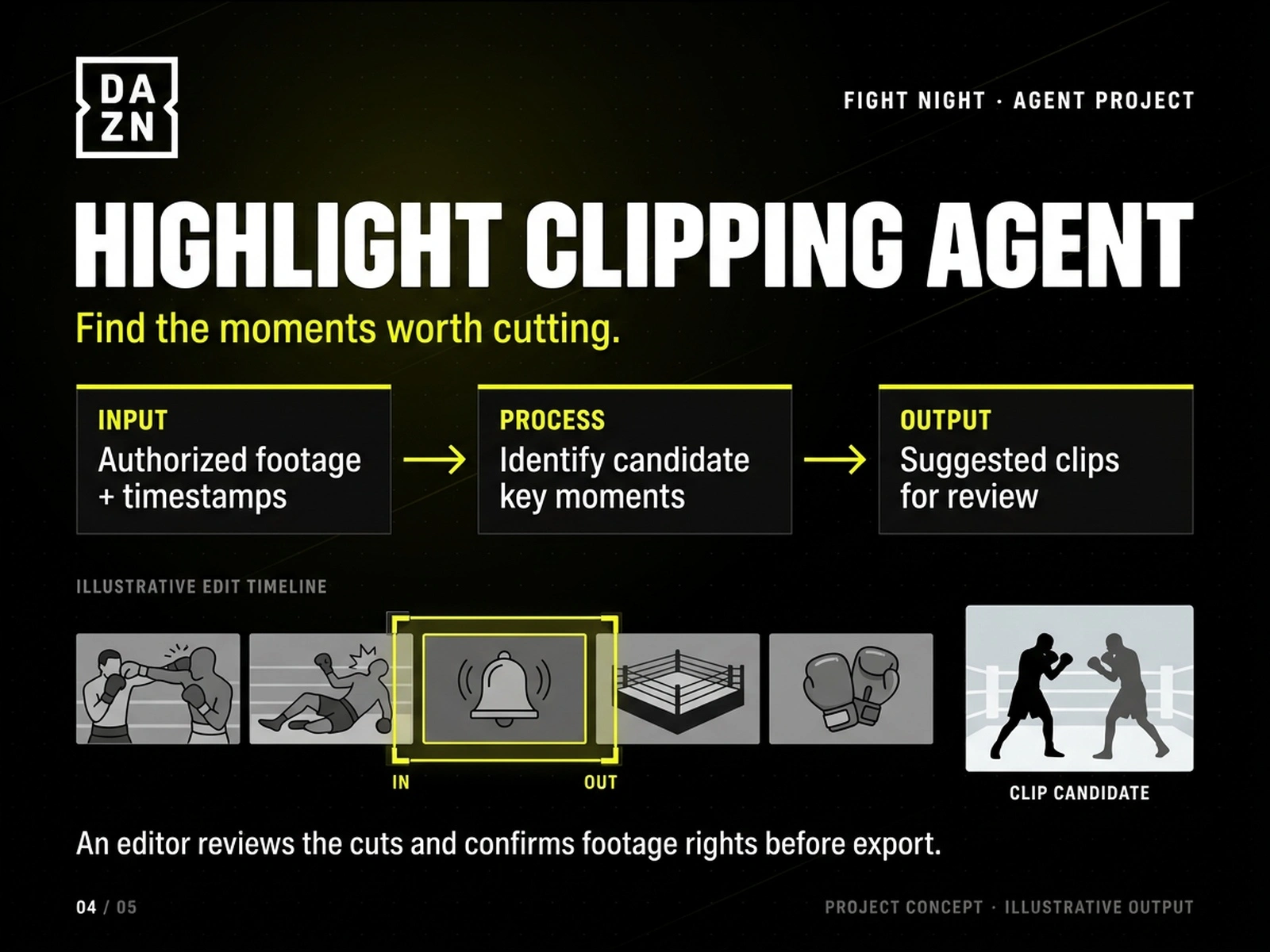
05 — Highlight Agent
Purpose: Surface notable fight moments for highlight-oriented workflows.
The Highlight Agent focuses on identifying or organizing notable moments from available fight-related information. This can support editorial workflows by helping prioritize moments for further inspection and potential highlight production.
Core capabilities
Process available descriptions or metadata related to fight moments.
Identify potentially notable events from the provided inputs.
Organize candidate moments for review.
Support downstream highlight selection and content workflows.
Technical focus: Moment identification, metadata processing, candidate organization, and human review.
Highlight identification depends on the available inputs and configured integrations; automated video clipping or direct video analysis is not assumed.
5. Workflow Automation with BuildShip
BuildShip was used as the workflow and automation layer supporting the project.
Rather than embedding all processing logic into one large workflow, the approach separates individual responsibilities into manageable components.
The workflow layer can support:
Workflow orchestration: Connecting the steps required to process inputs and produce agent outputs.
AI integration: Connecting model-driven processing to the surrounding application logic.
Data transformation: Preparing inputs and shaping outputs for downstream steps.
Error handling: Defining how failed requests or incomplete processing should be handled.
Modular development: Updating individual agent workflows independently as requirements evolve.
This separation creates a foundation for maintaining and extending the system as additional agents, data sources, or editorial requirements are introduced.
6. Technical Design Considerations
Several engineering considerations are important for making a multi-agent sports intelligence system dependable.
Grounded responses: Agents should rely on relevant available information rather than inventing fight results, statistics, or event details.
Structured outputs: Consistent response formats make it easier to present agent results in applications and connect them to downstream workflows.
Failure handling: Missing data, unsuccessful requests, and incomplete outputs should be handled explicitly instead of silently producing misleading responses.
Separation of responsibilities: Each agent should have a clearly defined scope to reduce duplicated logic and make troubleshooting easier.
Human oversight: Editorially sensitive outputs, statistical claims, social summaries, and highlight candidates should be reviewable where accuracy or publication quality matters.
These principles provide a technical foundation for improving reliability without sacrificing the flexibility of AI-driven content workflows.
7. Key Engineering Challenges
The project brings together several challenges common to AI-powered media systems:
Context management: Providing each agent with the information needed for its specific task.
Accuracy and hallucination control: Distinguishing verified event information from generated interpretations.
Workflow reliability: Managing dependencies and failures across connected automation steps.
Output consistency: Keeping responses useful and predictable across different agents.
Extensibility: Making it possible to improve one capability without redesigning the entire system.
The modular agent architecture addresses these concerns by separating responsibilities and making workflow-level improvements easier to manage.
8. Outcome and Future Opportunities
The project establishes a multi-agent approach to fight-night intelligence, combining specialized AI capabilities with BuildShip-based workflow automation.
Potential next steps include integrating verified live event feeds, connecting official fighter statistics, introducing source citations for Q&A responses, enabling social listening through authorized APIs, and linking highlight candidates to timestamped video assets.
Additional opportunities include agent-level evaluation, automated output validation, execution monitoring, and editorial approval workflows.
Conclusion
The DAZN Fight Night Agent Project demonstrates how AI agents and workflow automation can be combined to support specialized sports media tasks.
By separating recaps, Q&A, statistics, social coverage, and highlights into five focused agents, we created a modular approach to fight-night intelligence with BuildShip serving as the automation backbone.
The central engineering principle was specialization over monolithic automation: give each agent a clear responsibility, connect the processing through manageable workflows, and design the system to support accuracy, maintainability, and future expansion.
Like this project
Posted Oct 19, 2026
Built a multi-agent AI system for DAZN Fight Night using BuildShip to automate fight recaps, Q&A, statistics, social coverage, and highlight discovery
Likes
0
Views
1