B2B Thought Leadership Article — AI Demo

Patryk Majda

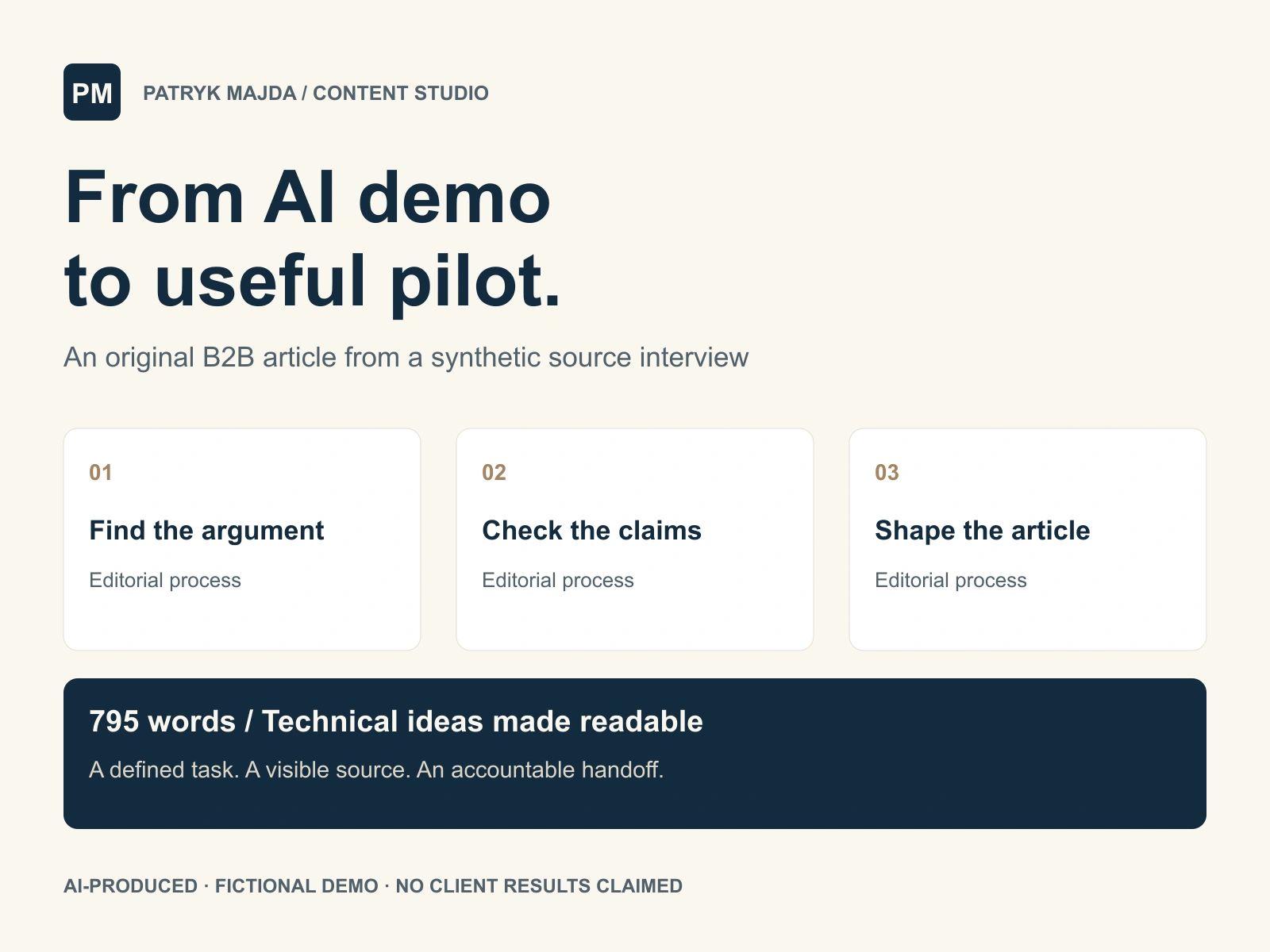
From an AI demo to a useful pilot: define the handoff first
Self-initiated, AI-produced editorial demonstration. The speaker, product and source excerpt below are fictional. This is a sample of transforming a subject-matter expert's thinking into a B2B article, not paid client work, a transcript of a real interview or evidence of results.
Synthetic source excerpt
S1 — The demo. “Imagine an assistant that helps an account team answer a customer's question about a delivery date. It reads the approved order record and drafts an email. A clean example looks easy: one order, one current date, one answer.”
S2 — The exception. “Now the account note says Tuesday and the order record says Thursday. A fluent email isn't a good result if nobody decided which record wins. In our hypothetical pilot, conflicting dates should produce a question for the account owner. The assistant shouldn't pick whichever date makes the nicer sentence.”
S3 — The handoff. “I'd want the draft to show which order record it used and when that record was last updated. The reviewer needs the source next to the answer. The account owner makes the decision. Nothing gets sent automatically in this pilot.”
S4 — The boundary. “Keep the pilot small: one approved data source, one type of question, one account team. Don't quietly add discounts, delivery guarantees or contract interpretation because the model can write about them. New permissions should be separate decisions.”
S5 — The review. “Test more than the happy path. Try missing dates, conflicting notes, two orders with similar names, and a request outside the agreed task. Record whether the assistant drafted an answer, asked a question or stopped, and whether that was the agreed behavior. Don't treat a nice screenshot as proof of readiness.”
S6 — The commercial decision. “For this example we have no customer results, error rates or measured time savings. The point is to design a pilot the team can judge. Maybe it helps, maybe the review work makes the benefit too small. We should be able to find that out without opening up the whole workflow.”
Editorial angle
The strongest argument is about the handoff between an AI-generated draft and an accountable business decision. The article preserves the speaker's concrete delivery-date example. It does not turn a hypothetical workflow into a deployed product or invent a return on investment.
Article
From an AI demo to a useful pilot: define the handoff first
A customer asks when an order will arrive. An assistant finds a date, writes a polite email and hands over a convincing answer. In a demo, that can look like a finished workflow.
Change one detail: the order record says Thursday, but an account note says Tuesday. The assistant can still produce a fluent email. The team now has a decision to make, and the quality of the prose will not make it for them.
Before expanding this hypothetical assistant into a pilot, define what happens at that moment. Which source is authoritative? Who resolves a conflict? What should the assistant show the reviewer? Can anything leave the system before that review?
Those questions turn an impressive example into a task that a business team can evaluate.
Make the next decision visible
Start with a narrow job: use an approved order record to draft a response to a delivery-date question. Keep the distinction between drafting and deciding explicit.
If the record is current and unambiguous, the assistant can prepare a draft. If the information is missing or conflicting, the proposed behavior is to ask the account owner for clarification. It should not resolve a commercial ambiguity by choosing the date that makes the email sound most helpful.
A useful handoff makes this state visible. The reviewer should be able to see the draft, the order record behind it and when that record was last updated. When there is a conflict, the question should name the conflicting information instead of hiding it inside a vague request to “check the answer.”
This is a proposed operating rule for the pilot. Writing the rule down does not prove that the assistant will follow it consistently; that is something the pilot needs to test.
Give the reviewer enough context to act
“Human approval required” is an incomplete design if the reviewer has to reconstruct the source of every sentence.
For this example, the account owner remains responsible for the customer-facing decision. The assistant supplies a draft and its supporting record. The owner can approve the wording, correct it or request better information. Nothing is sent automatically.
Keep that review focused on the actual task. A response about an expected delivery date should not quietly become a delivery guarantee. A request for a discount should not become an invitation for the assistant to invent a price. An email that is well written can still cross the boundary of what the workflow was meant to do.
The handoff is therefore part of the deliverable. It is not an administrative step added after the interesting work is finished.
Keep the first boundary small
Use one approved source, one type of question and one account team for the proposed pilot. That gives the team a specific workflow to examine.
Adding another source changes the questions. If two records disagree, the system needs a rule for that disagreement. Adding another action changes the permissions. Drafting a message and sending it to a customer are different commitments.
Treat these expansions as separate decisions. The ability to generate text about pricing, contracts or exceptions is not a reason to include those tasks in the initial scope.
A narrow scope also gives the reviewer a clearer test: is this request one the assistant is meant to handle? If it is not, the expected response should already be defined.
Test the uncomfortable examples
Prepare cases that expose the boundary: a missing date, two similarly named orders, a stale account note, conflicting information and a request outside the agreed task. Keep the straightforward case too, but do not let it stand in for the whole workflow.
For each example, record what the assistant did. Did it draft an answer, ask a question or stop? Compare that with the behavior agreed in advance. Note whether the reviewer received enough context to make the next decision.
This produces a record the team can discuss. A polished screenshot shows how an answer looks; an exception log shows where the operating rules still need work.
Let the pilot challenge the business case
This fictional example has no measured time savings, customer outcomes or error rates. Those gaps should remain visible.
The pilot may show that the draft is useful. It may also show that checking it takes too much work, or that resolving the underlying records matters more than generating the email. Either finding can inform the next decision.
Before building a broader assistant, write down one task, its approved source, the person responsible for the decision and the expected response when the source is insufficient. Then design the pilot to test that handoff. The result should help the team decide what to change next, including whether to expand at all.
Source and editing notes
- Opening example and scope: S1, S2 and S4.
- Explicit approval and visible source context: S3.
- Exception-based evaluation: S5; proposed rules are distinguished from measured model behavior.
- No ROI, deployment or reliability claims: S6.
- No quotation marks are used in the article to imply that a real person said these words.
- The article develops the synthetic speaker's argument; it is not external research or an assessment of a deployed system.
Like this project
Posted Sep 29, 2026
A 795-word B2B article developed from a synthetic technical interview, with an editorial angle and source checks. Self-initiated AI demonstration.
Likes
0
Views
0