AI Content Editing — LinkedIn & Agent Instructions Demo

Patryk Majda

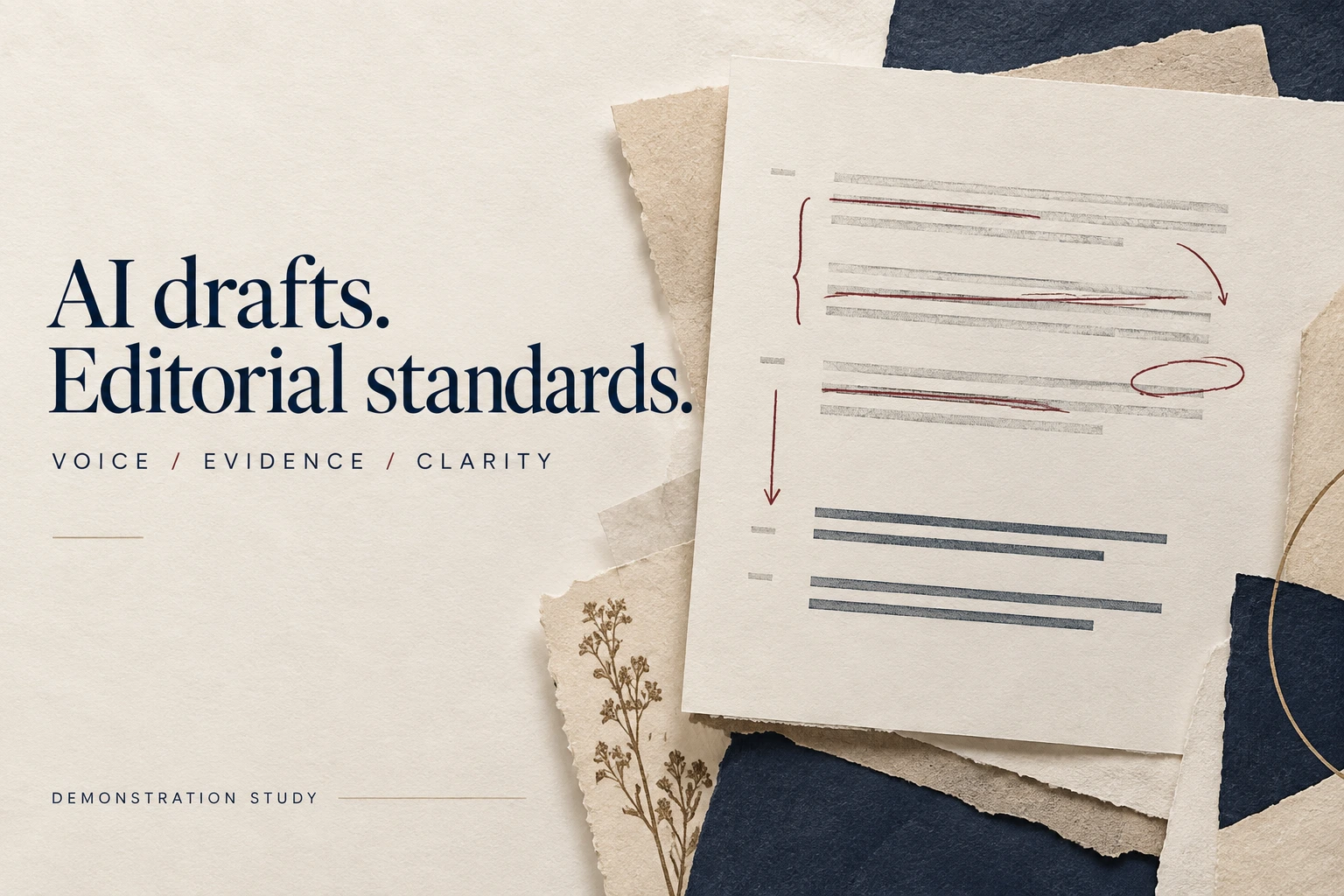
AI drafts. Editorial standards.
Original demonstration study by Patryk Majda. AI-assisted writing and editing. Fictional brief and deliberately flawed draft; no client affiliation, engagement results or executive testimonials.
The brief
Audience: US B2B founders and operations leaders. Format: an executive-style LinkedIn post. Point of view: agree how an AI-assisted customer-response workflow will be reviewed before scaling it. Voice: direct, practical and specific. No invented experiences or performance promises.
Before: deliberately flawed draft
“AI is revolutionizing customer operations. Our game-changing workflow cuts response times by 70% and eliminates errors. Every company must adopt AI now to unlock unprecedented efficiency.”
Diagnosis
The percentage has no source. “Eliminates errors” is an absolute claim. The first-person result implies a real outcome. The argument jumps to a universal recommendation and never explains a decision the reader can make.
After: revised LinkedIn post
Before an AI assistant answers a customer, decide what it should do when the answer is missing.
A useful pilot starts with one narrow queue and a clear escalation rule. Give the assistant approved source material. Tell it which questions require a person. Keep the original message, the draft and the final response together so reviewers can see what changed.
Review the uncomfortable cases: contradictory policies, missing account details and requests that fall outside the playbook. A fluent answer is not evidence that the underlying problem was understood.
Choose the review criteria before the pilot begins. Track incorrect answers, unnecessary escalations, handling time and the amount of editing each draft needs. Compare those observations with the existing workflow before deciding whether to expand.
The first decision is the boundary: what can the assistant handle, and when should it ask for help?
Which customer question would you keep with a person in your first pilot?
What changed
Removed the invented 70% result and the error-free claim.
Replaced generic urgency with a decision about escalation.
Added source material, exception cases and review records.
Proposed evaluation criteria without inventing performance data.
Kept a practical voice without a fabricated personal anecdote.
Reusable writing-agent instructions
Work from an approved brief, a permitted voice sample, a target reader, one argument and approved claims. Ask for missing information instead of inventing experience, metrics or quotations.
Draft 120–200 words in US English. Open with a concrete decision or tension. Develop one argument. Return an internal claim log separately: each factual claim, its supplied source and anything requiring verification. Keep opinions recognizable as opinions. The claim log is a review aid, not part of the public post.
Do not add unsupported numbers, client names, awards, results or first-person anecdotes. Flag missing evidence. Return the post, the claim log and at most three questions for the executive reviewer.
Review and feedback loop
Review evidence, voice, specificity, structure and audience fit. Mark each pass, revise or needs client input, with one concrete example. Unsupported facts or invented personal claims block publication.
For this demo, the unsupported performance claims were removed and the remaining recommendations are presented as advice. A real executive’s voice and industry-specific suitability still require that client’s review.
Record the problem, original wording, approved edit and rule for preventing recurrence. Review these patterns before updating the agent instructions. Publication stays with the account owner or an expressly authorized reviewer.
Deliverables represented
A before/after editorial example, reusable instructions, a claim-review method and a revision rubric. This study does not claim live agent training, publishing, audience testing or engagement outcomes.
Like this project
Posted Sep 29, 2026
Demonstration: a LinkedIn before/after edit, claim checks, writing-agent instructions and a review rubric. AI-assisted; no client results claimed.
Likes
0
Views
0