Premium Kitchen Storage Dispenser Design

Ayodele Eunice Monice


Premium Kitchen Storage Dispenser | Industrial Design, CAD Modeling & Design for Manufacturing (DFM)
Client
Confidential Home & Kitchen Products Company
Industry
Home & Kitchen Products • Consumer Goods • Food Storage Solutions • Manufacturing
Role
Lead Industrial Designer | Product Design Engineer | CAD Engineer | DFM Specialist
Project Overview
This project focused on the design and development of a premium kitchen storage dispenser that combines modern aesthetics, user-friendly functionality, and manufacturing efficiency. The objective was to create a versatile storage solution capable of dispensing dry food items such as rice, cereal, grains, pasta, coffee beans, pet food, and snacks while maintaining freshness, minimizing waste, and complementing contemporary kitchen interiors.
The product required an intuitive dispensing mechanism, generous storage capacity, and a compact footprint suitable for residential kitchens. Beyond functionality, the design emphasized durability, hygiene, ease of cleaning, and efficient production. Every stage of development was driven by the goal of delivering a market-ready consumer product that balances elegant industrial design with engineering practicality.
The project covered the complete product development process, including research, concept generation, industrial design, CAD engineering, mechanical integration, Design for Manufacturing (DFM), and production-ready visualization.
Project Objectives
The project was guided by several key objectives:
• Develop a premium and modern product identity
• Design a compact storage solution with maximum capacity
• Create a reliable and easy-to-use dispensing mechanism
• Improve food accessibility while minimizing product waste
• Ensure simple refilling, cleaning, and maintenance
• Integrate transparent storage sections for easy content visibility
• Optimize internal architecture for efficient dispensing
• Simplify manufacturing and product assembly
• Reduce production costs through Design for Manufacturing
• Develop production-ready CAD models suitable for prototyping and mass production
Product Research & Discovery
The development process began with extensive research into consumer kitchen organization habits, food storage products, and dispensing systems.
Research focused on:
• Kitchen storage behaviors
• Food preservation requirements
• Dispensing convenience
• User interaction
• Refilling frequency
• Cleaning accessibility
• Countertop space limitations
• Competitive product benchmarking
• Manufacturing methods
• Material technologies
The research identified opportunities to improve storage efficiency, reduce food waste, simplify user interaction, and create a more premium alternative to conventional food containers.
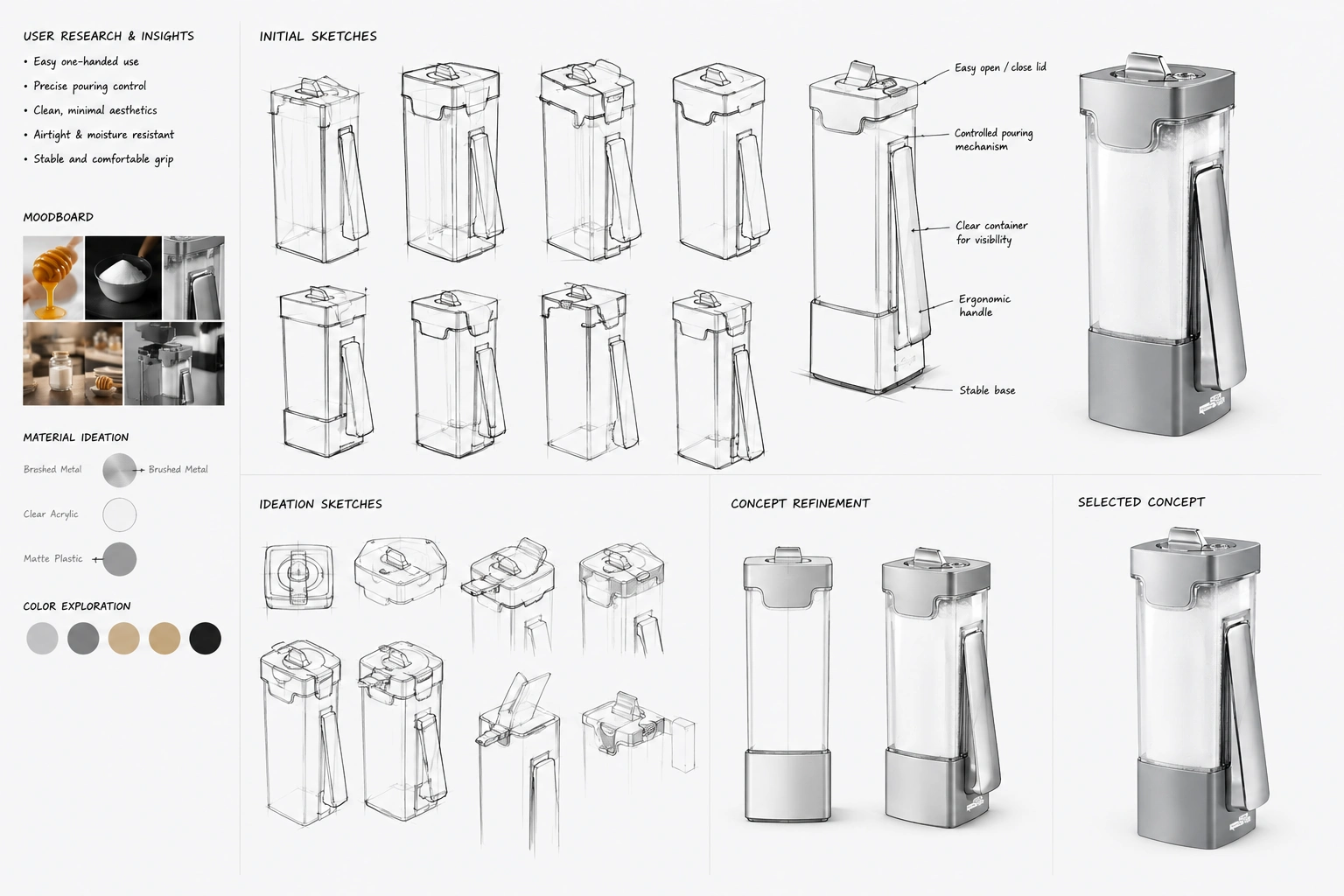
User-Centered Design Strategy
The design strategy prioritized functionality, cleanliness, and ease of everyday use while maintaining a premium visual identity.
Key design principles included:
• Minimal and elegant aesthetics
• Ergonomic dispensing operation
• Efficient use of countertop space
• Hygienic food handling
• Simple maintenance
• Modular construction
• Durable mechanical performance
• Manufacturing efficiency
Every design decision balanced aesthetics, engineering performance, and user convenience to create a product that integrates naturally into modern kitchens.
Ideation & Concept Development
Multiple concepts were explored through sketching and digital ideation before selecting the preferred design direction.
Concept exploration included:
• Overall product proportions
• Storage compartment layouts
• Dispensing mechanism concepts
• Lid opening systems
• Transparent viewing windows
• User interface and interaction points
• Base stability
• Surface detailing
• Branding opportunities
Each concept was evaluated based on usability, manufacturability, internal capacity, engineering feasibility, and visual appeal before moving into detailed development.
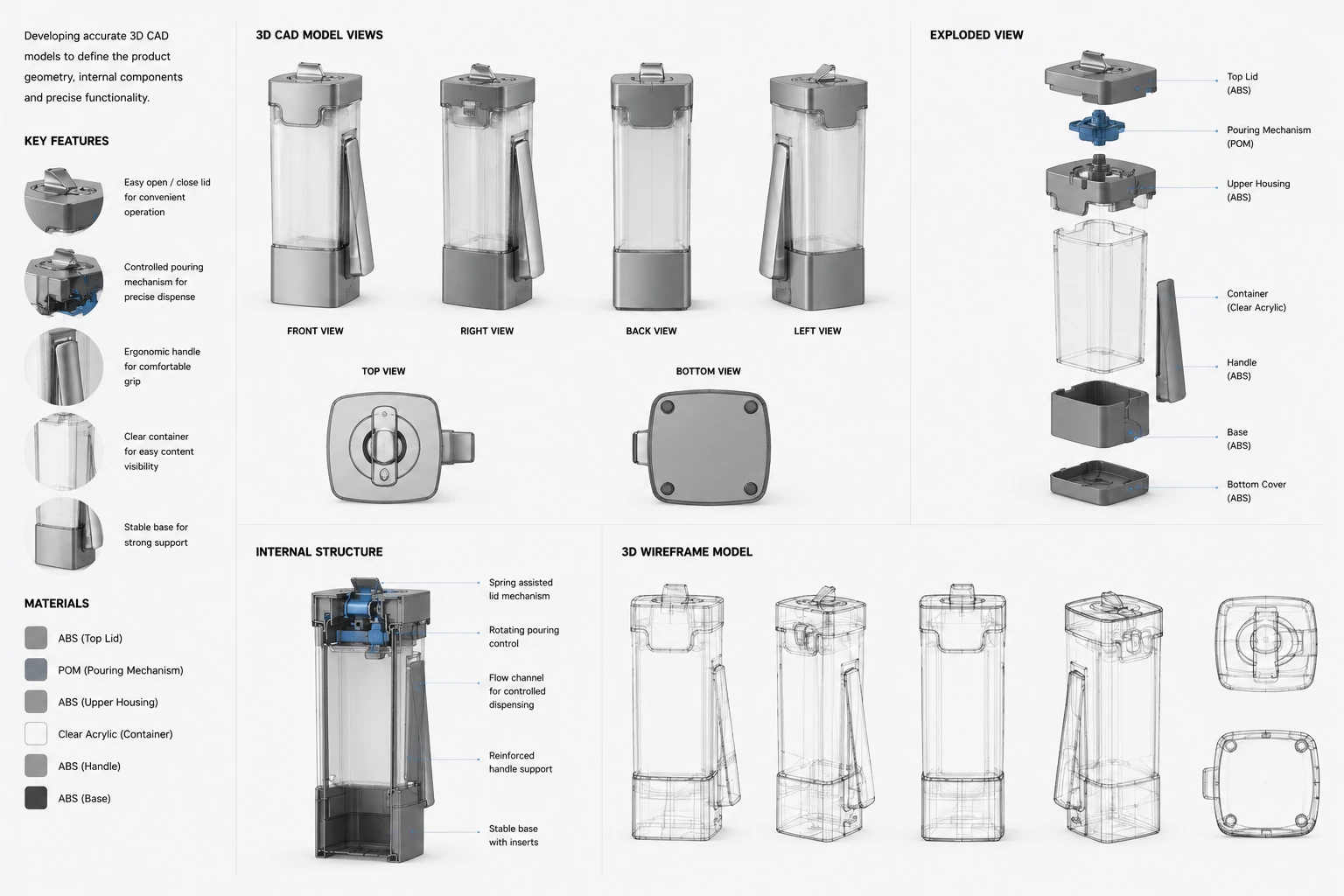
Industrial Design Development
Following concept selection, the product entered a detailed industrial design refinement phase to improve both appearance and functionality.
Development activities included:
• Product proportion refinement
• Surface continuity
• Ergonomic interaction points
• Dispensing handle design
• Lid accessibility
• Visual balance
• Structural detailing
• Premium surface finishes
Several refinement iterations ensured the final design achieved a clean, sophisticated appearance while supporting internal engineering requirements.
Mechanical Engineering & Product Development
Engineering development focused on integrating the dispensing mechanism and storage architecture into a robust and user-friendly product.
Engineering activities included:
• Internal storage compartment design
• Dispensing gate mechanism
• Rotary dispensing components
• Food flow optimization
• Lid locking system
• Structural frame development
• Fastener integration
• Internal reinforcement
• Assembly planning
• Component packaging
The internal architecture was optimized to ensure reliable dispensing, efficient product flow, and long-term durability under repeated use.
3D CAD Modeling
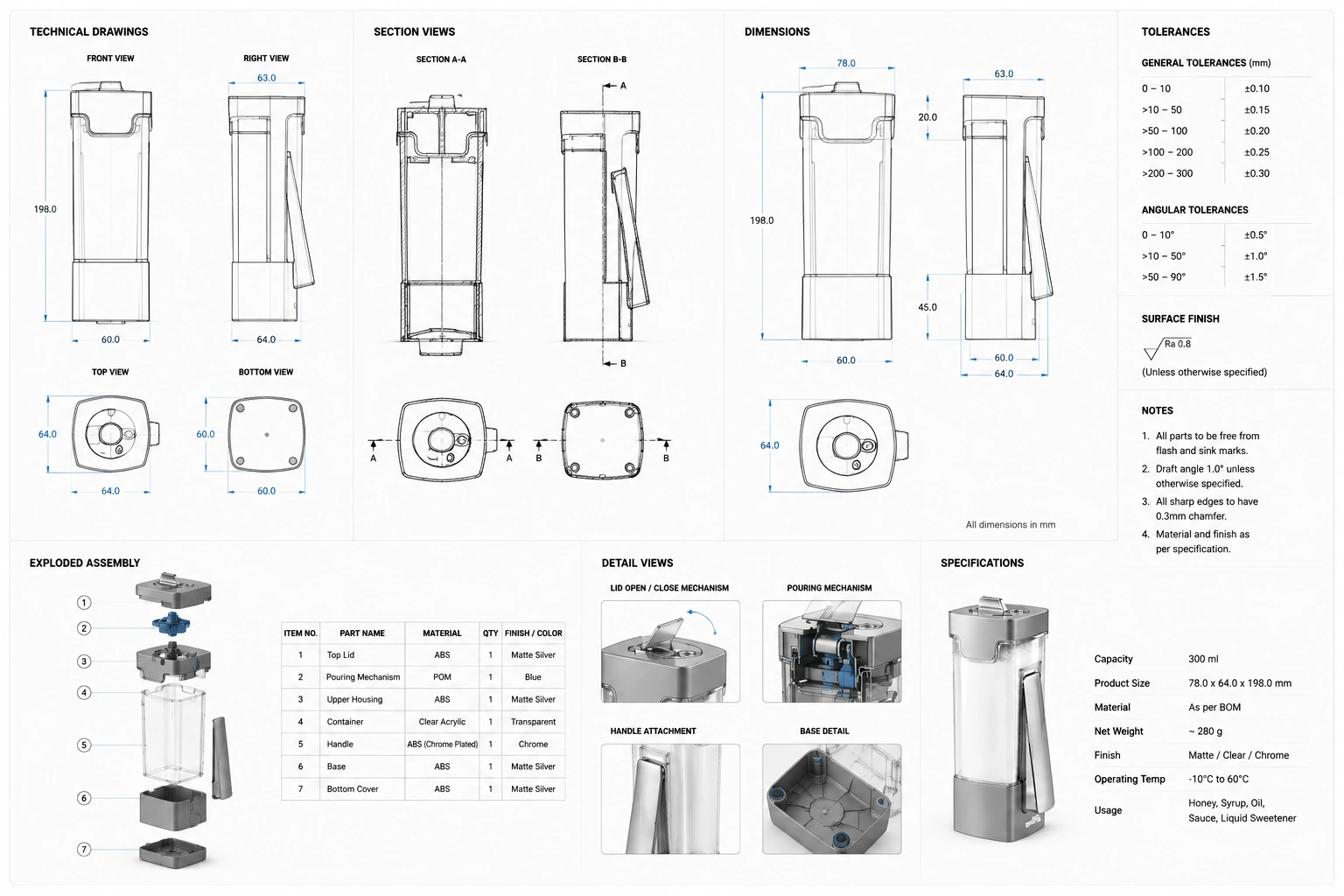
The approved concept was developed into a fully parametric CAD assembly suitable for engineering validation and manufacturing preparation.
CAD development included:
• Master assembly creation
• Exterior enclosure modeling
• Storage chamber design
• Dispensing mechanism modeling
• Internal support structures
• Fastener locations
• Assembly verification
• Tolerance definition
• Manufacturing revisions
• Production-ready engineering models
The CAD model provided accurate geometry for prototype development, tooling, engineering documentation, and production planning.
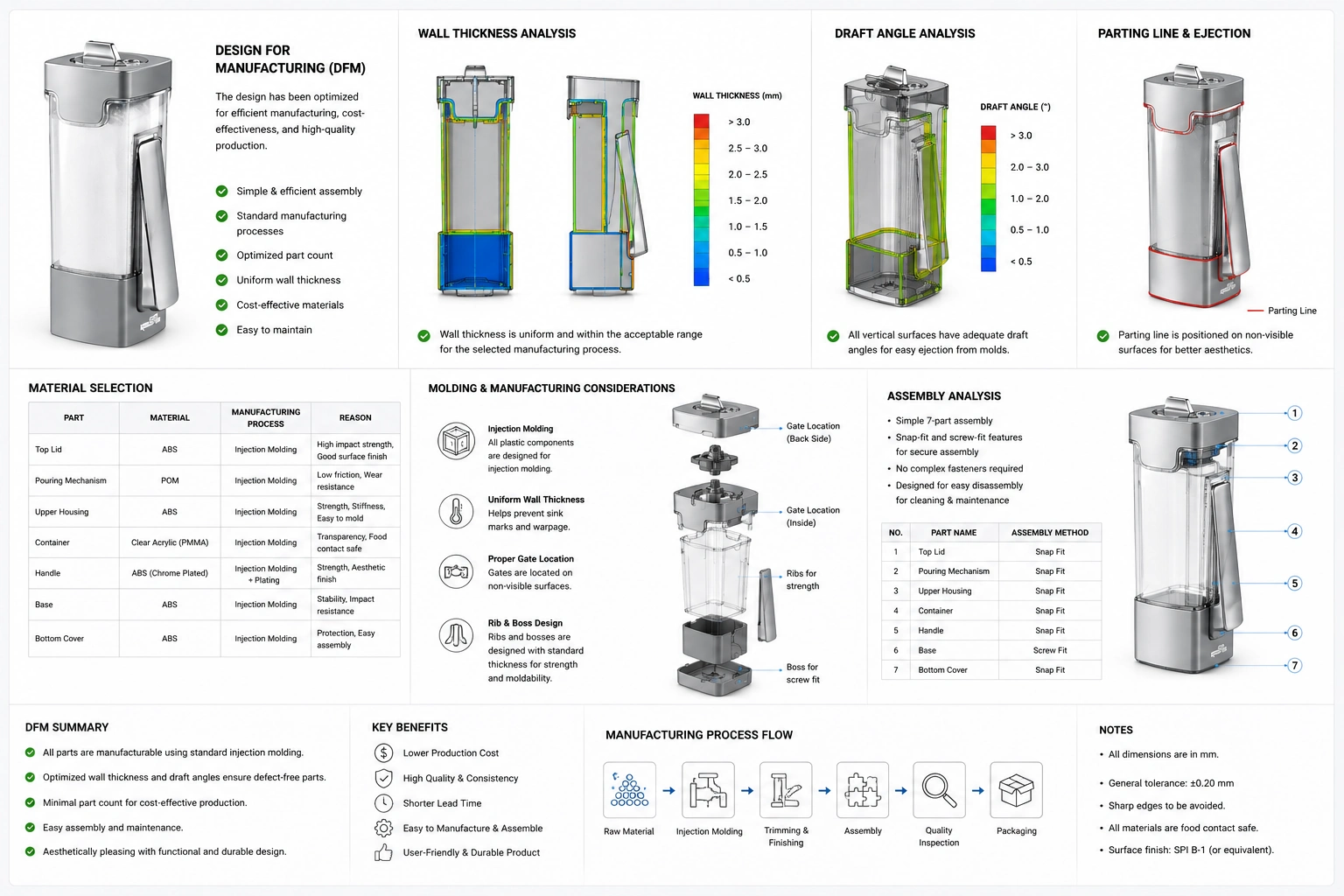
Design for Manufacturing (DFM)
Manufacturing requirements were integrated throughout development to improve efficiency, reduce tooling complexity, and optimize production costs.
DFM activities included:
• Injection molding optimization
• Uniform wall thickness
• Draft angle implementation
• Parting line planning
• Snap-fit feature development
• Fastener reduction
• Tool accessibility
• Assembly simplification
• Material optimization
• Production cost reduction
These improvements ensured consistent product quality while supporting high-volume manufacturing.
Material Selection
Material selection balanced food safety, durability, aesthetics, and manufacturing compatibility.
Recommended materials included:
• Food-grade ABS housing
• BPA-free transparent polycarbonate storage container
• Food-safe polypropylene dispensing components
• Silicone sealing gaskets
• Stainless steel fasteners where required
• Soft-touch elastomer grip surfaces
• Matte textured exterior finishes
The selected materials provide excellent durability, food safety, impact resistance, and long-term performance while maintaining a premium appearance.
Engineering Challenges
Several engineering challenges were addressed during product development.
Key challenges included:
• Designing a smooth and reliable dispensing mechanism
• Preventing food blockages during dispensing
• Maintaining freshness through effective sealing
• Maximizing storage volume within a compact footprint
• Simplifying product cleaning
• Reducing component count
• Balancing premium aesthetics with manufacturing requirements
Each challenge was resolved through iterative engineering analysis, CAD refinement, and design optimization.
Design Validation & Refinement
The product underwent multiple refinement cycles to optimize functionality, manufacturability, and user experience.
Validation activities included:
• Dispensing performance evaluation
• Internal packaging verification
• Assembly review
• Structural assessment
• Ergonomic evaluation
• Surface quality refinement
• Manufacturing analysis
• Product appearance validation
Continuous refinement ensured the final product achieved high standards for usability, durability, and production readiness.
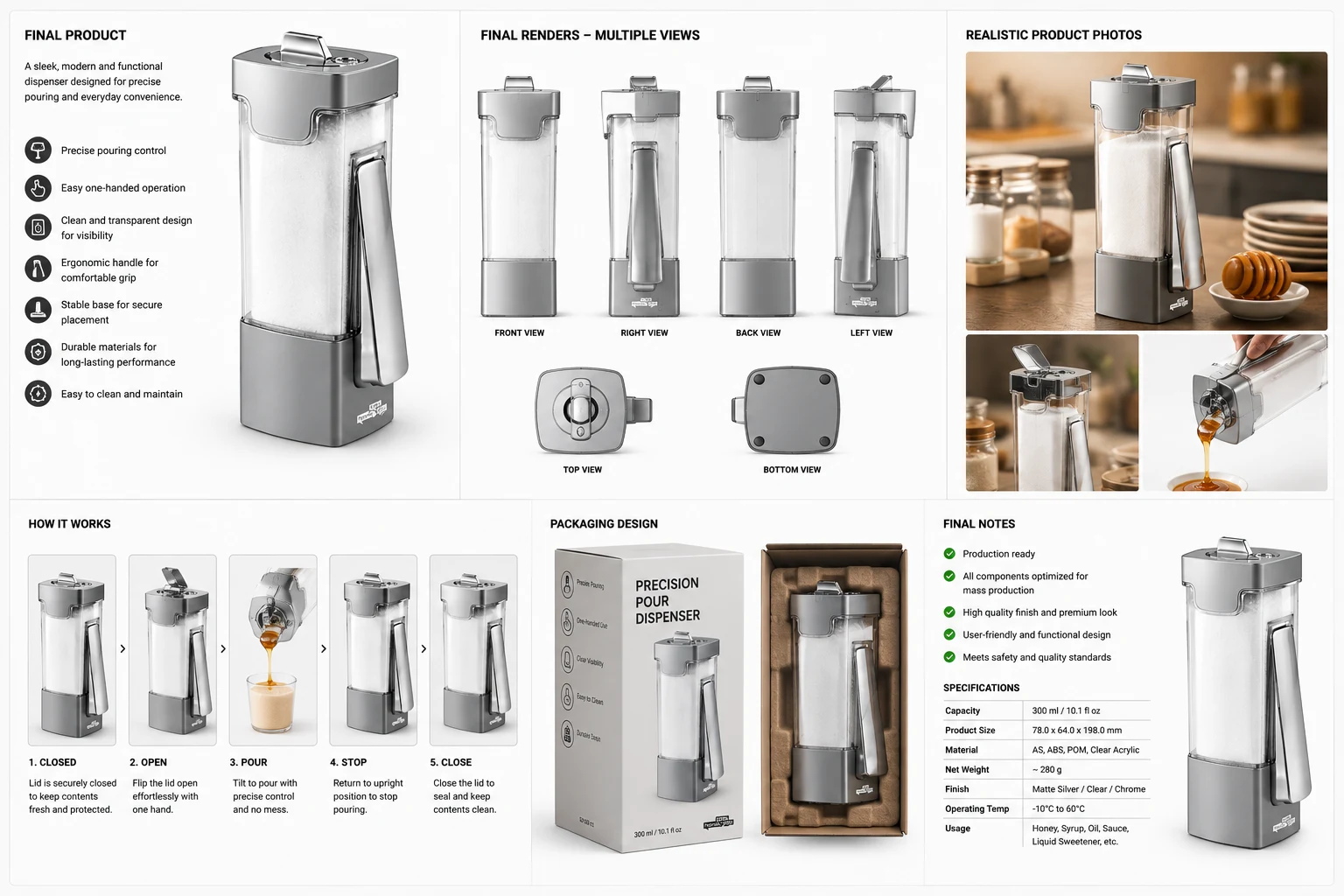
Visualization & Product Presentation
Professional visualization assets were developed to communicate the final product prior to physical prototyping.
Presentation assets included:
• Photorealistic hero renders
• Lifestyle kitchen visualizations
• Multiple viewing angles
• Exploded assembly renderings
• CAD engineering views
• Internal component cutaways
• Material and finish studies
• Technical presentation boards
These visual assets effectively demonstrated the product's premium appearance, engineering quality, and manufacturing readiness.
Deliverables
The completed project included:
• Product research and competitive benchmarking
• User-centered design strategy
• Industrial design concept development
• Concept sketches and ideation
• Mechanical engineering development
• Fully parametric 3D CAD assembly
• Internal dispensing mechanism design
• Detailed component modeling
• Design for Manufacturing (DFM)
• Material and finish recommendations
• Production-ready CAD files
• High-resolution product renderings
• Technical presentation documentation
Results
The final Premium Kitchen Storage Dispenser successfully combines elegant industrial design, intuitive functionality, and engineering precision into a production-ready consumer product. Its optimized dispensing mechanism, efficient internal storage architecture, and premium visual language provide a practical solution for modern kitchens while supporting reliable, high-volume manufacturing.
By integrating industrial design, CAD engineering, mechanical development, and Design for Manufacturing throughout the project, the final product demonstrates a complete product development workflow, from research and concept generation to engineering validation and manufacturing-ready design. The result is a commercially viable kitchen storage solution that enhances food organization, improves user convenience, and reflects high standards of quality, functionality, and manufacturability.
Like this project
Posted Jul 1, 2026
Designed a premium kitchen storage dispenser with modern aesthetics and user-friendly functionality.
Likes
7
Views
5
Timeline
Jun 5, 2026 - Jun 11, 2026