Smart Wearable Design and Development

Ayodele Eunice Monice


Smart Wearable Device | Industrial Design, CAD Modeling & Design for Manufacturing (DFM)
Client
Confidential Consumer Electronics Company
Industry
Wearable Technology • Consumer Electronics • Health & Fitness • Manufacturing
Role
Lead Industrial Designer | Product Design Engineer | CAD Engineer | DFM Specialist
Project Overview
This project focused on the design and development of a next-generation smart wearable device that seamlessly combines advanced technology, ergonomic comfort, and premium industrial design. The objective was to create a compact, lightweight, and aesthetically refined wearable capable of integrating sophisticated electronic components while providing exceptional comfort for continuous daily use.
The design needed to accommodate sensors, a rechargeable battery, wireless communication modules, a display interface, and internal electronics within an ultra-compact enclosure. In addition to visual appeal, the product was engineered for durability, manufacturability, and efficient assembly to support large-scale production.
The project encompassed the complete product development lifecycle—from user research and concept generation to industrial design, CAD engineering, Design for Manufacturing (DFM), and production-ready visualization.
Project Objectives
The project was guided by several strategic objectives:
• Develop a modern and recognizable industrial design language
• Create a lightweight and ergonomic wearable suitable for all-day comfort
• Optimize internal packaging for electronic components
• Design a durable enclosure that protects sensitive hardware
• Improve user interaction and accessibility
• Integrate wearable sensors without compromising aesthetics
• Simplify manufacturing and assembly
• Reduce production costs through efficient engineering
• Develop production-ready CAD models for prototyping and manufacturing
• Ensure scalability for future product variations
Product Research & Discovery
The project began with extensive research into wearable technology, user behavior, manufacturing methods, and emerging design trends.
Research activities focused on:
• Daily wearable usage habits
• Comfort during extended wear
• Human factors and ergonomics
• Sensor positioning
• Display visibility
• Charging solutions
• Water and dust resistance considerations
• Competitive product benchmarking
• Material technologies
• Manufacturing processes
The findings established the design requirements and engineering constraints that guided the entire development process while identifying opportunities to improve usability, comfort, and product differentiation.
User-Centered Design Strategy
The design strategy focused on creating a wearable that feels natural, comfortable, and intuitive while communicating a premium technological identity.
Key design principles included:
• Ergonomic fit
• Lightweight construction
• Minimal visual complexity
• Premium material appearance
• Comfortable skin contact
• Intuitive interaction
• Efficient internal architecture
• Long-term durability
Every design decision was evaluated from both the user's perspective and the manufacturer's perspective to ensure the product achieved an optimal balance between comfort, engineering performance, and production efficiency.
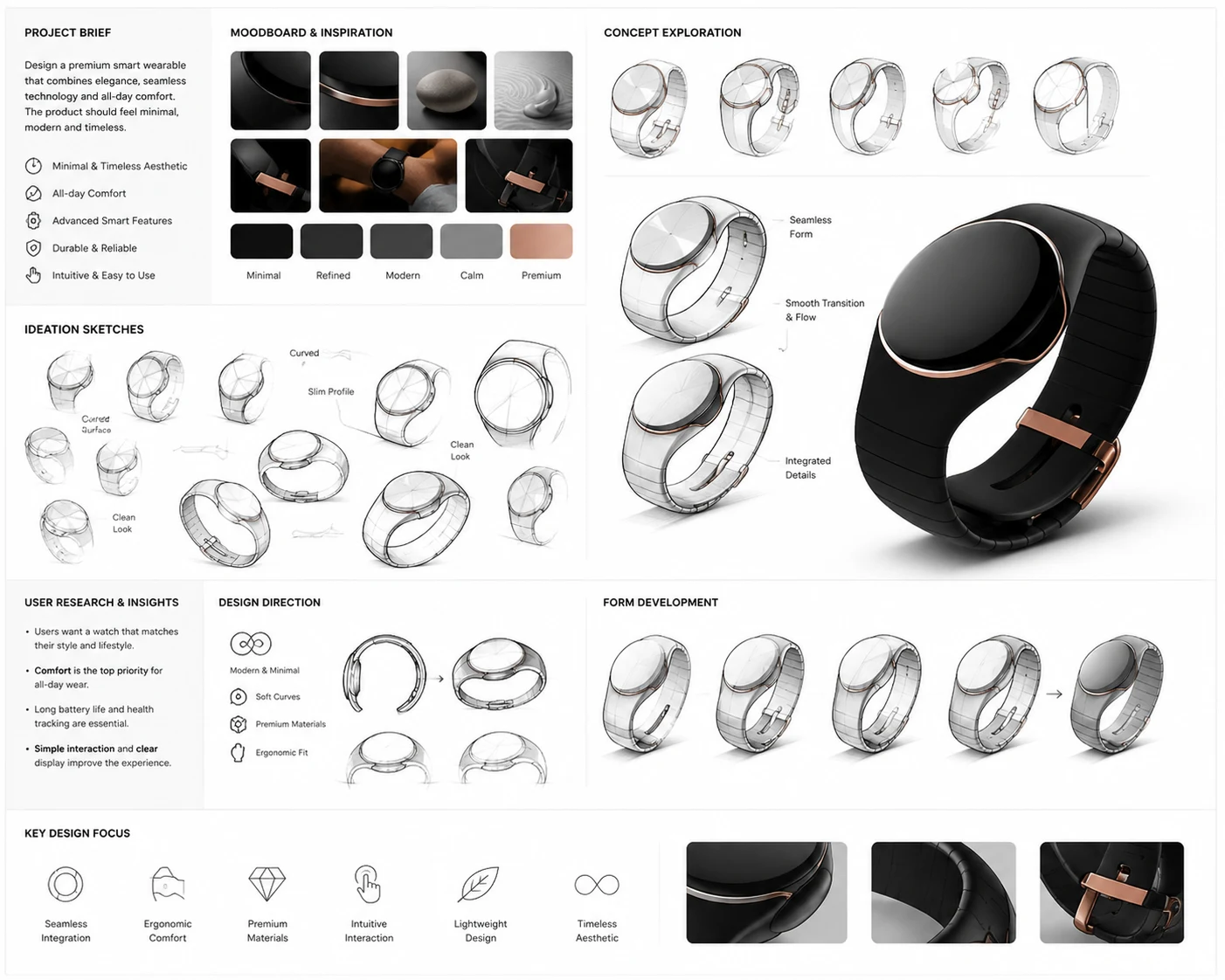
Ideation & Concept Development
The concept development phase explored multiple form factors, interface layouts, and product architectures through sketching and digital ideation.
Concept exploration included:
• Overall product proportions
• Enclosure shapes
• Display integration
• Sensor placement
• Button and touch interface positioning
• Charging interface concepts
• Strap attachment systems
• Surface detailing
• Brand identity integration
Each concept was evaluated based on ergonomics, aesthetics, engineering feasibility, manufacturing complexity, and user experience before selecting the final direction.
Industrial Design Development
The selected concept progressed through multiple refinement cycles to perfect both form and function.
Development activities included:
• Refining enclosure proportions
• Optimizing wrist ergonomics
• Improving display integration
• Enhancing visual balance
• Refining edge transitions
• Developing premium surface finishes
• Integrating functional details
• Improving overall product identity
Attention to detail ensured the wearable achieved a sophisticated appearance while remaining practical for engineering and manufacturing.
Mechanical Engineering & Product Development
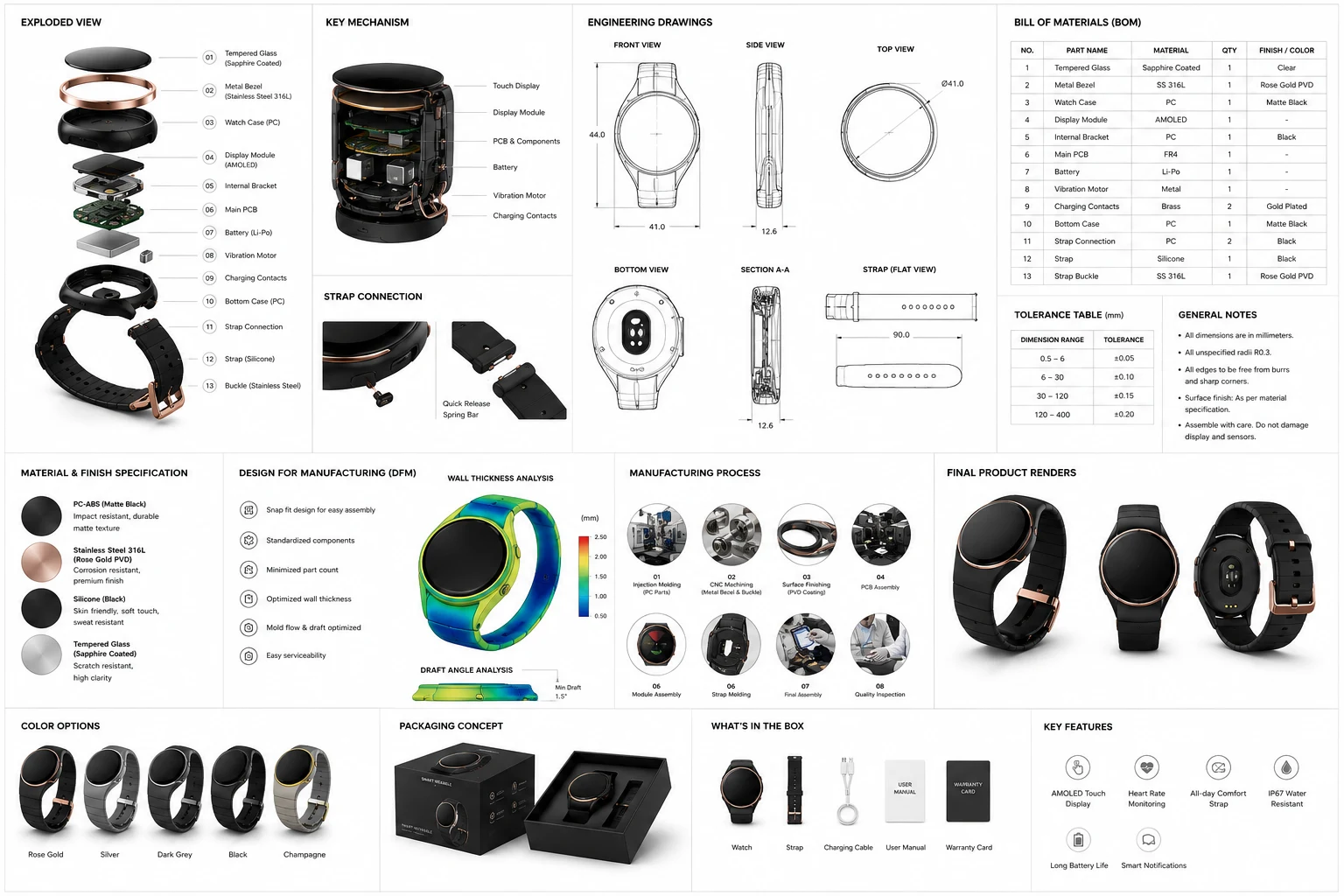
Engineering development focused on integrating all electronic and mechanical systems within an extremely compact form factor.
Engineering activities included:
• Internal frame development
• Battery packaging
• PCB mounting
• Sensor integration
• Display support structure
• Button mechanisms
• Charging interface integration
• Structural reinforcement
• Sealing features
• Assembly planning
The internal architecture was optimized to maximize available space while protecting sensitive components and supporting long-term product reliability.
3D CAD Modeling
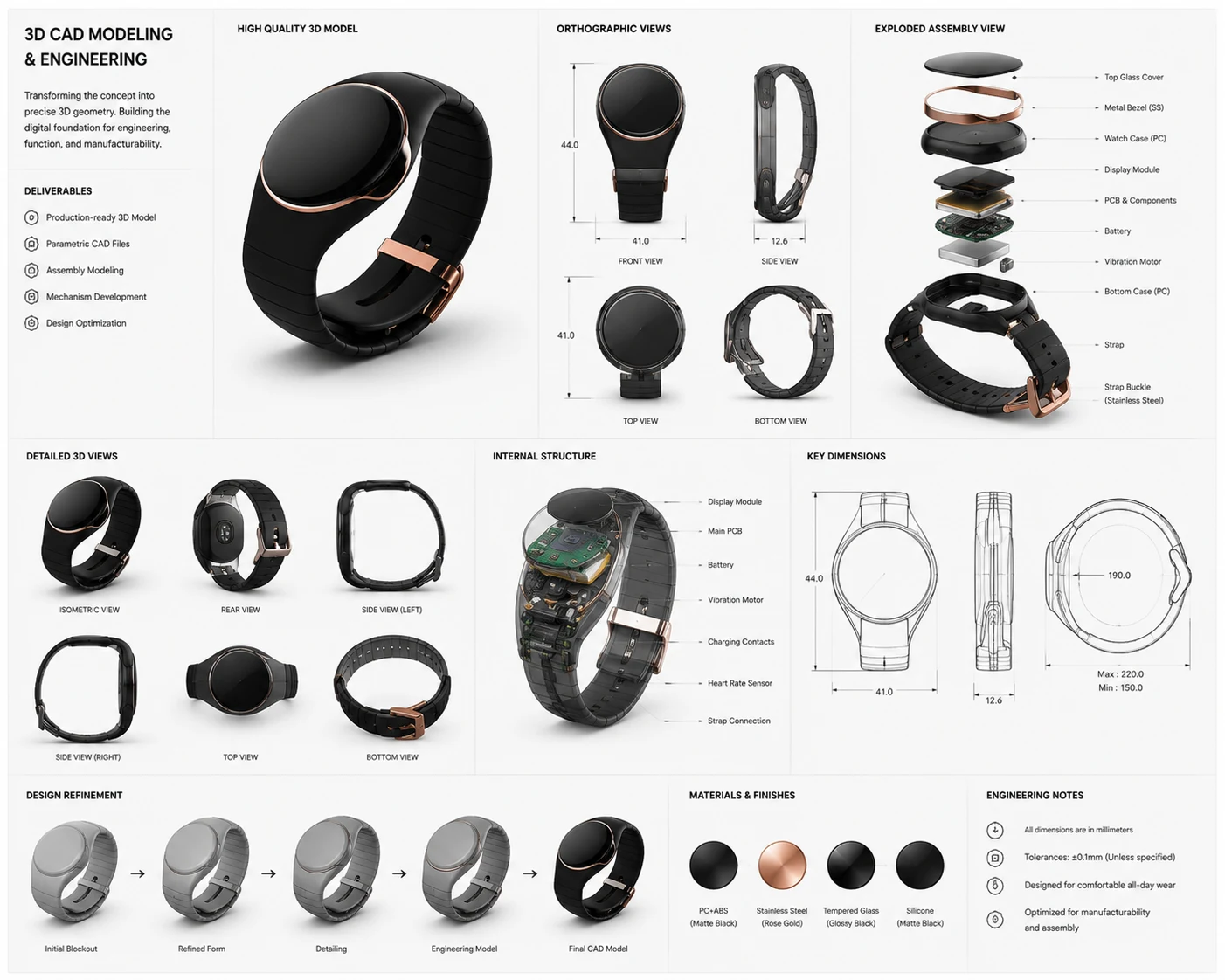
The wearable device was developed as a fully parametric CAD assembly suitable for engineering validation, prototyping, and manufacturing.
CAD development included:
• Master assembly creation
• Exterior enclosure modeling
• Internal structural components
• PCB packaging
• Battery compartment design
• Display housing
• Fastener integration
• Assembly verification
• Tolerance definition
• Engineering revisions
The completed CAD model provided accurate manufacturing geometry and served as the foundation for prototype development and production tooling.
Design for Manufacturing (DFM)
Manufacturing considerations were incorporated throughout development to improve production efficiency and reduce manufacturing risk.
DFM activities included:
• Injection molding optimization
• Uniform wall thickness
• Draft angle implementation
• Parting line planning
• Snap-fit feature development
• Fastener reduction
• Tool accessibility
• Assembly sequence optimization
• Material efficiency
• Production cost reduction
These improvements ensured the wearable could be manufactured consistently while maintaining premium quality standards.
Material Selection
Material selection balanced aesthetics, durability, user comfort, and manufacturing compatibility.
Recommended materials included:
• Glass-filled polycarbonate enclosure
• Medical-grade silicone wrist strap
• Stainless steel structural components
• Chemically strengthened glass display cover
• Soft-touch elastomer contact surfaces
• Precision-machined aluminum accent components
• Scratch-resistant exterior finishes
The selected materials deliver excellent durability, comfort, and premium aesthetics while supporting efficient manufacturing.
Engineering Challenges
Developing a compact wearable introduced several engineering challenges that required iterative refinement.
Key challenges included:
• Packaging numerous electronic components within a limited space
• Maintaining all-day wearing comfort
• Protecting sensitive electronics from environmental exposure
• Optimizing battery capacity without increasing size
• Managing heat generated by internal components
• Achieving reliable structural integrity with minimal wall thickness
• Simplifying assembly while maintaining premium quality
Each challenge was addressed through engineering analysis, CAD optimization, and continuous product refinement.
Design Validation & Refinement
The wearable underwent multiple refinement cycles to optimize both functionality and manufacturability.
Validation activities included:
• Ergonomic assessment
• Component packaging verification
• Assembly evaluation
• Structural analysis
• Surface quality refinement
• User interaction testing
• Manufacturing review
• Visual design evaluation
The iterative refinement process ensured the final design satisfied both engineering requirements and user expectations.
Visualization & Product Presentation
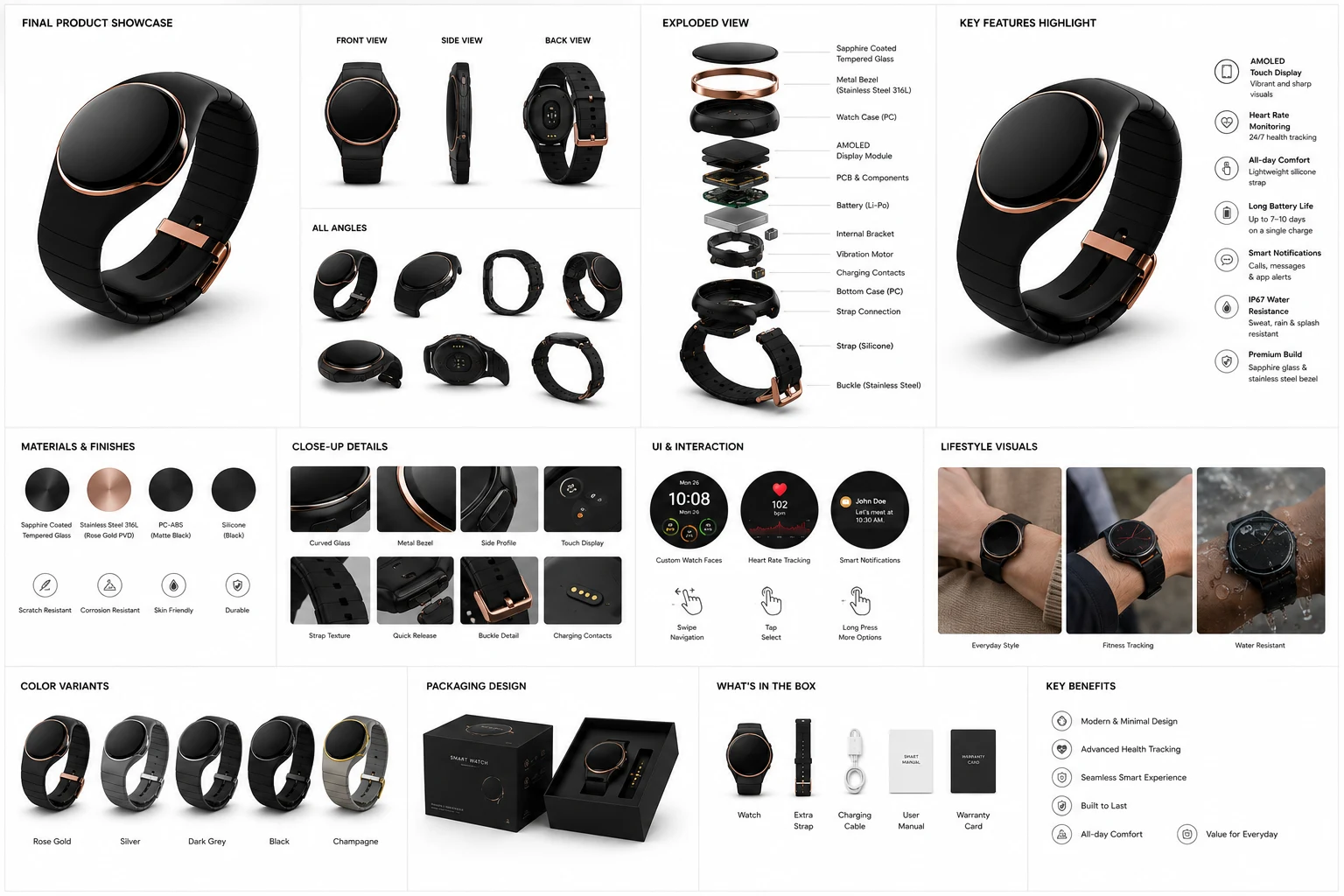
Professional visualization assets were developed to communicate the design prior to physical prototyping.
Presentation assets included:
• Photorealistic hero renders
• Lifestyle product visualizations
• Multiple viewing angles
• Exploded assembly renderings
• CAD engineering views
• Internal component cutaways
• Material and finish studies
• Technical presentation boards
These assets effectively showcased both the product's visual quality and engineering sophistication.
Deliverables
The completed project included:
• Product research and market analysis
• User-centered design strategy
• Industrial design concept development
• Concept sketches and ideation
• Mechanical engineering development
• Fully parametric 3D CAD assembly
• Internal component packaging
• Detailed component modeling
• Design for Manufacturing (DFM)
• Material and finish recommendations
• Production-ready CAD files
• High-resolution product renderings
• Technical presentation documentation
Results
The final smart wearable device successfully integrates advanced technology, ergonomic comfort, and premium industrial design into a compact, production-ready product. The optimized internal architecture, refined enclosure design, and efficient manufacturing strategy deliver a wearable that is both visually sophisticated and technically robust.
By combining industrial design, CAD engineering, mechanical development, and Design for Manufacturing throughout the project, the final solution demonstrates a complete product development workflow—from research and concept generation to engineering validation and manufacturing-ready design. The result is a commercially viable wearable technology product that offers exceptional usability, durability, and scalability for modern consumer markets.
Like this project
Posted Jun 30, 2026
Designed next-gen smart wearable focusing on technology, comfort, and manufacturability.
Likes
1
Views
0
Timeline
Apr 7, 2026 - Apr 14, 2026