Premium Drinkware Design and DFM

Ayodele Eunice Monice


Premium Drinkware Product Design | Industrial Design, 3D CAD Modeling & Design for Manufacturing (DFM)
Client
Confidential Consumer Products Brand
Industry
Consumer Products • Drinkware • Lifestyle Products • Manufacturing
Role
Lead Industrial Designer | Product Design Engineer | CAD Engineer | DFM Specialist
Project Overview
The goal of this project was to design a premium reusable drinkware product that combines sophisticated aesthetics, exceptional user comfort, and engineering precision. The client wanted a product that would stand out in the growing premium drinkware market while offering superior functionality, durability, and manufacturing efficiency.
Beyond creating an attractive product, the project focused on delivering a complete product development solution—from initial research and concept generation to engineering, CAD development, and Design for Manufacturing (DFM). Every stage of the process was carefully managed to ensure the final design was visually distinctive, technically robust, and ready for prototyping and large-scale production.
The final outcome is a refined drinkware solution that reflects modern industrial design principles, thoughtful engineering, and production-ready manufacturing considerations.
Project Objectives
The project was guided by several key objectives that balanced user needs, engineering requirements, and commercial viability.
The primary objectives included:
• Develop a clean and premium industrial design language
• Create an ergonomic form that feels comfortable during prolonged use
• Improve the drinking experience through thoughtful lid and opening design
• Design a secure leak-resistant closure system
• Maximize internal volume while maintaining compact external proportions
• Optimize structural strength without unnecessary material usage
• Reduce manufacturing complexity and production costs
• Simplify assembly for efficient mass production
• Create production-ready CAD suitable for tooling and manufacturing
• Ensure the design could be easily adapted into future product variations
Product Research & Discovery
Every successful product begins with understanding the market, the user, and the technical constraints.
The discovery phase involved extensive research into premium drinkware products, manufacturing methods, consumer expectations, and emerging design trends.
Areas of research included:
• Consumer usage habits
• Hydration routines
• Portability requirements
• Ergonomic grip preferences
• Cleaning and maintenance
• Leak prevention technologies
• Thermal insulation considerations
• Manufacturing processes
• Material performance
• Sustainability opportunities
• Competitive product benchmarking
Multiple existing products were evaluated to identify design opportunities, common user frustrations, and engineering improvements. These insights established a clear design direction and defined the technical requirements that guided the rest of the development process.
User-Centered Design Strategy
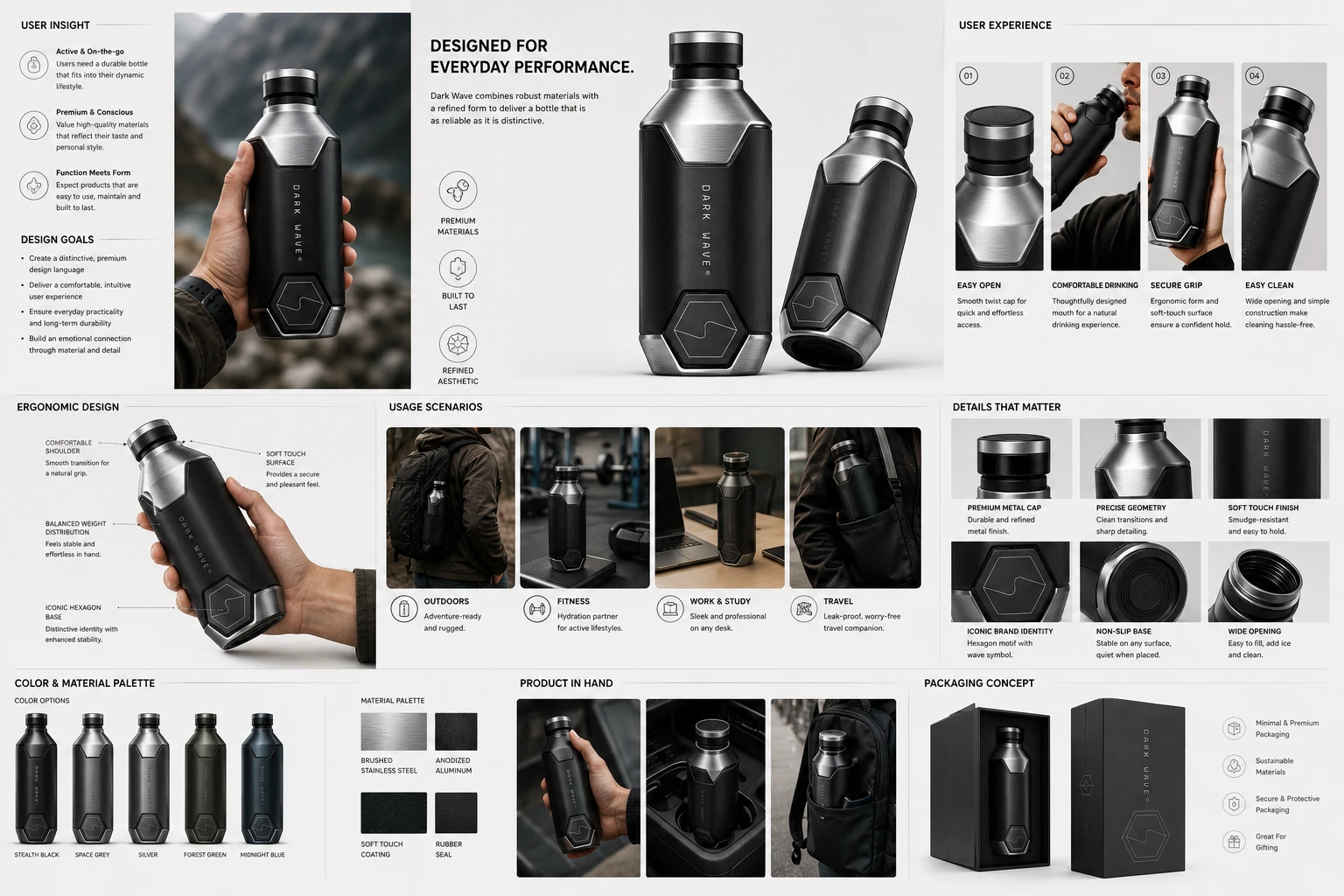
The design strategy focused on creating a product that feels intuitive, premium, and enjoyable to use every day.
Rather than prioritizing appearance alone, the design process balanced aesthetics with usability, engineering performance, manufacturing efficiency, and long-term durability.
The design philosophy emphasized:
• Minimal yet distinctive styling
• Comfortable one-handed operation
• Balanced visual proportions
• Smooth transitions between components
• Clean product architecture
• Functional simplicity
• Efficient assembly
• Long product lifespan
Every design decision was evaluated from the perspective of both the end user and the manufacturing team to ensure the product performed as well as it looked.
Concept Development
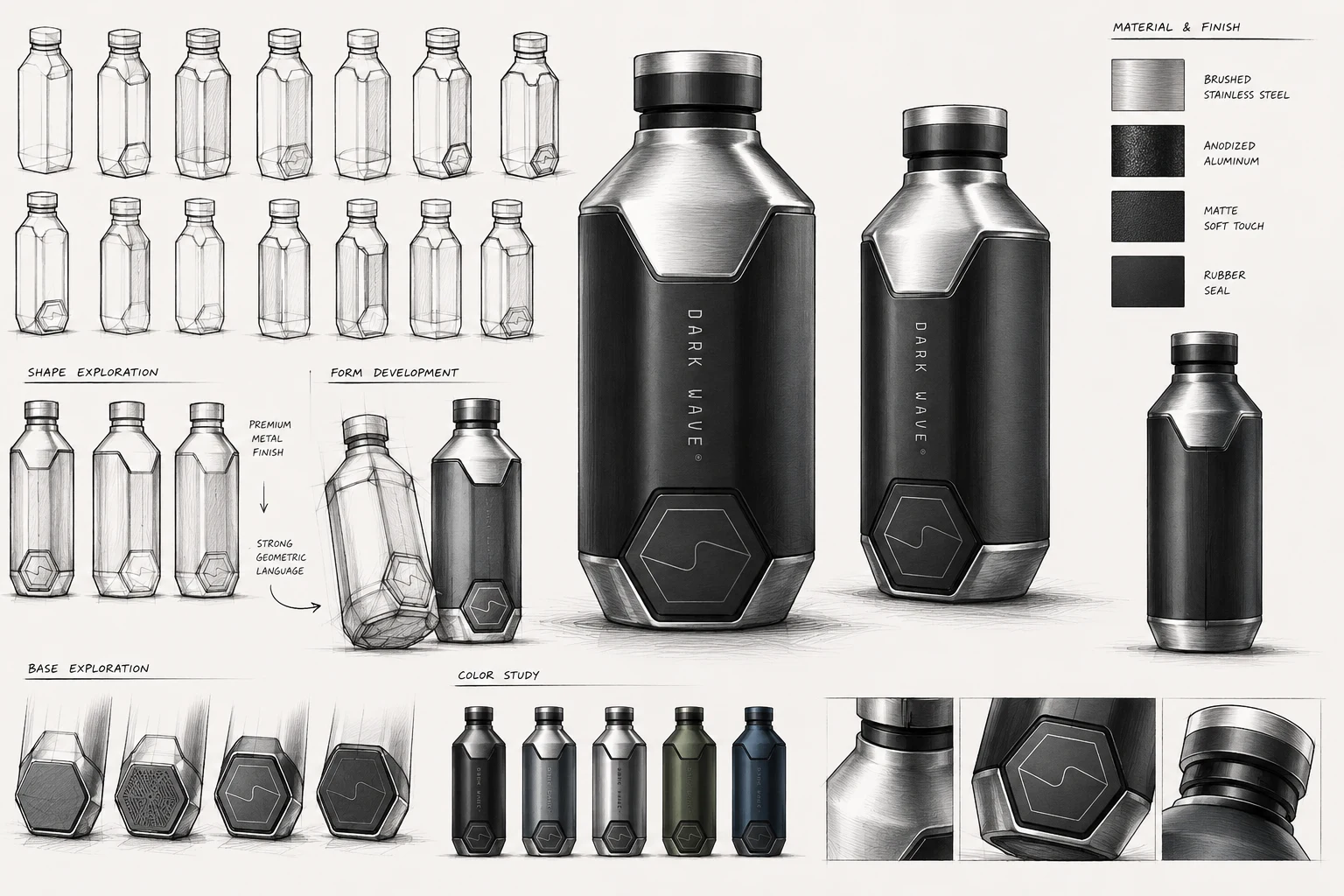
Concept generation began with rapid ideation, allowing multiple design directions to be explored before selecting the strongest solution.
Numerous sketches and digital concepts investigated different approaches to:
• Body proportions
• Overall silhouette
• Grip ergonomics
• Lid mechanisms
• Drinking interface
• Base geometry
• Surface detailing
• Branding opportunities
• Visual balance
Each concept was reviewed against user experience, manufacturability, structural integrity, production cost, and aesthetic appeal.
Following several evaluation rounds, the strongest concept was selected for refinement and engineering development.
Industrial Design Development
Once the preferred concept had been selected, the product entered a detailed industrial design refinement phase.
This stage focused on perfecting every visible aspect of the product, ensuring the final design communicated quality while remaining practical for manufacturing.
Development activities included:
• Refining body proportions
• Improving hand comfort
• Optimizing lid integration
• Perfecting surface continuity
• Refining edge radii and transitions
• Balancing visual weight
• Enhancing premium appearance
• Defining product details
Several design iterations were completed to refine every curve, intersection, and interface until the product achieved a cohesive and timeless appearance.
3D CAD Modeling
Following design approval, the product was developed into a fully parametric engineering model using professional CAD software.
Every component was modeled with manufacturing accuracy, allowing the design to move seamlessly into prototyping and production.
CAD development included:
• Master model creation
• Solid modeling
• Surface modeling
• Internal component architecture
• Lid assembly
• Thread development
• Seal interface design
• Tolerance definition
• Manufacturing clearances
• Assembly validation
• Engineering revisions
The CAD model became the foundation for engineering review, visualization, prototyping, and future tooling development.
Engineering & Product Development
Engineering development focused on ensuring the product delivered reliable long-term performance while remaining practical to manufacture.
Critical engineering considerations included:
• Structural integrity
• Weight optimization
• Leak-proof performance
• Assembly efficiency
• Material compatibility
• Thermal expansion
• Impact resistance
• User safety
• Serviceability
• Dimensional consistency
Engineering validation ensured the final design met functional requirements without compromising aesthetics or production efficiency.
Design for Manufacturing (DFM)
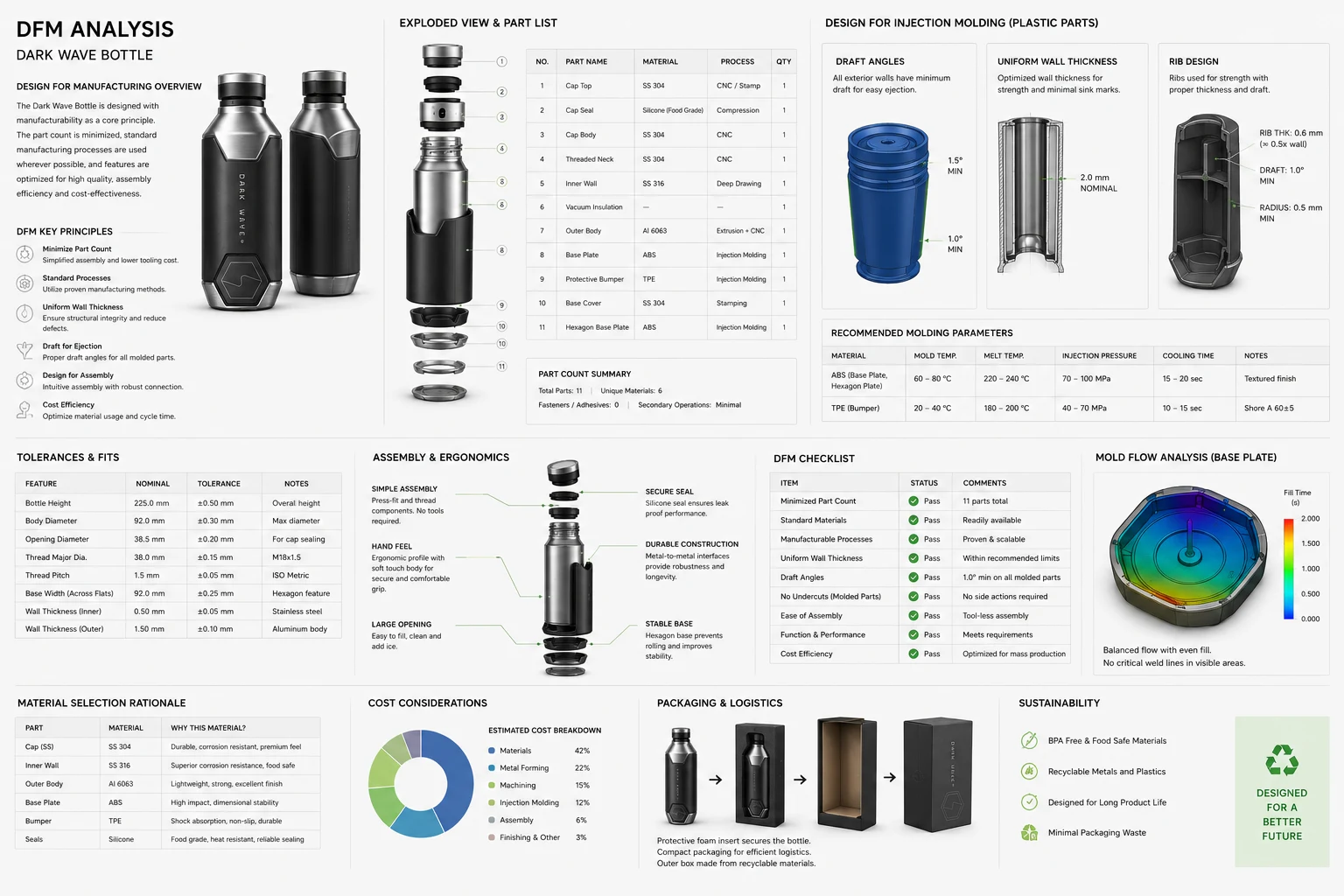
Design for Manufacturing principles were integrated from the earliest stages of development to reduce production risks and improve manufacturing efficiency.
The DFM process addressed:
• Uniform wall thickness
• Draft angle optimization
• Injection molding requirements
• Parting line placement
• Tool accessibility
• Component simplification
• Snap-fit opportunities
• Fastener reduction
• Material efficiency
• Cycle time optimization
• Cost reduction
• Assembly optimization
By incorporating manufacturing requirements throughout development, the final product is well suited for high-volume production with reduced tooling complexity and improved consistency.
Material Selection
Material selection played a critical role in achieving the desired balance between performance, appearance, durability, and manufacturing efficiency.
The proposed material strategy included:
• Double-wall stainless steel for the main vessel
• BPA-free food-grade polymer for the lid
• Food-grade silicone seals for leak prevention
• Powder-coated exterior finishes
• Brushed stainless steel accent surfaces
• High-wear resistant internal finishes
Material selection considered mechanical performance, food safety, production methods, durability, sustainability, and long-term customer satisfaction.
Engineering Challenges
Several engineering challenges were encountered throughout development, requiring multiple design iterations and technical problem-solving.
Key challenges included:
• Designing a reliable leak-proof sealing system
• Maintaining structural strength while minimizing weight
• Maximizing internal liquid capacity
• Integrating multiple components into a compact assembly
• Balancing premium aesthetics with manufacturing constraints
• Simplifying assembly for production
• Ensuring consistent tolerances across mating components
Each challenge was resolved through iterative CAD refinement, engineering reviews, and continuous evaluation of manufacturability.
Design Validation & Refinement
Following engineering development, the product underwent several rounds of refinement to optimize both functionality and appearance.
Validation activities focused on:
• Ergonomic assessment
• Dimensional verification
• Assembly evaluation
• Surface quality inspection
• Component fit analysis
• Visual proportion refinement
• Manufacturing review
• User interaction improvements
The continuous refinement process ensured the product met design intent while remaining feasible for manufacturing.
Visualization & Product Presentation
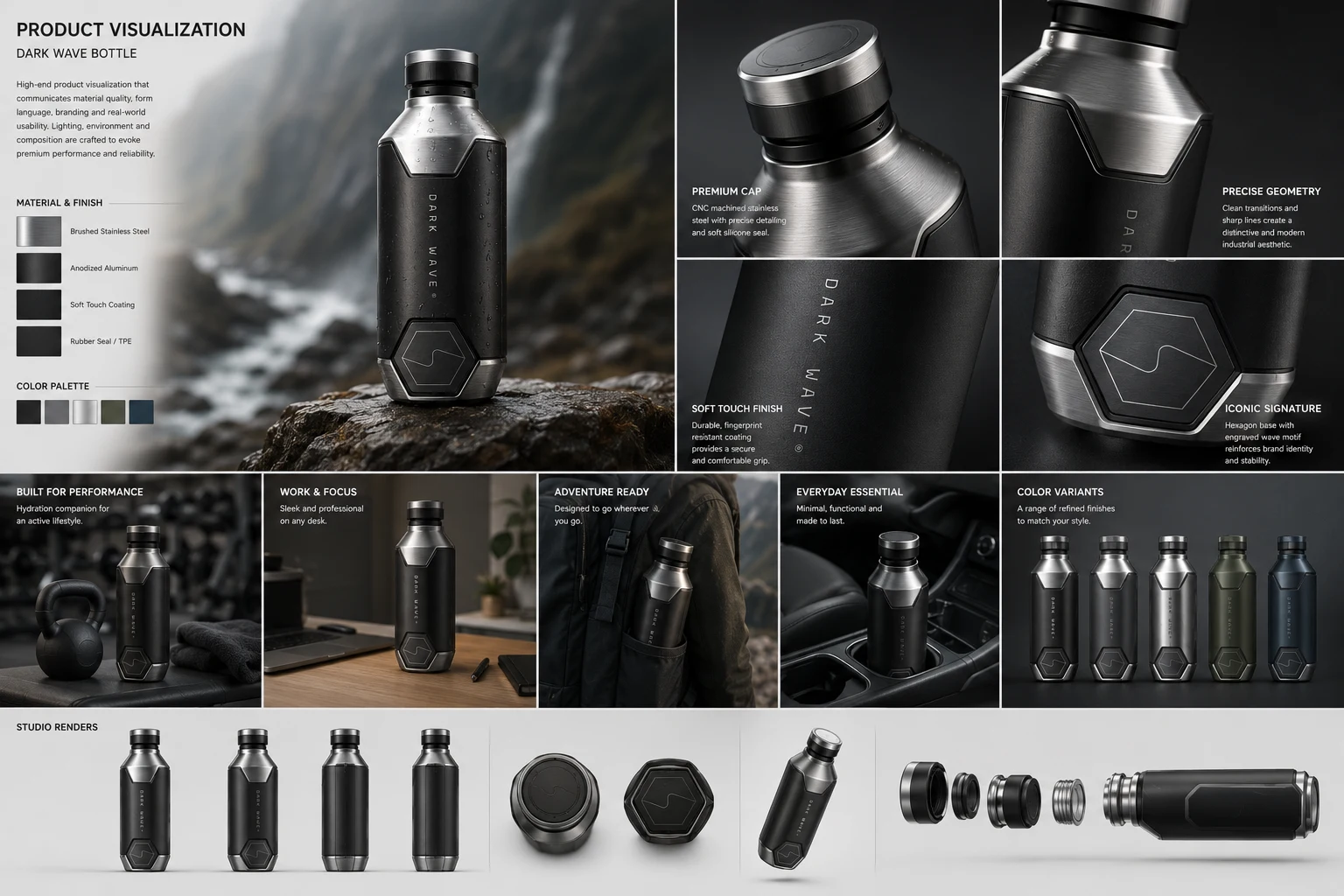
High-quality visualizations were created to communicate the final product to stakeholders before physical prototyping.
Presentation assets included:
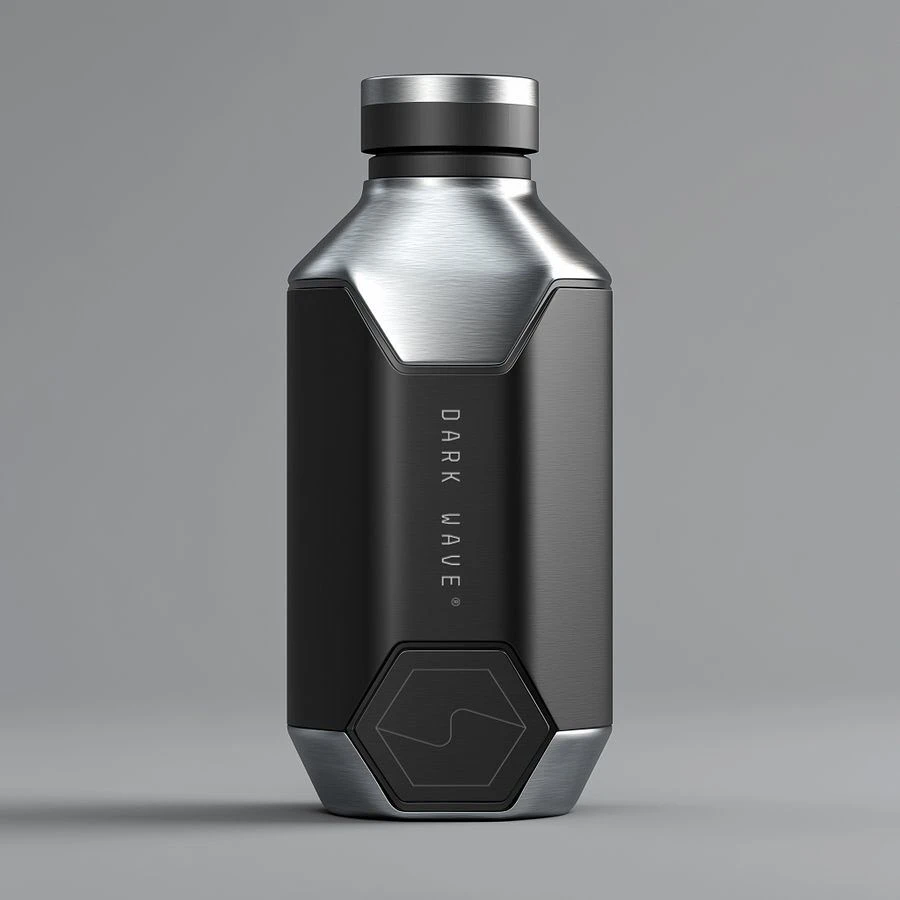
• Photorealistic hero renders
• Studio lighting renders
• Lifestyle visualizations
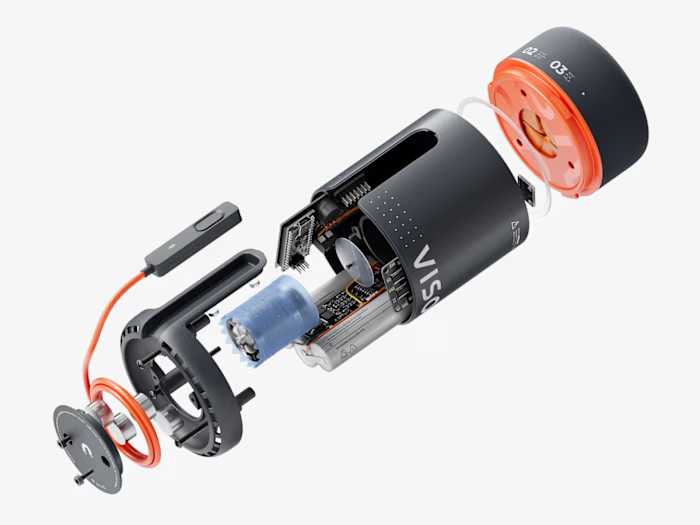
• Exploded assembly views
• CAD engineering images
• Orthographic drawings
• Detail close-up renders
• Material and finish studies
• Manufacturing presentation boards
These assets effectively demonstrated both the visual quality and engineering sophistication of the final design.
Deliverables
The completed project included:
• Product research and competitive benchmarking
• User-centered design strategy
• Concept sketch development
• Design refinement
• Fully parametric 3D CAD model
• Assembly design
• Detailed component engineering
• Design for Manufacturing (DFM)
• Material recommendations
• Engineering-ready CAD files
• Production-ready renderings
• Technical presentation documentation
Results
The completed drinkware product successfully combines elegant industrial design with practical engineering and manufacturing efficiency. The final design delivers a premium user experience through carefully considered ergonomics, refined aesthetics, and durable construction while remaining optimized for large-scale production.
By integrating research, industrial design, CAD engineering, and Design for Manufacturing into a unified workflow, the project demonstrates a complete product development process from concept to production-ready design. The result is a commercially viable drinkware solution that reflects thoughtful innovation, engineering precision, and a strong focus on usability, quality, and manufacturability.
Like this project
Posted Jun 28, 2026
Designed a premium, production-ready drinkware with CAD modeling and DFM principles.
Likes
1
Views
0
Timeline
Feb 12, 2026 - Feb 16, 2026