Autonomous Service Robot Design and Engineering Project

Ayodele Eunice Monice


Client
Confidential
Industry
Automation • Robotics • Smart Manufacturing
Role
Industrial Designer | Product Design Engineer | CAD Development
Project Overview
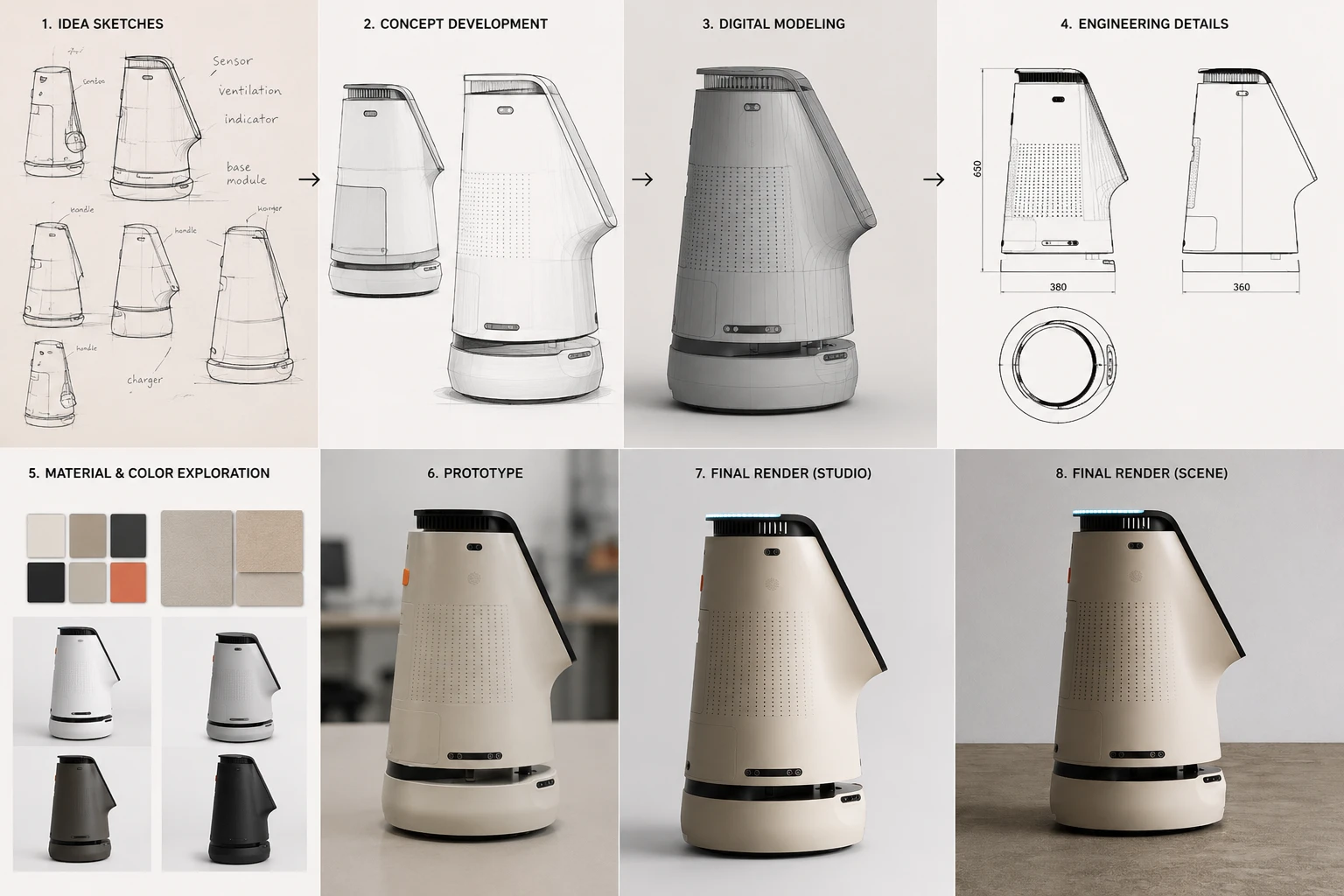
The objective of this project was to design a modern autonomous service robot capable of operating in commercial, industrial, and public environments while maintaining a clean, approachable appearance and a robust engineering foundation.
The client required a product that balanced advanced functionality with manufacturable construction, allowing the robot to integrate sensors, navigation hardware, electronic components, batteries, and service modules inside a compact enclosure. The design needed to communicate reliability, intelligence, and safety while remaining production-ready for future manufacturing.
This project covered the complete product development process from industrial design concept generation through engineering-focused CAD development, design refinement, and manufacturing preparation.
Project Goals
The primary goals included:
• Develop a distinctive industrial design language
• Create a stable and functional robot architecture
• Optimize internal packaging for electronic components
• Design modular body panels for easier assembly and maintenance
• Improve manufacturability for injection molding and CNC fabrication
• Ensure the robot maintained a premium and professional appearance
• Balance aesthetics with engineering feasibility
• Produce production-quality CAD suitable for engineering development
Research & Discovery
The project began with market research and product benchmarking to understand existing autonomous service robots used in logistics, healthcare, hospitality, retail, and commercial facilities.
Key research areas included:
• User interaction
• Human-centered design
• Navigation requirements
• Sensor placement
• Accessibility
• Serviceability
• Structural integrity
• Manufacturing methods
Insights gathered during this phase helped define the overall product architecture while identifying opportunities to improve usability and visual differentiation.
Design Strategy
The design language focused on creating a robot that appears intelligent, approachable, and highly capable without looking overly mechanical.
Several guiding principles influenced the design:
• Smooth geometric surfaces
• Minimal visual complexity
• Balanced proportions
• High structural rigidity
• Efficient internal packaging
• Modular construction
• Future scalability
Every design decision supported both user experience and engineering performance.
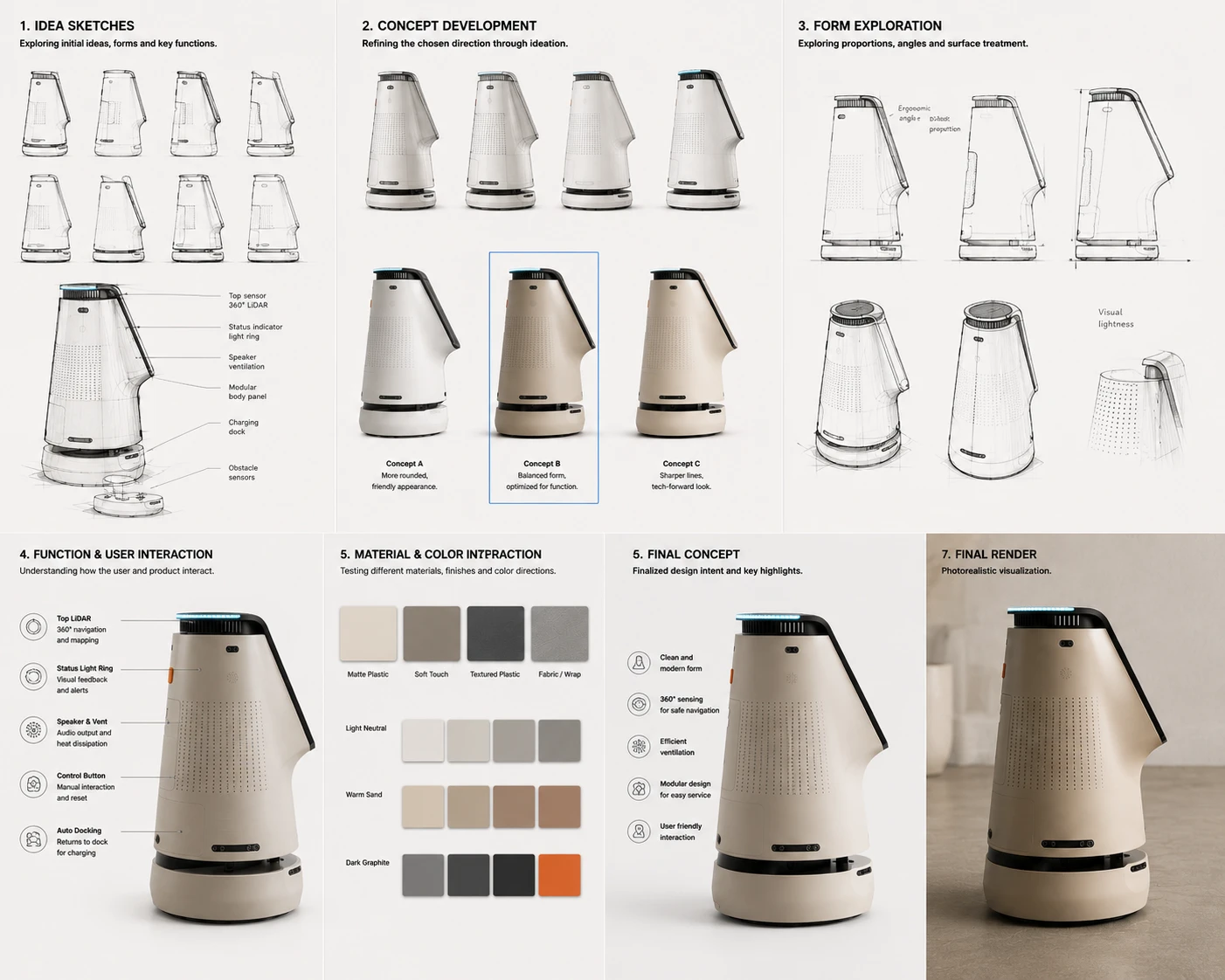
Concept Development
Multiple design concepts were explored through iterative sketching and digital ideation.
Various body proportions, panel separations, wheel configurations, display integration, ventilation layouts, and sensor placements were evaluated before selecting the final direction.
The chosen concept provided the strongest balance between aesthetics, stability, manufacturability, and internal space utilization.
CAD Engineering
After selecting the preferred concept, the entire robot was developed in detailed 3D CAD.
Engineering development included:
• Primary chassis design
• Exterior enclosure modeling
• Structural frame development
• Battery compartment
• Electronics housing
• Sensor mounting locations
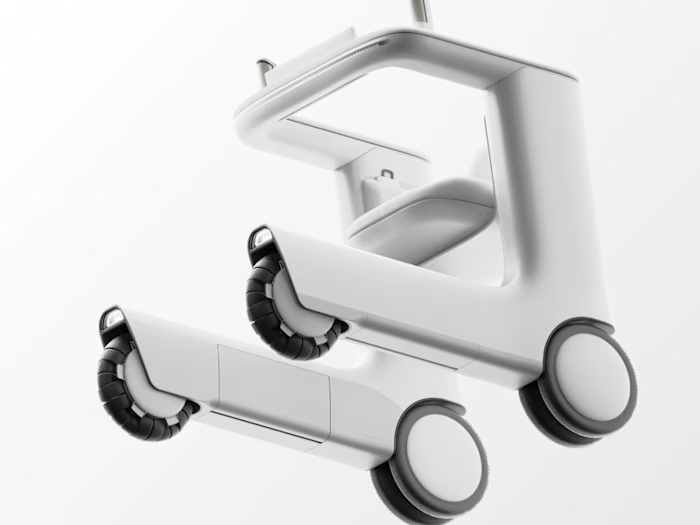
• Wheel assembly integration
• Service access panels
• Fastener strategy
• Internal support structures
The CAD model was continuously refined to ensure all components could coexist within the available packaging space while maintaining structural integrity.
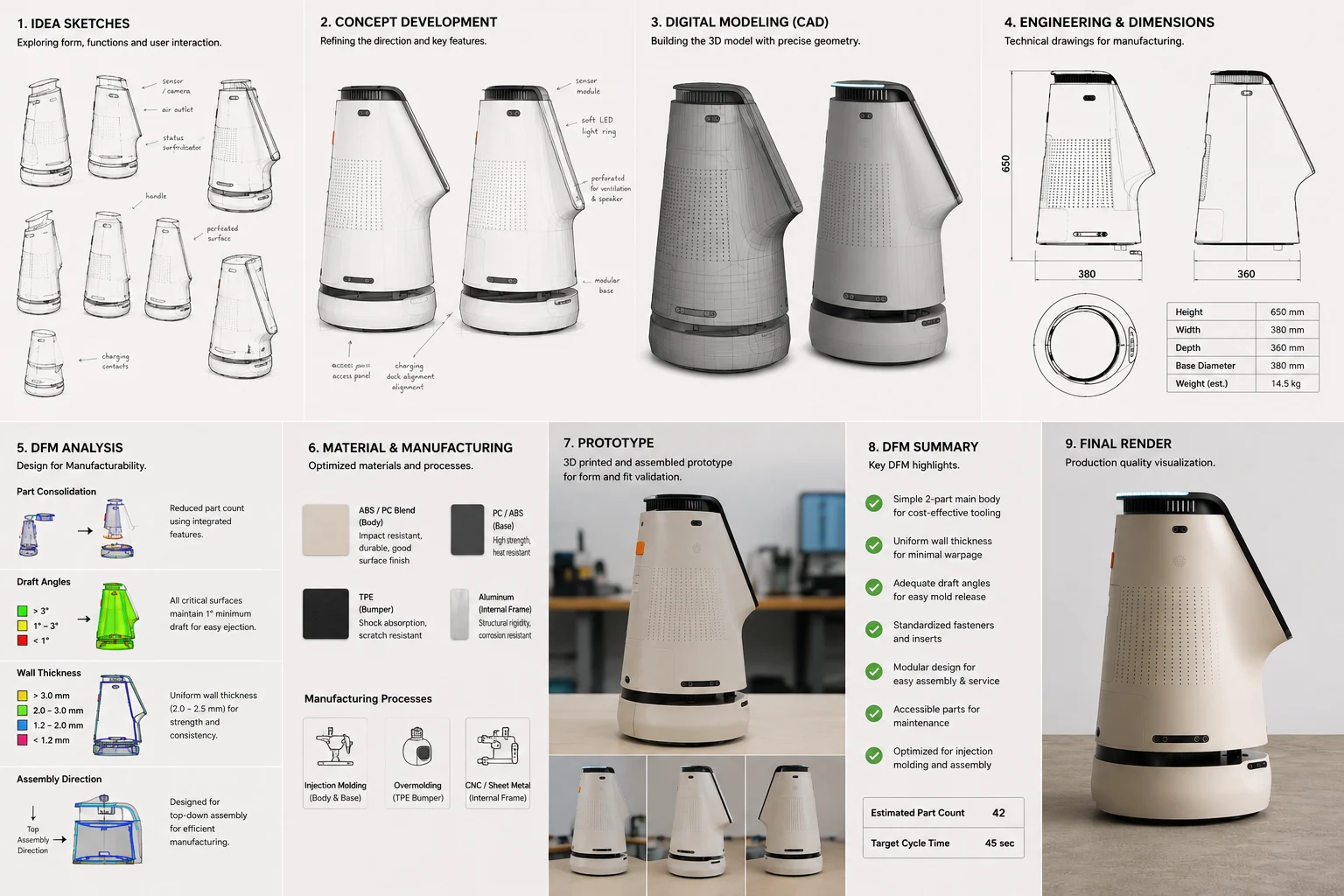
Design for Manufacturing (DFM)
Manufacturing feasibility was considered throughout the design process.
The enclosure was optimized for realistic production using methods such as:
• Injection molded plastic components
• CNC-machined structural parts
• Sheet metal brackets
• Standard fastening hardware
• Modular assembly techniques
Wall thickness consistency, draft angles, assembly access, and tooling considerations were incorporated to reduce manufacturing complexity and production costs.
Design for Manufacturing (DFM)
Engineering Challenges
Several technical challenges were addressed during development:
• Maximizing usable internal volume
• Maintaining overall structural rigidity
• Integrating sensors without compromising aesthetics
• Creating removable service panels
• Achieving a stable center of gravity
• Managing ventilation and heat dissipation
• Designing around manufacturing constraints
Each challenge required multiple design iterations before reaching the final solution.
Design Refinement
Numerous refinement cycles were completed to improve:
• Surface continuity
• Panel alignment
• Visual balance
• Manufacturing efficiency
• Component accessibility
• Ergonomics
• Mechanical integration
Attention to small engineering details ensured the final product achieved both premium aesthetics and practical functionality.
Visualization & Presentation
High-quality product visualizations were created to communicate the final design.
Deliverables included:
• Photorealistic product renders
• Multiple product perspectives
• CAD engineering views
• Section views
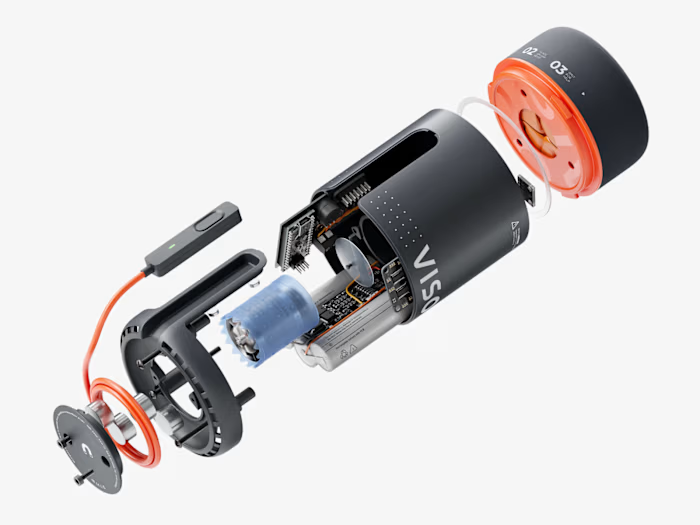
• Exploded assembly visuals
• Material and finish exploration
These assets allowed stakeholders to fully evaluate both the appearance and engineering of the product prior to prototyping.
Deliverables
The final project included:
• Complete industrial design
• Production-ready 3D CAD model
• Exterior surface development
• Internal component packaging
• Manufacturing-oriented assembly design
• Engineering documentation
• High-resolution renderings
• Product presentation assets
Results
The final autonomous service robot successfully combines modern industrial design with practical engineering, resulting in a product that is visually distinctive, structurally sound, and ready for the next stages of prototyping and manufacturing.
The modular architecture improves maintainability, the optimized internal layout supports future hardware upgrades, and the refined exterior communicates innovation while remaining practical for commercial deployment.
This project demonstrates expertise across the full product development lifecycle, from concept ideation and industrial design to CAD engineering, design for manufacturing, and production-focused product development.
Like this project
Posted Jun 28, 2026
Designed an autonomous service robot balancing aesthetics with engineering.
Likes
1
Views
0
Timeline
Jan 3, 2026 - Jan 8, 2026