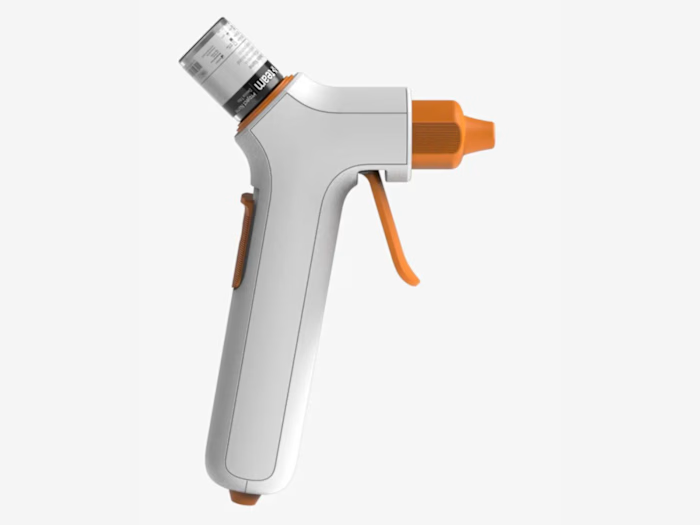
Smart Coffee Machine Design for Home Appliance Manufacturer

Ayodele Eunice Monice

Smart Coffee Machine Design | Industrial Design, CAD Modeling & Design for Manufacturing (DFM)
Client
Confidential Home Appliance Manufacturer
Industry
Home Appliances • Consumer Electronics • Kitchen Products • Manufacturing
Role
Lead Industrial Designer | Product Design Engineer | CAD Engineer | DFM Specialist
Project Overview
This project involved the end-to-end design and engineering of a smart coffee machine that seamlessly combines premium aesthetics, intelligent functionality, and manufacturing efficiency. The objective was to create a modern countertop appliance capable of delivering a high-quality brewing experience while maintaining a compact footprint and a clean, contemporary appearance suitable for both residential and office environments.
The product required the integration of brewing components, water storage, electronic controls, sensors, heating systems, and user interface elements within a streamlined enclosure. Every aspect of the design was developed to enhance usability, simplify maintenance, improve manufacturing efficiency, and support scalable production.
The project covered the complete product development lifecycle, including user research, concept development, industrial design, CAD engineering, mechanical integration, Design for Manufacturing (DFM), and production-ready visualization.
Project Objectives
The project was guided by several key objectives:
• Develop a premium and modern product identity
• Create an intuitive brewing experience for everyday users
• Optimize the internal layout for brewing components and electronics
• Design an ergonomic water tank and bean container for easy refilling
• Improve accessibility for cleaning and maintenance
• Integrate a user-friendly digital control interface
• Reduce manufacturing complexity and assembly time
• Optimize material usage without compromising structural performance
• Develop production-ready CAD models for prototyping and manufacturing
• Design a modular architecture for future product variations
Product Research & Discovery
The development process began with comprehensive research into consumer behavior, coffee preparation routines, appliance trends, and existing coffee machine designs.
Research focused on:
• User brewing habits
• Kitchen countertop space limitations
• User interaction with appliance controls
• Water and coffee bean refilling
• Cleaning and maintenance requirements
• Brewing workflow optimization
• Competitive product benchmarking
• Manufacturing methods
• Material selection
• Safety and durability requirements
The findings identified opportunities to improve usability, product appearance, serviceability, and manufacturing efficiency while establishing clear design requirements for the project.
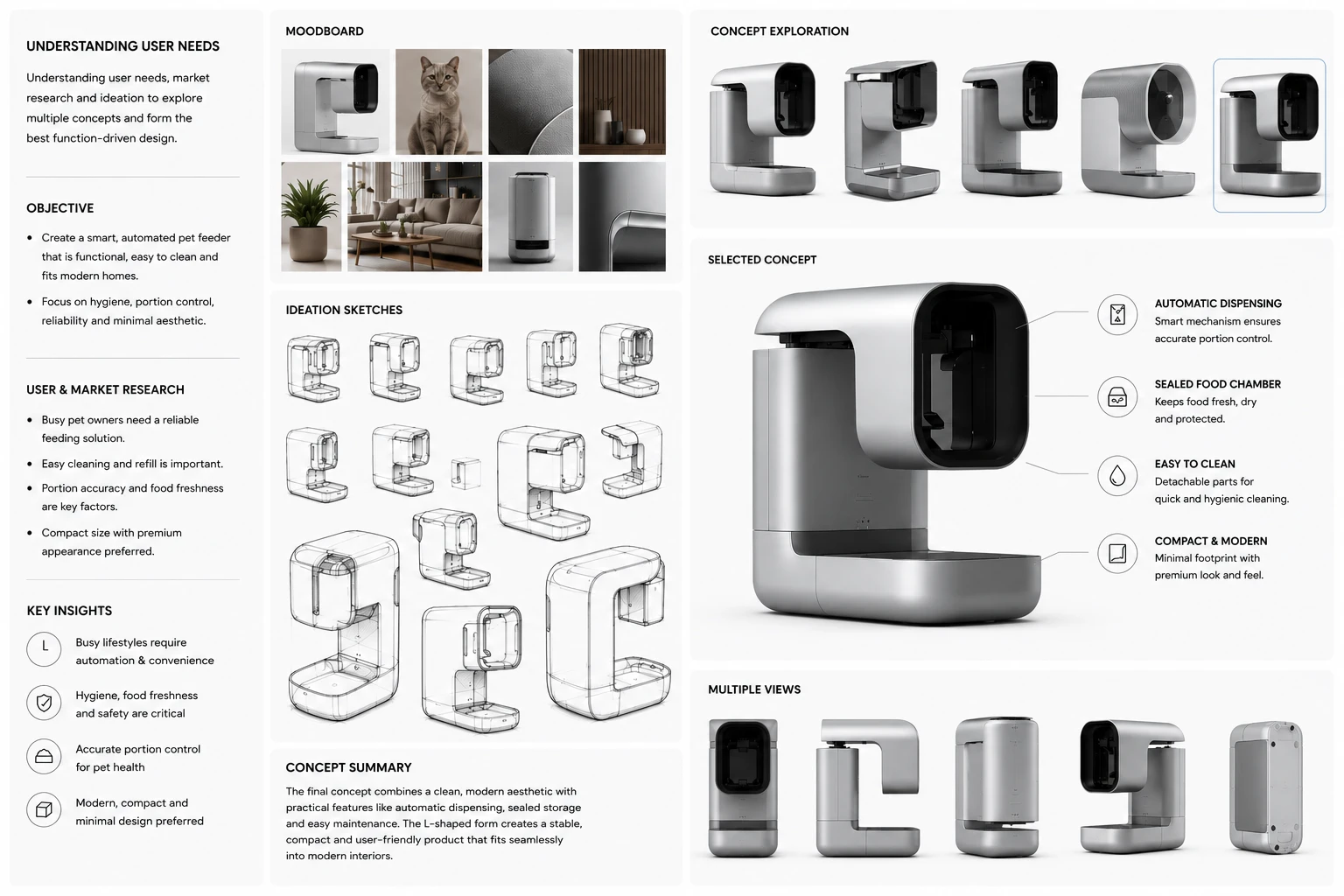
User-Centered Design Strategy
The design strategy centered on creating a product that feels intuitive, elegant, and effortless to use while delivering consistent brewing performance.
Key design principles included:
• Clean and minimalist aesthetics
• Premium material expression
• Ergonomic user interaction
• Efficient countertop footprint
• Logical component accessibility
• Simplified maintenance
• Modular internal architecture
• Manufacturing efficiency
Every design decision balanced visual refinement with engineering practicality and long-term product reliability.
Ideation & Concept Development
Multiple concepts were explored through hand sketches and digital ideation to evaluate different design directions before selecting the final concept.
Concept exploration included:
• Overall product proportions
• Brewing system configurations
• Water reservoir placement
• Bean hopper integration
• Display and control panel layouts
• Cup clearance options
• Access door mechanisms
• Ventilation strategies
• Branding opportunities
Each concept was assessed for user experience, manufacturability, component packaging, visual appeal, and engineering feasibility before advancing to detailed development.
Industrial Design Development
Following concept selection, the product entered a detailed industrial design refinement phase where every visible surface and interaction point was optimized.
Development focused on:
• Product proportions
• Surface continuity
• Ergonomic touch points
• Display integration
• Access panel design
• Control interface placement
• Premium detailing
• Visual balance
Several refinement cycles ensured the coffee machine achieved a sophisticated appearance while supporting internal engineering requirements.
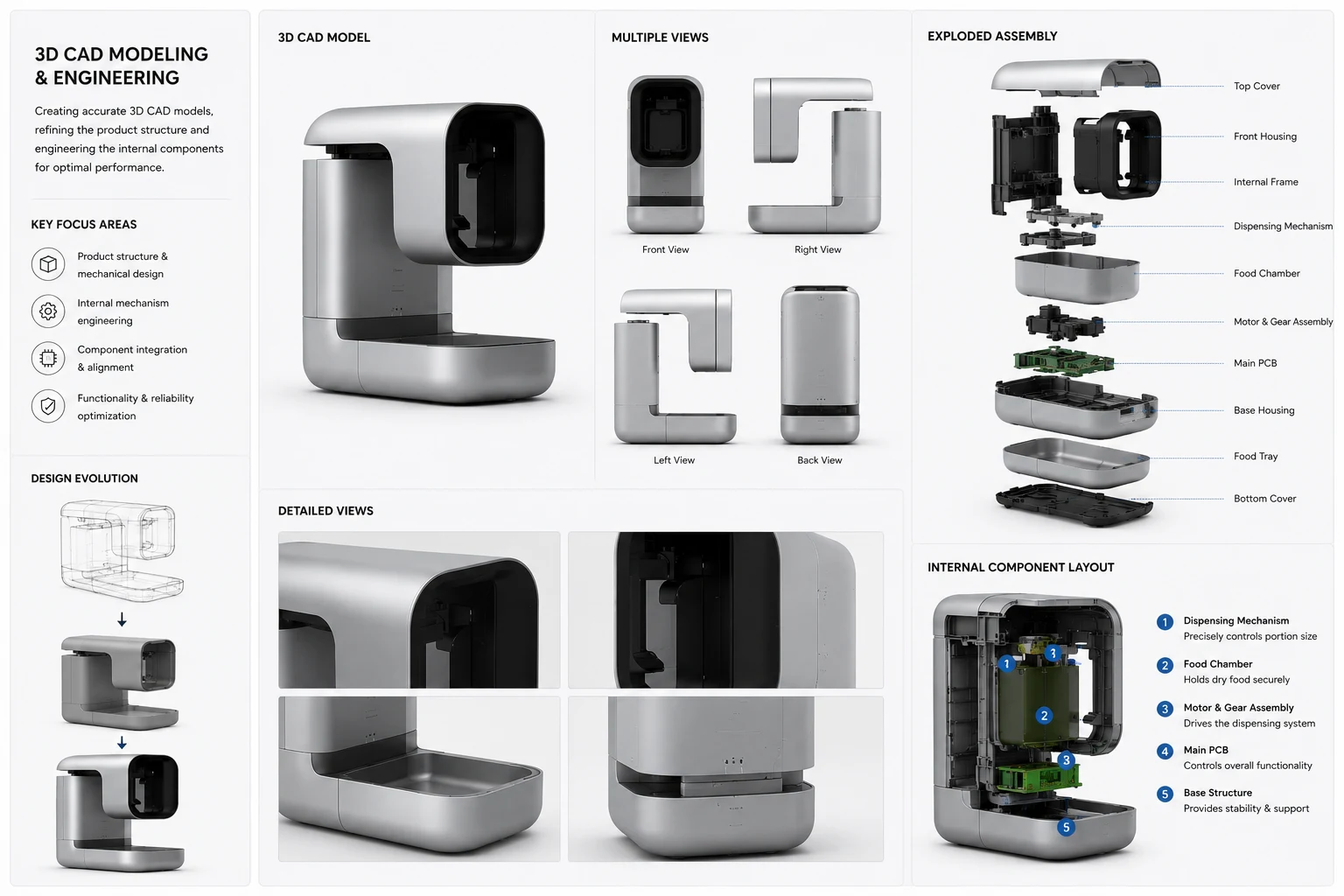
Mechanical Engineering & Product Development
Engineering development translated the approved concept into a fully functional product architecture.
Engineering activities included:
• Internal frame development
• Brewing chamber integration
• Water reservoir packaging
• Bean hopper design
• Grinder housing integration
• Heating system layout
• Pump mounting
• PCB and electronics packaging
• Cable routing
• Structural reinforcement
• Assembly planning
The internal architecture was optimized to maximize serviceability, improve airflow, and simplify manufacturing.
3D CAD Modeling
The selected design was developed into a fully parametric 3D CAD assembly suitable for engineering validation and production preparation.
CAD development included:
• Master assembly creation
• Exterior enclosure modeling
• Internal component packaging
• Brewing mechanism integration
• Water tank design
• Electronic housing development
• Fastener strategy
• Assembly validation
• Tolerance definition
• Engineering revisions
The CAD model provided accurate manufacturing geometry for prototyping, tooling development, and production documentation.
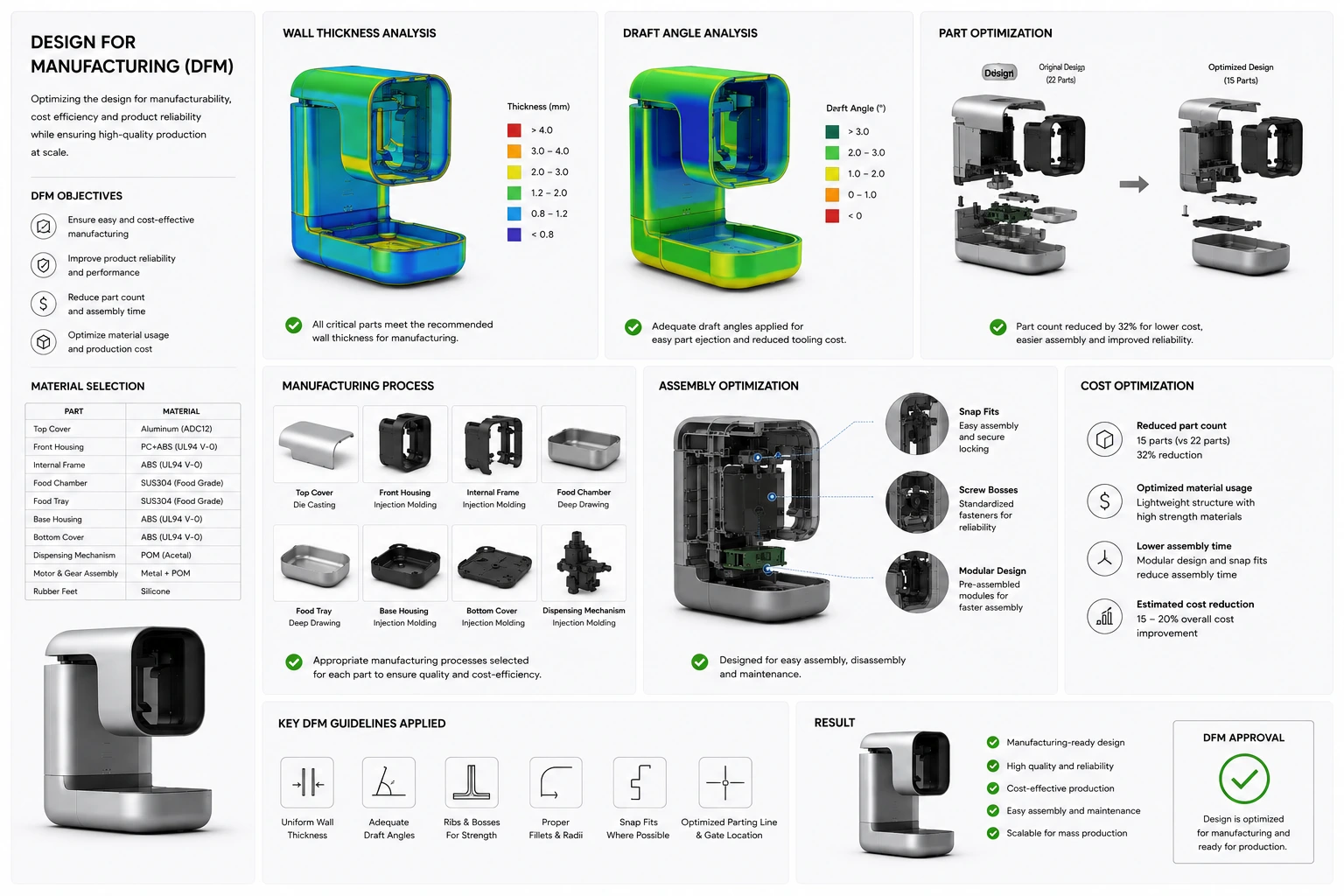
Design for Manufacturing (DFM)
Manufacturing considerations were integrated throughout the project to improve production efficiency and reduce manufacturing risks.
DFM activities included:
• Injection molding optimization
• Uniform wall thickness
• Draft angle implementation
• Parting line evaluation
• Tool accessibility
• Snap-fit feature development
• Fastener reduction
• Modular assembly planning
• Material optimization
• Production cost reduction
These improvements simplified manufacturing while ensuring high-quality production and consistent assembly.
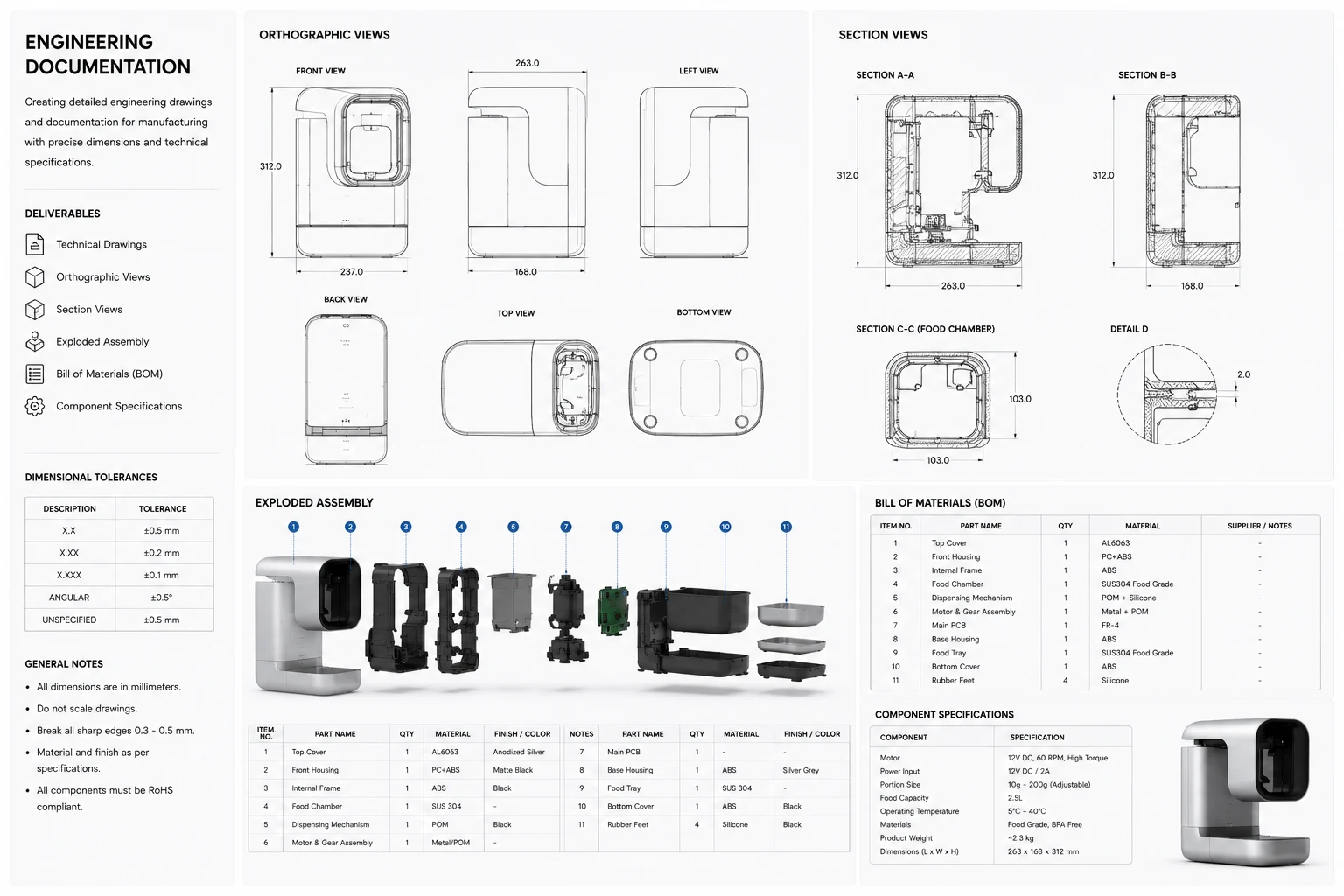
Material Selection
Material selection balanced aesthetics, durability, food safety, thermal performance, and manufacturing compatibility.
Recommended materials included:
• Food-grade ABS housing
• Polycarbonate water reservoir
• Stainless steel brewing components
• High-temperature engineering polymers
• Silicone sealing elements
• Tempered glass display panel
• Brushed aluminum decorative accents
• Matte textured exterior finishes
These materials provide excellent durability, heat resistance, and a premium visual appearance while supporting efficient manufacturing.
Engineering Challenges
Several engineering challenges required careful problem-solving during development.
These included:
• Packaging multiple brewing systems within a compact enclosure
• Managing heat around electronic components
• Designing efficient internal water flow paths
• Improving accessibility for maintenance
• Reducing vibration and operational noise
• Maintaining structural rigidity
• Simplifying product assembly
• Balancing premium aesthetics with manufacturing constraints
Each challenge was resolved through iterative engineering analysis, CAD refinement, and continuous design optimization.
Design Validation & Refinement
Multiple refinement cycles were completed to optimize both engineering performance and user experience.
Validation activities included:
• Internal packaging verification
• Assembly evaluation
• Ergonomic assessment
• Structural analysis
• Surface quality refinement
• Manufacturing reviews
• Component accessibility evaluation
• Product appearance validation
The final design successfully satisfied engineering, manufacturing, and user experience requirements.
Visualization & Product Presentation
Professional visualization assets were created to communicate the final design prior to physical prototyping.
Presentation assets included:
• Photorealistic hero renders
• Lifestyle kitchen renders
• Multiple product viewing angles
• Exploded assembly illustrations
• CAD engineering views
• Internal component cutaways
• Material and finish studies
• Technical presentation boards
These assets clearly demonstrated the product's design quality, engineering sophistication, and production readiness.
Deliverables
The completed project included:
• Product research and competitive benchmarking
• User-centered design strategy
• Industrial design concept development
• Concept sketches and ideation
• Mechanical engineering development
• Fully parametric 3D CAD assembly
• Internal component packaging
• Brewing system integration
• Detailed component modeling
• Design for Manufacturing (DFM)
• Material and finish recommendations
• Production-ready CAD files
• High-resolution product renderings
• Technical presentation documentation
Results
The final Smart Coffee Machine successfully combines premium industrial design, intuitive user interaction, and engineering precision into a production-ready consumer appliance. Its compact architecture, optimized internal layout, and thoughtfully designed user interface provide an exceptional brewing experience while supporting efficient manufacturing and long-term reliability.
By integrating industrial design, CAD engineering, mechanical development, and Design for Manufacturing throughout the project, the final product demonstrates a complete product development workflow, from research and concept generation to engineering validation and manufacturing-ready design. The result is a commercially viable smart kitchen appliance that reflects modern aesthetics, functional innovation, and manufacturing excellence.
Like this project
Posted Jul 1, 2026
Designed a smart coffee machine with optimal aesthetics and functionality.
Likes
5
Views
2
Timeline
May 12, 2026 - Jun 18, 2026