Strategic Intelligence in the AI

Victor T Tam Yan


Strategic Intelligence in the AI Era: How Modern Leaders Turn Data Into Decisions
By Victor — Thought Leadership & Strategic Intelligence Writer
In the last decade, artificial intelligence has moved from a futuristic concept to a practical, everyday tool embedded in the workflows of thousands of businesses. But while most organisations now understand the value of automation, predictive analytics, and machine learning, a new frontier is emerging — one that goes beyond data processing and into the realm of strategic clarity.
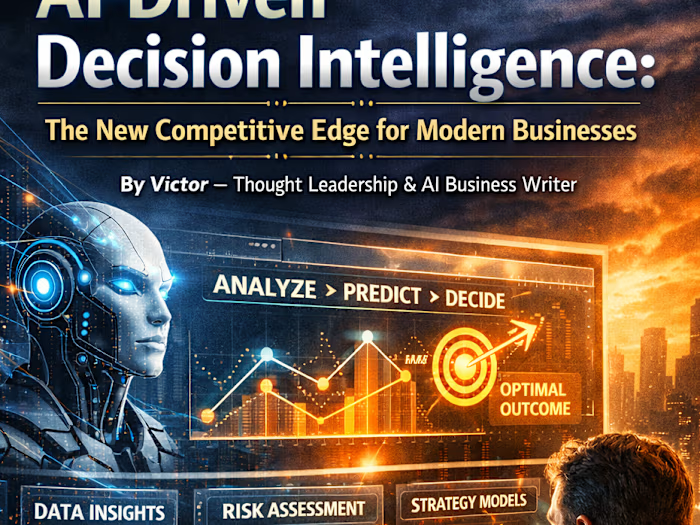
This frontier is AI‑driven decision intelligence, a discipline that blends data science, behavioural psychology, and business strategy to help leaders make faster, smarter, and more consistent decisions. For founders, executives, and operational teams navigating increasingly complex markets, decision intelligence is becoming a defining competitive advantage.
Why Decision‑Making Is the Last Untouched Bottleneck
Most companies have already optimised their operations. They’ve automated repetitive tasks, digitised workflows, and adopted cloud‑based tools. Yet despite all this progress, one area remains stubbornly human, slow, and inconsistent: decision‑making.
Leaders still rely on:
gut instinct
incomplete data
siloed information
biased interpretations
outdated reporting cycles
This creates bottlenecks that ripple across the entire organisation. A delayed decision can stall a product launch. A misinformed decision can derail a marketing campaign. A biased decision can distort hiring, budgeting, or resource allocation.
Decision intelligence aims to solve this by giving leaders real‑time clarity, contextual insights, and predictive foresight — without replacing human judgment.
What Decision Intelligence Actually Does
At its core, decision intelligence uses AI to:
analyse vast datasets
identify patterns humans miss
simulate outcomes
recommend optimal actions
reduce uncertainty
highlight risks
quantify trade‑offs
But the real power lies in how it integrates with human thinking. Instead of replacing decision‑makers, it augments them.
A CEO can see how different pricing strategies affect revenue.
A marketing director can test campaign variations before spending a dollar.
A supply‑chain manager can predict disruptions weeks in advance.
A founder can model growth scenarios with remarkable accuracy.
Decision intelligence becomes a strategic partner — one that never sleeps, never gets overwhelmed, and never loses track of the data.
Real‑World Use Cases Across Industries
Decision intelligence is already reshaping industries in ways that feel subtle but transformative.
Retail
AI models forecast demand, optimise inventory, and personalise customer experiences. Retailers reduce waste, increase margins, and respond faster to market shifts.
Finance
Banks use decision intelligence to assess risk, detect fraud, and guide investment strategies. It enhances compliance while improving customer trust.
Healthcare
Hospitals use predictive models to allocate staff, manage patient flow, and anticipate equipment needs. The result is better care and reduced operational strain.
Professional Services
Consulting firms use decision intelligence to deliver sharper insights, faster analysis, and more accurate strategic recommendations.
Startups
Founders use AI‑driven simulations to test business models, forecast cash flow, and refine their go‑to‑market strategies.
Across all sectors, the pattern is the same: better decisions → better outcomes.
The Human‑AI Partnership
One of the biggest misconceptions about AI is that it removes human agency. In reality, decision intelligence strengthens it.
Humans excel at:
creativity
empathy
ethical judgment
long‑term vision
AI excels at:
pattern recognition
data processing
scenario modelling
probability analysis
Together, they form a hybrid decision‑making model that is more accurate, more consistent, and more resilient than either could achieve alone.
The Cultural Shift Behind Better Decisions
One of the most overlooked aspects of decision intelligence is the cultural transformation it triggers inside an organisation. When leaders begin relying on AI‑supported insights, the entire decision‑making environment becomes more transparent, more accountable, and more data‑driven. Teams stop making choices based on hierarchy or habit, and start grounding their actions in evidence, probability, and strategic alignment.
This shift reduces internal friction. Instead of debating opinions, teams evaluate scenarios. Instead of defending assumptions, they explore models. Instead of reacting to problems, they anticipate them. Decision intelligence doesn’t just improve outcomes — it improves the quality of conversations happening inside a business.
It also empowers mid‑level managers and operational staff. When insights are accessible, visual, and easy to interpret, decision‑making becomes decentralised. People closest to the work can act faster, with more confidence, and with a clearer understanding of how their choices affect the broader organisation. This creates a more agile, resilient, and responsive business culture.
Barriers to Adoption — and How Companies Overcome Them
Despite its benefits, many organisations hesitate to adopt decision intelligence because they fear complexity, cost, or disruption. But the reality is that modern AI platforms are becoming increasingly accessible. Cloud‑based tools, no‑code interfaces, and modular analytics systems allow businesses to start small and scale gradually.
The biggest barrier is not technology — it’s mindset. Companies that succeed with decision intelligence treat it as a long‑term capability, not a quick fix. They invest in training, encourage experimentation, and integrate AI insights into their existing workflows rather than forcing a complete overhaul. Over time, the organisation becomes more comfortable with data‑driven thinking, and the benefits compound.
The Strategic Payoff
Businesses that embrace decision intelligence early often discover unexpected advantages. They identify new revenue opportunities faster. They respond to market changes with greater precision. They reduce operational waste and improve customer satisfaction. Most importantly, they build a decision‑making framework that scales — one that grows stronger as more data flows through the system.
In a competitive landscape where speed and clarity determine survival, decision intelligence becomes more than a tool. It becomes a philosophy — a way of running a business that blends human judgment with machine‑driven insight to create a smarter, more adaptive organisation.
Why Businesses Should Adopt Decision Intelligence Now
The companies that adopt decision intelligence early will gain:
faster strategic execution
reduced operational risk
improved forecasting accuracy
stronger competitive positioning
better resource allocation
higher profitability
In a world where markets shift overnight, the ability to make high‑quality decisions at speed is no longer optional — it’s existential.
The Future of Decision‑Making
As AI continues to evolve, decision intelligence will become a standard part of every organisation’s toolkit. Leaders won’t ask, “Should we use AI for decision‑making?” They’ll ask, “How did we ever operate without it?”
The future belongs to businesses that combine human intuition with machine‑driven clarity — and the transformation has already begun.
Victor Tyan,MIB,BCom
Like this project
Posted Apr 12, 2026
Strategic Intelligence in the AI Era: How Modern Leaders Turn Data Into Decisions By Victor — Thought Leadership & Strategic Intelligence Writer In the last ...