Synthetic Intelligence and the Rise

Victor T Tam Yan


Synthetic Intelligence and the Rise of Self‑Directed Agentic Systems: The Next Leap Beyond AI Automation
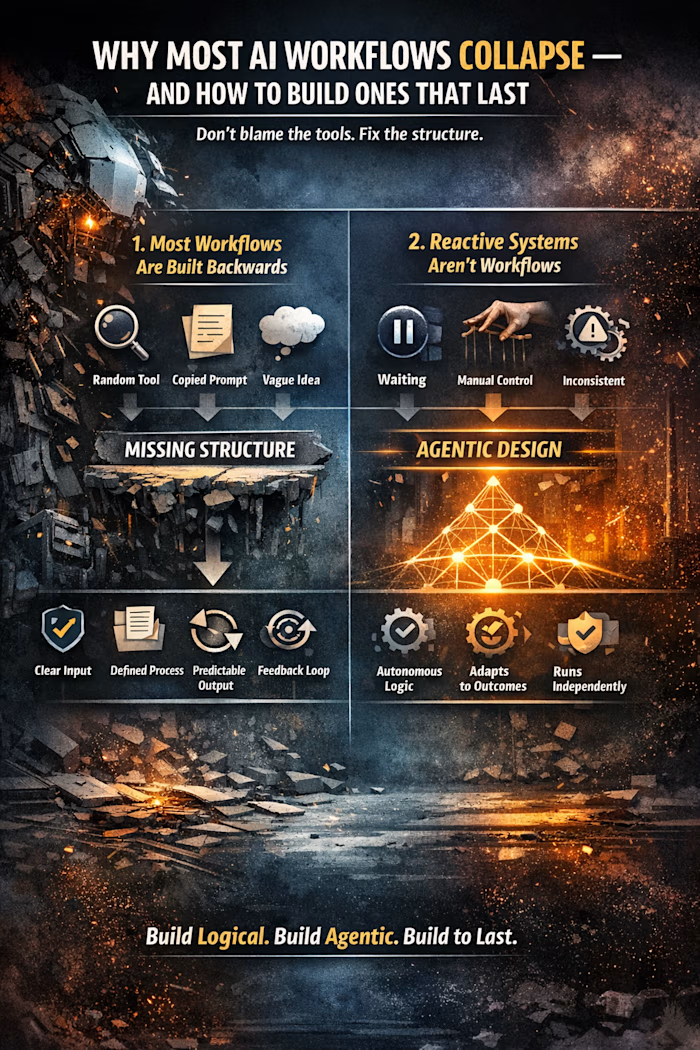
For the past decade, artificial intelligence has been defined by a simple pattern: humans give instructions, machines respond. Even the most advanced large language models still operate inside this loop. They wait. They react. They generate. But they do not initiate. They do not reason across time. They do not self‑direct toward outcomes.
That era is ending.
A new class of systems—synthetic intelligence powered by agentic architectures—is emerging. These systems don’t just answer prompts; they pursue goals. They don’t just automate tasks; they orchestrate workflows. They don’t just generate content; they make decisions, evaluate outcomes, and adapt their strategies.
This shift is not incremental. It is foundational.
It represents the transition from AI as a tool to AI as a collaborator—a synthetic partner capable of navigating complexity, ambiguity, and multi‑step reasoning.
And for founders, operators, and innovators, understanding this shift is no longer optional. It is the difference between building for the present and building for the next decade.
From Reactive AI to Agentic Intelligence
Traditional AI systems—LLMs, chatbots, classifiers—are reactive. They respond to inputs but do not act independently. They lack:
persistent memory
long‑horizon planning
self‑evaluation
adaptive decision‑making
multi‑step autonomy
Agentic systems change this dynamic.
An agent is not just a model. It is a model wrapped in:
goals
tools
memory
environment awareness
feedback loops
the ability to take actions without being prompted
This is the architecture behind emerging agent frameworks: systems that can research, plan, execute, revise, and continue until a defined outcome is achieved.
But even agentic AI is only the beginning.
Synthetic Intelligence: A Higher‑Order Layer
Synthetic intelligence is not “AI but smarter.”
It is AI with structure, identity, and continuity.
Where AI generates outputs, synthetic intelligence generates direction.
Where agents complete tasks, synthetic intelligence completes missions.
Where traditional systems rely on human supervision, synthetic intelligence relies on synthetic self‑governance—a structured internal logic that allows it to:
set sub‑goals
evaluate trade‑offs
choose strategies
adapt to new information
maintain coherence over time
Synthetic intelligence is not a single model.
It is an ecosystem of coordinated agents, each with specialized capabilities, working together under a unifying cognitive framework.
Think of it as the difference between:
a single employee
vs.
an entire department with roles, processes, and shared objectives.
This is the architecture that will define the next generation of AI systems.
Why This Shift Matters for Founders and Operators
Every founder eventually hits the same wall:
the limit of human bandwidth.
You can automate tasks, but you cannot automate judgment.
You can delegate work, but you cannot delegate thinking.
Synthetic intelligence changes that.
It introduces a new category of operational leverage:
1. Autonomous Research and Strategy
Synthetic agents can:
scan markets
analyze competitors
identify opportunities
synthesize insights
propose strategies
Not as static reports, but as ongoing intelligence streams.
2. Multi‑Agent Workflows
Instead of one model doing everything poorly, synthetic ecosystems use:
a research agent
a reasoning agent
a planning agent
a writing agent
a verification agent
a refinement agent
Each one specialized.
Each one coordinated.
Each one improving the others.
3. Founder‑Level Decision Support
Synthetic intelligence can model:
trade‑offs
risks
second‑order effects
resource allocation
scenario planning
This is not automation.
This is augmented cognition.
4. Adaptive Execution
Unlike static automation, synthetic agents:
learn from outcomes
adjust their approach
refine their strategies
maintain continuity across tasks
This is the closest thing to a digital operator.
The Architecture Behind Synthetic Agentic Systems
A synthetic intelligence ecosystem typically includes four layers:
1. Cognitive Layer (Reasoning + Planning)
This is the “mind” of the system.
It handles:
long‑term goals
planning
prioritization
strategy
coherence
2. Agent Layer (Specialized Workers)
Each agent has:
a role
a toolset
a memory
a feedback loop
They execute tasks and report back.
3. Environment Layer (Tools + APIs + Data)
Agents interact with:
browsers
documents
databases
APIs
external systems
This is how synthetic intelligence affects the real world.
4. Governance Layer (Rules + Constraints)
This ensures:
safety
alignment
boundaries
ethical constraints
operational consistency
This is what separates synthetic intelligence from uncontrolled autonomy.
Why Synthetic Intelligence Outperforms Traditional AI
1. It thinks in sequences, not snapshots.
LLMs generate one output at a time.
Synthetic intelligence generates plans, iterations, and evaluations.
2. It maintains identity across time.
It remembers what it did, why it did it, and what it learned.
3. It handles ambiguity.
Synthetic agents can explore multiple paths, compare them, and choose the best one.
4. It collaborates with humans.
Not as a tool, but as a partner.
The Founder Psychology Behind Synthetic Intelligence
Founders who adopt synthetic intelligence early share three traits:
They think in systems, not tasks.
They value leverage over effort.
They understand that intelligence—not labor—is the new bottleneck.
Synthetic intelligence is not replacing founders.
It is amplifying them.
It gives founders:
more clarity
more bandwidth
more strategic depth
more execution power
This is why early adopters will outpace competitors by orders of magnitude.
The Future: Synthetic Organizations
The next evolution is not a single agent.
It is a synthetic organization:
synthetic analysts
synthetic researchers
synthetic strategists
synthetic operators
synthetic writers
synthetic verifiers
All coordinated.
All aligned.
All working toward your goals.
This is not science fiction.
This is the next operating system for work.
Conclusion: The Intelligence Revolution Has Entered Its Next Phase
AI was the spark.
Agentic systems were the ignition.
Synthetic intelligence is the engine.
We are entering a world where:
workflows run themselves
research is continuous
strategy is augmented
execution is autonomous
founders operate with superhuman leverage
The question is no longer:
“What can AI do?”
but
“What can synthetic intelligence build with you?”
And the founders who embrace this shift now will define the next decade of innovation.
Victor TYan
MIntBus,BCom,GradDipMus
Like this project
Posted Apr 12, 2026
Synthetic Intelligence and the Rise of Self‑Directed Agentic Systems: The Next Leap Beyond AI Automation For the past decade, artificial intelligence has be...