
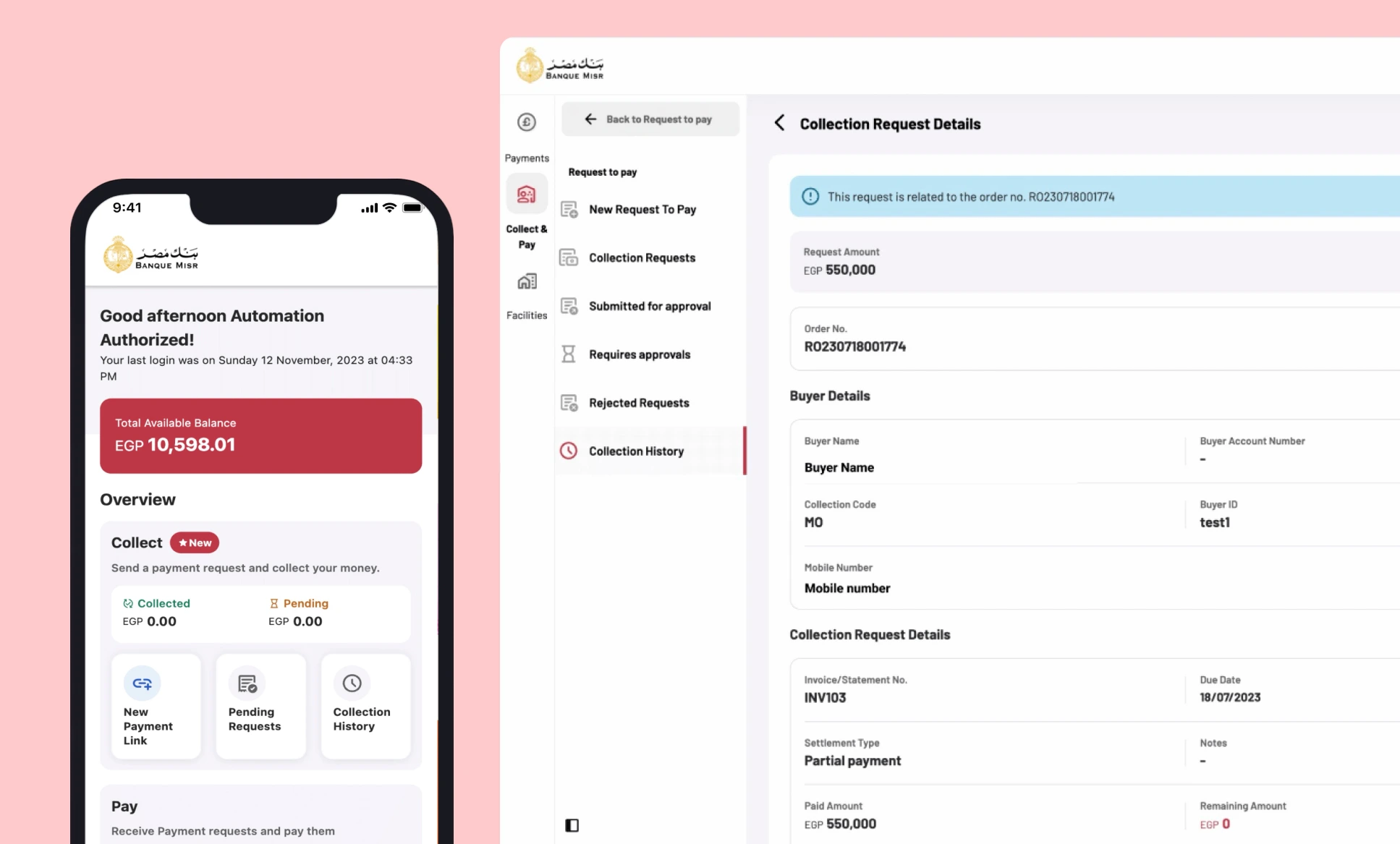
Modernizing Cash Collection for Egypt's Digital Economy
Designing a cashless payment ecosystem for corporate distributors and merchants at Banque Misr
The Challenge
The Business Problem
Egypt's corporate sector relied heavily on manual cash handling, creating security risks, inefficiencies, and low visibility into invoice collection status.
The User Pain Points
Corporates struggled to track payments across merchants
Merchants needed simpler digital payment methods
Decision makers hesitated without clear ROI and seamless integration
Research & Discovery
Concept Testing & Validation
Interviewed 14 participants across multiple industries throughout Egypt including corporate distributors and merchants to validate two key user journeys:
Corporates initiating collection requests
Merchants paying through the mobile app
I recruited participants in the field, conducted in-depth interviews, and gathered internal data through contextual inquiry to refine our concepts and validate core assumptions.
Synthesis & Definition
Facilitated cross-functional workshops with researchers, designers, PMs, and POs:
Developed detailed personas
Translated insights into "How Might We..." questions
Mapped end-to-end journey with emotional highs and lows
Ideation to Concept
With a clear problem space defined, I moved into solution mode.
Collaborative Workshops
Facilitated brainstorming sessions with PMs, POs, and UX peers, encouraging open sketching and concept exploration.
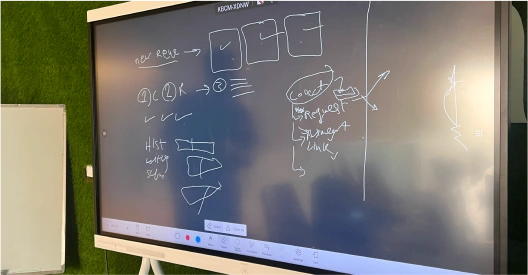
Wireframing & MVP Definition
Refined promising ideas into low-fidelity wireframes and mapped information architecture. After benchmarking competitors and running two validation workshops, we scoped five core features for the minimum viable product.
Prototyping & Testing
Built interactive prototypes for both platforms and launched an aggressive testing schedule.
Testing Approach
7 rounds of usability testing spanning 6 quarters (1-2 rounds per quarter).
In early rounds, I handled everything solo: participant recruitment, session facilitation, note-taking, and analysis. As the team grew, I focused primarily on the merchant app while collaborating on corporate dashboard insights.
Key Discoveries That Shaped the Design
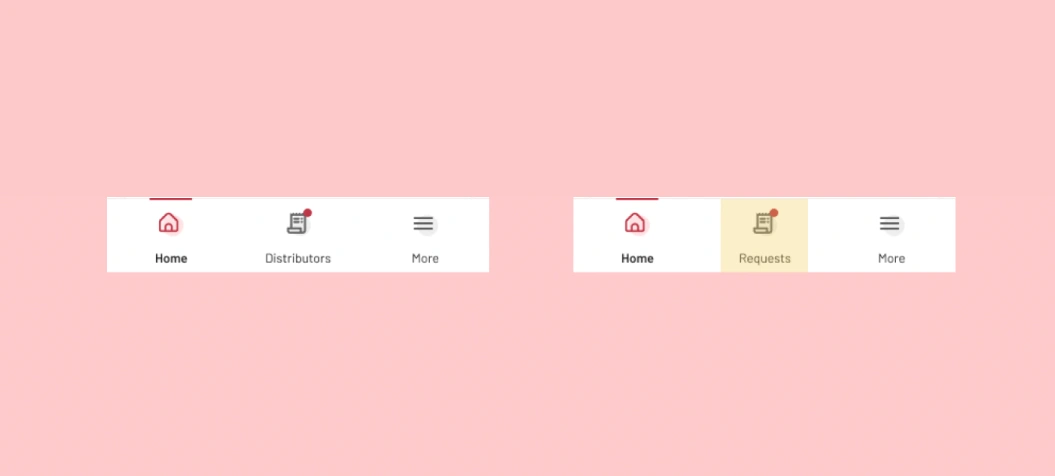
Confusing Labels
The "Distributors" tab created hesitation → Renamed to "Requests" for instant comprehension.
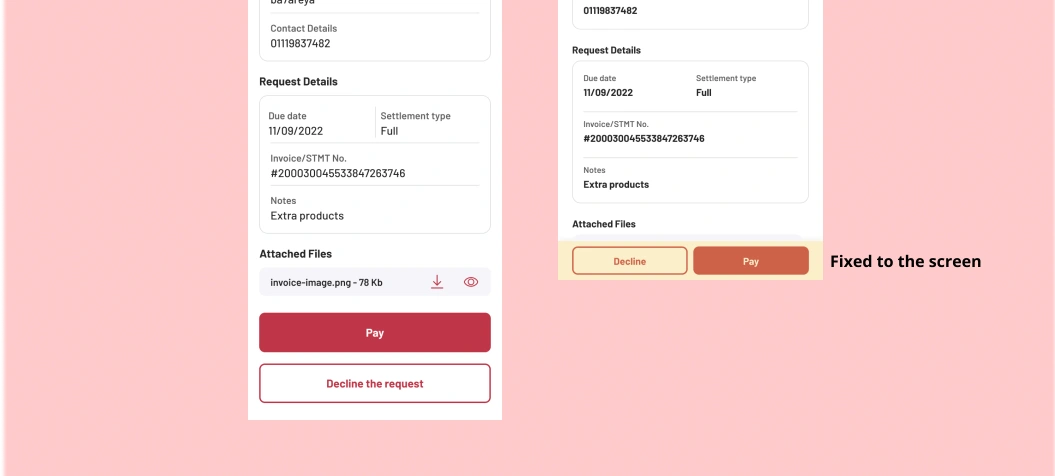
Hidden CTAs
Merchants consistently missed the Pay button → Implemented a persistent footer CTA for constant visibility.
Information Hierarchy
Users wanted requests sorted by due date → Made it the default view.
Design-to-Development Handoff
To ensure design fidelity through implementation:
Created comprehensive design specifications for both platforms
Established a design QA process with engineering
Logged enhancement tickets for gaps before launch
Implemented a UX writing review checkpoint where writers verified tone, messaging clarity, error states, and microcopy consistency before development.
Impact & Results
Product Outcomes
Simplified Navigation
For both corporates and merchants, reducing time-to-action and improving adoption confidence.
Streamlined Flows
For request creation and payment, removing friction from daily operations.
Increased Trust
Through improved UX writing, clear error handling, and intuitive CTAs.
Testing Framework
Became the standard for the product tribe.
Designed Business Impact
The Cash Collection solution was designed as a scalable digital ecosystem to:
Modernize payment workflows for Egyptian corporates and merchants
Reduce reliance on manual cash handling, improving security and efficiency
Lay foundational infrastructure for Egypt's move toward a cashless economy
Note: I completed the design phase through final handoff to development. The product was in development when I transitioned from the company.
Reflection & Learnings

What I Learned
Resilience Under Pressure
Stepping up as sole designer for four months taught me to prioritize ruthlessly, communicate proactively, and maintain design quality under time constraints.
Cross-Functional Collaboration
Workshops with researchers, PMs, and engineers surfaced insights none of us would have found alone.
Timing and Framing Matter
Early-stage open questions revealed context; later validation questions tested specific hypotheses.
Iterative Testing Builds Confidence
Each round removed uncertainty and built team confidence that we were solving the right problems the right way.
Closing Thoughts
This project tested me in ways I didn't anticipate from conducting research solo to maintaining design excellence during team transitions. But it also reinforced my belief that good design emerges from deeply understanding user needs, collaborating across disciplines, and iterating relentlessly.
The Cash Collection product isn't just a digital tool; it's a step toward transforming Egypt's economy, one transaction at a time.
0 likes · 6 views · Apr 8, 2026
Designed a cashless payment ecosystem for corporate distributors and merchants at Banque Misr.


