SXSW London Mobile App

Mahmoud Ahmed


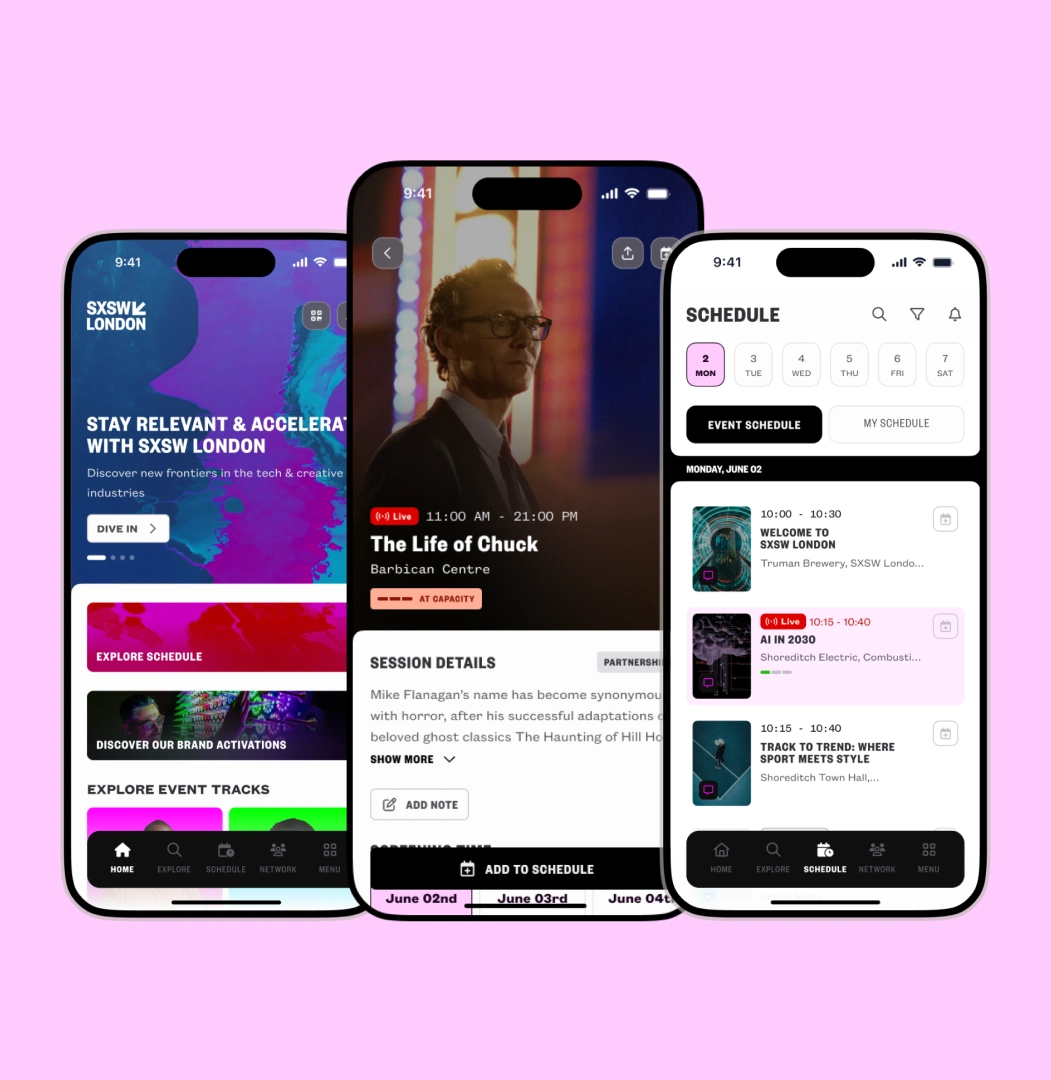
SXSW London Mobile App
Designing a Scalable White-Label Event Platform for Thousands of Attendees
Introduction
Project Overview
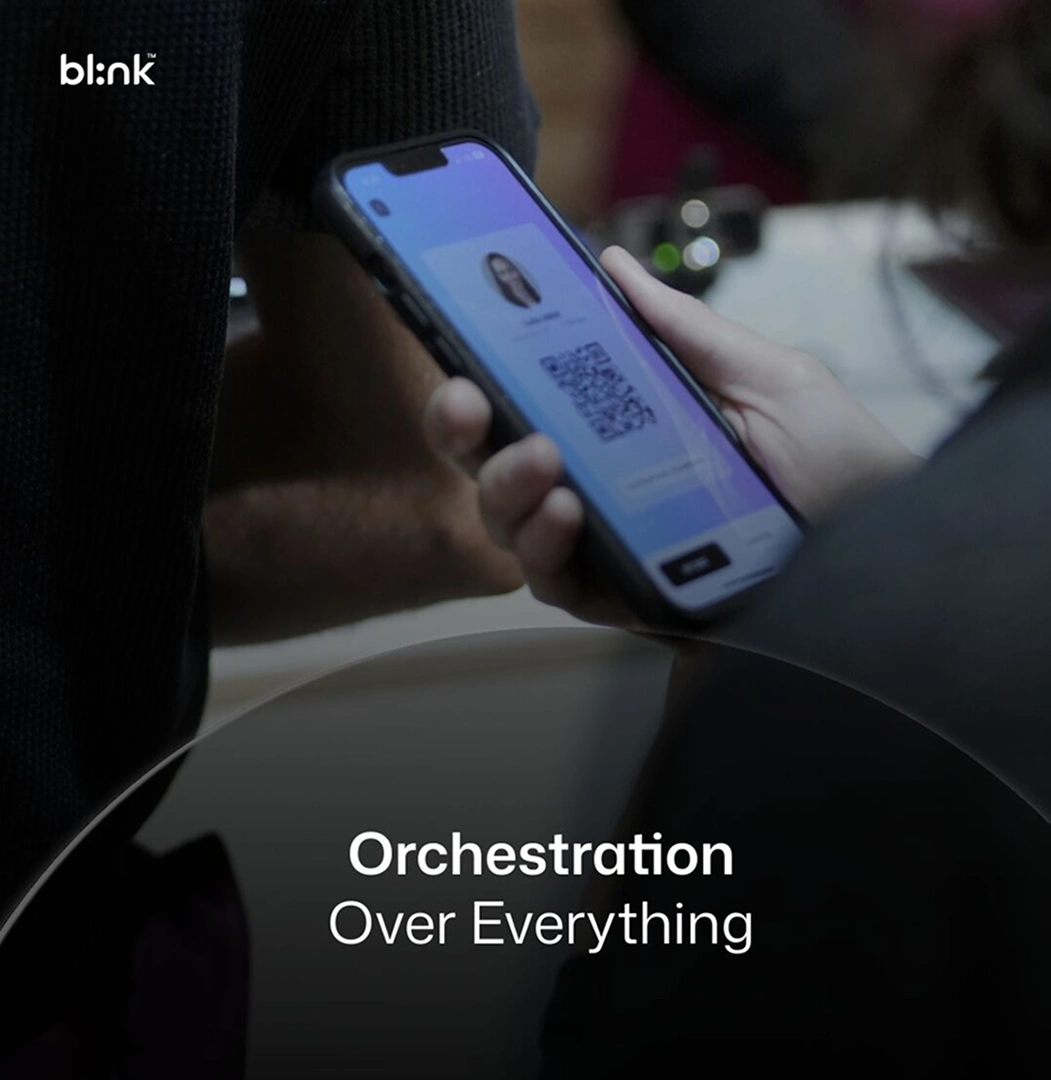
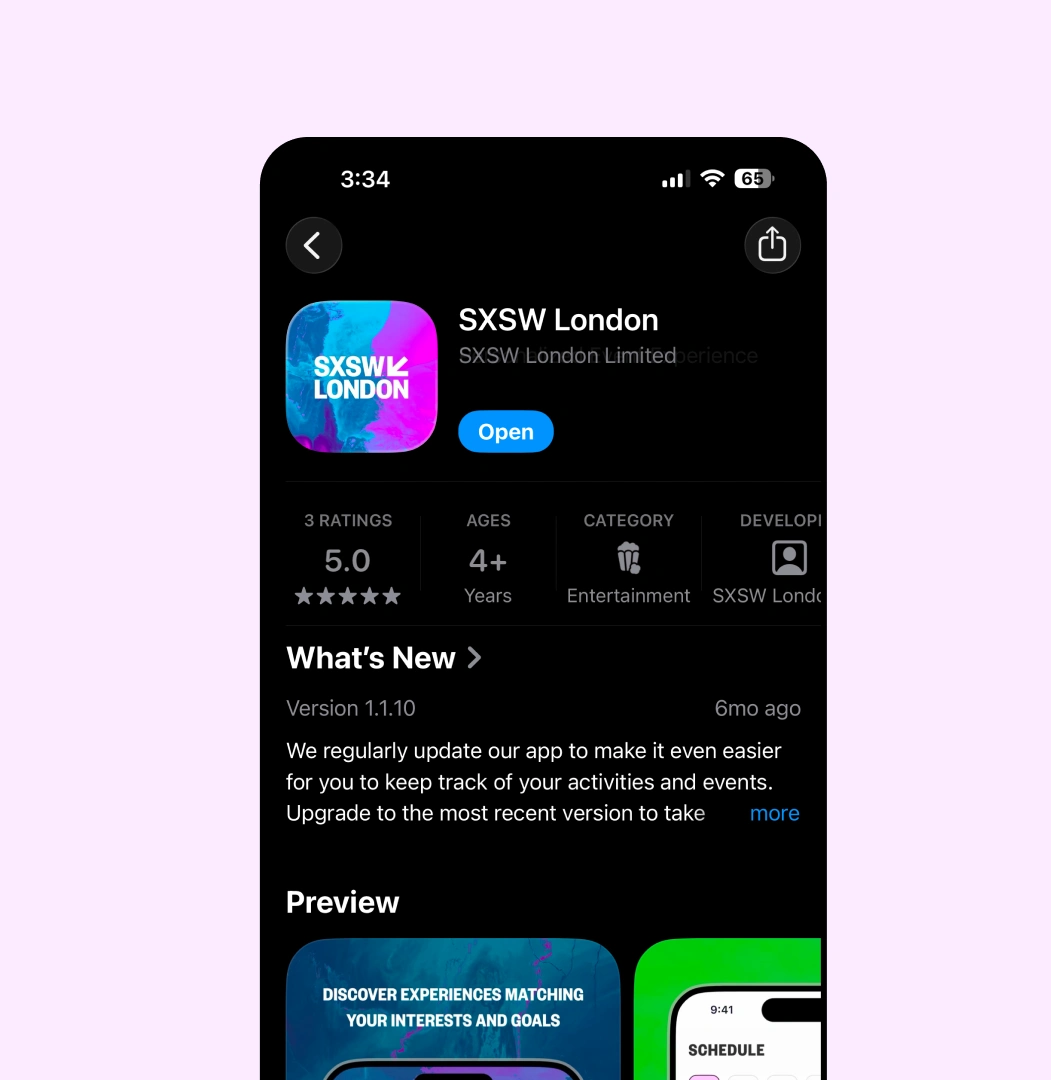
The GA Mobile App is a white-labeled event platform by bl:nk designed to enhance attendee experiences at large-scale events. SXSW London served as our flagship client, validating modular architecture for future global events.
About SXSW London 2025
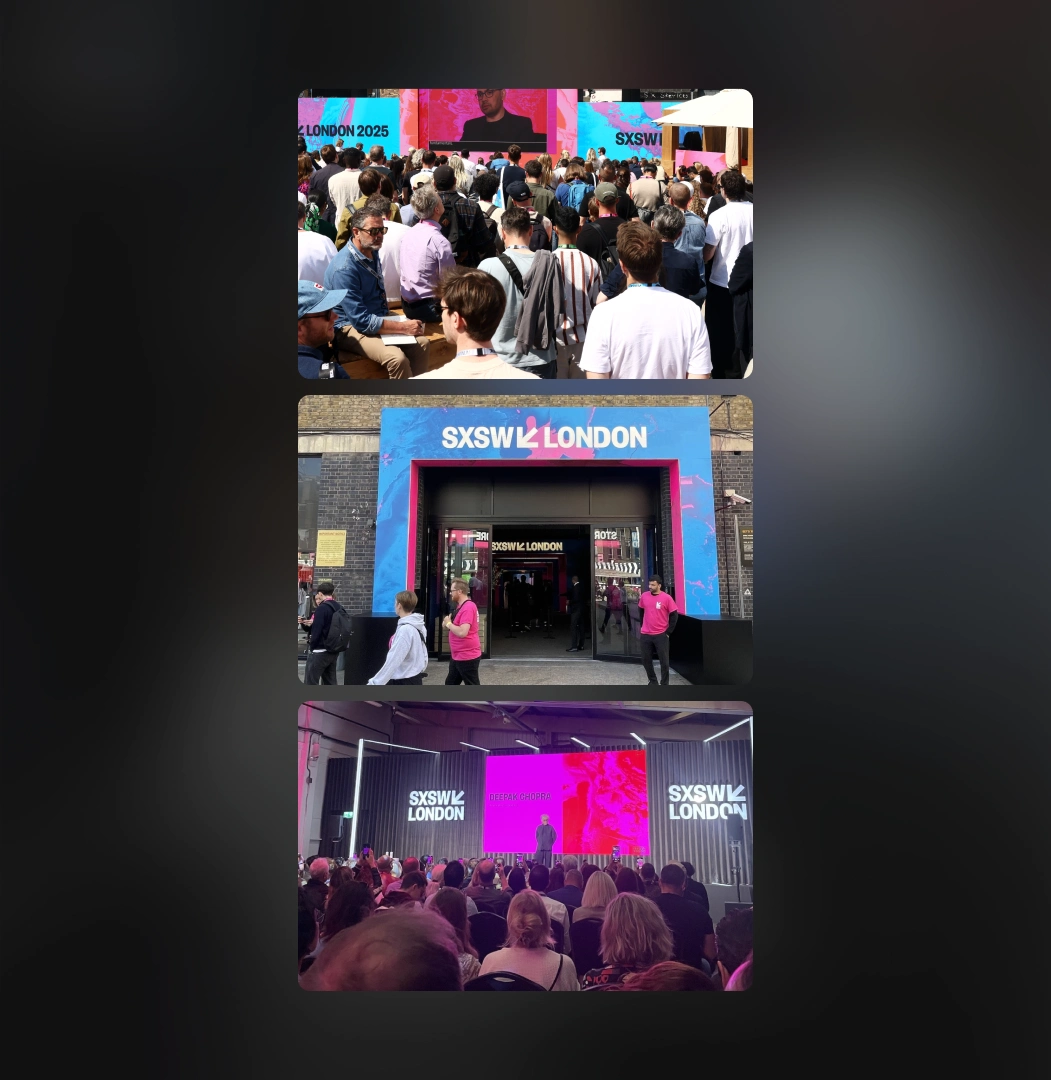
The Brand: SXSW is a world-famous festival from Austin, and Sydney, where tech, music, and film come together. In June 2025, the festival launched in London for the first time.
The Scale: With over 1,200 events across 34 locations, the mobile app was the main tool attendees used to navigate the busy schedule.
My Role
Senior Product Designer. Owned end-to-end design for SXSW London, from research through delivery. Led 2 designers while coordinating with product, engineering, and stakeholders.
Timeline
Oct 2024 – Jun 2025 (8 Months)
Team
2 Product Designers
Product Manager
Product Owner
Engineering Team
Recognition 🏆
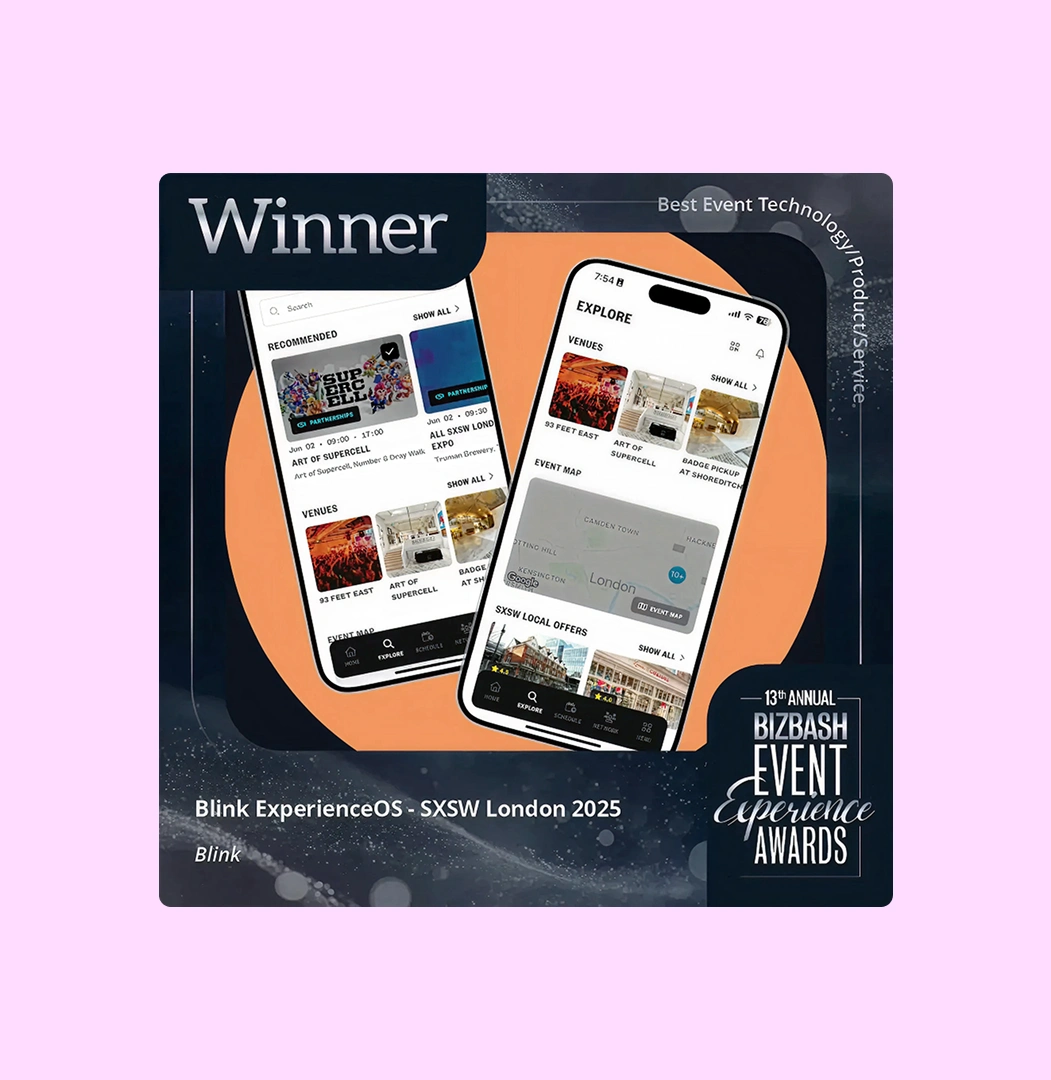
The SXSW London App was recognized globally, winning Best Event Technology/Product/Service at the 13th Annual BizBash Event Experience Awards.
Executive Summary
The Problem
Large-scale event attendees struggle to navigate complex venues, manage packed schedules, and make meaningful connections. All while expecting a seamless digital experience.
Business Context
Create an event platform that easily integrates with any brand, fully customizable and instantly recognizable.
The Solution
A modular, white-label mobile app architecture that serves diverse user types through integrated scheduling, wayfinding, and networking features designed for scale.
"Our goal was to create a flexible, scalable solution that could adapt to any major event while delivering consistent value to attendees."
The Challenge
Navigation Confusion
Attendees frequently got lost in large venues, leading to missed sessions and a drop in overall event satisfaction.
Session Overwhelm
The massive number of sessions causes choice paralysis, making users feel lost without clear guidance on what to attend.
Networking Gaps
Lack of effective channels for connecting with like-minded attendees and building meaningful professional relationships.
Information Sharing
No efficient way to share session or venue details with friends on-site.
Performance Expectations
Users demanded fast, intuitive experiences but would abandon slow or complex interfaces.
Business Requirements
Create a white-labeled platform adaptable to different event brands while ensuring scalability for events with thousands of concurrent users.
Discovery & Research
The Knowledge Gap
This was SXSW London's first year, and I had no prior knowledge of the SXSW ecosystem. Before designing anything, I needed to deeply understand what makes these events unique and valuable to attendees.
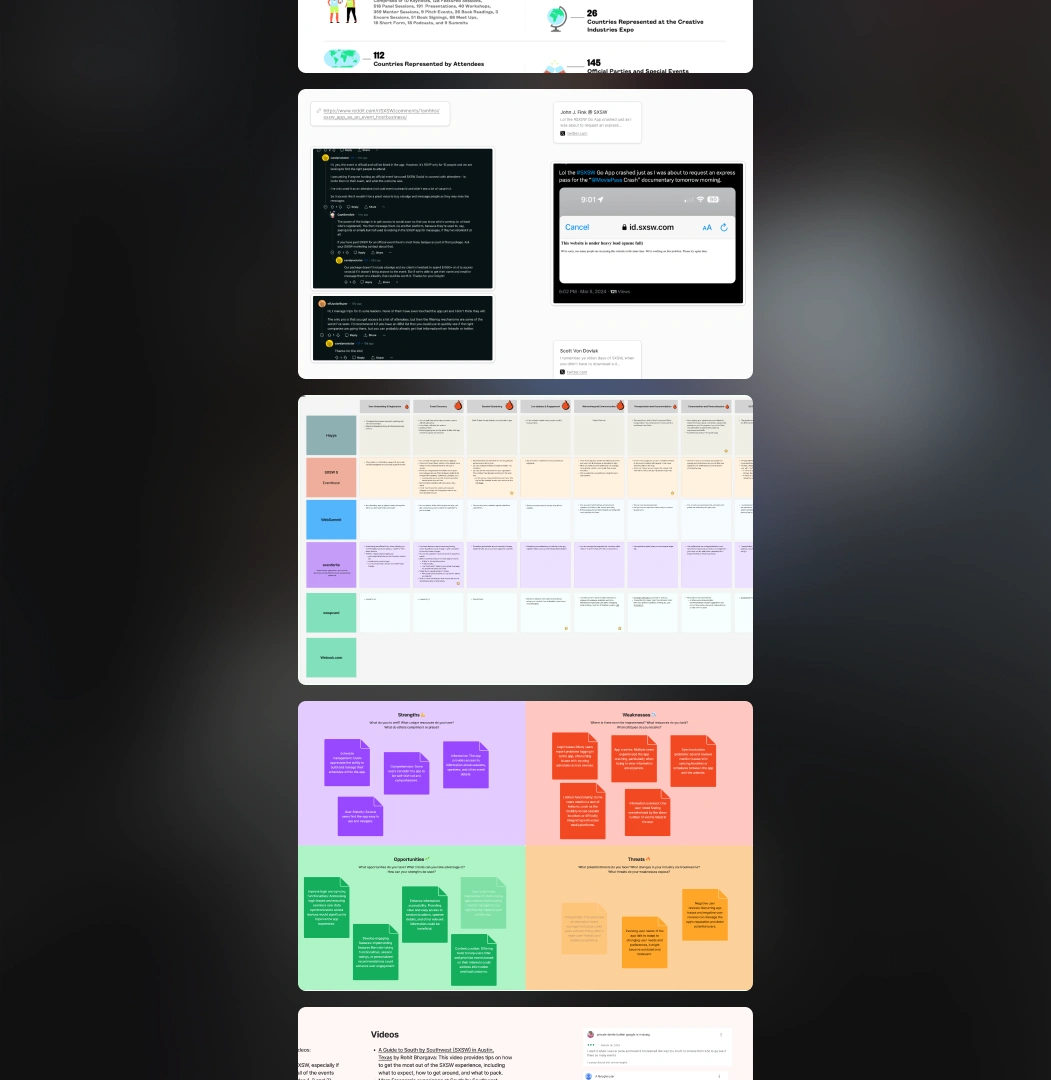
Secondary Research
Analyzed SXSW Austin and Sydney event structures, programs, and audience behaviors
Reviewed published statistics and demographic data spanning multiple years
Studied attendee-generated content including vlogs, social media posts, and reviews
Competitive Analysis
Mapped feature sets across different event apps to identify core functionality
Identified successful UI patterns and engagement strategies from similar large-scale platforms
Primary Research
Conducted targeted user interviews with past SXSW attendees from Austin and Sydney
Created a hypothetical user personas based on behavioral patterns and motivations
Key Insights
Planning Behavior: Users actively build personal schedules, showing strong intention to plan ahead.
Networking Priority: High interest in tools connecting like-minded professional attendees.
Real-time Needs: Heavy usage spikes require a fast, intuitive interface that works under pressure.
Context Switching: Frequent movement between sessions, maps, and social features.
Persona
Three Behavioral Segments Identified Through Discovery Research:
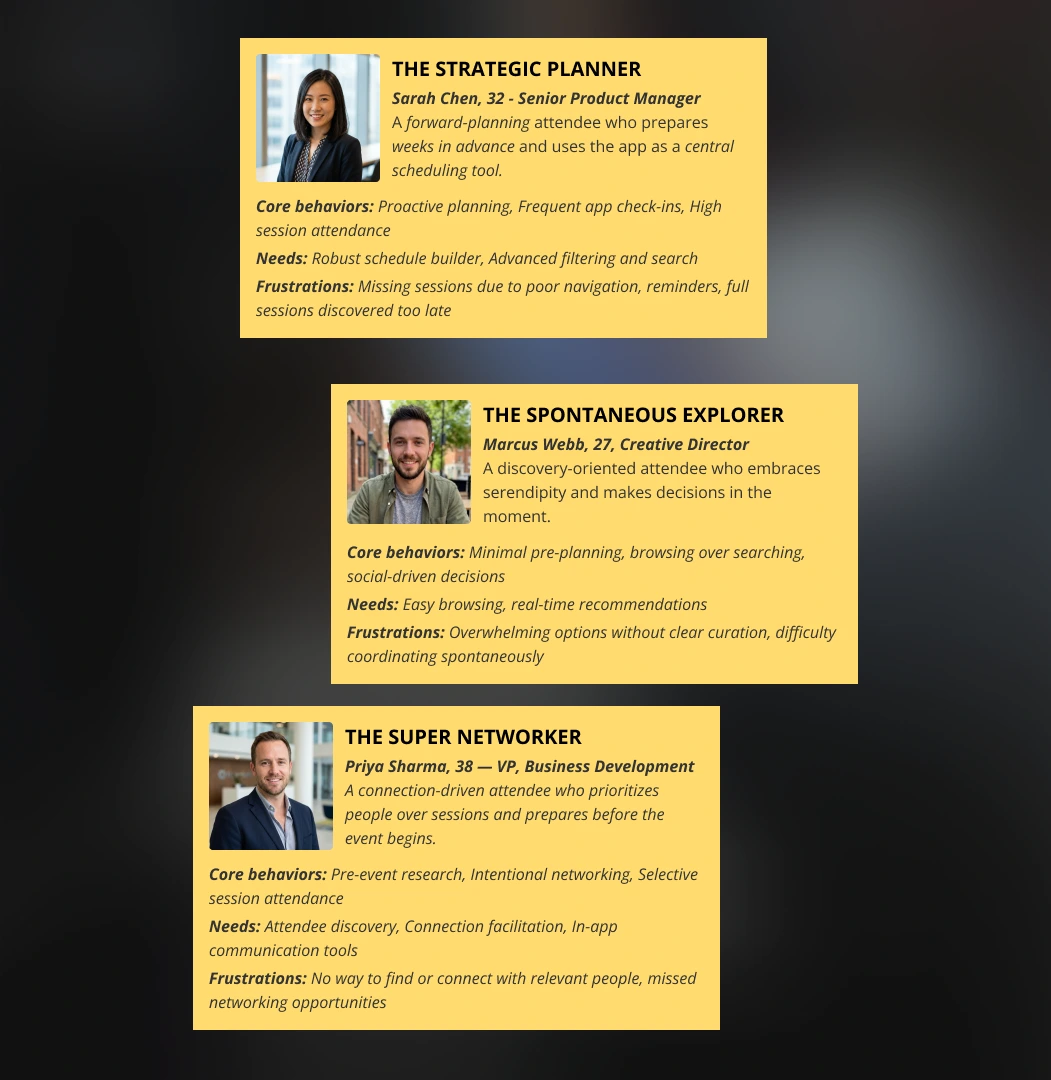
THE STRATEGIC PLANNER
Sarah Chen, 32 — Senior Product Manager
A forward-planning attendee who prepares weeks in advance and uses the app as a central scheduling tool.
Core behaviors: Proactive planning, Frequent app check-ins, High session attendance
Needs: Robust schedule builder, Advanced filtering and search
Frustrations: Missing sessions due to poor navigation, reminders, full sessions discovered too late
THE SPONTANEOUS EXPLORER
Marcus Webb, 27 — Creative Director
A discovery-oriented attendee who embraces serendipity and makes decisions in the moment.
Core behaviors: Minimal pre-planning, browsing over searching, social-driven decisions
Needs: Easy browsing, real-time recommendations
Frustrations: Overwhelming options without clear curation, difficulty coordinating spontaneously
THE SUPER NETWORKER
Priya Sharma, 38 — VP, Business Development
A connection-driven attendee who prioritizes people over sessions and prepares before the event begins.
Core behaviors: Pre-event research, Intentional networking, Selective session attendance
Needs: Attendee discovery, Connection facilitation, In-app communication tools
Frustrations: No way to find or connect with relevant people, missed networking opportunities
Defining Success
Design Goals
Enable effortless planning: Users should be able to build and manage their personal schedule with minimal friction
Reduce navigation anxiety: Attendees should feel confident moving through the venue and finding sessions
Facilitate meaningful connections: The app should actively support networking, not just allow it
Scale across events: Architecture must be flexible enough for future white-label deployments
Ideation & Exploration
Long-Term Goals (LTG)
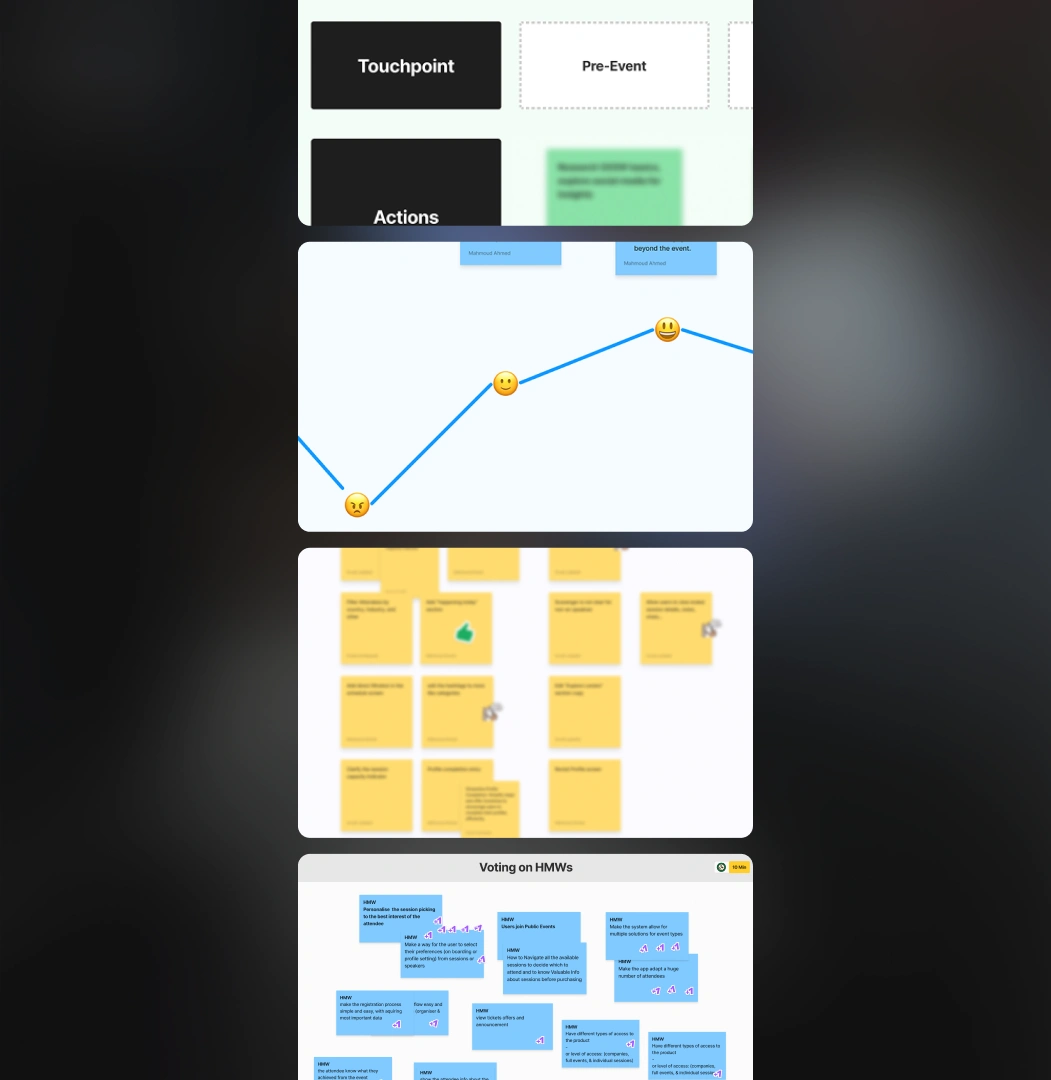
Before jumping into solutions, we aligned on the broader product vision. This wasn't just about SXSW London. It was about building the foundation for Blink's event platform ambitions.
2-Year Vision: Blink aims to become the leading comprehensive event management solution serving all market segments (B2B, B2C)
How Might We...
HMW help users quickly build a personalized schedule without feeling overwhelmed by options?
HMW provide venue navigation that works in the chaos of a live event?
HMW enable spontaneous social coordination without requiring heavy app engagement?
User Journey Mapping
We mapped the complete attendee journey across three phases (Pre-event, During event, Post-event) to identify key moments for design intervention.
"The journey map revealed that the highest-anxiety moments occurred during transitions, moving between sessions, finding new venues, coordinating with friends. These became priority areas for design focus."
Concept Wireframing
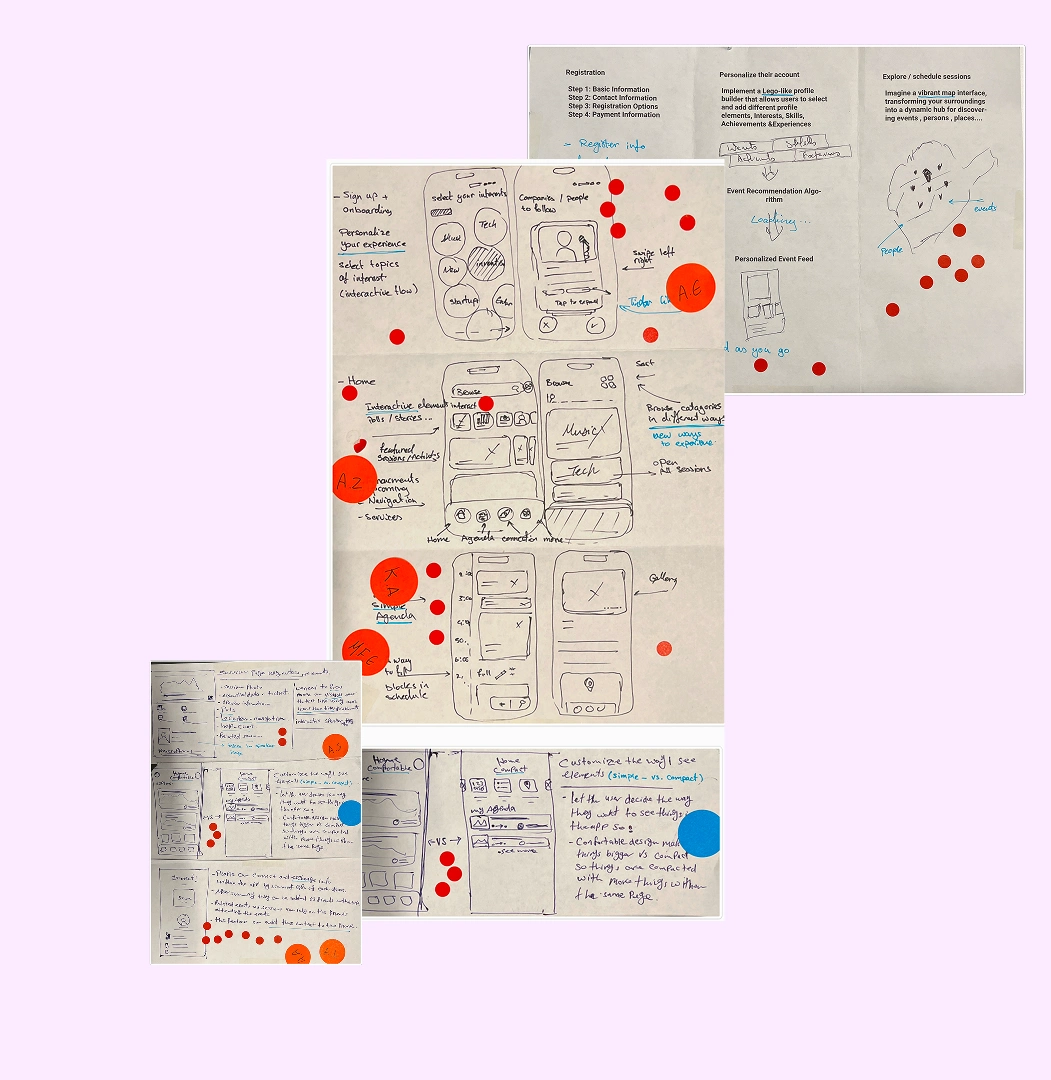
We explored multiple approaches for key features before committing to high-fidelity design.
Design Process
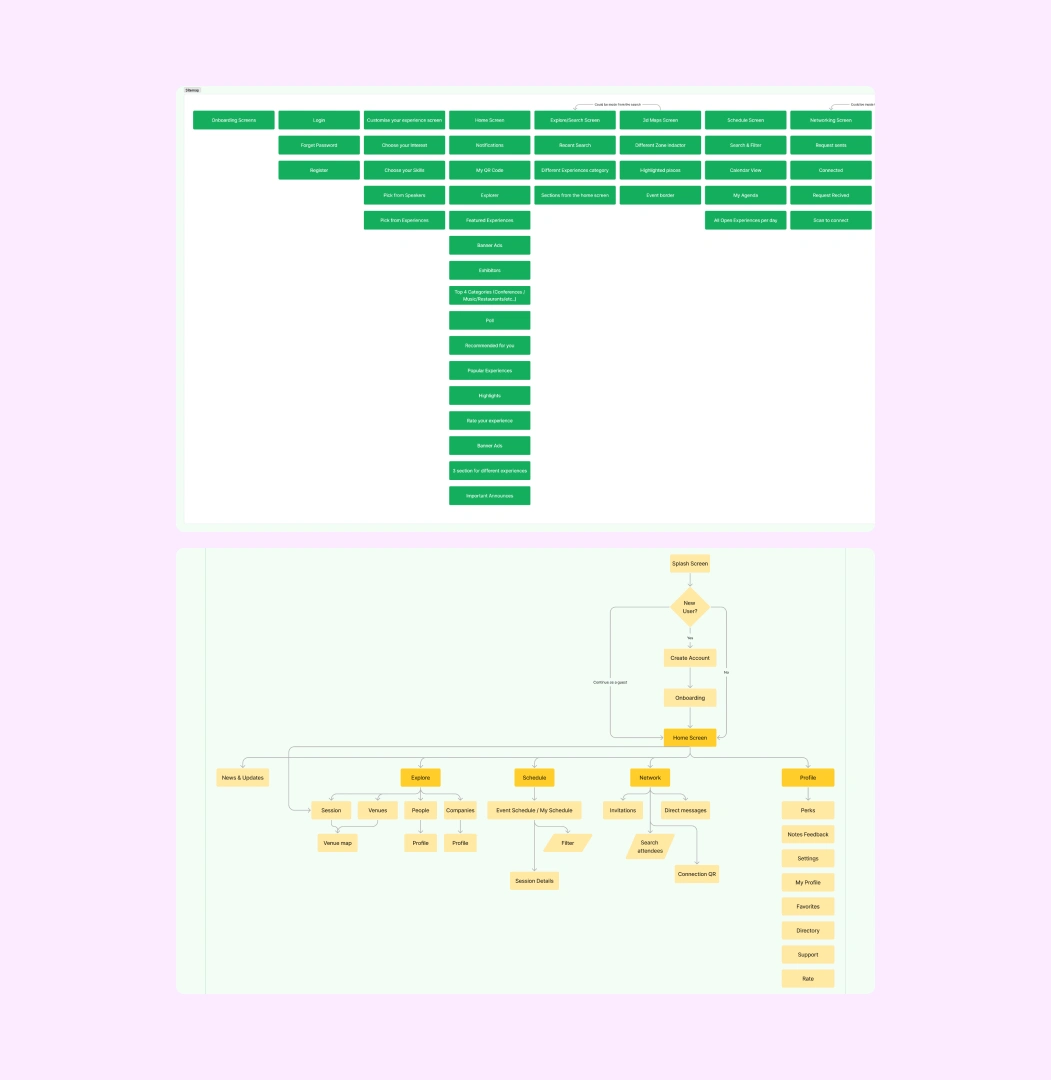
Strategic Framework
Vision Alignment: Collaborated with stakeholders to align product vision with user needs and business goals
Requirements Definition: Translated research insights into clear design requirements and success metrics
Iterative Design: Established design sprints focused on core user journeys
Cross-functional Integration: Maintained ongoing alignment with development and product teams
Design System Integration
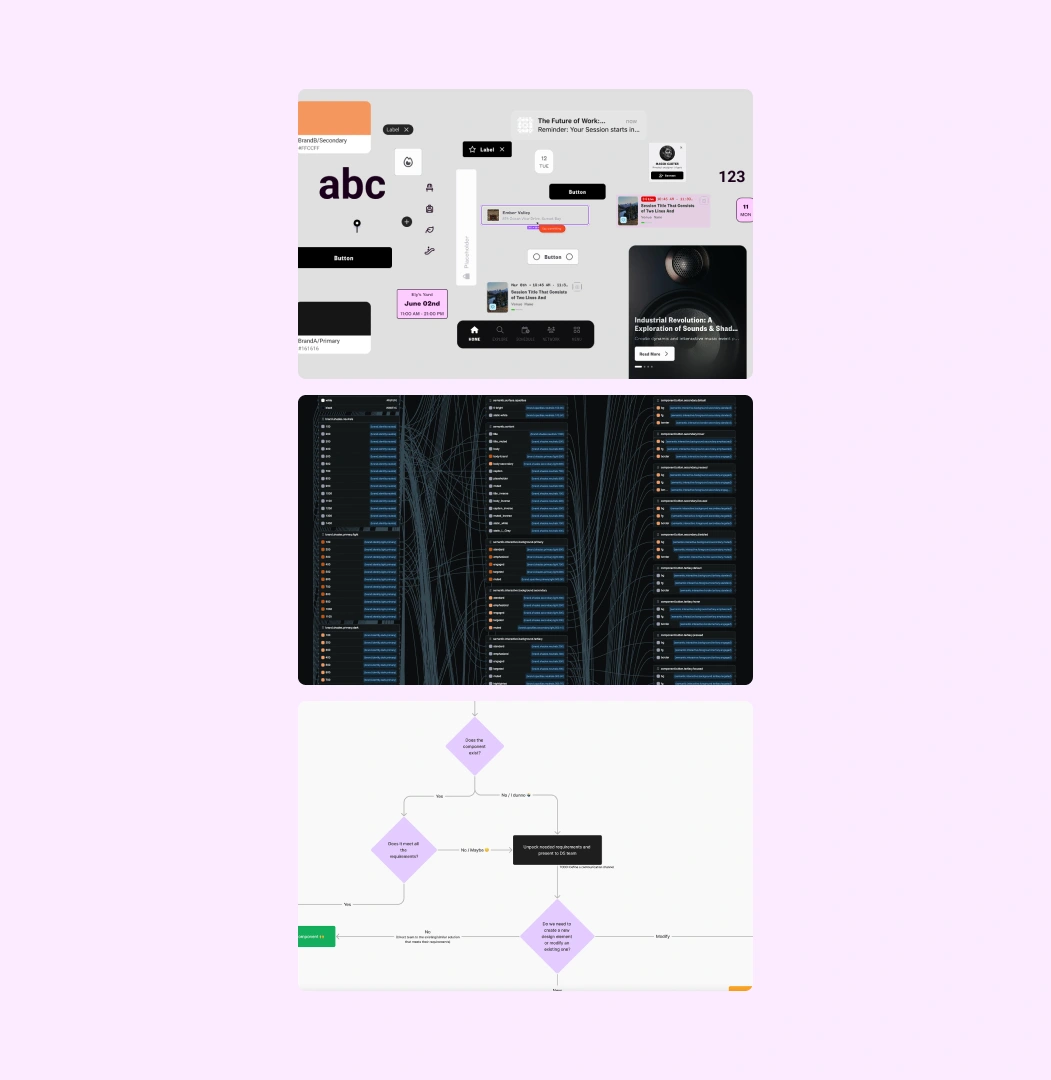
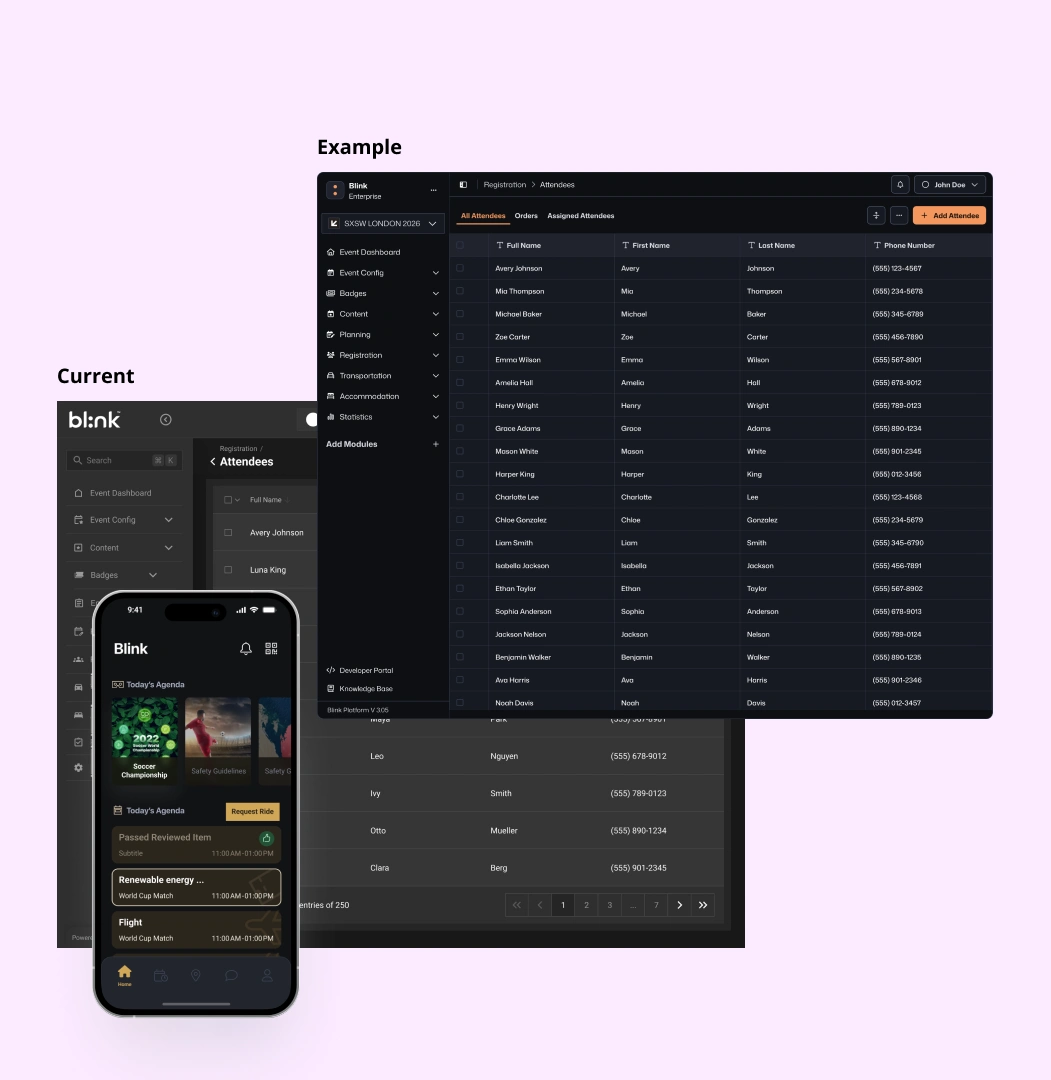
I led rebuilding Blink's design system
The Problem I Inherited
When I joined, the existing system was in disarray — no single source of truth, dozens of duplicated components, ~90% detached instances, and brand switching that took 4–8 weeks. Trust in the system was broken.
Architecture Approach
Atomic design methodology: Atoms → Molecules → Organisms → Templates
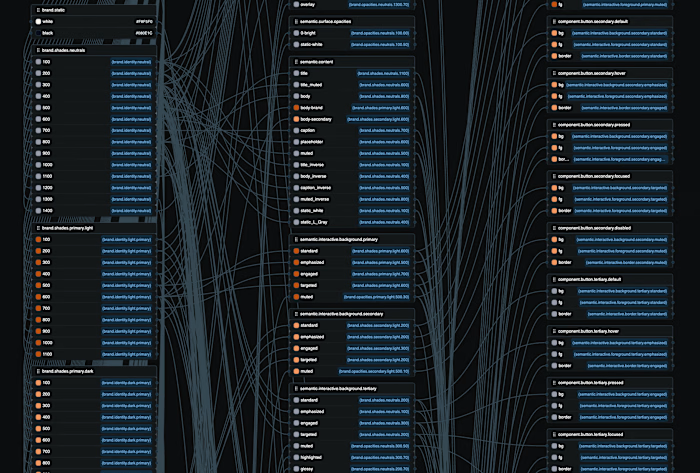
Token structure: I created a solid structure that consists of core, semantic, component Tokens
Hybrid governance model: Centralized standards with federated contribution.
The Rebuild Strategy
Foundation Building (Phase 1): Build new system alongside existing work; announce components for immediate use, maintain existing designs until refactor opportunities arose
Pilot Implementation (Phase 2): Test on a new product to prove value and build team confidence in design system again
System Expansion (Phase 3): Roll out successful patterns to existing products, establish governance model, and scale team involvement and ownership
Impact
4–8 weeks brand switching → 3–5 days
How This Enabled SXSW London
The rebuilt system meant our small team delivered 50+ consistent screens with zero detached instances, accelerating delivery by ~300%.
Impact: Reduced end-to-end delivery time by 90% transforming a traditional 4–8 week production cycle into a 3-day rapid deployment.
Execution & Delivery
Core Features Delivered
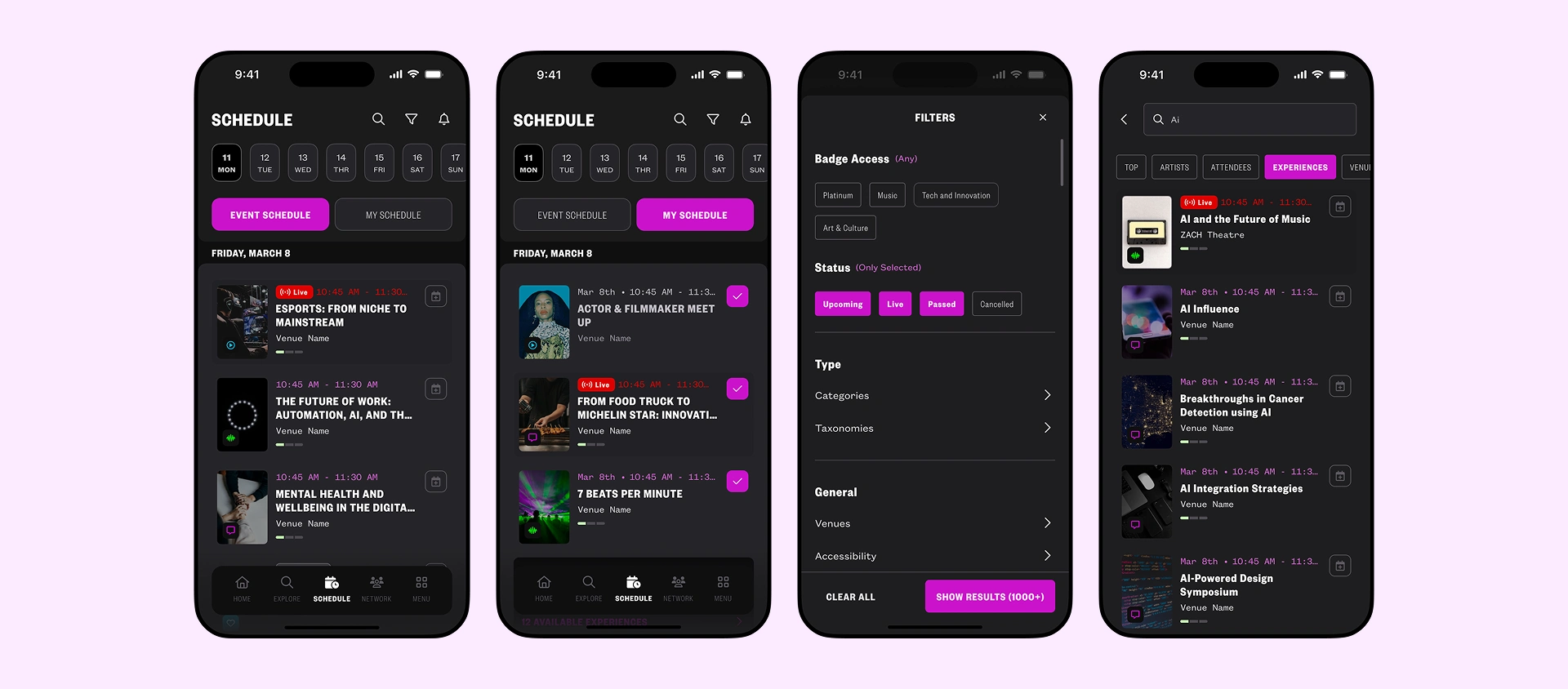
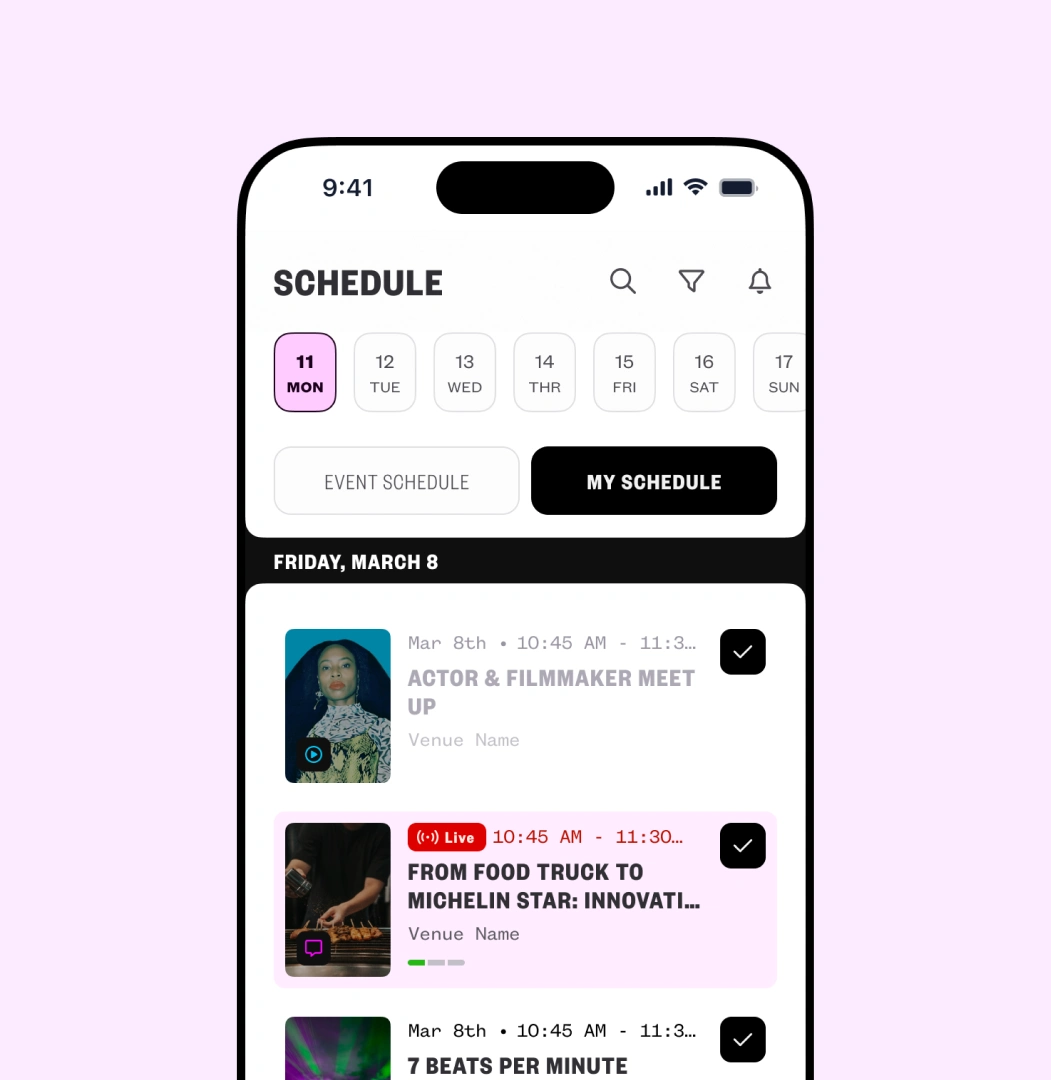
Personal Schedule Builder: Intuitive session planning and management
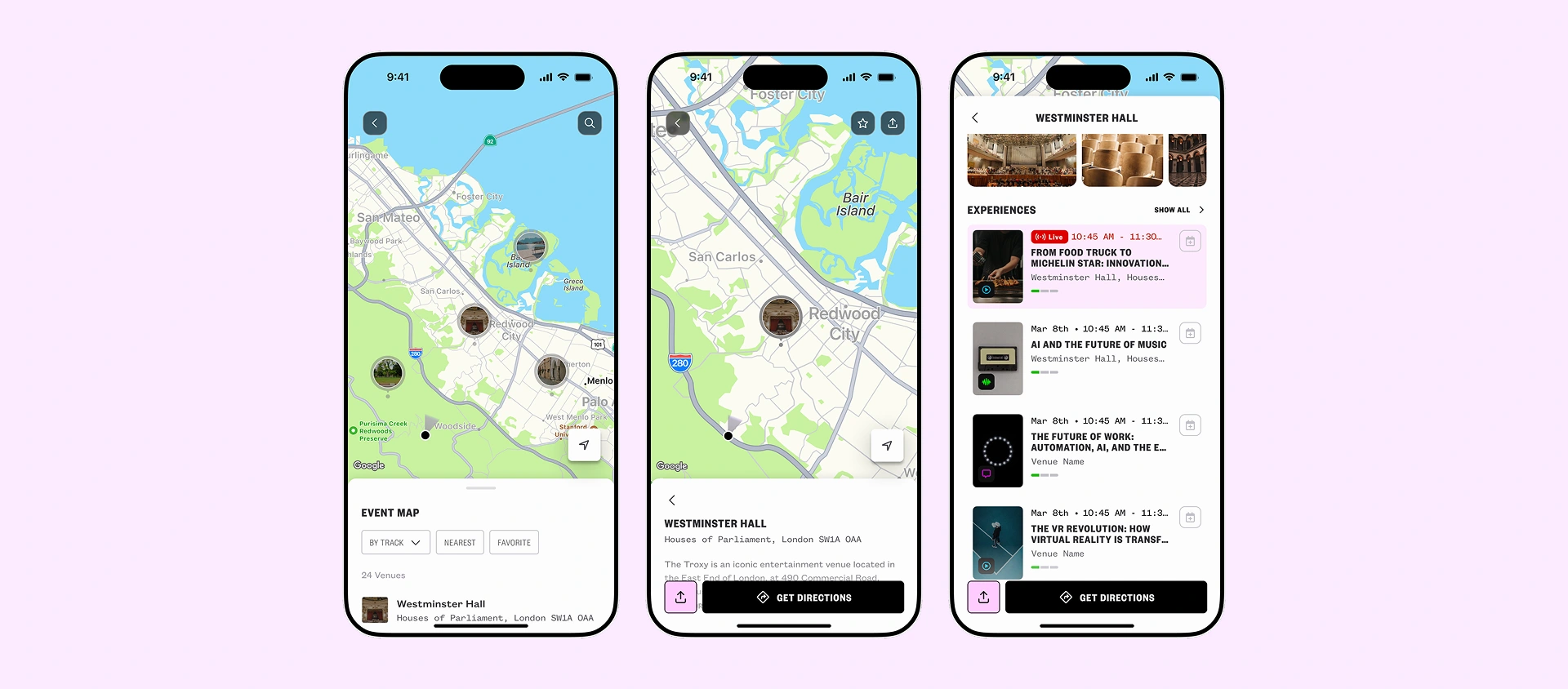
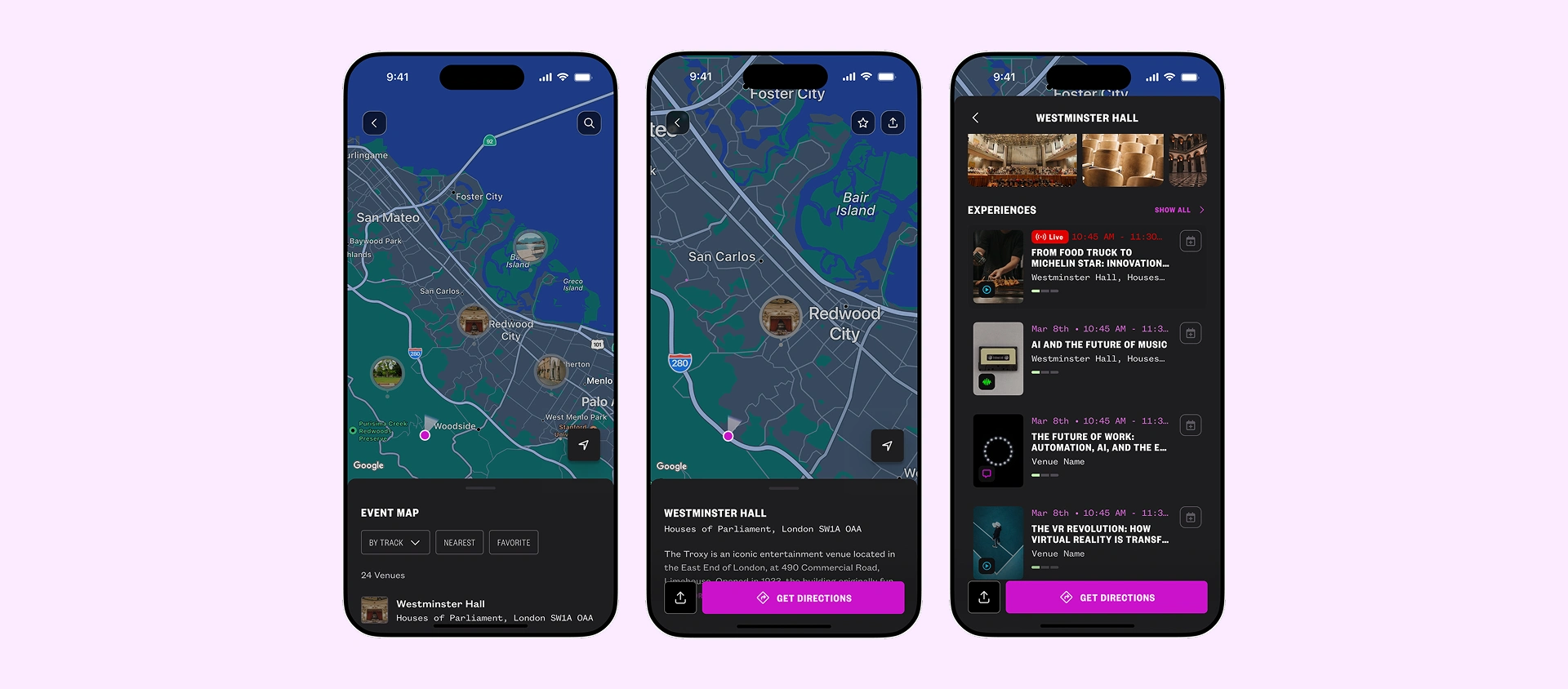
Interactive Venue Maps: Turn-by-turn navigation with real-time updates
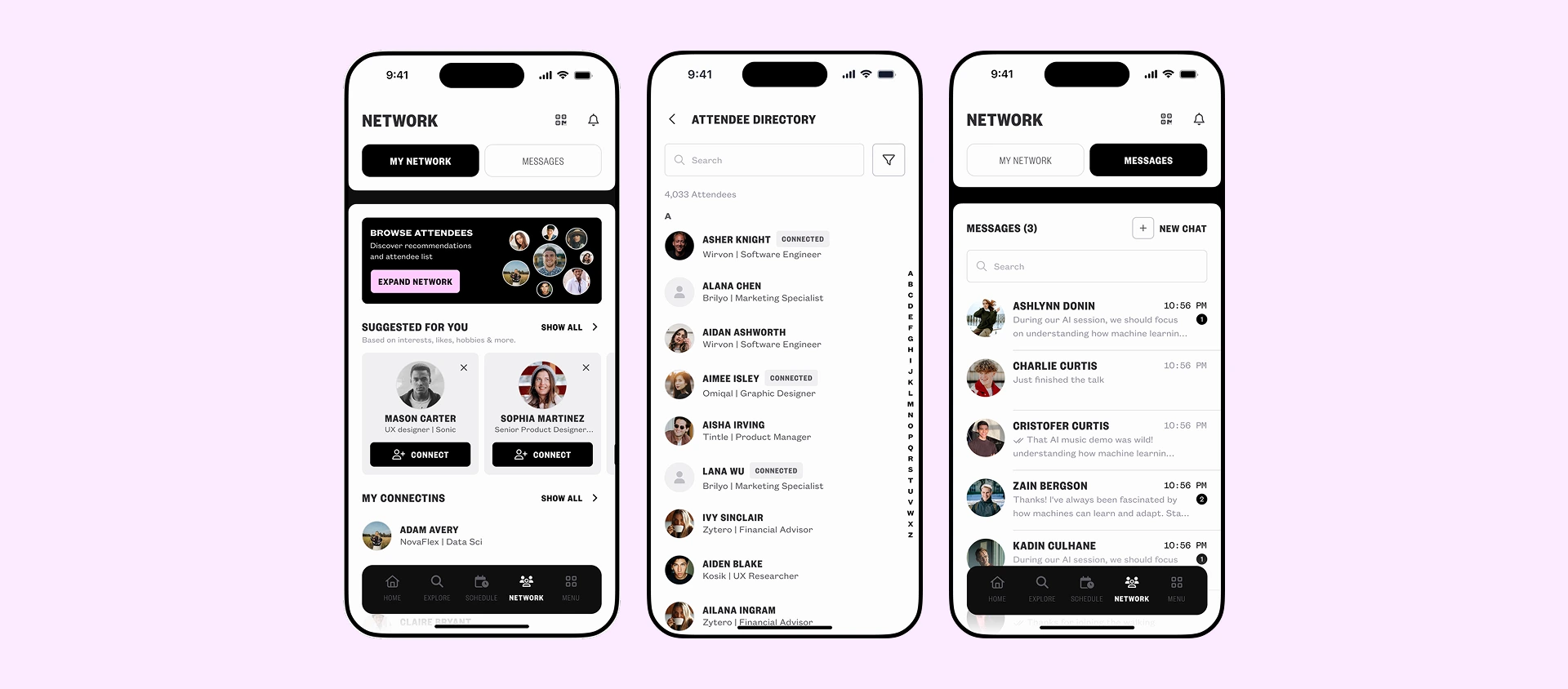
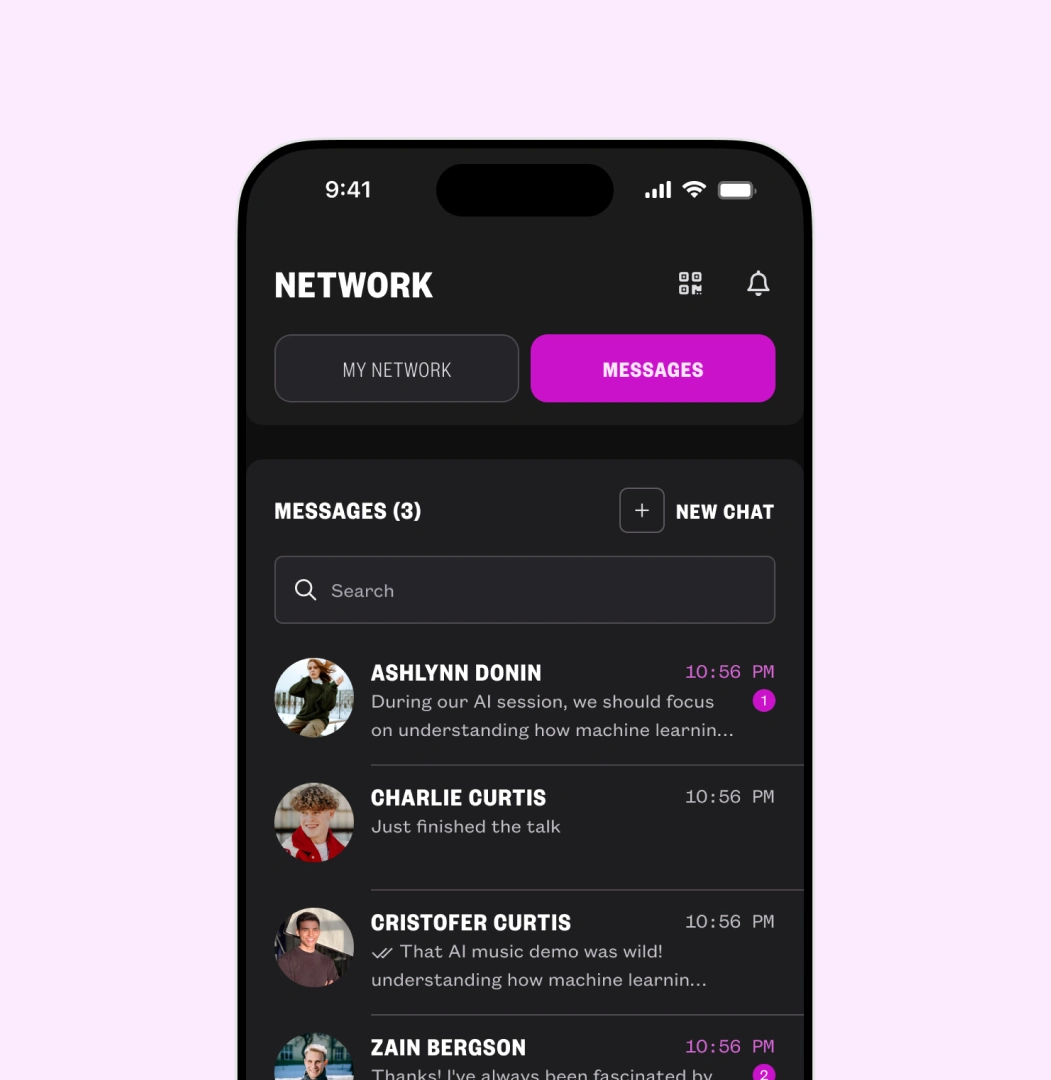
Networking Tools: Attendee discovery and connection feature
Live Updates: Real-time session changes and announcements
Social Sharing: Quick sharing of sessions and venue information
Technical Considerations
Optimized for high-traffic scenarios with thousands of concurrent users
Offline-capable core features for areas with poor connectivity
Cross-platform consistency between iOS and Android implementations
Team Management
Established a "Sprint & Review" rhythm to prioritize work across multiple design cycles.
Prioritized work across multiple design sprints
Delegated tasks to junior designers while providing mentorship through daily design crits to maintain quality standards.
Facilitated cross-functional design reviews and stakeholder presentations to ensure technical feasibility.
Managed timeline delivery under pressure
Key Screens
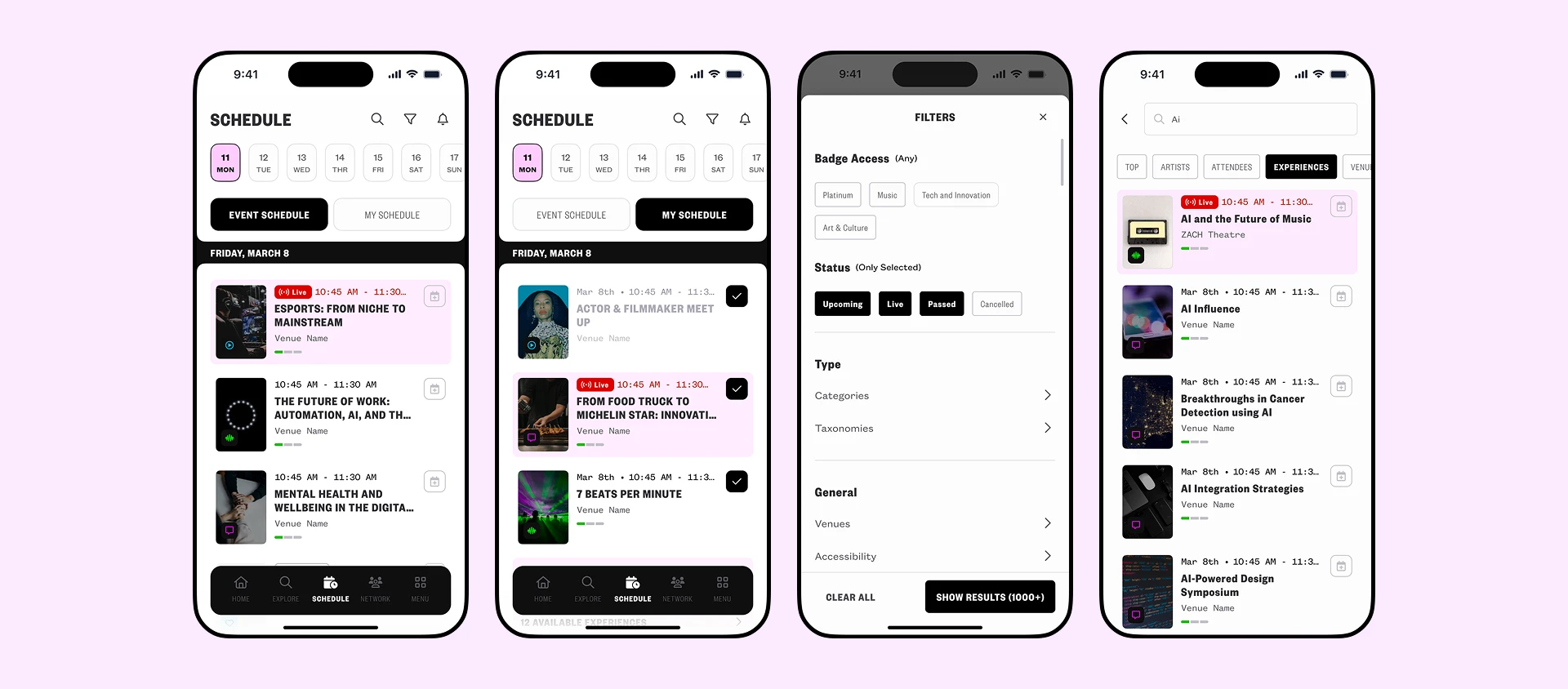
Schedule Builder
A central hub to help users find sessions, and manage agenda
Venue Navigation
Navigate complex venues with confidence
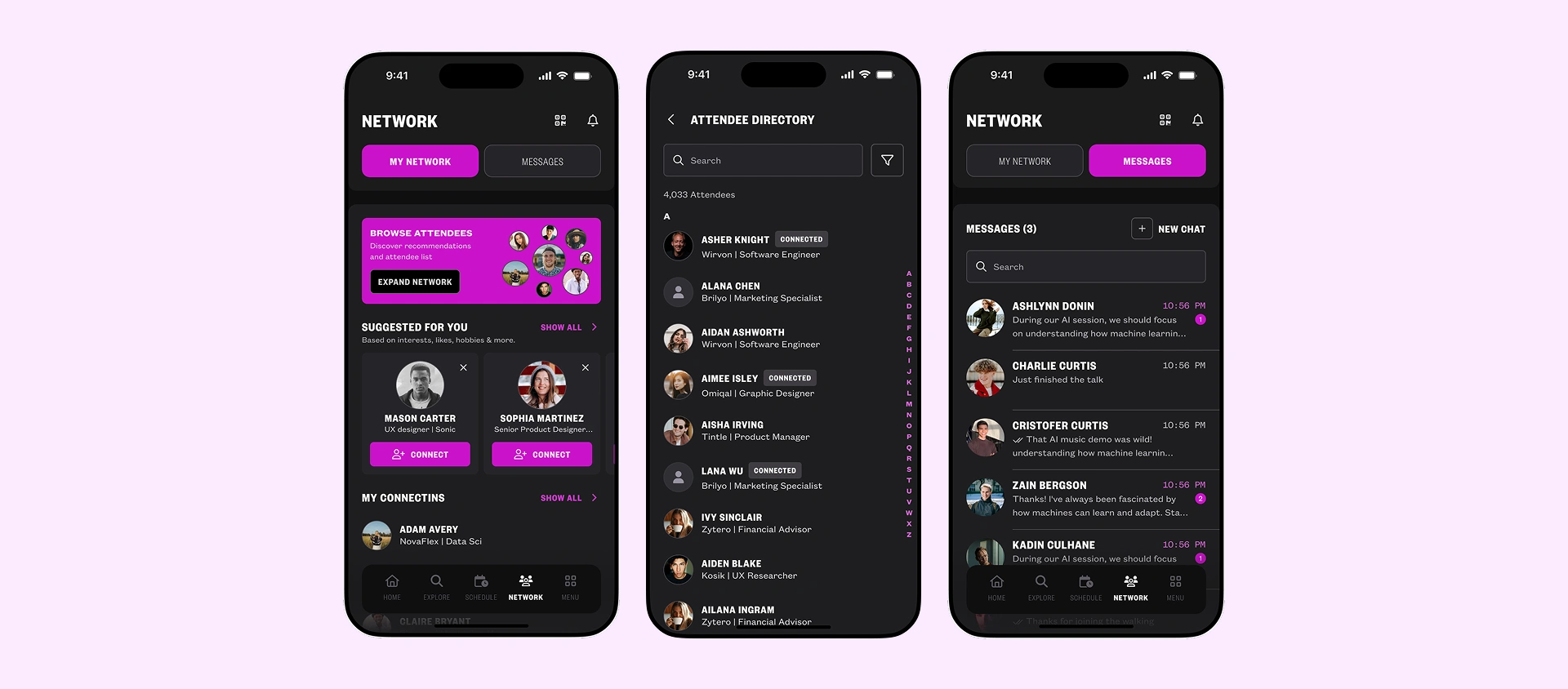
Networking Hub
Discover and connect with relevant attendees
Validation & Iteration
Usability Testing
We conducted multiple rounds of usability testing throughout the design process to validate assumptions and refine interactions. Below is one example that shaped a key design decision.
Venue Navigation Flow
Participants: 5 past event attendees
Method: Moderated task-based testing with prototype
Task: "You have a session starting in 15 minutes — find your way to the venue."
Finding
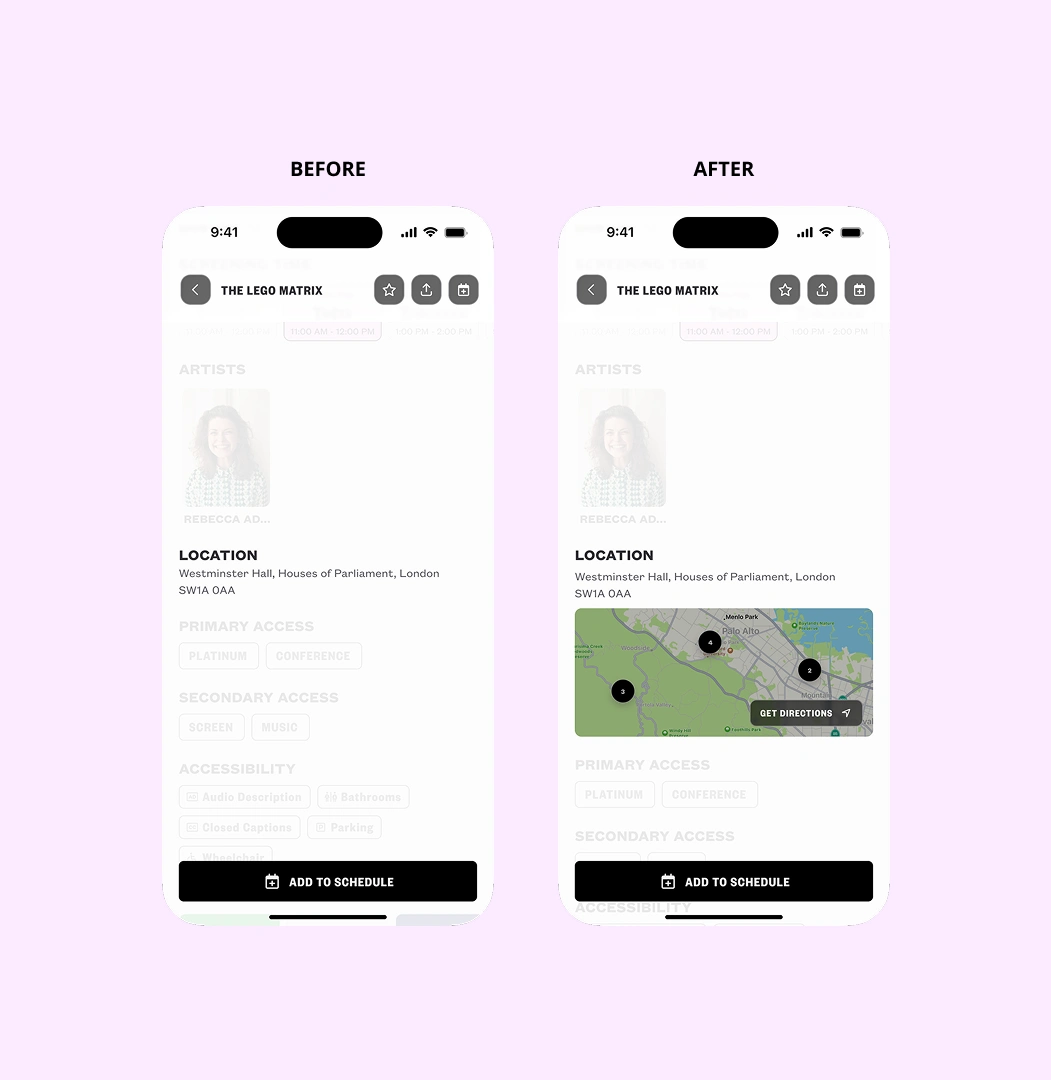
Users instinctively looked for navigation options within the session details screen. When directions weren't available there, they felt frustrated — having to exit and manually search for the venue broke their flow.
Design Decision
We added a "Get Directions" action directly to the session details screen, allowing users to seamlessly transition from viewing session information to navigating to the venue. This reduced steps and aligned with users' mental model of session to location.
Results & Impact
Pre-Launch Preparation
Strategic Planning
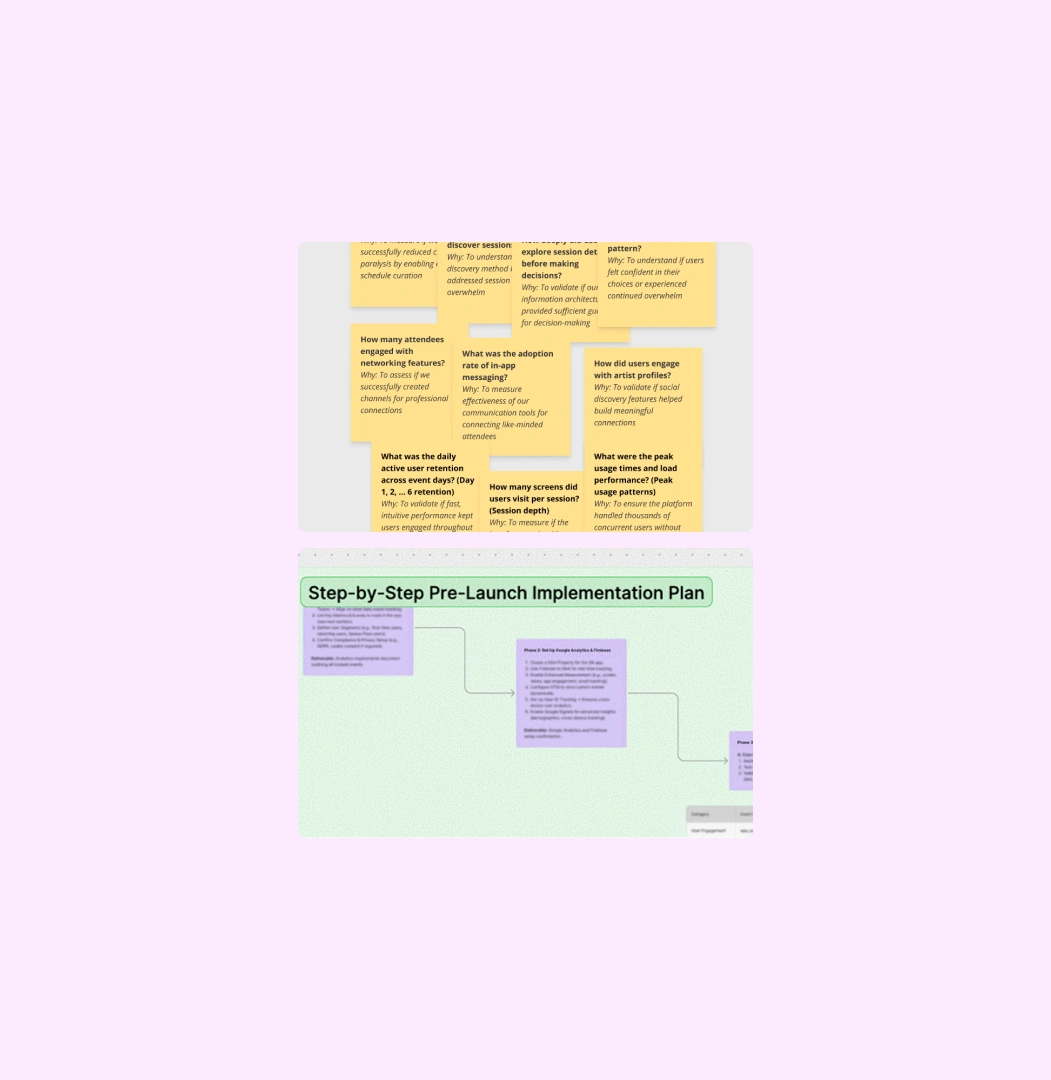
Defined comprehensive event tracking strategy to measure user behavior and app performance
Established key metrics and success indicators before launch
Set up analytics infrastructure to capture real-time usage data during the event
Coordinated with stakeholders on monitoring and support protocols
Launch Success
Results & Impact
21k Daily Active users
~94% of all event attendees actively used the mobile app
Results & Impact
71.3% Conversion Rate of users who actually added the session to the schedule and attended the sessions
Results & Impact
17.8K Conversations Started
Proves meaningful engagement
Results & Impact
6 Platforms Design System Adoption
The implementation impressed the management. I recommended to scale this approach across all products. A headless design system now is getting adopted across MD, Organizer, Shop, and VIP, ID, and Users dashboard
Post-Event User Engagement Analysis
Strong Performance Areas
Planning Behavior: Users actively built personal schedules, demonstrating strong intention to use the app as their primary event companion
Networking Success: Networking tools showed promising interaction with high engagement rates, validating our solution to the networking gaps problem
Optimization Opportunities
Search vs. Browse: Lower engagement in explore/search functionality compared to browsing behavior
Note-taking Features: Limited adoption of session note capabilities, indicating opportunities for future UX refinement
Content Discovery: Room for improvement in helping users find relevant sessions and experiences
Post-Launch Insights & Iteration
After the event, analytics and user feedback revealed a key pain point.
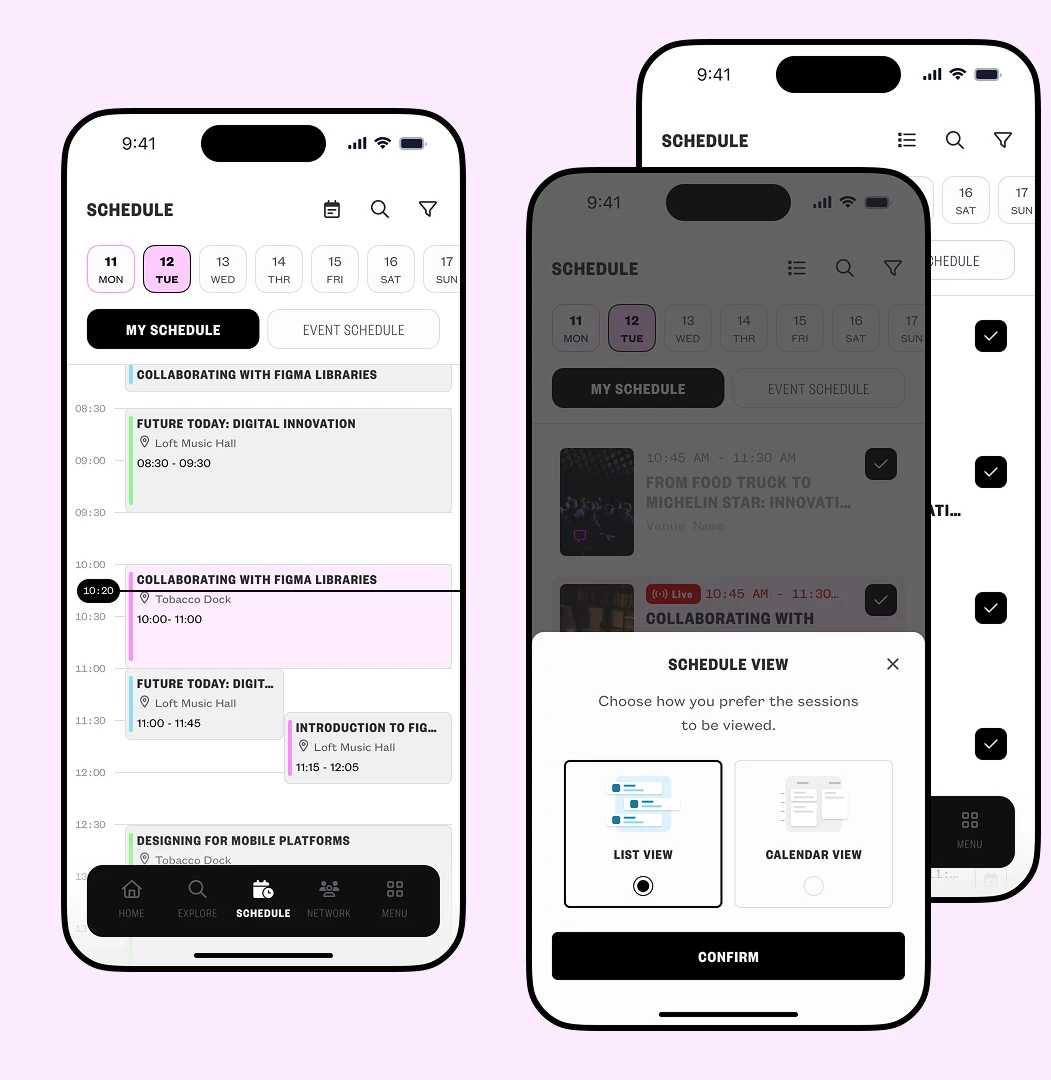
The Problem
Users struggled to identify overlapping sessions and time conflicts in their schedule. The agenda view made it difficult to visualize when sessions competed for the same time slot, leading to missed sessions and frustration.
Context
While planning intent was high with users adding an average of 31.5 sessions to their personal schedules, we observed a significant friction point:
19.6% of sessions were later removed.
29% of planned sessions were never attended
Suggesting a breakdown between intent and execution. Through user interviews:
User Feedback
"The list view made it impossible to see that two sessions were at the same time I had to mentally track everything."
"I kept adding sessions without realizing they overlapped. By the time I noticed, I'd already missed one."
"I added my whole day, then realized half of it conflicted. Spent 10 minutes cleaning up my schedule."
The Solution
We designed a new calendar view that displays sessions on a time-based grid, making conflicts immediately visible at a glance.
Validation
We ran usability testing comparing the calendar view against other schedule view approaches. Users strongly preferred the calendar view for conflict detection while still appreciating the agenda view for quick scanning.
Outcome
Calendar view is currently in development and scheduled for the next release, giving users the ability to toggle between agenda (for quick reference) and calendar (for planning and conflict management).
Reflections

"Each product I help shape, shapes me in return, refining how I think, see, and build what comes next."
What I Learned
Designing white-labeled products requires flexible systems that adapt quickly to real-time needs.
Early cross-functional alignment prevented costly late-stage changes
Leading designers while delivering under pressure demonstrated that team growth and project success can happen at the same time.
Launching a meaningful, functional product proved more valuable than delaying for theoretical perfection.
Like this project
Posted Apr 8, 2026
Designed a scalable mobile app for SXSW London, enhancing attendee navigation at large-scale events.
Likes
0
Views
2