Skills Demand in Nigeria Dashboard

Osinachi Promise Luke


Skills Demand in Nigeria (2019 - 2023) Dashboard
Table of Content
Introduction
Nigeria’s labor market is constantly evolving due to technological advancements, economic shifts, and government initiatives. The demand for various skills has increased, especially in response to unemployment rates, entrepreneurship opportunities, and market trends. This Skills Demand Dashboard provides insights into the types of skills in demand across different states in Nigeria, the target audience for these skills, and the key reasons driving skill demand from 2019 to 2023.
Business Problem
The mismatch between skills and job market needs has contributed to high unemployment rates and underemployment in Nigeria. Key issues include:
The lack of awareness about in-demand skills.
The inability of job seekers to align with industry needs.
A gap between government training programs and market demand.
To bridge this gap, it is crucial to analyze which skills are in high demand and what factors influence their necessity.
Project Objectives
Identify key skills in demand across different states.
Analyze the reasons driving skill demand.
Determine the primary target audience for skill acquisition programs.
Provide insights for policymakers, educators, and job seekers.
Data Source
The dataset was sourced from Kaggle, containing records of skill demands in 15 Nigerian states.
Process
Data Cleaning & Transformation – Handling missing values, formatting inconsistencies, and ensuring data accuracy.
Exploratory Data Analysis (EDA) – Examining Demand level and reasons for demand.
Data Visualization – Presenting insights using Power BI.
Tools Used
Microsoft Excel for data cleaning, transformation, and initial analysis.
Power BI for filtration, data visualization and in-depth analytics.
Key Insights
1. Overview of Skill Demand in Nigeria
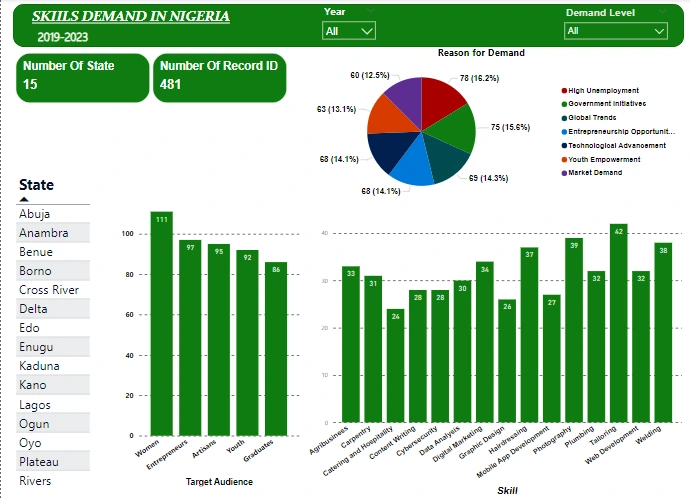
Number of States Analyzed: 15
Total Number of Records: 481
The data covers multiple states and provides a broad perspective on skill demand in Nigeria. The insights can guide both government agencies and private institutions in making informed decisions.
2. Reasons for Skill Demand
The key drivers for skill demand include:
High Unemployment (16.2%) – Many people are acquiring new skills to improve job prospects.
Government Initiatives (15.6%) – Programs launched by the government to encourage skill development.
Global Trends (15.6%) – The rise of digital skills due to international labor market changes.
Entrepreneurship Opportunities (14.3%) – Many individuals seek skills for self-employment.
Technological Advancement (14.1%) – The demand for digital and tech-based skills.
Youth Empowerment (14.1%) – Programs focused on equipping young people with employable skills.
Market Demand (12.5%) – Employers and industries require specific skills.
Economic conditions and technology are shaping skill demand. The data suggests that government efforts and global labor market trends significantly influence skill acquisition.
3. Target Audience for Skill Acquisition
The top target groups for skill acquisition include:
Women (111 requests) – Women are a key demographic for skill development programs.
Entrepreneurs (97 requests) – Many individuals are learning skills to start businesses.
Artisans (95 requests) – Traditional craftsmanship and trade skills remain relevant.
Youth (92 requests) – Young people are a major focus for training programs.
Graduates (86 requests) – University graduates seek additional skills to become employable.
Women, youth, and entrepreneurs are the most active participants in skill acquisition programs. This suggests that training initiatives should focus on these groups to maximize impact.
4. Most In-Demand Skills in Nigeria (2019-2023)
The top requested skills include:
Web Development (42 requests) – The rise of digital businesses has increased demand for web development skills.
Photography (39 requests) – Creative industries continue to grow, increasing the need for photographers.
Data Analysis (36 requests) – Organizations require data skills for decision-making.
Digital Marketing (32 requests) – Businesses rely on digital marketing for growth.
Agriculture & Agribusiness (33 requests) – The agricultural sector remains essential for Nigeria’s economy.
Tech-related skills, digital marketing, and creative industries are experiencing the highest demand. The rise of data-driven decision-making in businesses is also reflected in the increased demand for data analysis skills.
Recommendations
Based on the findings, the following recommendations can help bridge the skill gap in Nigeria:
Focus on Digital Skills Training – Programs should prioritize web development, digital marketing, and data analysis to align with market trends.
Expand Government Initiatives – More funding and programs should be directed at youth, women, and entrepreneurs to boost employability.
Promote Entrepreneurship Programs – Given the rise in entrepreneurial skill demand, more resources should be allocated to support small businesses.
Enhance Awareness of Global Trends – Institutions should update curriculums to match international job market trends.
By implementing these strategies, Nigeria can reduce unemployment and equip its workforce with the skills needed for the future.
Like this project
Posted May 20, 2025
Dashboard analyzing skill demand in Nigeria from 2019 to 2023.
Likes
0
Views
4
Timeline
Feb 17, 2025 - Feb 28, 2025