Global Cybercrime Trend Analysis

Osinachi Promise Luke

Cybercrime Rate Analysis
Table of Content
Project Overview
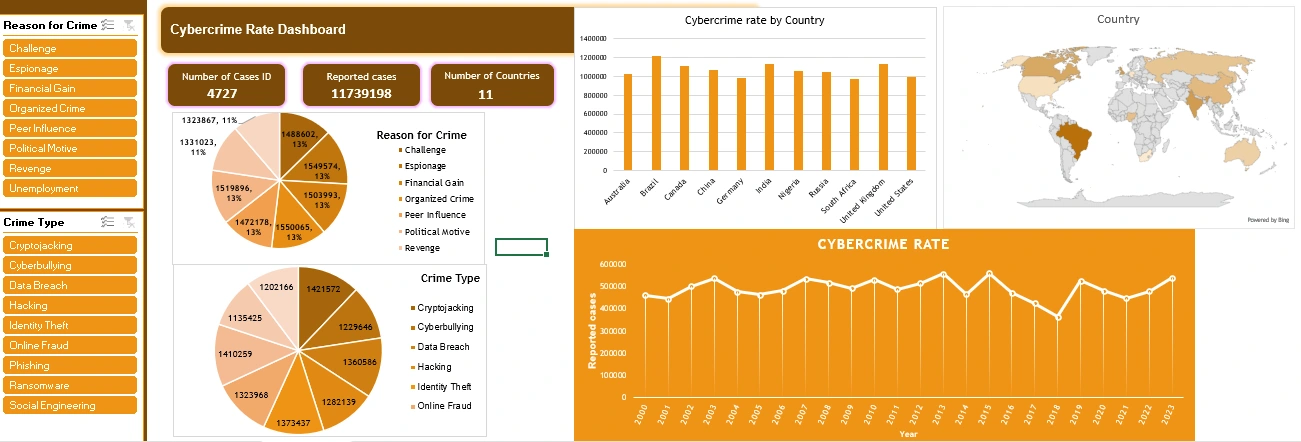
Cybercrime is a growing global threat, impacting individuals, businesses, and governments. The rise in cybercriminal activities has raised concerns about data security, financial fraud, identity theft, and digital harassment. Understanding the trends and factors driving cybercrime can help authorities develop better preventive measures. This Cybercrime Rate Dashboard provides insights into reported cybercrime cases, reasons behind cyber offenses, and the distribution of cybercrime incidents across countries. It also examines trends over time to help policymakers, law enforcement agencies, and cybersecurity professionals make informed decisions.
Business Problem
With the increasing reliance on digital platforms, cybercrime has evolved, making it essential to:
Identify the primary motives behind cybercrimes.
Understand which cyber threats are most prevalent.
Analyze the geographical distribution of cyber offenses.
Track the trend of cybercrime cases over time to predict future risks.
Addressing these issues will help in developing stronger cybersecurity frameworks, enforcing stricter policies, and raising awareness among users.
Project Objectives
Identify Key Motivations – Understand the major reasons behind cybercrimes.
Categorize Crime Types – Analyze the most common cybercrime activities.
Geographical Analysis – Determine which countries experience the highest cybercrime rates.
Trend Analysis – Evaluate how cybercrime has evolved over the years
Data Process
The dataset was sourced from Kaggle, containing records of reported cybercrime cases worldwide.
Data Cleaning and Tranformation
Premliminary Analysis
Data visualization
Tools Used
The tool used in this analysis is Microsoft Excel
Key Insights
1. Cybercrime Overview
Total Cases ID: 4,727 (Unique case identifiers)
Total Reported Cases: 11,739,198
Number of Affected Countries: 11 Cybercrime is widespread, affecting multiple regions and millions of people globally. The large number of reported cases highlights the urgent need for enhanced cybersecurity measures.
2. Reasons for Cybercrime
The top motives behind cyber offenses include:
Financial Gain – Criminals target individuals and organizations to steal money or financial information.
Organized Crime – Coordinated cybercriminal groups exploit technology for large-scale attacks.
Political Motive – Cyberattacks are used for espionage, propaganda, or to disrupt political stability.
Revenge & Peer Influence – Some crimes are driven by personal conflicts, peer pressure, or ideological beliefs.
Unemployment & Challenge – Some cybercriminals engage in hacking for fun, learning, or due to lack of job opportunities.
Financial gain remains the dominant reason for cybercrime. However, political and personal motives also contribute significantly. This indicates that both economic and ideological factors drive cyber threats.
3. Types of Cybercrimes
The most reported cybercrimes include:
Identity Theft & Online Fraud – Among the top cybercrimes affecting victims.
Hacking & Ransomware – Criminals gain unauthorized access to systems, often demanding payment.
Phishing & Data Breaches – Fraudulent schemes to steal personal data.
Cryptojacking – A rising trend where hackers use victims’ computers to mine cryptocurrency.
Cybercriminals use diverse techniques, with fraud, hacking, and phishing being the most common. The rise in cryptojacking suggests an increasing focus on digital currency-related crimes.
4. Cybercrime Rate by Country
Cybercrime incidents are distributed across 11 countries, with the highest number of cases reported in:
Brazil (1218317)
United Kingdom (1133196)
Inida (1130816)
Canada (1106278)
China (1071345)
Nigeria (1059090)
Russia (1047115)
Australia (1025592)
Cybercrime is a global issue, with some countries experiencing more attacks due to higher digital penetration and financial activity. Countries with weaker cybersecurity laws may also be more vulnerable.
5. Cybercrime Trends Over Time
Reported Cases Over the Years (2000 - 2023)
A steady increase in cybercrime cases over the years.
Notable spikes in 2015 and 2020, possibly linked to advancements in technology, increased internet usage, and global crises.
A temporary decline in 2018, followed by an increase again.
Cybercrime is continuously evolving. The rise in 2020 may be linked to the COVID-19 pandemic, which increased online activities. The trend suggests that cyber threats will continue to grow unless proactive measures are taken.
Recommendations
Based on this analysis done, we recommend the following actions:
Strengthen Cybersecurity Laws – Governments should enforce stricter policies to combat cybercrime.
Increase Public Awareness – Organizations should educate users on how to recognize and prevent cyber threats.
Enhance Digital Security – Businesses should invest in advanced security protocols to protect customer data.
Monitor Emerging Cyber Threats – Authorities should track new attack methods, such as cryptojacking, and develop countermeasures.
International Collaboration – Countries should work together to share intelligence and combat cybercrime globally. By addressing these areas, we can reduce the impact of cybercrime and create a safer digital environment.
Like this project
Posted Jun 3, 2025
Analyzed global cybercrime trends to aid in developing preventive measures.
Likes
0
Views
3
Timeline
Jan 1, 2023 - Oct 1, 2023