SAO: Standardize, Automate, Outsource. How I Decide What Ships

Zahid Hussain


Overview
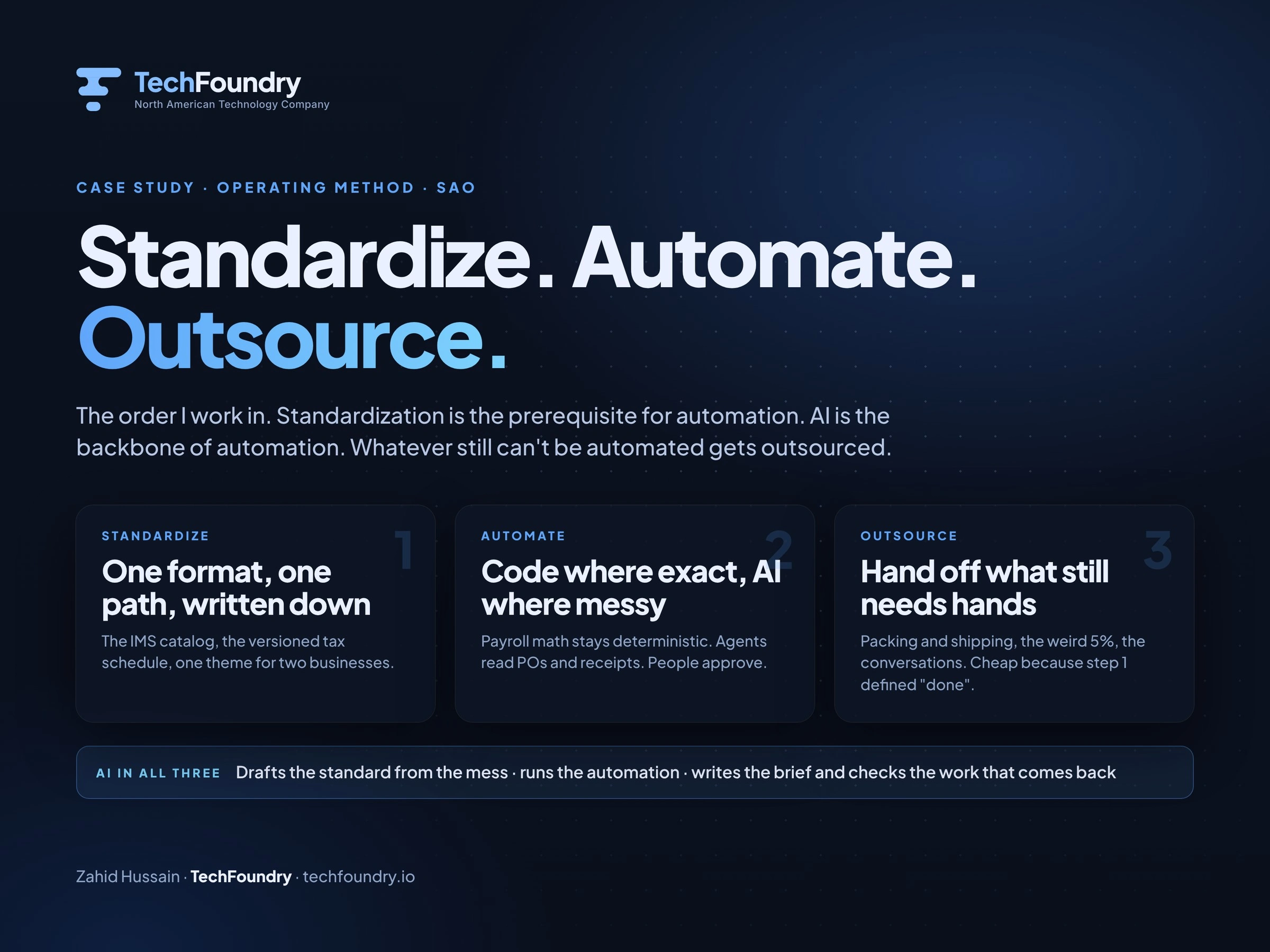
SAO is the order I work in: Standardize, Automate, Outsource. Standardization is the prerequisite for automation. AI is the backbone of automation. Anything that still can't be automated gets outsourced. The order matters more than any single step, and AI has a job in all three, not just the middle one.
This isn't a methodology I read about. It's what fell out of building and running software for TechFoundry's two businesses, AI and software on one side and Aerless telecom hardware on the other, with a small team. Below is how each step works, with the real systems it produced.
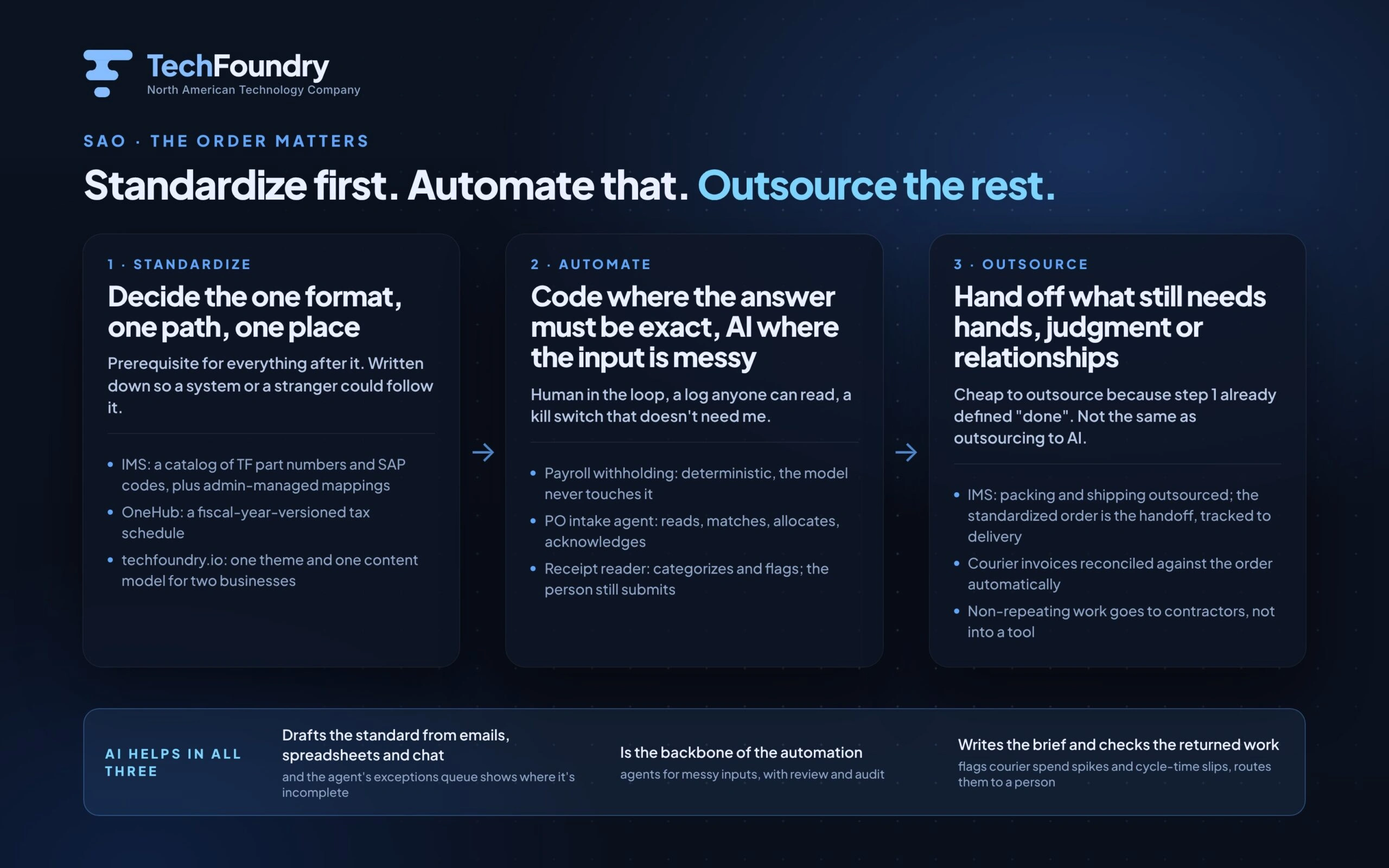
SAO: Standardize, Automate, Outsource. The three steps, with the role AI plays in each.
Why the order matters
Automating a process nobody has written down doesn't remove the mess. It bakes the mess into code, and the agent happily invents the steps you forgot to describe. Outsourcing a process nobody has written down is worse: you pay someone to be confused on your behalf. So the first move is always the boring one.
Step 1. Standardize
Standardizing means deciding the one format, the one path and the one place a piece of work lives, then writing it down so a system or a stranger could follow it.
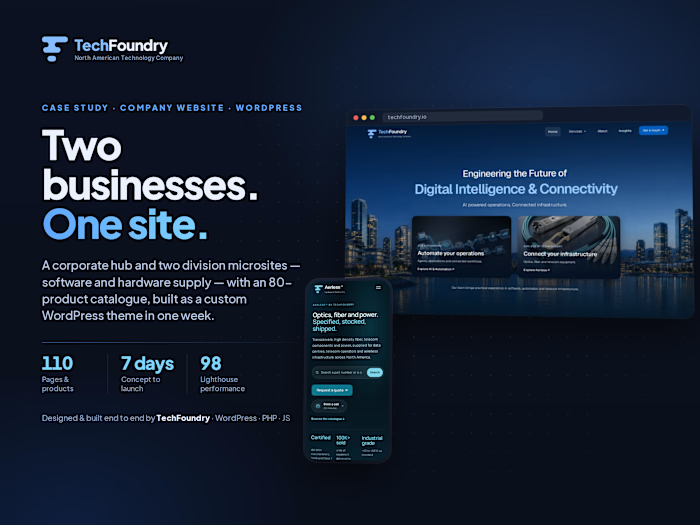
In TechFoundry IMS, purchase orders used to arrive as emails full of raw part strings. The standard is the catalog: every product has a TechFoundry part number and an SAP equipment code, and admin-managed mappings link the strings customers actually write to the parts we actually stock. In OneHub, our payroll platform, the standard is a fiscal-year-versioned tax schedule (min, max, fixed amount, rate, excess-over) that replaces the whole year atomically, instead of tax math living in someone's head. On techfoundry.io, the standard is one hand-coded theme, one design system and one content model for two businesses, instead of two sites.
Where AI helps: it is very good at turning a pile of emails, old spreadsheets and chat history into a first draft of the standard, which a person then corrects. And once an agent is running, its exceptions queue is the most honest list you'll ever get of where the standard is still incomplete. The IMS conflict queue is exactly that: every unmatched line is a mapping we haven't written yet.
Step 2. Automate, with AI as the backbone
Once a process is standardized, the question is what kind of automation each part needs. Where the answer has to be exact, deterministic code: payroll withholding pulls its brackets straight from the tax schedule, and the model never touches the math. Where the input is messy, AI: an agent reads an emailed PO line by line, matches it to the catalog, allocates stock or raises supplier orders, and sends the customer an acknowledgement with an ETA. In OneHub, Claude reads uploaded receipts, categorizes the line items and writes a plain-English summary that flags policy risks and missing documentation; the person still submits the claim.
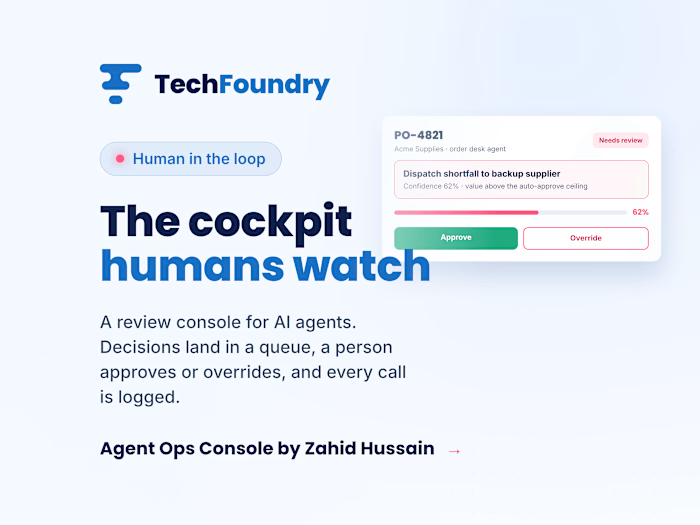
Every automation I keep running has three things: a human somewhere in the loop, a log a non-engineer can read, and a kill switch that doesn't need me. The agent registers and notifies; people decide. The Agent Ops Console I built exists for exactly this: a review queue where a person approves, edits or overrides before anything executes, with every call logged, including the ones the human changed.
Step 3. Outsource what you can't automate
What's left after standardizing and automating is the work that needs hands, judgment or relationships: physical handling, the weird 5% of cases, the conversations. That is what gets outsourced, to a partner, a contractor or a specialist, and it is cheap to outsource precisely because step 1 already wrote down what "done" looks like.
The clearest example is inside the order flow itself. In IMS, once the agent has validated a PO, matched every line and allocated stock, the physical work of packing and shipping is outsourced. The shipping companies work inside the same platform, so the handoff is the standardized order rather than an email thread: what to pack, where it goes, when it's due. Shipments are tracked to delivery, the customer's acknowledgement already carries the ETA and tracking number, and the courier's invoice is reconciled against the order automatically when it lands. Inside the software business, the same rule applies: work that doesn't repeat goes to contractors rather than being forced into a tool.
Where AI helps: it drafts the brief from the standard, turns an exceptions queue into a scoped piece of work for a person, and checks what comes back against the spec before anyone else has to look at it. In IMS the reporting agent does exactly that for the outsourced leg, flagging a courier's spend spiking or a vendor's cycle time slipping and routing it to the right person. Outsourcing to AI, though, is not what this step means. If a model can do it reliably, it belongs in step 2.
What SAO rules out
It rules out automating first because a demo looked good. It rules out outsourcing a mess. And it rules out letting AI touch the parts where a wrong answer costs more than the labor you'd save; payroll tax is the example I use with every client. The best automation audits I've run ended with "leave this one alone."
Where it shows up
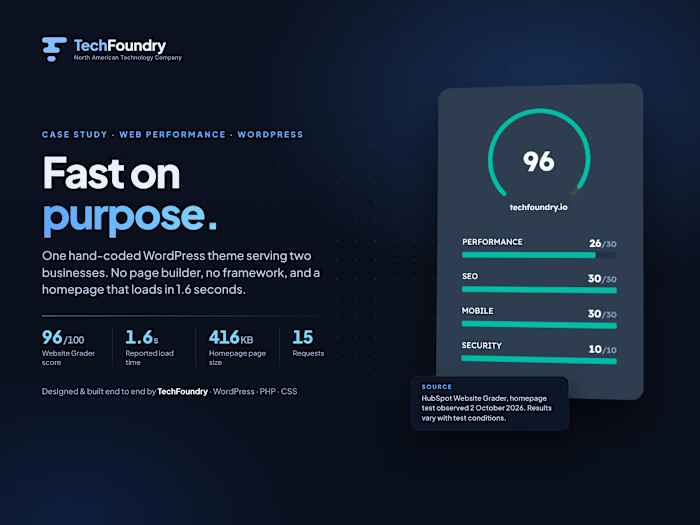
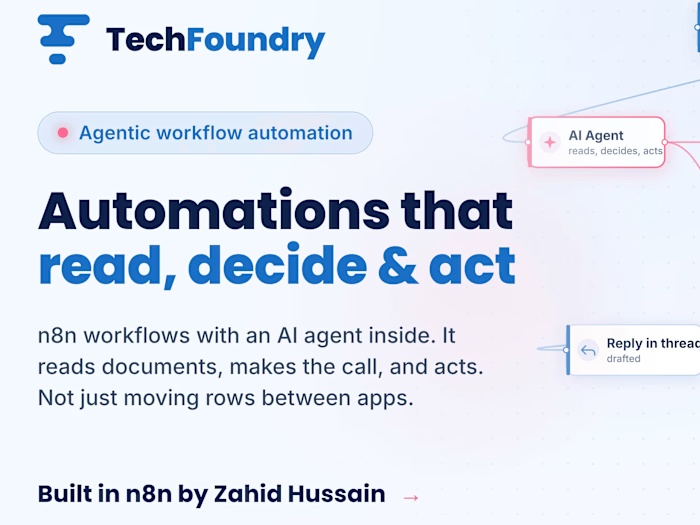
Every system on this profile went through the same three steps. The IMS intake agent, the OneHub payroll and expense modules, the PDF Reader Agent that reads attachments inside n8n and is only allowed to reply when the output fits a schema, and the two-business website that scored 96/100 on HubSpot's grader without a page builder. The $1,200 automation audit I offer is SAO applied to someone else's workflow: which step each process is actually at, and what to standardize before anyone writes code.
The company version of this piece is on the TechFoundry blog: Standardize, Automate, Outsource: The Order We Work In.
Like this project
Posted Oct 5, 2026
My rule for every workflow: standardize it, automate it with AI at the core, outsource what can't be automated. AI helps at every step. Shown on IMS and OneHub.
Likes
2
Views
3
Clients
TechFoundry