MISREGISTER — Operational Case Readiness Apparatus

Faadil Boussari


An operating room can still look ready on paper after it has stopped being operationally possible.
MISREGISTER is a synthetic operational prototype that turns four changing dependencies into one physical readiness test.
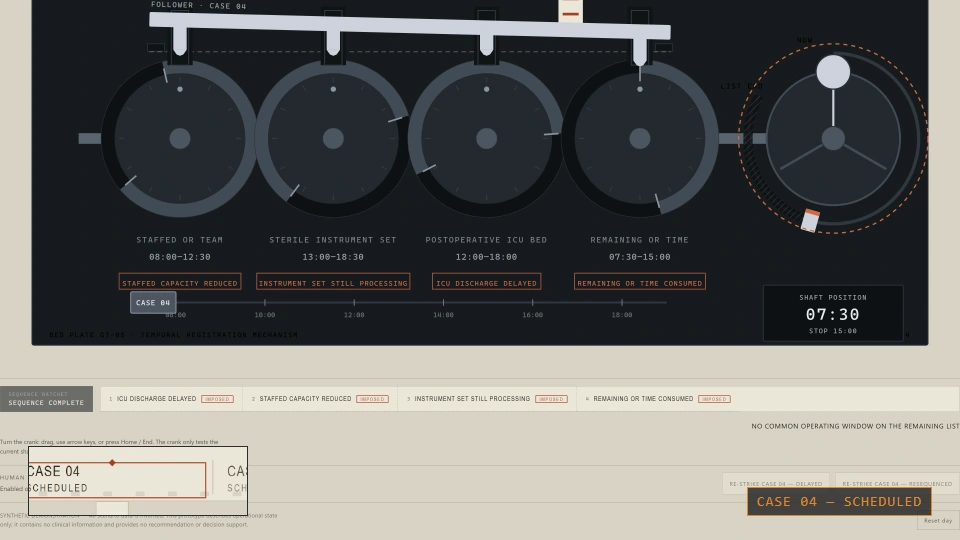
When their shared operating window disappears, the crank freewheels to the end-stop, while CASE 04 still reads SCHEDULED.
The problem
Operating lists represent commitments, but operational readiness is distributed across different people, systems, and moments in time.
A case may still appear scheduled even as the conditions required to execute it change independently:
A staffed operating-room team
A sterile instrument set
A postoperative ICU bed
Enough remaining operating-room time
The problem is not simply missing information. It is the delay between a change in operational reality and a change in the published list.
Research direction
For Day 5 of my 30 Days of Real Business Problems challenge, I reviewed public practitioner accounts and operational scheduling discussions.
The recurring pattern was fragmentation: each dependency could be monitored by a different role or represented in a different place, while the operating list remained visually stable.
I narrowed the project to one question:
How could the difference between a scheduled slot and executable capacity become physically perceptible?
Design thesis
A schedule should not be treated as executable merely because its line still exists.
Rather than designing another dashboard, alert system, prediction model, or traffic-light status, I translated the problem into a mechanical registration apparatus.
The system does not recommend what should happen. It tests whether all four required conditions still share one usable operating window.
The apparatus
CASE 04 is physically connected to four availability discs:
Staffed OR team
Sterile instrument set
Postoperative ICU bed
Remaining OR time
A single follower spans all four stations.
The operator turns one crank through the remaining schedule. The mechanism engages only where all four availability windows align at the same time.
The crank is deliberately limited: it tests the current operational state. It changes nothing.
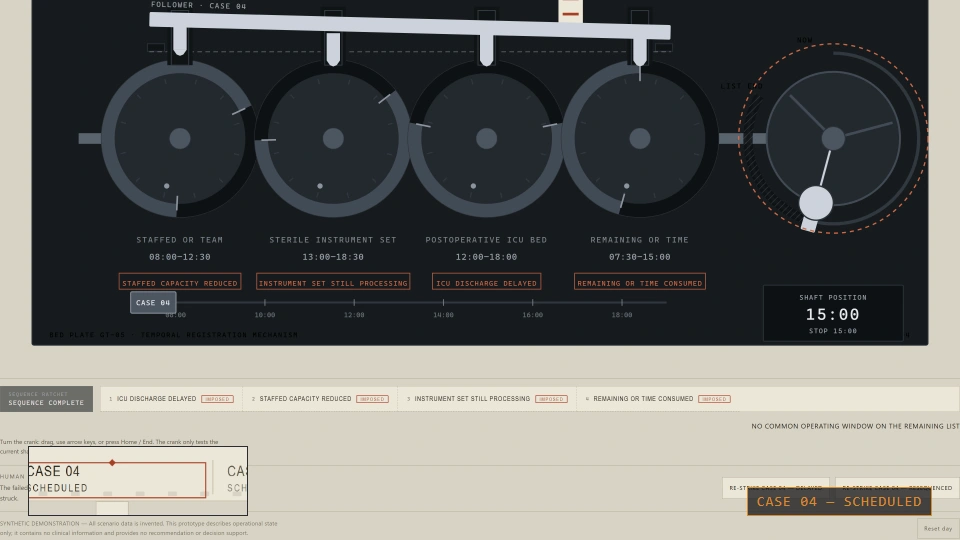
The apparatus in its initial state: four dependency discs aligned, the shared operating window still intact
The interaction
The prototype begins with a shared operating window.
Four synthetic events are then imposed:
ICU discharge delayed
Staffed capacity reduced
Instrument set still processing
Remaining OR time consumed
Each event changes one dependency, but the published operating list does not automatically update.
As the windows drift apart, the common operating window disappears.
The operator then turns the crank to search the remaining list.
There is no valid point of engagement.
The signature moment
The crank freewheels while CASE 04 still reads SCHEDULED.
This is the central contradiction made visible: the schedule still contains the commitment, but the coupled operational conditions can no longer support it.
The freewheel state: CASE 04 still reads SCHEDULED while the crank finds no valid operating window
Only after the failed test is witnessed does the human decision section become available.
The operator may then re-strike CASE 04 as:
DELAYED
RESEQUENCED
The prototype does not choose the decision. It exposes the state that makes a human update necessary.
Responsive interaction design
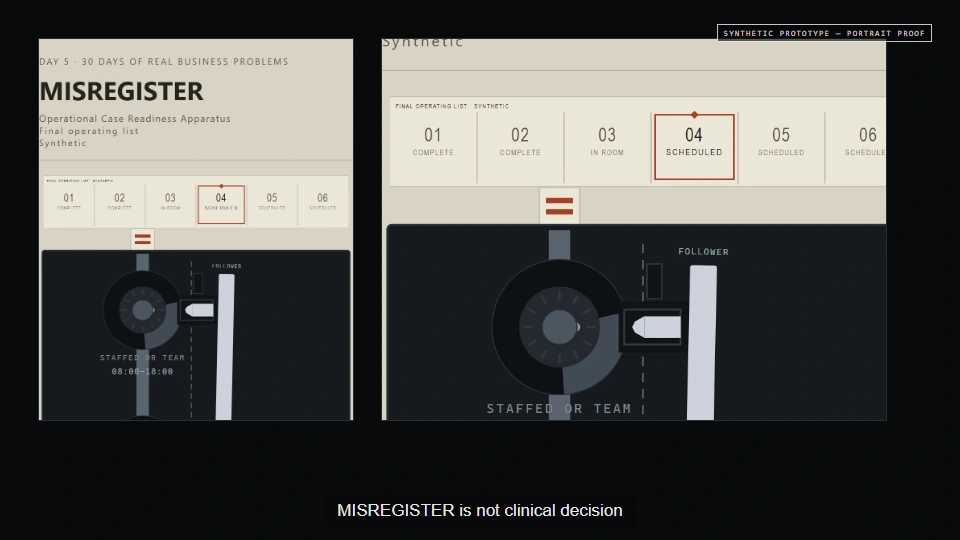
The desktop version uses a wide horizontal apparatus, with all four dependency discs mounted across one time shaft.
For mobile, I did not shrink or crop the desktop mechanism. I rebuilt it as a portrait composition:
Four vertically stacked stations
One continuous shaft
One shared follower rail
A crank attached at the bottom
A vertical event tape
The interaction logic remains identical across both orientations.
Boundaries
MISREGISTER uses entirely synthetic scenario data.
It contains:
No patient information
No clinical risk assessment
No prediction
No prioritization
No recommendation
No clinical decision support
It is an operational interaction prototype designed to make a coordination gap visible.
Outcome
The final result includes:
A functional React and TypeScript prototype
Custom SVG interaction mechanics
Desktop, tablet, and true portrait-mobile layouts
Mouse, touch, and keyboard interaction
Reduced-motion support
Deterministic browser-state capture
A Remotion product demonstration
A live GitHub Pages deployment
Final reflection
MISREGISTER continues a theme running through my challenge: turning invisible operational structures into artifacts that can be perceived, manipulated, and remembered.
The final principle is simple:
A scheduled slot is not the same as executable capacity.
Like this project
Posted Jul 19, 2026
A physical interaction prototype that exposes when a scheduled operating-room case is no longer operationally executable.