Before Bar One: Catch the Wrong Edition Early

Faadil Boussari

A rehearsal can lose valuable time before the first note is played.
Orchestra librarians and ensemble teams regularly receive parts from different publishers, years, or editions. Two files may look correct independently while containing incompatible rehearsal marks, inserted measures, cuts, or structural differences.
The problem often remains invisible until the ensemble reaches the conflicting passage.
Before Bar One explores a different workflow: compare the structural landmarks of every part before rehearsal begins, expose the exact point of divergence, and replace the incompatible edition while there is still time to act.
The problem
Musicians do not merely need the correct notes. Every part must belong to the same structural version of the piece.
When one part comes from another edition:
Rehearsal marks may no longer correspond
Measure counts can diverge
Cuts or inserted passages may be missing
Players can arrive at the same landmark at different moments
Rehearsal time becomes diagnosis time
Existing workarounds depend heavily on manual inspection, institutional knowledge, email threads, and discovering the discrepancy in the room.
Research
This concept emerged from public research into operational problems across the music industry.
The strongest evidence came from orchestra librarians and ensemble practitioners describing:
Structurally incompatible editions
Guest parts arriving late or in unusable formats
Emergency preparation being transferred to librarians
Rehearsal time being consumed by edition reconciliation
The research was conducted using public sources discovered through Agent Reach and Exa. No prospects were contacted, and no automated outreach was performed.
Product thesis
Most tools treat a musical part as a document.
Before Bar One treats it as a route through time.
Each part is mapped against shared structural landmarks. If one route diverges, the interface reveals where the ensemble stops travelling together.
The goal is not to analyze musical quality or replace an orchestra librarian's judgment. It is to make structural incompatibility visible earlier.
The prototype
The demonstration uses five ensemble parts:
Violin I
Violin II
Viola
Cello
Horn in F
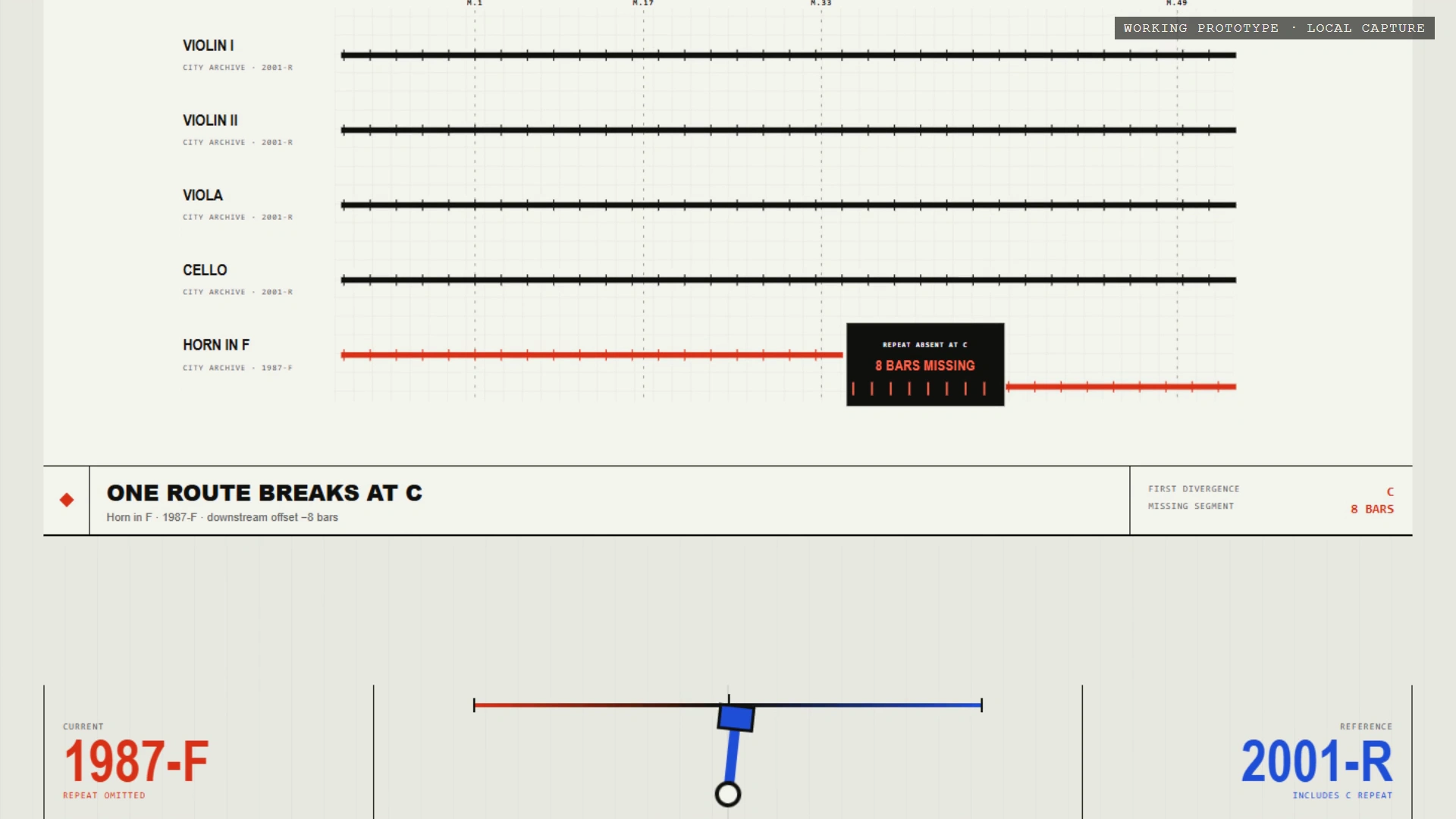
Four parts use reference edition 2001-R. The Horn in F part uses edition 1987-F.
The structural check detects an eight-measure divergence after rehearsal mark C.
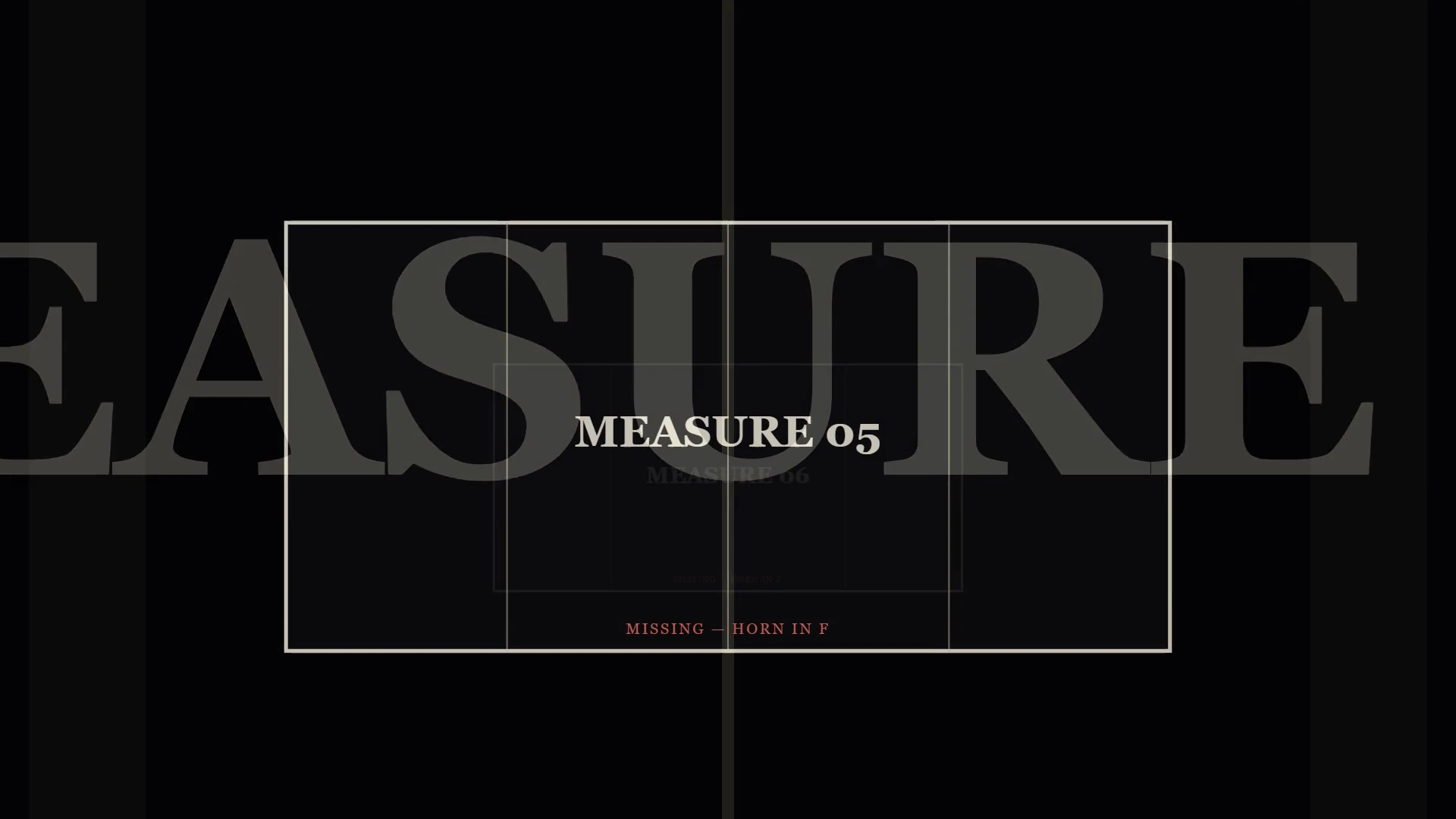
The eight-bar chasm: the Horn in F route ruptures, revealing a visible structural gap where eight measures are missing after rehearsal mark C
Instead of presenting another conventional warning card, the product turns edition selection into a physical switching action. The incompatible route ruptures in red, an eight-bar gap becomes visible, and the user moves an edition lever from 1987-F to 2001-R.
The missing measures return to the route and every part arrives at rehearsal mark D together.
Signature interaction
The central interaction combines two visual metaphors:
The Eight-Bar Hole: missing structural time becomes a visible rupture.
The Edition Switchyard: changing editions behaves like rerouting a railway junction.
Pulling the lever is not decorative. It represents the product's core decision: replace the incompatible source and restore structural alignment across the ensemble.
Why this direction
Early visual explorations were too close to familiar card-based dashboards. They explained the problem but did not make the consequence memorable.
The final direction abandons the dashboard metaphor and builds the interface around musical time, rupture, alignment, and rehearsal landmarks.
The experience moves between two visual worlds:
A dark, theatrical representation of rehearsal failure
A precise cream-colored working interface for diagnosis and correction
This creates an emotional problem moment followed by a credible operational action.
Interaction flow
Load the ensemble's part metadata
Run the structural check
Follow every route through rehearsal marks A–D
Detect the Horn in F divergence after C
Inspect the eight missing measures
Switch from edition 1987-F to reference edition 2001-R
Restore the missing structural segment
Confirm that all five parts arrive at D together
Final title card
Honesty and limitations
Before Bar One is a functional front-end prototype, not a production music-analysis platform.
The edition identifiers, structural landmarks, and rehearsal data used in the demonstration are synthetic and locally prepared.
The prototype does not currently:
Parse uploaded PDF or MusicXML scores
Verify real publisher catalogues
Provide licensed musical content
Connect to orchestra-library databases
Automatically determine the correct artistic edition
Those integrations would require licensed source material, domain validation, and further technical development.
The prototype demonstrates the interaction model and structural-checking workflow without presenting simulated data as a live external integration.
Outcome
Before Bar One turns an obscure but expensive rehearsal failure into a product interaction that can be understood visually.
It demonstrates how domain research, interaction design, creative direction, and front-end implementation can transform a niche operational problem into a credible and distinctive product concept.
Like this project
Posted Jul 17, 2026
A working prototype that helps ensemble teams detect structurally incompatible musical parts before they cost valuable rehearsal time.