Quse App

Heather Peters



Designed an end-to-end budgeting experience that simplifies financial planning for everyday users while supporting advisor-led workflows.
Impact
Established a scalable product foundation currently in development, with active conversations for B2B adoption
Role
Led end-to-end product and UX design, shaping the experience, system, and brand cohesion
Problem
Traditional budgeting tools are complex, inconsistent, and require prior financial knowledge. Users struggle to maintain them, while advisors lack efficient tools to support clients at scale.
Insight
Budgeting fails when it requires too much manual effort or financial literacy.
Users need a system that feels simple and guided, while advisors need a structure that reduces hands-on management.
Solution
Designed a simplified, system-driven budgeting experience that reduces complexity and supports both self-serve and advisor-led use.
Enabled:
– A guided budgeting framework that requires no prior knowledge
– Automation of financial planning to reduce manual input
– A structure that supports both individual users and advisor workflows
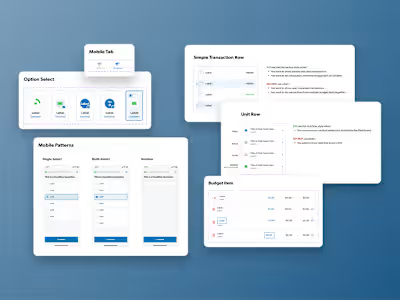
Unified the experience with consistent interaction patterns, clear information hierarchy, and cohesive branding.
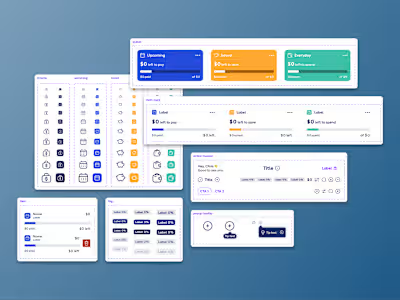
Introduced a design system to accelerate development and ensure consistency as the product scales.
Goal
Create a new model for budgeting that could serve both direct users and financial institutions, supporting potential B2B and B2C adoption.
Results
Product in active development
Engaged in ongoing conversations with banks and advisory firms for potential adoption
Like this project
Posted Mar 24, 2026
Designed an end-to-end budgeting experience that simplifies financial planning for everyday users while supporting advisor-led workflows.