
Church leaders have invited young people into family history for over a decade, and FamilySearch keeps building for them, from the Together app to youth days at RootsTech. The core Family Tree, though, still speaks mostly to experienced researchers: back in 2018, a FamilySearch designer reported that only 2% of users were under 18.
In this concept I asked what would make a young person open their tree and come back to it, using Yu-kai Chou’s Octalysis framework to design for motivation, not only for screens. It starts with a new line, “Their Story Is Yours,” so that finding a record feels like carrying someone’s story forward.
TL;DR · FamilySearch concept project
Increase the engagement of younger audiences
No rebranding, just expansion
Use the hollow square from the logo as creative material
Add gamification aesthetics and features
I kept the logo and grew a language from it
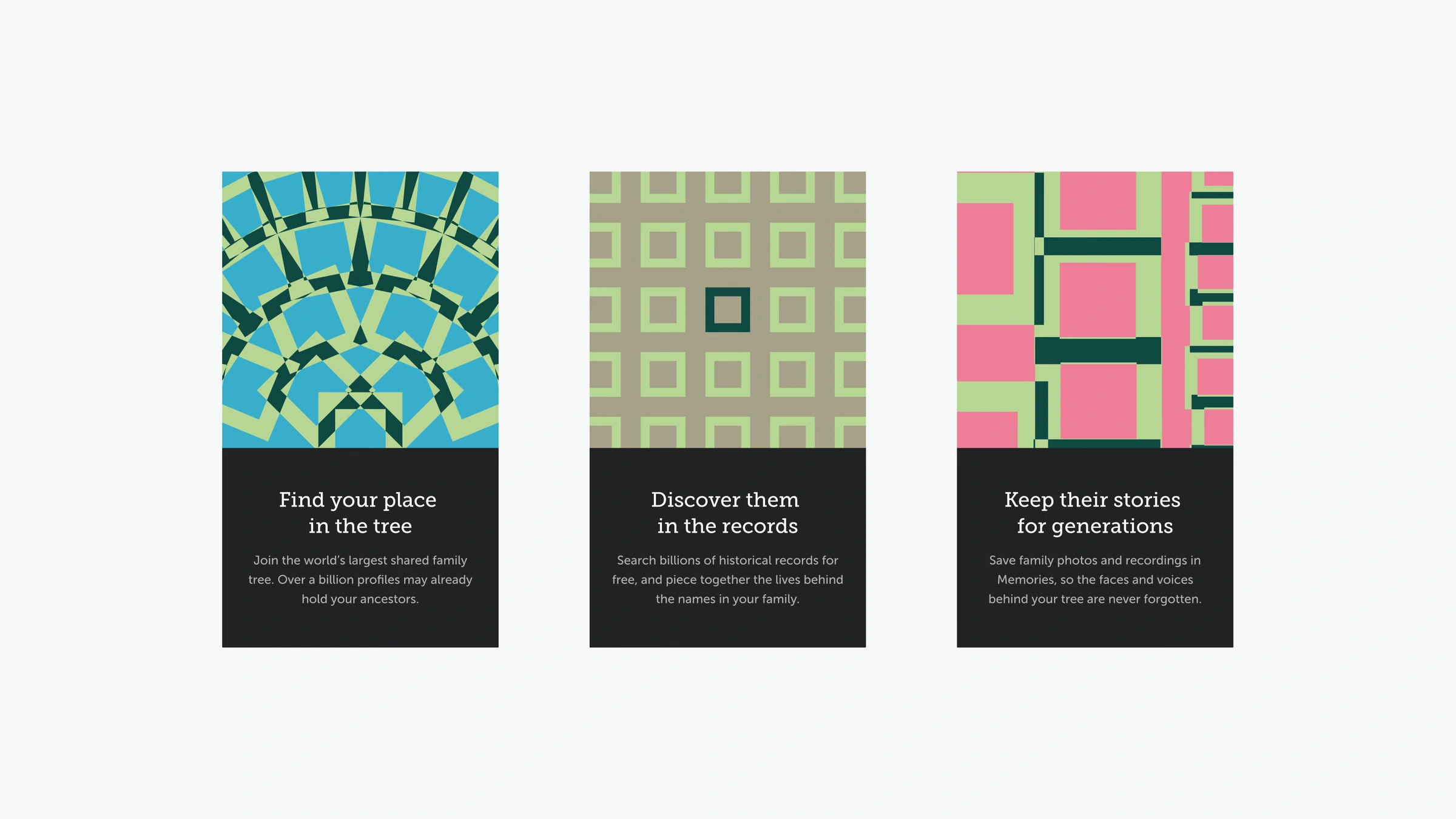
My first idea was a new logo made of squares. The further I pushed it, the clearer it became that I could keep the familiar FamilySearch mark and make the product feel a little younger. So I took the hollow square at the center of the FamilySearch logo, built a tool to repeat, rotate and overlap it, and tested the patterns on the sign-in screen, discovery cards, a cap and a tote.


The square became the structure of the Family Tree
In the Family Tree, the square frames portraits, toolbar buttons and the controls that expand a branch. Every person card keeps the portrait, name and dates in the same place, so your eye knows where to land as you move from one relative to the next. Moving around the tree and opening a relative’s story respond instantly, which gives it some of the feel of a game while the focus stays on the people.
Ordinances are there when you need them
The same tree serves two audiences. Some people come to explore relatives and relationships, while members of The Church of Jesus Christ of Latter-day Saints also come to check temple ordinance status. A toggle shows that status on each person card and hides it again, so the workflow is there for members without becoming everyone’s default.
Progress you can see, not a number going up
Your Family Grove turns the relatives in your tree into a 3D tree where each glowing leaf is one person. A few relatives make a small tree and thousands make a full canopy, so the count gets a shape. This draws on Octalysis’s Development and Accomplishment drive: like a personal trophy room, the reward is seeing how much of your own family you’ve found.
The Grove is yours to shape
Themes change the island’s colors and materials, and separate controls set the time of day, the weather and the background, each taking effect as you try it. That room to experiment draws on Empowerment of Creativity and Feedback. It also deepens Ownership, since the Grove becomes something you shaped while the family in it stays the same.
Try the Grove yourself
The prototype runs right in your browser. Switch between 400 and 7,000 relatives to watch the canopy fill in, then try the themes, the time of day and the weather. Drag to turn the island and scroll to zoom. The family in it is sample data.
A snapshot becomes an invitation
Snapshot sends a picture of your Grove to a relative, with a question about a missing branch or a story they remember. It’s a member-get-member idea built on Octalysis’s Social Influence and Relatedness drive. An invitation from someone in your own family gives you a personal reason to open the tree and add what you know.
Results and next steps
The result is a working prototype that carries one visual language from sign-in to the Family Tree, and a Grove that makes progress visible and easy to share. It’s a concept with no usage data yet, so if it shipped I’d track the share of users under 18 against that 2%, the week-one return rate for new young users, and relatives added per session. The biggest lesson was that the product didn’t need a rebrand to feel younger, only a wider use of the identity FamilySearch already had.
Next, I’d test whether younger users can find a relative and understand why the Grove grows. I’d also prototype a temple beside the tree and ask Church members whether it feels meaningful as a milestone in their temple work.
1 like · 23 views · Jul 24, 2025
A concept to make FamilySearch more inviting to younger users, with a language grown from the logo’s hollow square and a 3D Grove of relatives.

