Bright 2.0 — Patient Companion Redesign

Iñigo Hernández


Bright 2.0 — Patient Companion Redesign
Product Design · UX Strategy · Mobile UI · Healthtech · AI UX
Bright is a digital health companion that helps patients manage conditions, medication, symptoms, and treatment routines over time.
For this freelance redesign concept, I explored how Bright could become clearer, more trusted, and more useful from the first touchpoint through long-term patient support. The brief focused on improving the full patient journey from acquisition to activation, engagement, and retained value.
Context
Patients can arrive at Bright from different entry points: a treatment program, a healthcare partner, a specific condition, or direct discovery.
That creates a product challenge. Bright needs to feel immediately relevant for one condition, while also showing that it can support the patient beyond a single treatment moment.
I focused the redesign around Maria persona, a patient managing type 2 diabetes and high cholesterol. The goal was to help her understand Bright quickly, set up her health profile, track meaningful patterns, and return because the product becomes more personal over time.
Problem
The experience needed to feel more connected across marketing, onboarding, product use, and long-term support.
The main UX problems I focused on were:
Patients need to understand the value before signing up: Bright should explain what it does in a simple, patient-first way.
Onboarding needs to feel personal, not heavy: The setup should collect enough context to be useful without feeling like paperwork.
Tracking needs to become a habit: Medication, symptoms, energy, and routines should feel easy to log every day.
Insights need to feel specific and calm: Patients should receive useful observations based on their own behavior, not generic health content.
Retention should come from trust: The product should become more useful after every check-in, especially during the first week and before doctor appointments.
My Tasks
I redesigned the future-state product journey across onboarding, activation, engagement, and retention.
Product strategy and UX flow mapping
Mobile UX and UI design
Patient journey design
Content strategy and UX writing
Medical tracking flows
AI insight concepts
Smart chat experience
Doctor follow-up flow
First-week activation strategy
Navigation and widget system
Onboarding and Conversion
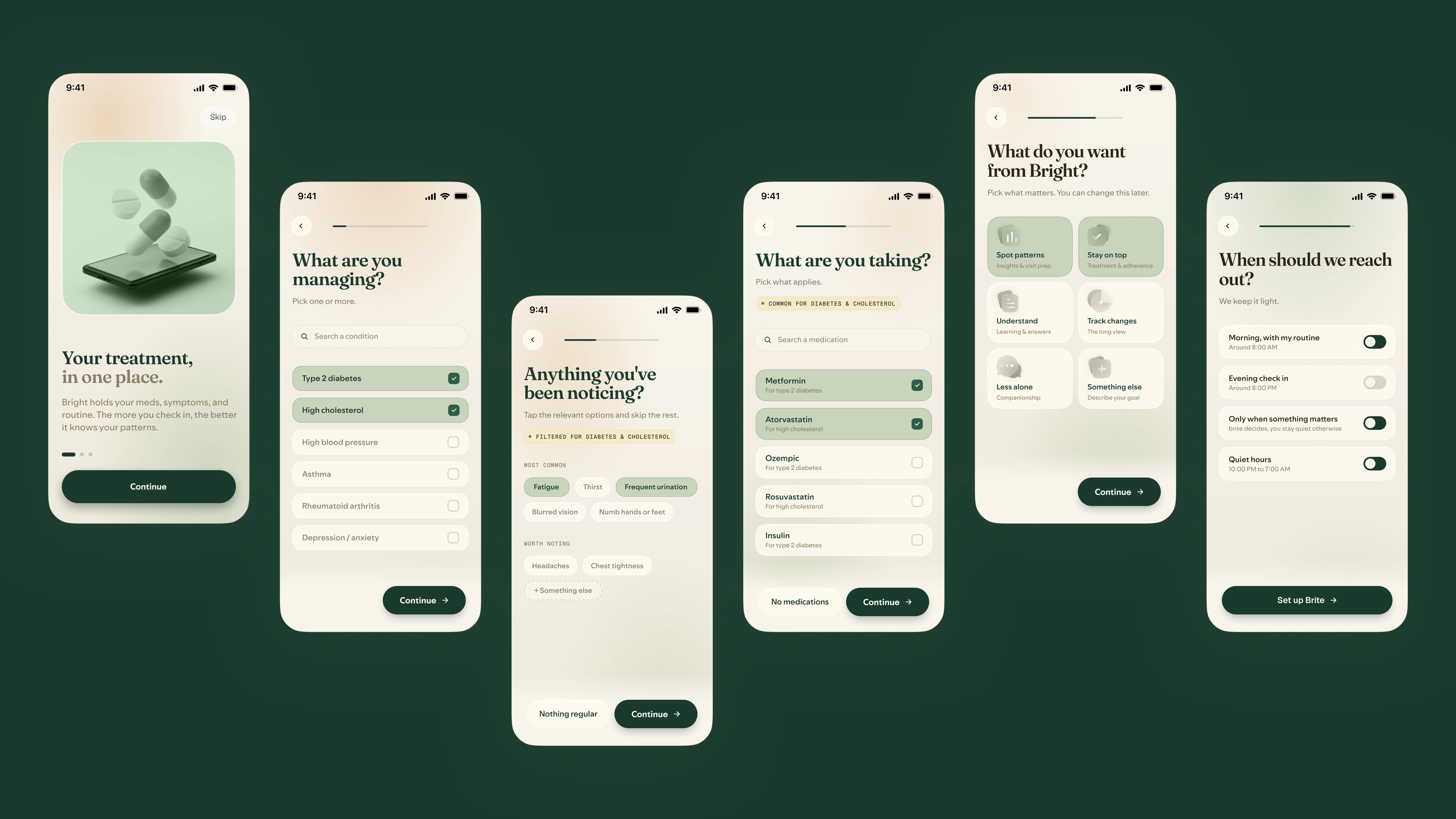
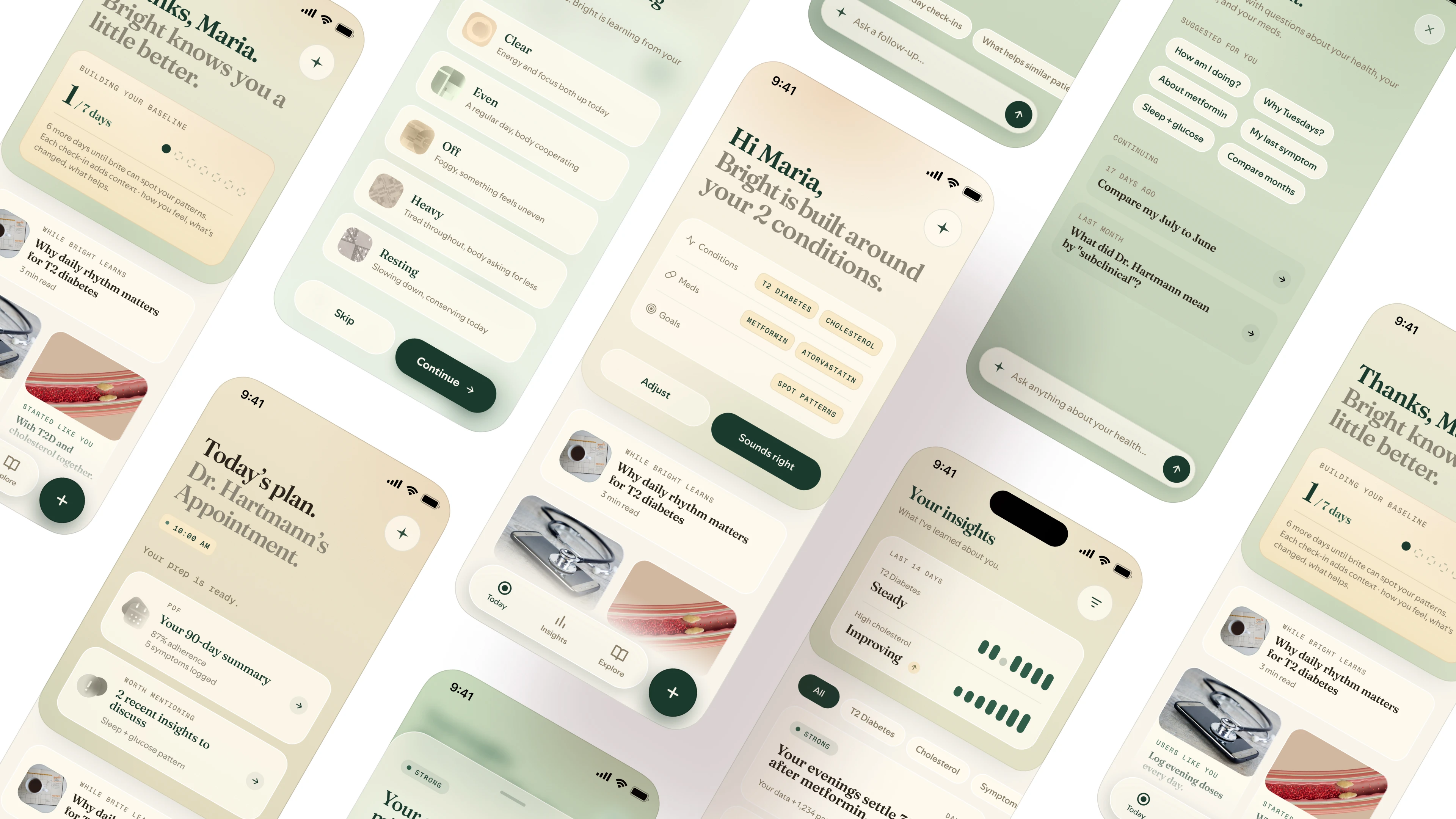
The onboarding flow introduces Bright as one place to manage treatments, medication, symptoms, and health patterns.
Instead of asking for too much too early, the setup starts with a few meaningful inputs:
Conditions
Medication
Recent symptoms
Personal goals
Preferred check-in rhythm
Notification preferences
The flow is designed to make Bright feel personal before asking the patient for deeper commitment. Maria can quickly see that the product is built around her health context, not around a generic tracking experience.
First Week Activation
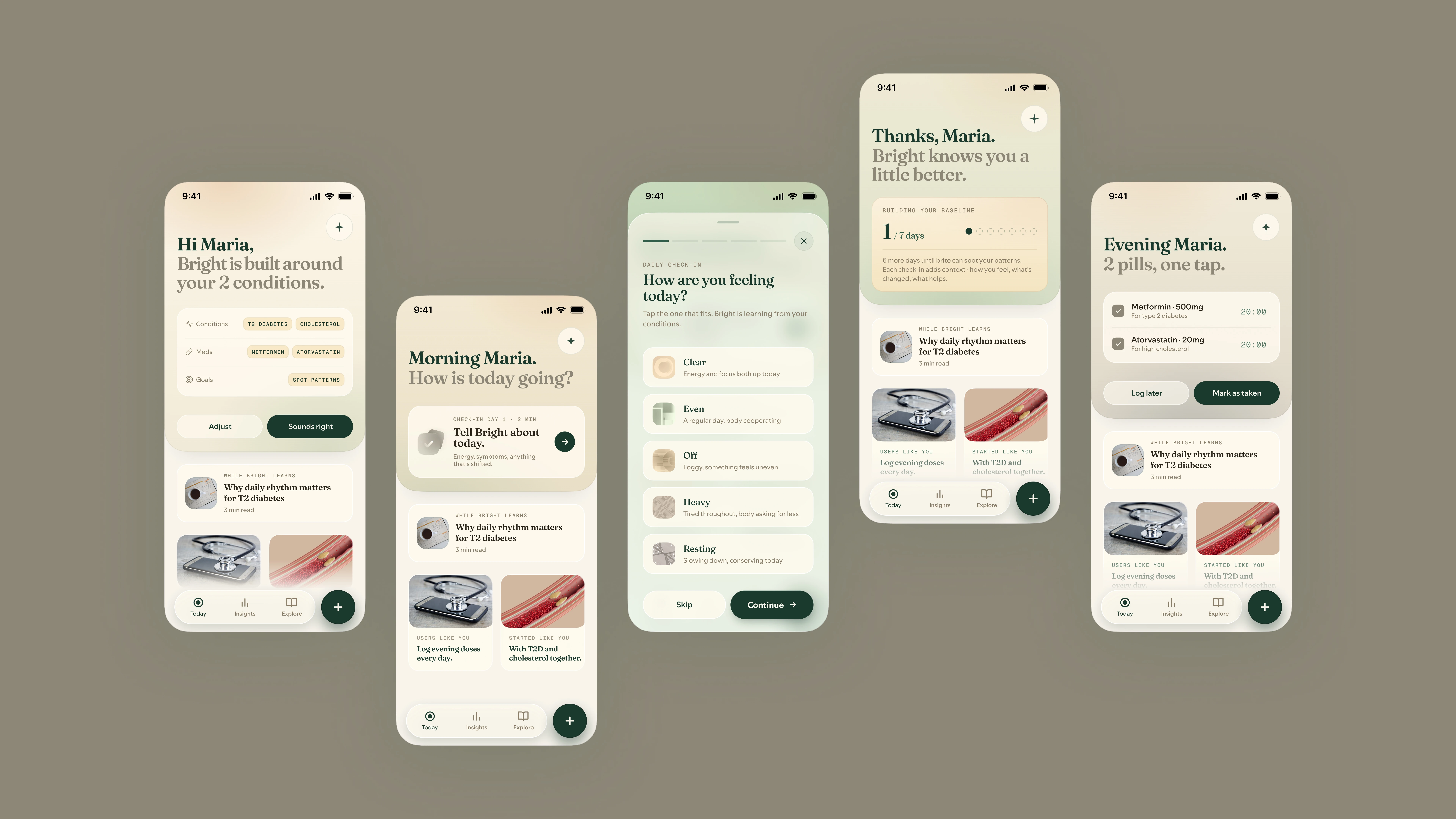
The first week is designed as a learning period.
Bright explains that each check-in helps the product understand what is normal for the patient. Over seven days, the system starts building a baseline from medication logs, symptoms, energy levels, and daily routines.
This gives Maria a clear reason to return: every small action improves the quality of future insights.
The aim is to create an early “this is learning from me” moment, so the product feels useful before long-term habits are fully formed.
Engagement, AI Insights, and Daily Use
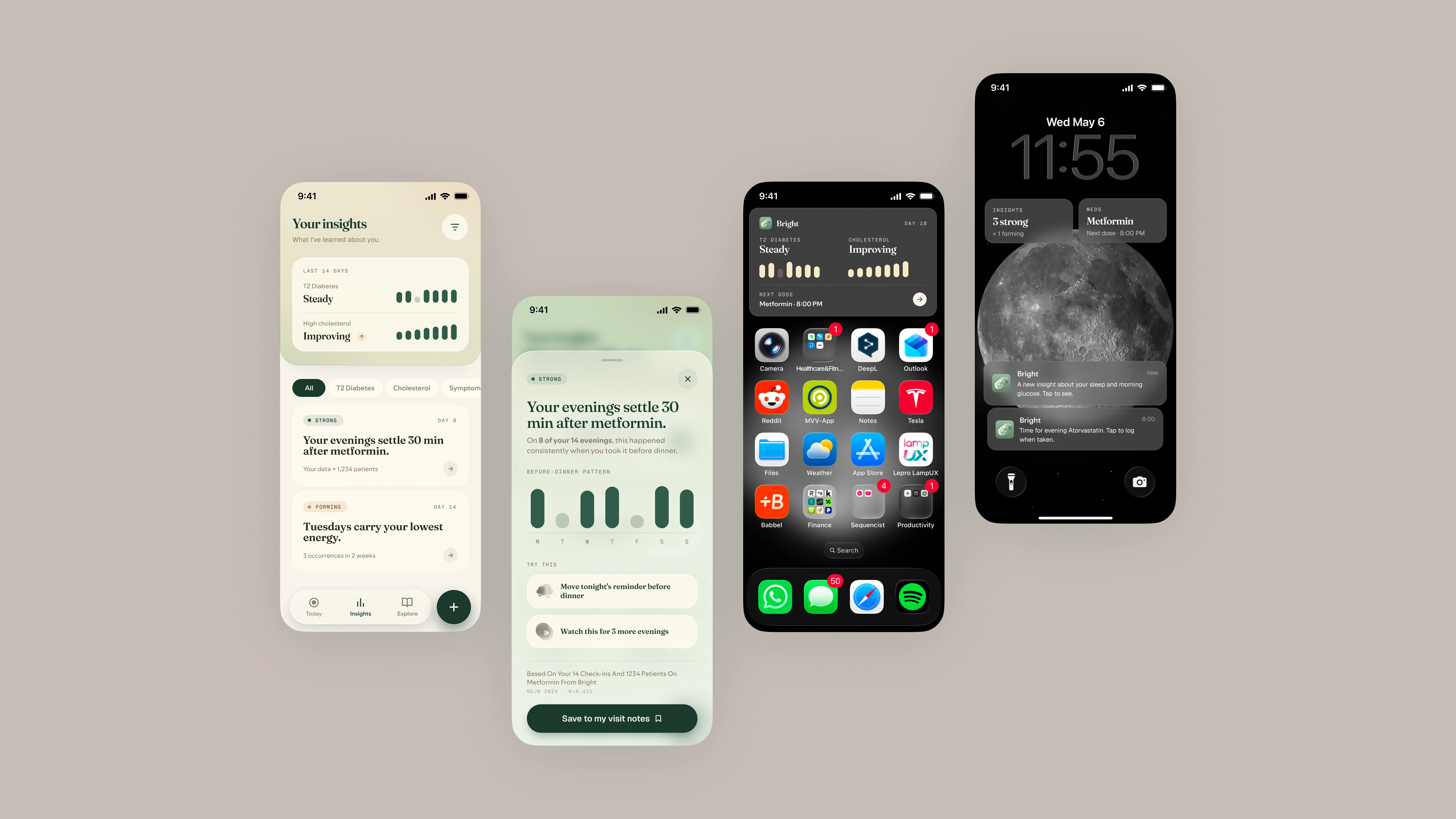
The main experience is built around simple daily actions:
Today
Insights
Explore
Quick add
The tracker supports medication, symptoms, energy, routines, and health events. The interface uses quiet cards, clear hierarchy, and soft visual cues so the product feels supportive rather than clinical or stressful.
Bright’s AI layer turns tracking into learning. Instead of showing generic advice, it connects recommendations to Maria’s own behavior.
For example:
“Your evenings settle 30 minutes after metformin.”
“Tuesdays carry your lowest energy.”
“Your pattern stayed consistent in 6 of your last 8 check-ins.”
Configurable widgets help patients make the home screen more relevant to their own goals, such as medication adherence, symptom changes, condition-specific tips, or upcoming doctor preparation.
Doctor Follow-up and Long-term Retention
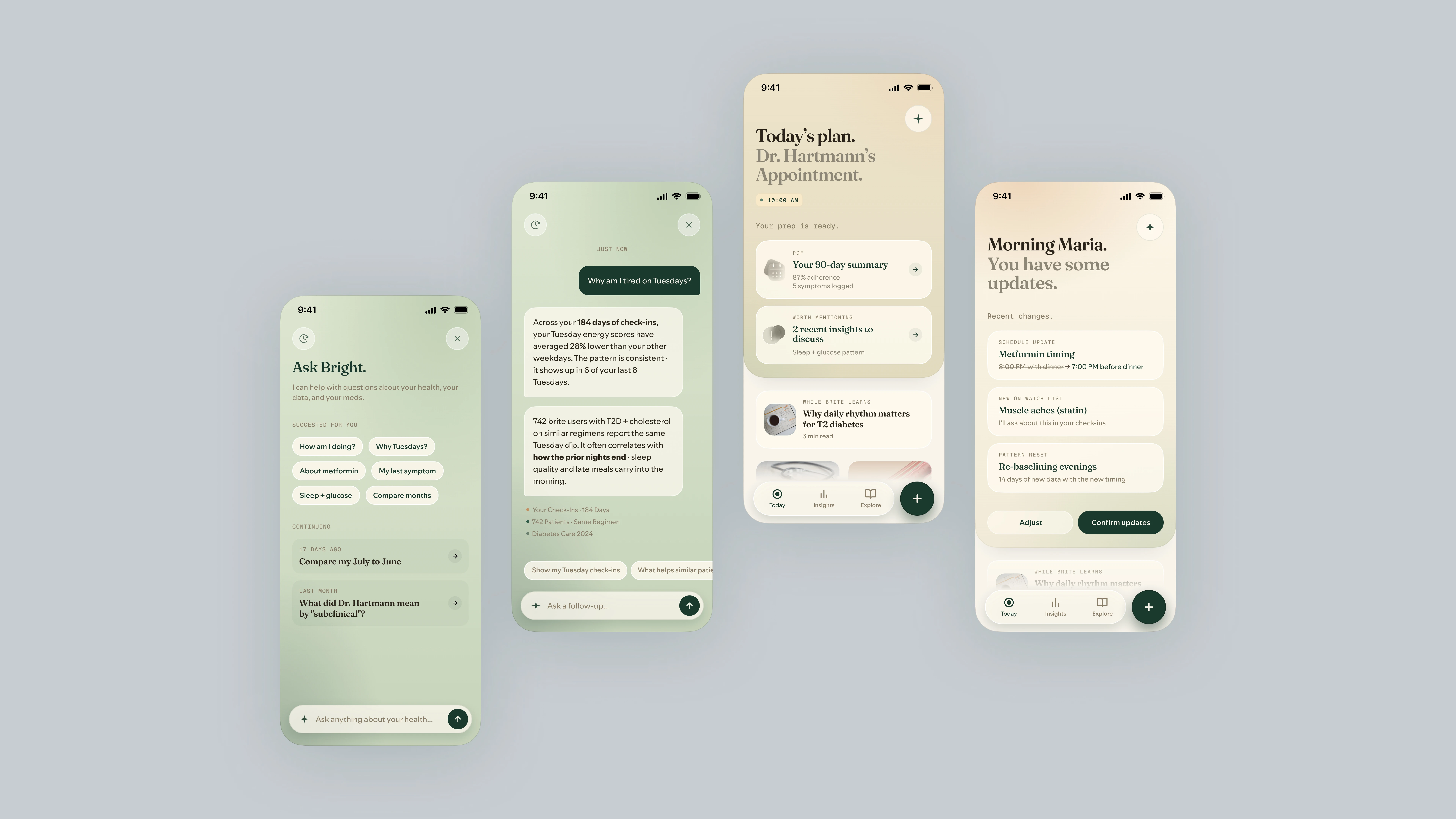
The retention flow focuses on trust, personal context, and repeated value.
Before a doctor appointment, Bright can prepare a simple summary of recent symptoms, medication adherence, changes, and questions worth discussing.
After the appointment, Bright helps Maria follow new instructions, track updated medication timing, watch symptoms, and adjust routines.
Over time, Bright becomes more than a tracker. It becomes a calm health companion that helps the patient understand patterns, prepare for care moments, and feel more confident managing their condition.
Design Direction
The visual system uses a warm, calm, and human healthtech style.
I explored:
Soft cream and green tones
Rounded cards
Editorial typography
Clear daily prompts
Low-pressure CTAs
Quiet notification patterns
Modular widgets
Simple tracking components
Patient-friendly health content
The goal was to make the product feel trustworthy and personal without making it feel cold, complex, or overly medical.
Outcome
The redesign creates a clearer journey from first impression to long-term patient value.
Bright moves from a treatment-specific entry point into a broader patient companion by connecting onboarding, daily tracking, AI insights, smart chat, doctor preparation, and habit formation into one consistent experience.
The result is a mobile product concept that helps patients understand what to do today, what is changing over time, and why coming back to Bright is worth it.
Deliverables
End-to-end patient journey map
Future-state UX flow
Onboarding and activation screens
First-week learning concept
Main navigation redesign
Medical tracker experience
AI insight and content recommendation concepts
Smart chat flow
Doctor follow-up flow
Retention experience
Mobile UI direction and component system
Like this project
Posted May 26, 2026
Redesigned Bright’s patient journey across onboarding, daily tracking, AI insights, and doctor follow-up to improve trust, activation, and retention.
Likes
1
Views
9