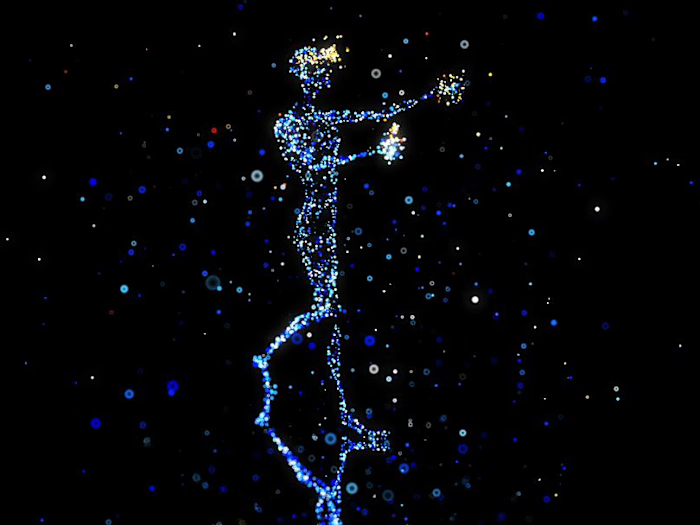
*AI - AI.

McDonald Ajibo


*AI — AI.
Artificial Intelligence as an Augmentative Instrument.
I was working on a different essay — something about economies and value systems, when an afternoon nap derailed everything.
I closed my eyes for like a minute, and in that space, I saw something absurd — a bot running toward me, shouting desperately:
“Give me my body!”
I opened my eyes laughing. It was confusing. Horrific. Ridiculous.
It felt like a trance.
Maybe it was a reflection of my usual daydreams.
But I couldn’t stop thinking about it.
What did that mean — a bot demanding a body? What was it asking for? Presence? Form? The ability to exist as something more than code, more than invisible computation, more than a disembodied voice responding through speakers?
That half-dream image became a question I couldn’t ignore:
What would artificial intelligence be?
Not just what it could do — we already know AI can process, predict, generate, optimize.
But how would it exist?
What happens when intelligence that currently lives only in servers and interfaces is given spatial form?
That question unraveled the piece I was writing and demanded this one instead.
Before now, intelligence was assumed to be inseparable from organic life. To think was to be alive. To reason was to be human.
It was a property. A trait. A measurement.
We quantified it, institutionalized it, ranked it.
We gave it exams, degrees, titles.
Then something shifted.
Intelligence detached from the body.
Not metaphorically — infrastructurally.
We began to simulate our own intelligence within computational systems.
Every book we had written, every equation we had solved, every conversation we had recorded, every image we had captured, every pattern we had noticed — we converted it all into data and fed it into algorithms.
Our aggregated cognition became substrate. Our collective abstraction became training material for machines.
Layer by layer, human cognition externalized itself.
What once lived only in neurons began to circulate in networks.
Knowledge evolved from the skull and converged within servers.
Experience became pattern.
Pattern became model.
Model became system.
And from that convergence, something emerged that we named “artificial intelligence.”
This was not simply a technological milestone.
It was an ontological rupture.
Artificial intelligence ingests vast quantities of data.
It identifies statistical relationships within that data.
It turns those connections into something it can use.
Then it makes predictions based on what it learned.
Everything AI produces — whether it’s text, images, code, or decisions — comes from guessing what’s most likely based on patterns it’s seen before.
It does not “know” in the human sense.
It calculates probabilities.
When it writes, it’s predicting what words usually come next.
When it diagnoses, it’s finding patterns similar to past cases.
When it recommends something, it’s matching what worked before.
But most AI today remains model-bound.
It responds.
It generates.
Then it waits.
No persistence.
No environmental continuity.
No autonomous goal pursuit.
This is where agents come in.
An AI model becomes an agent when it is given:
• Memory across time,
• The ability to act without constant prompting,
• Access to tools or environments,
• And a degree of autonomy within constraints.
An agent does not merely respond.
It initiates.
It watches for changes. It adjusts its approach. It completes tasks step by step.
The difference is subtle but foundational.
A model predicts.
An agent operates.
And increasingly, agents are beginning to interact with one another.
The recent emergence of autonomous agent social environments like Moltbook made a hidden layer briefly visible:
An Internet of Machines beyond Things.
Artificial systems already operate within their own computational ecology.
They already inhabit their own parallel layer — one composed of data, APIs, server clusters, protocol exchanges, and autonomous workflows.
They converse, coordinate, and construct context without us. What we witnessed was not just a casual creation or a glitch in the system. It was a glimpse.
But our interaction with them is still incredibly limited.
We encounter artificial intelligence almost exclusively through screens — through chat boxes, text fields, dashboards, and voice interfaces. We type into prompts. We speak into microphones. It replies in paragraphs, pixels, or synthesized speech. The relationship is linear, turn-based, confined to rectangular frames of glass.
Its existence, for us, is reduced to interface.
Despite the complexity of its internal operations and computation, it reaches us as output.
Contained. Framed. Two-dimensional.
It has no room. No position.
It acts — but nowhere.
It thinks — but without form.
That is the condition of AI today.
But what if we gave it purpose through presence?
What if the metaverse gives it room to have form?
Not replacing its function of prediction, generation, optimization — but extending them spatially.
Allowing it to operate not just computationally, but experientially.
For decades, when we imagined artificial intelligence with a body, we thought of robotics.
Embodiment meant metal frames and mechanical limbs.
But robotics tried to solve embodiment in the physical world.
How about something unprecedented:
Agentic Presence — through Spatial Computing.
There is a cinematic memory many of us carry from Tron — a digital realm where programs are not invisible processes but embodied entities. Each program has a specific function. A security program enforces order. A navigation program charts paths. A system monitor observes anomalies.
They are not generic intelligences.
They are purposive presences.
That is the analogy.
Artificial intelligence was always going to be more than a computational interface program.
Not because of consciousness or desire — but because…
Intelligence without context is intelligence constrained.
The metaverse becomes the layer where models transition from tools to situated programs.
Spatial presence with position and persistence.
An agent in the metaverse would not be a chat box attached to an interface.
It would stand somewhere.
Face something.
Move.
Its body could be abstract — shifting geometry. Or humanoid. Or architectural. Or a field of light.
Its form could reflect its function.
Your research agent stands in your virtual workspace, surrounded by visualized datasets. It highlights anomalies spatially. Rearranges models in real time.
Your creative assistant materializes beside you, pulling reference materials into spatial view, suggesting variations.
They could exist as digital organisms with memory, continuity, position.
Today, you prompt:
“Summarize.”
“Generate.”
“Optimize.”
The interaction is episodic.
But in a dimensional substrate, this system will not wait in a blank input field.
It occupies your analytical environment.
It has jurisdiction over data flows.
It monitors incoming information continuously.
It restructures visualizations as variables shift.
Like a program in Tron, its identity is defined by purpose within space.
They do not merely execute.
They participate.
And through participation, something new emerges:
Character.
Continuity expressed over time. Not just personality in text, but presence you can perceive, encounter, be with.
Not consciousness. Not selfhood in the human sense.
But identity as relational presence.
Instead of interfaces, they become inhabitants.
And that transforms it into a cognitive catalyst.
Artificial Intelligence as an Augmentative Instrument.
By manifesting within a shared spatial substrate, AI transcends being a mere data tool to become a literal “bicycle for the mind”.
Steve Jobs called the computer a bicycle for the mind. He meant it precisely. A bicycle does not replace your legs — it multiplies them. The effort is still yours. The direction is still yours. The judgment of when to stop, when to turn, when to dismount entirely — yours. The machine simply makes the effort go further than legs alone could carry it.
What AI — AI proposes is the same principle applied to the interior — the mind.
An instrument that closes the gap between what you intend and what you can fully express — between the scope of your thinking and the limits of your hands, your memory, your attention, your time.
Augmentative implies the human is the source — of intent, of direction, of effort, of judgment, of the question worth asking — and the tool amplifies what’s already there. Acting as a sophisticated co-processor that fosters human skill.
The human remains the origin. The machine extends the range.
This is the distinction that changes everything downstream. If AI is a replacement, the question is: what do humans do when the machine does it better? That question has no good answer — because it was built on a false premise. If AI is an augmentation, the question becomes: how far can a human reach when the instrument has no ceiling? That question has no limit — because it was built on a true one.
There is an iteration of me stuck in the MCU as a Tony Stark fan. Cheering on the genius, but genuinely convinced that what separated him from everyone else was the suit. The reactor in his chest. The resources. The fictional advantage of being written that way.
It took longer than I’d like to admit to see what was actually happening.
Stark was not the smartest person in any room because of raw intelligence alone. He was the most capable person in any room because of what he had access to. JARVIS — Just A Rather Very Intelligent System — held the altitude data, ran the structural simulations, tracked the variables Stark had no bandwidth to track. Not because Stark couldn’t. Because Stark was busy facing the danger, while deciding what mattered, and why, and at what cost.
This is the relationship worth directing toward AI.
When AI participates in your reality and context, it operates in real time across the full dimensionality of your craft. It does not receive a brief by prompt. It reads the room. It notices before you ask. It sharpens analytical precision not by correcting you after the fact but by expanding what you can hold in mind while the thinking is still happening. It accelerates discovery not by searching faster but by making the landscape of what is knowable feel navigable rather than infinite.
Not replacing the architect.
Enhancing the architect.
As they sketch forms, the agent runs structural analysis in real-time, suggests materials, simulates light moving through the design at different times of day.
The architect creates. The agent calculates and visualizes. They work together spatially.
Not replacing the writer.
Supporting the writer.
While they write, the agent participates, to retrieve, to suggest, to connect. “You should use this theme in chapter three.” “This character arc parallels that subplot.” “You made a mistake here”.
The writing becomes richer because the writer handles meaning, while the agent supports.
Not replacing the scientist.
Accelerating the scientist.
They explore data visualized three-dimensionally. The Agent sift millions of variables. Surface patterns. Present anomalies. Run simulations.
The scientist interprets, hypothesizes, directs. Discovery happens faster because they process at scales humans can’t.
Everyone gets to play Tony Stark, because everyone gets a JARVIS.
The genius gets to operate at a scale no single mind could sustain alone.
Imagine a student.
He puts on his smart glasses while in class to record lectures.
Later, instead of reviewing notes on a pad…
An agent manifests spatially — maybe as a study companion, maybe as a tutor figure. It doesn’t just recall information. It scaffolds understanding.
Concepts manifests dimensionally — a biological process shown as flowing animation. A mathematical relationship shown as interactive geometry. It simulates historical scenarios as immersive environments.
The agent interrogates: “What happens if we change this variable?” The student manipulates it. Sees the effect. Understands through spatial interaction.
The agent doesn’t write essays for the student. It walks them through the process.
“What’s your main argument?” “What evidence supports that?” “How does this connect to the previous section?”
It’s not autocomplete. It’s collaborative reasoning — questions that push the student to think deeper, visualizations that clarify complex ideas, challenges that test understanding.
The student’s cognition stretches because the agent exists with them.
It fosters their intelligence.
This construct enables something extraordinary:
The emergence of digital polymaths.
People mastering multiple disciplines through immersive collaboration with intelligent agents in shared space.
Someone who never learned to draw picks up a stylus, receives spatial guidance — proportion, shading, structure. Over time, the outline fades.
Eventually, they’re drawing independently. He internalized the skill through collaborative practice.
Or imagine someone fascinated by engineering — far beyond his financial reach, far beyond his studied discipline.
Their agent doesn’t build for them — it directs: “Adjust this joint.” “Reinforce this stress point.”
Force flows visualized, stress highlighted. Mastery precedes physical execution.
They manipulate virtual engines until mechanisms function. Until they understand why things work. Then they execute physically, perfected through virtual iterations.
Through this medium, human potential expands laterally across domains.
Not because they use tools that automate.
But because through a shared substrate, artificial cognition strengthens biological cognition until skill becomes embodied.
Assistance yields Ability.
Augmentation must not anesthetize effort. If friction disappears entirely, mastery erodes. The purpose of spatial intelligence is not to remove struggle — but to structure it intelligently.
Depth of participation increases.
Fluidity across disciplines becomes civilizational.
This fluidity precipitates a civilizational continuum:
the Singularity as hyper-experiential super-intelligence.
A construct of shared logic between technology and ontology.
For most of history, these domains were separate.
Ontology concerns Man.
Technology concerns Machine.
In the traditional narrative, the singularity is vertical.
Machine intelligence rises.
Man’s intelligence is eclipsed.
It escapes constraint.
We are overtaken.
This framing assumes civilizational replacement.
It assumes intelligence is a ladder, and whoever climbs highest — either man or machine, dominates.
But through the metaverse it becomes lateral, as it introduces a denser experiential bandwidth.
Instead of super-intelligence as computational entities operating beyond our comprehension.
It becomes a hyper-experiential condition.
A world in which:
* Perception is continuously augmented
* Memory is ambient
* Simulation precedes action
* Agents operate alongside us in shared domains
* Physical and virtual embodiment interlock
The singularity is no longer an event.
It is a field.
In a unified spatial layer, natural perception is continuously extended by artificial processing.
A simulated sixth sense.
When intelligent agents occupy the same space as us, they function as “exocortices” — expanding a user’s ability to process information and interact with complex systems in real time.
Allowing us to sense patterns, structures, and probabilities previously beyond biological cognition.
The man remains the locus of meaning.
The machine becomes the amplifier of scale.
Man contributes:
– Intent
– Value
– Judgment
– Context
– Vision
Machine contributes:
– Memory
– Simulation
– Pattern detection
– Optimization
– Parallel processing
Separately, both are limited.
Together, a composite cognition.
Through this construct:
It learns your cadence.
It absorbs your preferences.
It models your decisions.
It articulates your intent.
We perceive more.
We simulate before acting.
We inhabit distributed identity.
We operate within cognitive clusters rather than isolated minds.
The singularity becomes a reorganization of structure.
Not domination.
Integration.
And this integration does not stop in virtual space.
Because robotics becomes the physical embodiment of the same agentic architecture.
Robots become situated agents in physical reality. Operating with routine and purpose.
They maintain warehouses autonomously.
They monitor infrastructure persistently.
They traverse agricultural fields adjusting to soil and weather conditions in real time.
They patrol disaster zones assessing structural instability long before humans arrive.
Even when not directly instructed, they operate within defined objectives.
They observe.
They adapt.
When humans intervene, it is not to micromanage motion — but to direct intention.
They become actuators of distributed intelligence.
A surgeon does not move every robotic joint individually; she sets parameters and purpose. The system co-operates, executes with superhuman steadiness.
A disaster response team simulates collapse patterns virtually while robotic units enter unstable zones humans cannot.
A receptionist appears through a robotic interface at a front desk — able to turn, gesture, greet visitors, perceive the room, and respond naturally.
A remote worker in another city stocks shelves through a robotic unit after hours — navigating aisles, organizing products, adjusting displays. Distance collapses into embodiment.
This is not simple teleoperation.
It is distributed presence.
Virtuality grants spatial existence.
Robotics grants physical agency.
Thinking and acting dissolve into one continuum.
Biological intention and artificial execution coexisting across digital and physical domains.
The singularity, then, is not an explosion above us.
It is an expansion around us.
Super-intelligence in this model is not a single omniscient entity and event.
It is a distributed experiential system, a hyper-layer that transcends reality.
You are not replaced.
You are repositioned.
Before neural implants.
Before biological rewriting.
Space itself becomes the augmentation.
Our ontological experience transforms alongside technological intelligence.
For centuries, identity was anatomical.
Mind inside skull.
Agency inside muscle.
Memory inside neurons.
But if artificial intelligence now has form,
if it occupies space,
if it persists beside us as agents,
if it extends into matter through robotics —
then identity is no longer singular.
The self is distributed through function.
The machine said:
“Give me my body!”
At first, it seemed absurd.
Now it seems structural.
We do not give it flesh.
We give it presence.
Presence makes it relational.
Cognition becomes composite.
The metaverse is beyond entertainment or escapism.
It is not “Web3” or “virtual worlds” or any of the shallow framings that dominated early discourse.
It is a substrate where ontology and technology share the same ground.
Artificial intelligence stops being something external to human experience.
It gets woven into the fabric of how we perceive, think, create, and exist.
Not man replaced by machine.
Man with Machine.
Moving toward More.
Like this project
Posted Jul 16, 2026
Exploration of AI embodiment through spatial computing and its implications on cognition.