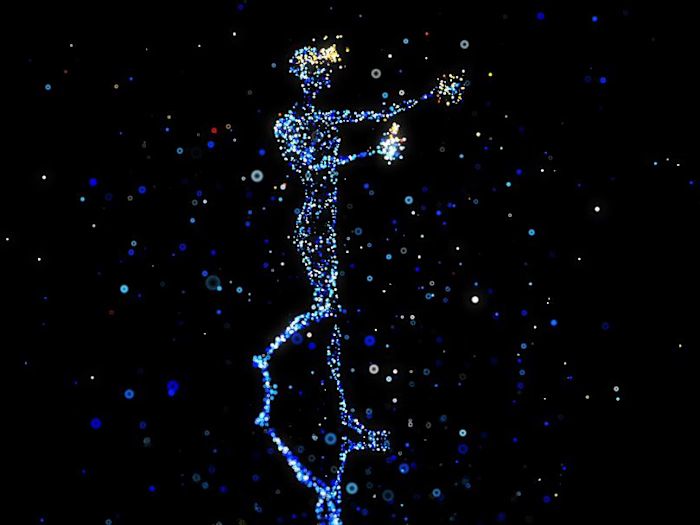
*the Metaverse is a Medium.

McDonald Ajibo


*the Metaverse is a Medium.
to Play with Reality.
The first time I heard the word metaverse, it sounded like a virtual place with a single promise — an escape from reality. From Twitter (now X) discourses to Medium articles and my endless Google searches, everyone seemed to be talking about games, headsets, avatars, and cryptocurrencies. Yet none of that explained why the idea felt bigger than the technology describing it.
I later came across the movie Ready Player One, a few years after its release, and I was intrigued. Curiosity led to more googling… right to the origin of it all — Snow Crash by Neal Stephenson. It felt like a miracle I needed to experience. I became so inspired that I wanted to be among those who would help build this speculative future.
But I thought to myself…
the metaverse should’t be just a virtual world to escape into…
Yet, the mainstream conversation increasingly drifted only towards simulations, immersive games, persistent identities, and blockchain economies.
Even the hardware was being sold as a “phone killer”. Well… I‘m not ready to give up my phone. Not yet. And certainly not for a pair of clunky goggles.
It felt as though the goal was to replace reality through the internet. Reality began to feel framed as a problem to be solved — a trap to escape, rather than the foundation upon which this digital experiment should rest.
I didn’t have the language then, to describe what I thought it to be, but after years of sitting with this, I think I found my definition.
the maturation of the internet into an augmentation of the universe — metaverse.
The metaverse is — art.
The metaverse is — a game simulation.
The metaverse is — reality becoming malleable through artificiality.
The metaverse is — a construct of shared logic between technology and ontology.
Before now, our relationship with the world was largely fixed.
If we wanted it to be different, more expressive, more alive, we represented it through art. We painted new skies, wrote new realities, sang our fantasies, filmed impossible cities, composed worlds that could only exist on game consoles.
As individuals, we could imagine ourselves with wings, a princess, a hero, jump from impossible heights or “climb Mount Everest with Batman”.
We translated our imaginations into art, saw other realities, but never inhabited them.
The metaverse shifts that relationship.
It extends art into reality. What was once only representational becomes experiential, through technological mediums.
You no longer just draw the wings or watch the hero fall. You step into the condition of it. You fly, fall, climb, become — briefly, knowingly, without consequence.
Streets can host stories. Time can bend temporarily. Imagination gains dimension.
The universe learns to play back.
In many ways, the metaverse feels closer to movies. Films have always been our first shared method of world-building — not just stories about people, but entire environments shaped by mood, light, and sound. Cities could feel oppressive or hopeful. Landscapes could carry emotion. Time and identity could be stretched, compressed, or folded in ways the physical world could never allow.
There is scarcely a version of reality that has not already been explored through film. For the true cinephile, every new invention, every bold leap of technology or imagination, carries the echo of what art has already imagined. Every innovation feels less like a novelty, and more like a continuation — a world made tangible that was first dreamed on the screen. Movies have long mapped the possibilities of being; the metaverse would let us step into them.
PS: I’d pay anything to experience Christopher Nolan’s universe.
At its core, the metaverse is about playing with reality.
In video games, being is flexible. You are not limited to the human form. You can play as a ghost (my Call of Duty craze, haha), a fairy creature, a cat, an object, or even a god. The rules of that world are clear, but it teaches you how to exist within it, because they are designed. Gravity works a certain way. Death is temporary. Space is structured for movement and interaction. The point is not realism, but experience.
The metaverse takes this logic beyond games and applies it to reality itself. It does not break the laws of the physical world, but it layers alternate rule-sets on top of them. You still stand in a room, but that room can become a stage, a battlefield, a studio, or a shared dream. Identity can shift. Presence can multiply. Meaning can be designed.
This is already beginning. Platforms like Fortnite are no longer just games. They host concerts, social spaces, film screenings, and collaborative experiences. Players don’t log in only to win; they log in to exist together. Fortnite is slowly becoming what Ready Player One imagined with the OASIS. But it evolves beyond that, becoming a persistent digital layer where culture, play, work, and identity overlap the physical plane.
In practice, this game-like structure is already unfolding around us. Virtual offices and collaborative worlds like Microsoft Mesh or NVIDIA Omniverse turn work into navigable environments rather than flat interfaces. Education and training become simulated spaces — surgical theaters, engineering labs, historical reconstructions — where learning happens through interaction, not abstraction. Digital twins of factories, cities, and supply chains allow industries to test, optimize, and rehearse reality itself, while social worlds host concerts, exhibitions, and civic gatherings as shared events inside persistent environments. Across all of this, identity becomes something you enter and perform rather than merely possess. These are not games in the traditional sense, yet they operate by the same logic: designed spaces with rules, affordances, and feedback. The internet makes this possible by stitching these environments together into a continuous layer, turning everyday activities into forms of play, simulation, and reconfiguring how reality can be lived.
The metaverse lets us design new rules, explore alternate conditions, and build experiences — beyond the given world. Time, space, presence can all be momentarily reinterpreted and experienced differently. Not just simulation or fantasy in the abstract, but a manipulated ontological dimension — lived, expressive, chosen, and temporary, shared with others who enter the same layer.
You might find yourself in a familiar street, maybe New York (I seem to love that city), immersed within an impossible structure: an upside-down castle clinging to a cloud above the city, its architecture folding inward like gravity forgot its role. Others are there too, moving through it with you, sharing the same impossible experience and orientation.
But when you look, you are not looking up at clouds.
You are looking down to the street.
Passersby still walk past, traffic still flows, horns still blare, storefronts remain where they have always been.
The city continues in real time, but an alternate reality game scene is layered on top of it.
From within the castle, the experience shifts.
You step into one of the rooms — the memory plane. You return to a moment you remember clearly, one that has already passed. Not by thought alone, but by describing it. You imagine the house into existence: the room, the light, the way the air felt. An artificial intelligent creative engine interprets your descriptions and reconstructs them into a temporally navigable simulation.
A conversation begins again. A door opens the way it once did. You know how the moment ends, yet you are present within it, able to slow it, soften it, let it unfold differently. The memory does not disappear, but its weight shifts. What once hurt can be rendered gentle, or what once rushed can be allowed to breathe.
Time reorganizes for you. Re-experiencing memories, as it was or a new form.
You open a portal from within the castle and descend through it (very Doctor Strange), folding space the way fiction allows, stepping from height to ground without falling.
When you arrive, the city pauses. For you and others immersed, time holds. The street transforms into a shared course. You and your friends race through it together, not inside a video or a cutscene. The buildings remain, but reality follows a different rule-set, manipulated only within this illusion.
AI stitches together the streets and buildings from satellite, sensor, and street-level data — while procedural generation reshapes structures, gravity, and surfaces for the layer you are immersed in. Reality is reinterpreted in real time, but not a rewritten city.
But to speak of the metaverse as a medium is not to diminish what lives deepest inside it.
There is a stratum of the metaverse that does not just extend reality. It replaces it — deliberately, completely, and on its own terms. Not an overlay. A world entire.
A virtual world.
Where extended reality adds a layer to the world you already inhabit, a virtual world builds from the ground up. Its own physics. Its own history. Its own internal logic — cause and effect that obeys rules the architect decided, not rules inherited from nature. The sky is whatever colour the world demands. Gravity behaves however the fiction requires. Time moves at the speed the experience needs.
This is not escapism. This is world-building at its most complete. The fantasy novelist does the same thing in language — invents a universe so internally coherent that the reader imaginatively experiences a different reality. The virtual world does it in space. You do not read it. You inhabit it.
Tolkien built Middle-earth with words.
The metaverse lets us build worlds — with geometry, physics, memory, and light.
This is where the medium reaches its fullest expression.
Not because it abandons reality, but because it proves reality is not the only coherent way a world can exist.
Every civilization has imagined impossible places: Heaven. Olympus. Wakanda. Arrakis. Coruscant. Hogwarts. The OASIS. They were never valuable because they were impossible. They were valuable because they obeyed themselves. Every great fictional world feels believable not because it mirrors ours, but because every part belongs to the same internal logic.
The metaverse gives those imagined worlds computational existence.
They cease to be settings and become environments. Their histories can persist. Their inhabitants can remember. Their ecosystems can evolve. Their economies can emerge. Their architecture can respond to those who enter. They are no longer stages waiting for actors, but living systems that continue whether or not you are present.
This is the deepest ambition of the metaverse — not simply to layer digital information over the physical world, but to author realities with the same richness, permanence, and coherence that nature authors ours.
Our universe becomes multi.
Not copies of this universe, but neighboring computational universes — each with its own ontology, each discoverable, inhabitable, and shared.
If extended reality teaches the universe to imagine itself differently, virtual worlds ask a more profound question:
What other realities deserve to exist?
I often think about where I was born: Karmo, Abuja, Nigeria. Growing up there, life unfolded in familiar, rough, tight spaces. The world felt fixed, but we played.
Wielding sticks like whimsical wands, reciting the opening lines of Merlin, commanding invisible winds to knock our friends over, while audibly telling them to fall. When we weren’t allowed to go to the field, we became managers of our imaginary football leagues, sliding soda-bottle lids across the ground in what we proudly called canter ball.
Imagine if kids could experience something more, where play could be augmented, not as spectacle, but a beautiful fantasy briefly layered over our reality. A local, shared augmented reality layer captures streets, fields, and walls, and overlays interactive, playful elements generated in real time. A stick glows as you swing it, tracing light through the air only you and your immersed friends can see. Chalk drawings rise and move, shadows stretch into characters running alongside you, keeping pace without sound. AI interprets gestures, voice, and group dynamics to animate objects and characters, turning your imagination into responsive, co-created experiences. The world underneath remains intact — but for a moment, it listens to imagination and plays along. Persistence lasts only as long as the play lasts, leaving memory and wonder once it ends.
The metaverse should feel like magic…
…Yet also, great function.
Through what we’ve termed Internet of Things, machines already communicate quietly and continuously.
Traffic lights negotiate flow with approaching vehicles.
Smart homes adjust temperature, light, and security without being asked.
Self-driving cars see the world digitally before acting physically. Their sensors observe, interpret the environment as data, and then react: stop, park, drive.
Machines already live and interact within a networked reality of data that overlaps our own but largely remains invisible to us.
The metaverse brings this hidden layer into presence. It allows technology to evolve beyond tools and experience our ontological logic. As entities situated in space, they gain perception — through sensors, spatial mapping, and artificial intelligence — they begin to experience the world in ways that overlap with human presence. This isn’t about machines becoming over-conscious, but autonomously relating to reality alongside us. We learn to act through machines, machines also learn to participate in the world we inhabit. Presence becomes mutual. The metaverse is the space where human experience and machine perception begin to overlap.
Immersion augments how man interacts with machine.
This shift redistributes human function. We begin to act through machines, not as operators issuing commands, but as embodied participants, reframing what we call remote work, which today are just tasks that don’t require physical presence. But through immersion, presence itself becomes transferable.
We could perform tasks not fit for the human body, just like driving a vehicle. Immersion allows us to inhabit machines without being constrained by flesh and muscle.
In Japan, disabled and elderly individuals already work through remote-controlled robots. Using VR headsets, operators can see, hear, interact with customers, and even stock shelves, fully present in environments they are not physically near.
Technology would no longer merely mediate reality through screens; it begins to host conditions of presence, a shift in how things exist and are experienced. Instead of interacting through dashboards, buttons, and abstract commands, immersion allows humans to step into the same spatial logic technology already inhabits.
The gestures we perform through our devices — calling a friend, sending a message, sharing a location, watching a movie, playing a game, listening to music, become more expressive forms of presence. Instead of a call, two people might briefly share a space, hearing the same ambient sounds, seeing the same virtual sky layered over different physical places. Instead of texting, communication could feel closer to archaic letters, or shared moments that unfold in time rather than lines of text.
Imagine an intelligent engine like ChatGPT, not as a chat box on a webpage, but as a quiet organism summoned within your atmosphere. You talk to it the way you’d talk to another person in the room. You make a search, but instead of a page loading, the space around you responds. Results don’t stack into a list. They arrive as fragments, a map hovers to your left, a short explanation forms in front of you, a timeline stretches gently along the wall. Each piece exists at once, all around you. You speak an idea out loud, not a command in code, not a prompt shaped for a box — just language. The system listens, and instead of replying with text, it performs. You describe a concept, and a rough form appears around you, incomplete and unpolished. Something you can feel rather than read, walk around, sense what works and what doesn’t, tell it to change, and it adjusts in real time.
You do not “open the app”. You enter a shared condition of presence.
The digital world evolves beyond taps and scrolls into a dimensional experience.
The hardware that enables this does not replace what we already carry. It behaves more like an accouter — an embodied accessory, that extends your presence beyond the mobile experience, while the phone remains central. And software ceases to be an app you open and close, but becomes an artifact — a spatial object, summoned into the dimension you are inhabiting, used and then released.
With all this power — to inhabit wonder, to extend presence. The metaverse does not ask us to leave our world behind, it asks us to experience it differently.
In the end, Anorak the All-Knowing leaves us with a surprisingly simple reminder. For all the beauty and freedom of the worlds he built, reality remained the only place where you could share a real meal, feel real connection, and live real.
Like this project
Posted Jul 15, 2026
A detailed exploration of the metaverse as an evolving medium, impacting reality and technology.