Mushpreneur Digital Presence and Content Strategy Audit

Maryam Shakeel


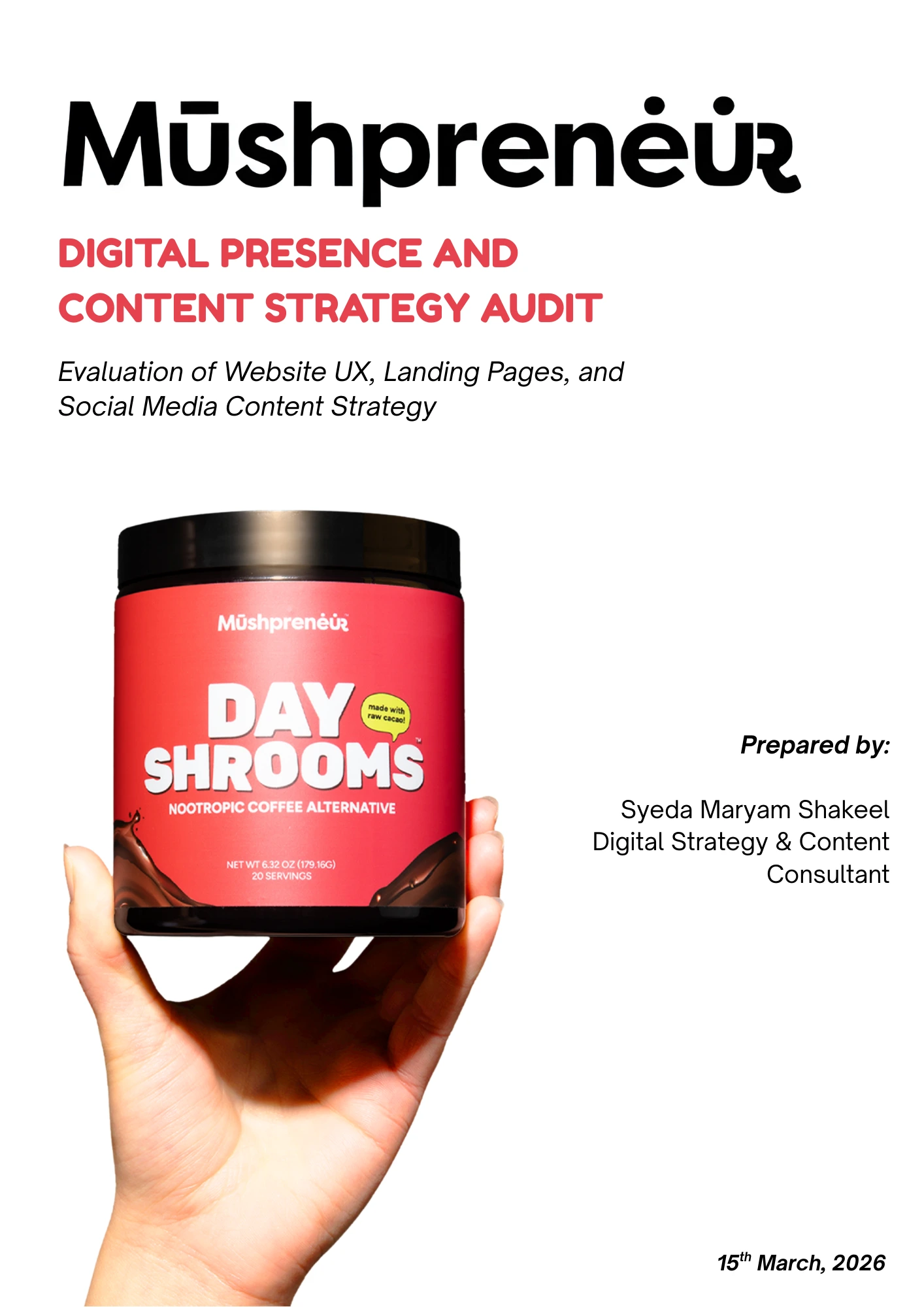
Case Study: Mushpreneur — Digital Presence and Content Strategy Audit
This project involved conducting a comprehensive digital presence and content strategy audit for Mushpreneur, a productivity-focused beverage brand operating in a highly competitive, content-driven category.
The objective of the engagement was to systematically evaluate the brand’s digital ecosystem and identify structural inefficiencies limiting content performance, user engagement, and conversion outcomes.
Note: Certain proprietary details, exact data points, and implementation specifics have been intentionally generalized or omitted to maintain confidentiality.
Scope of Work
The audit was delivered as a 55-page detailed report, supported by a condensed one-page executive summary.
The scope included:
Social media content analysis across multiple formats
Website UX and UI evaluation
Messaging and positioning assessment
End-to-end funnel analysis from content discovery to purchase
Analytical Framework
To ensure consistency and depth, the audit was structured across three primary layers:
Content Layer — Evaluation of how effectively content captures attention, communicates ideas, and retains users
Experience Layer (UX/UI) — Assessment of how information is structured, presented, and navigated
Funnel Layer — Analysis of how users transition from awareness to conversion
Each medium was evaluated using defined frameworks within this structure.
Social Media Analysis Framework
Social content was evaluated using a structured content effectiveness model, consisting of:
Hook Effectiveness — Speed and clarity of attention capture
Narrative Structure — Logical sequencing of information and storytelling flow
Message Clarity — Degree of focus on a single core idea per content piece
Retention Design — Pacing, density, and cognitive load in short-form formats
Key Findings
The analysis indicated that while content intent and volume were strong, execution lacked structural consistency.
Hooks were frequently delayed, reducing early retention. Narrative sequencing was inconsistent, with key insights introduced later than optimal. Content often attempted to communicate multiple ideas simultaneously, reducing clarity and recall.
Additionally, content design did not consistently align with attention patterns typical of short-form platforms, limiting overall performance.
Carousel Content Framework
Carousel posts were evaluated using a content design and readability framework, focusing on:
Information hierarchy and prioritization
Cognitive load and text density
Logical progression across slides
Visual structuring through typography and spacing (UI)
Key Findings
Carousels were observed to be text-heavy with limited visual hierarchy, reducing readability on mobile devices. Slide progression did not consistently build toward a clear conclusion, impacting completion rates.
From a UI perspective, insufficient differentiation between key and supporting information reduced scannability and engagement.
Website UX and UI Evaluation Framework
The website was evaluated using a combined UX and UI framework:
UX (User Experience)
Clarity of value proposition
User flow and navigation logic
Friction points within the journey
Alignment with expectations set by social content
UI (User Interface)
Visual hierarchy and layout prioritization
Typography and readability
Component consistency across pages
Visibility and placement of calls-to-action
Key Findings
The website contained relevant information but lacked immediate clarity in communicating the product’s differentiated value.
From a UX perspective, user flow did not consistently guide visitors toward a defined action, and key trust-building elements were underrepresented.
From a UI perspective, improvements were identified in visual hierarchy and content prioritization to enable more efficient information processing.
Funnel Analysis Framework
The user journey was evaluated using a three-stage funnel model:
Awareness (Social Content)
Consideration (Intermediate Experience)
Conversion (Website and Purchase Flow)
Key Findings
A structural disconnect was identified between awareness-stage content and conversion-stage touchpoints.
Users were directed from social platforms directly to the primary website without a transitional layer to reinforce messaging or guide decision-making. This created friction within the user journey and reduced conversion efficiency.
Core Insight
The central insight derived from the audit was that performance limitations were not due to insufficient content effort, but due to the absence of an integrated system connecting content strategy, user experience, and conversion pathways.
Strategic Recommendations
The recommendations focused on introducing system-level improvements across all layers.
At the content level, a structured approach emphasizing early hooks, clear narrative progression, and single-message focus was proposed to improve retention and clarity.
For carousel content, simplification through reduced text density, improved visual hierarchy, and stronger sequencing was recommended.
At the funnel level, the introduction of an intermediate layer between social content and the main website was proposed to improve continuity and reduce drop-off.
On the website, enhancements in UX flow, value proposition clarity, and UI hierarchy were recommended to strengthen usability and conversion effectiveness.
Outcome
The audit provided a structured and actionable framework to improve engagement consistency, enhance clarity of communication, and reduce friction across the user journey.
The accompanying one-page summary presents a synthesized view of the key findings and recommendations derived from the full 55-page report, with sensitive details intentionally abstracted.
Like this project
Posted Mar 17, 2026
This case study breaks down how Mushpreneur’s digital ecosystem was analyzed to uncover gaps across content, UX/UI, and conversion pathways.
Likes
0
Views
16
Clients
Mushpreneur