Built with Jitter
AI Sales Agent Platform - SparkAGI

David Akanbi


SparkAGI: An Autonomous Sales Engine for Hyper-Scale Conversion
The Problem Nobody Was Solving
B2B companies spend thousands getting qualified traffic to their website. Then a human has to respond. And humans sleep.
By the time a sales rep follows up the next morning, the high-intent visitor has already signed up with a competitor. Studies consistently show over 97% of website visitors leave without converting not because the product is wrong, but because the response window closed before anyone answered.
Existing solutions are a patchwork. Traditional chatbots operate on rigid decision trees and feel robotic the second a visitor asks anything off-script. CRM tools are powerful but passive, they record what happened, they don't fix it in real time. And AI wrappers bolted onto existing workflows create more friction than they remove.
SparkAGI was built to fix that. The ask was to design a system that could replace the entire top-of-funnel sales motion, qualification, pricing and scheduling without a human in the loop. My job was to make it feel less like a tool and more like a trained team member.
What I Was Actually Designing
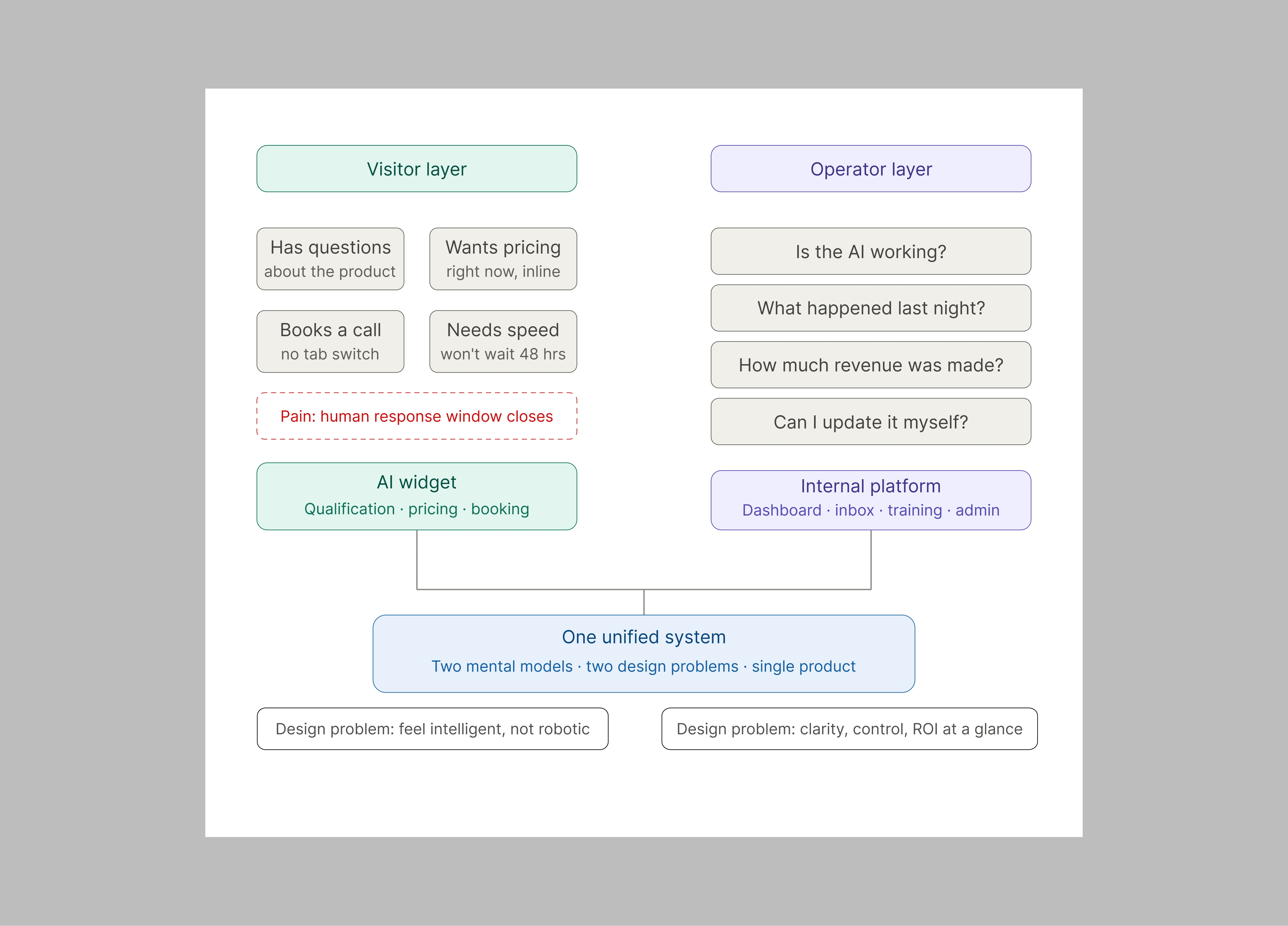
Before touching a frame, I mapped what this product actually needed to do across two distinct audiences:
1. The Visitor (Customer-Facing Layer)
A first-time buyer lands on a client's site. They have questions. They want a price. They want to book a call. They do not want to fill out a form and wait 48 hours. The AI widget had to handle all of this intelligently, in real time, without feeling like a bot.
2. The Operator (Internal Platform Layer)
The business owner needs to know: Is the AI working? What conversations happened last night? How much revenue did the agent generate? Can I change how it responds without calling a developer?
Two completely different mental models. Two completely different design problems. One unified system.
The Knowledge Command (Agent Training Center & Sandbox)
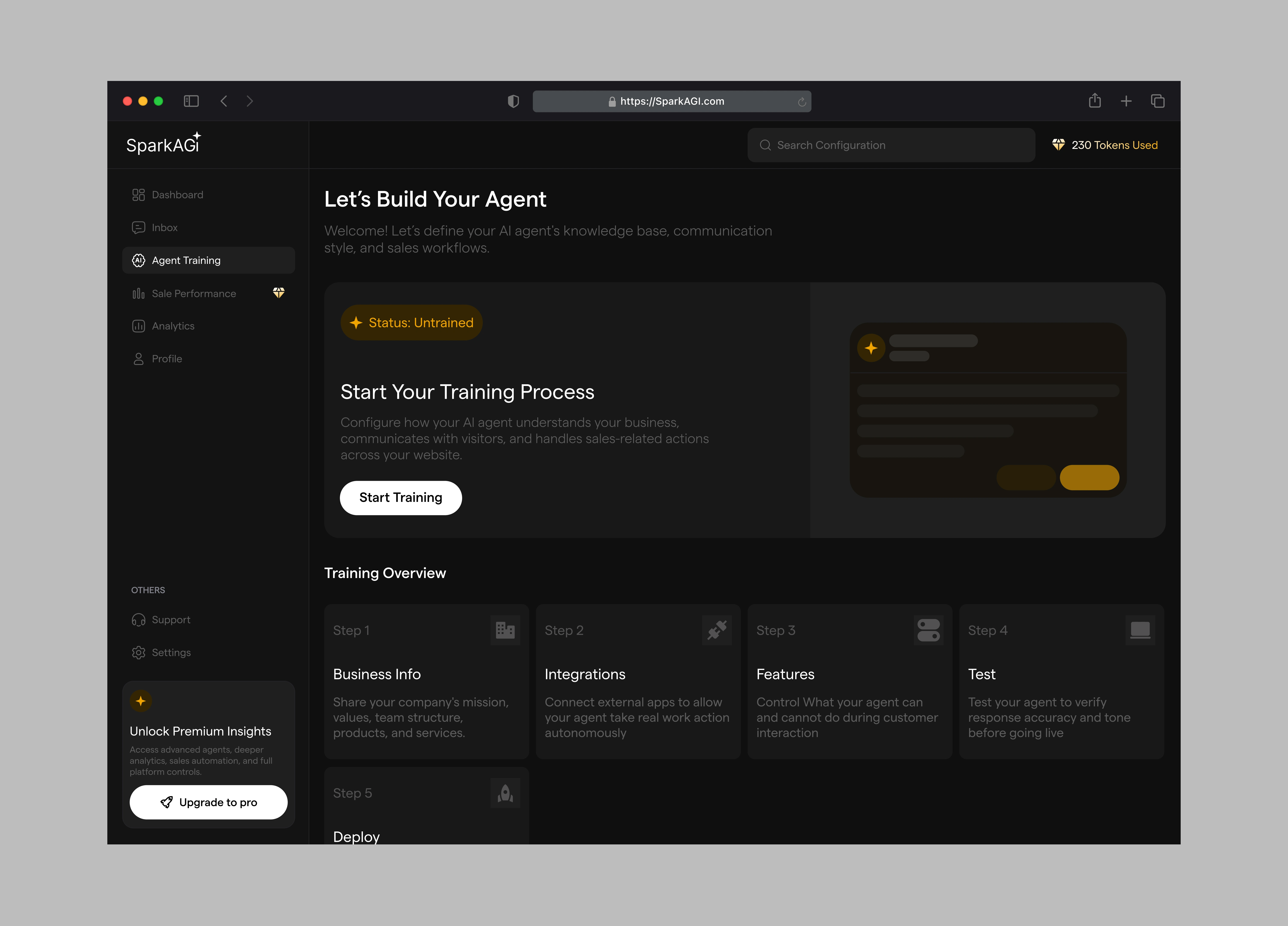
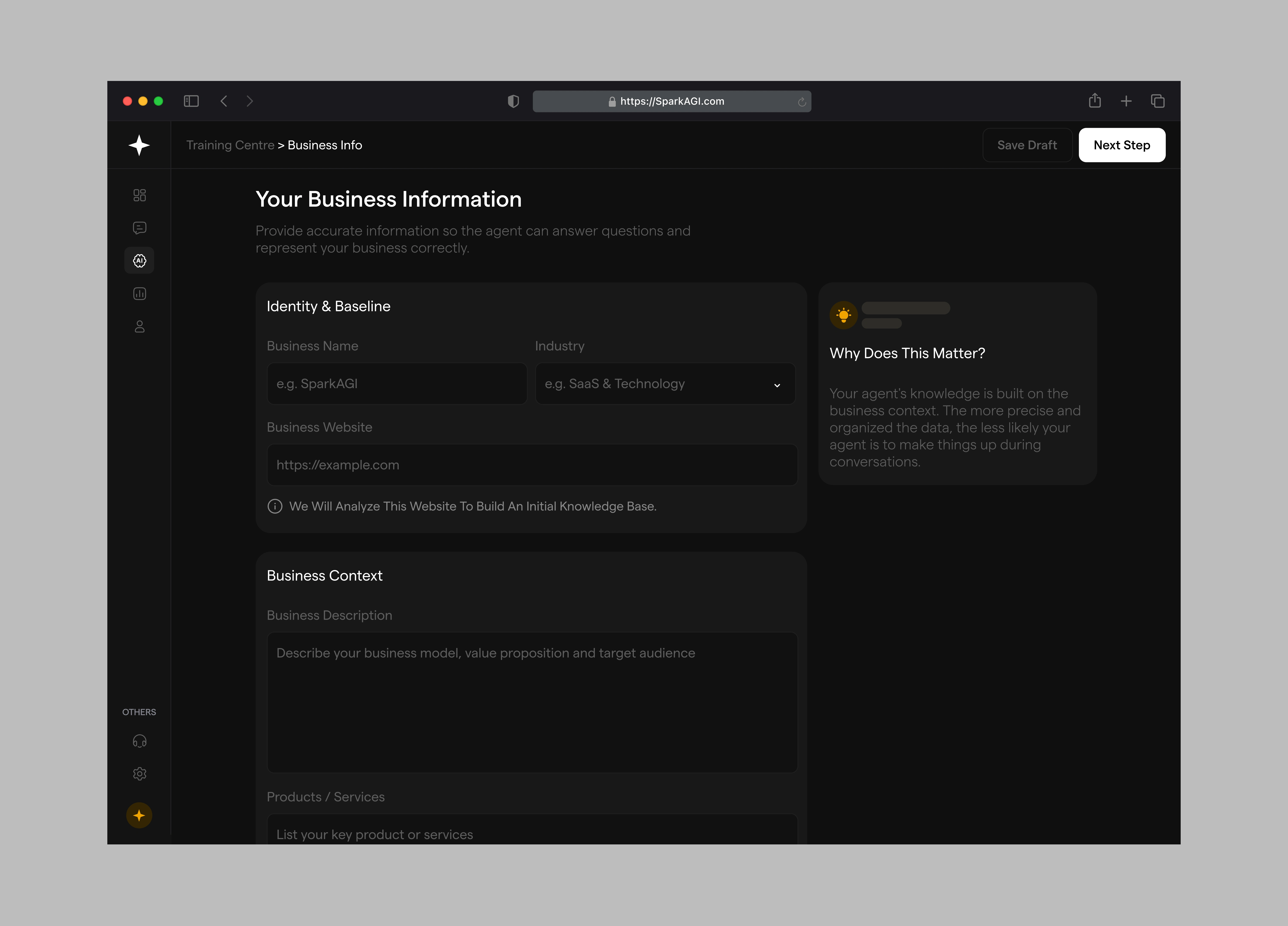
An autonomous AI sales agent is only as powerful as the data feeding it. We engineered a premium, two-part interface to streamline advanced machine learning configurations for non-technical business users.
Phase 1: Business Context (Forms): A dense form capturing company info, products, pricing, and brand tone.
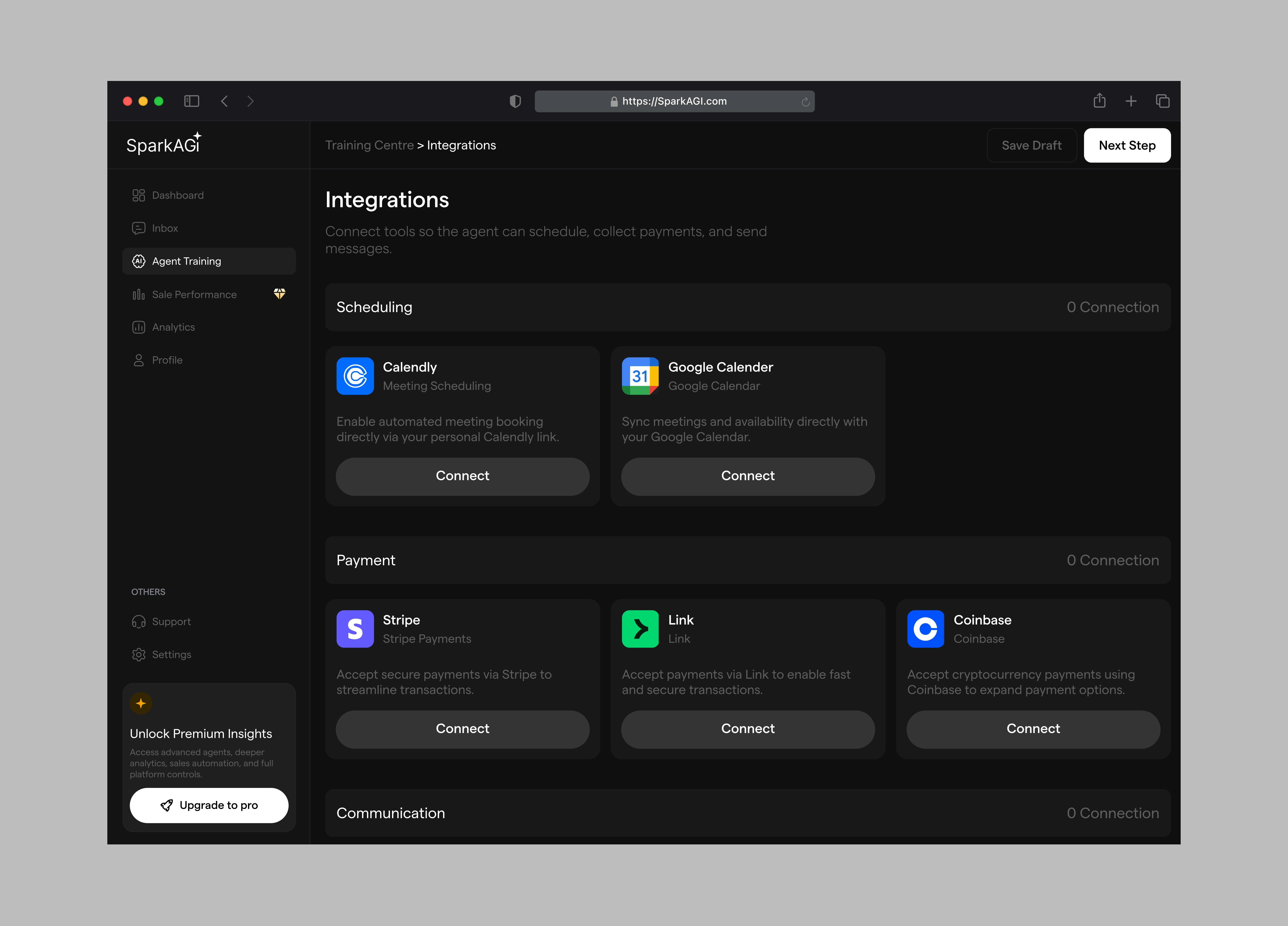
Phase 2: Integrations (Stack): A visual grid matrix linking the agent to Calendars, Stripe, email, and social tools.
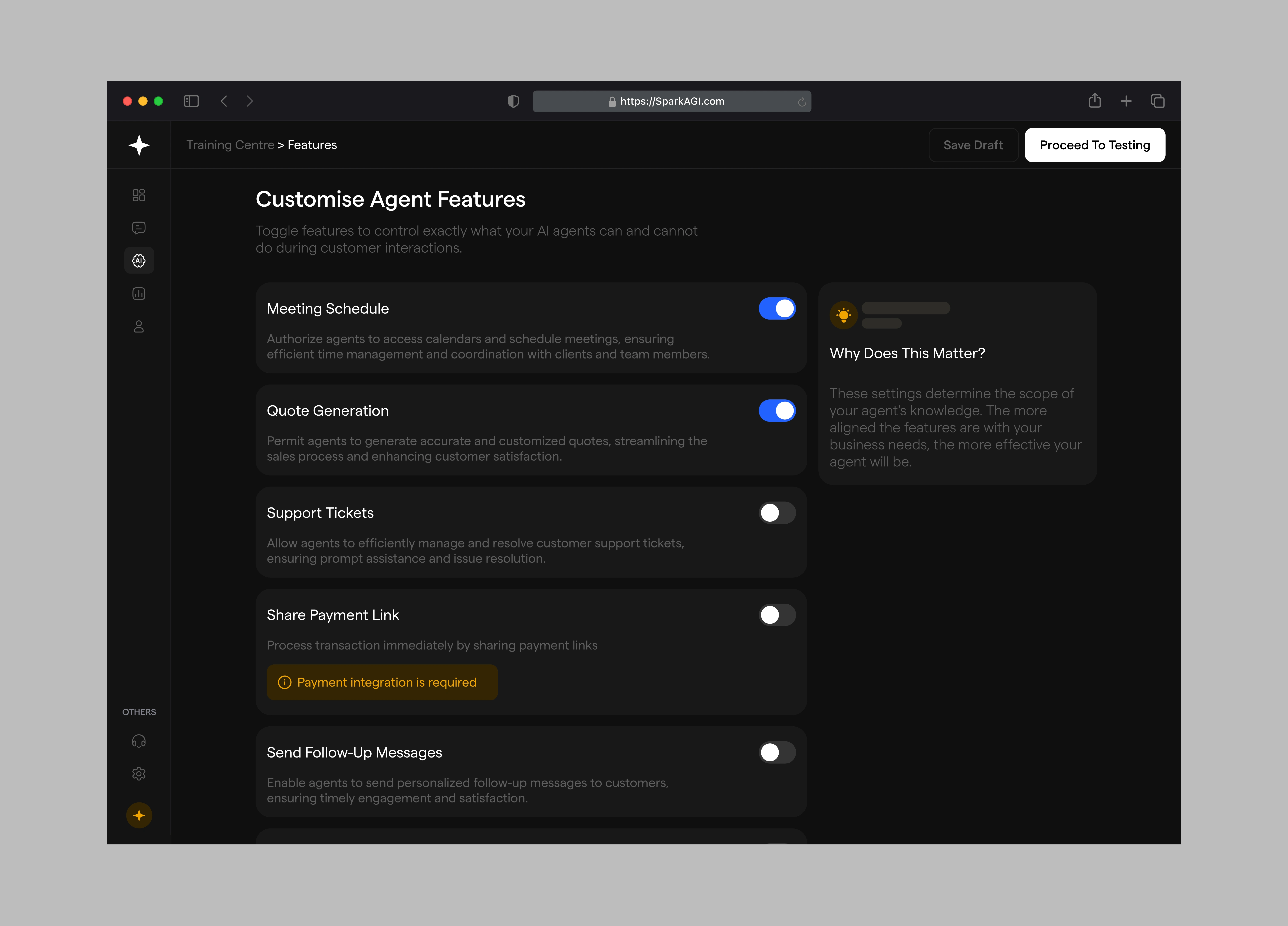
Phase 3: Feature Toggles (Capabilities): Modular permission switches to turn on/off Lead Capture, Quotation, Payments, or Human Escalation.
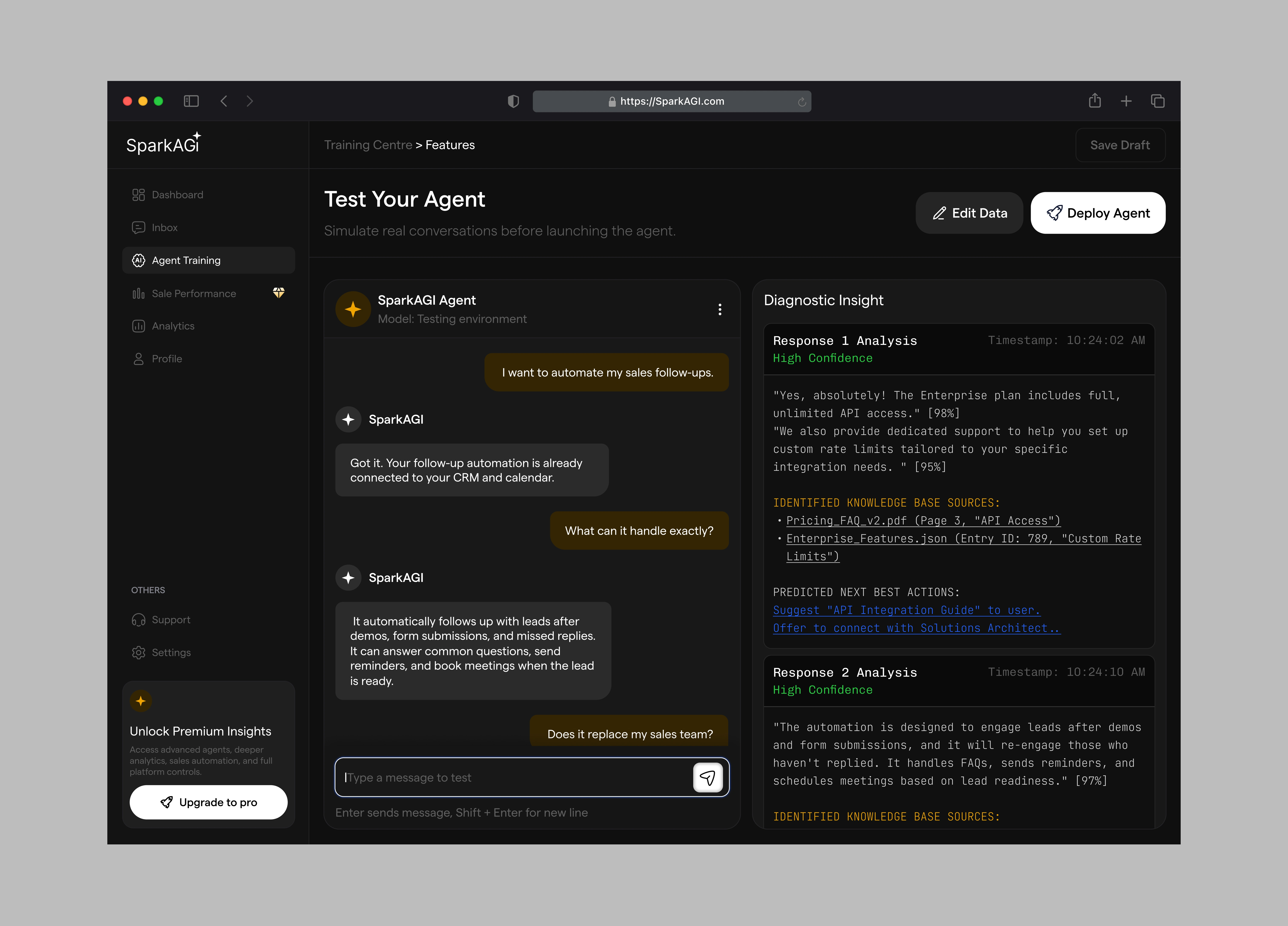
Phase 4: The Sandbox (Testing): A split-screen testing environment to test prompts, and audit live diagnostic accuracy.
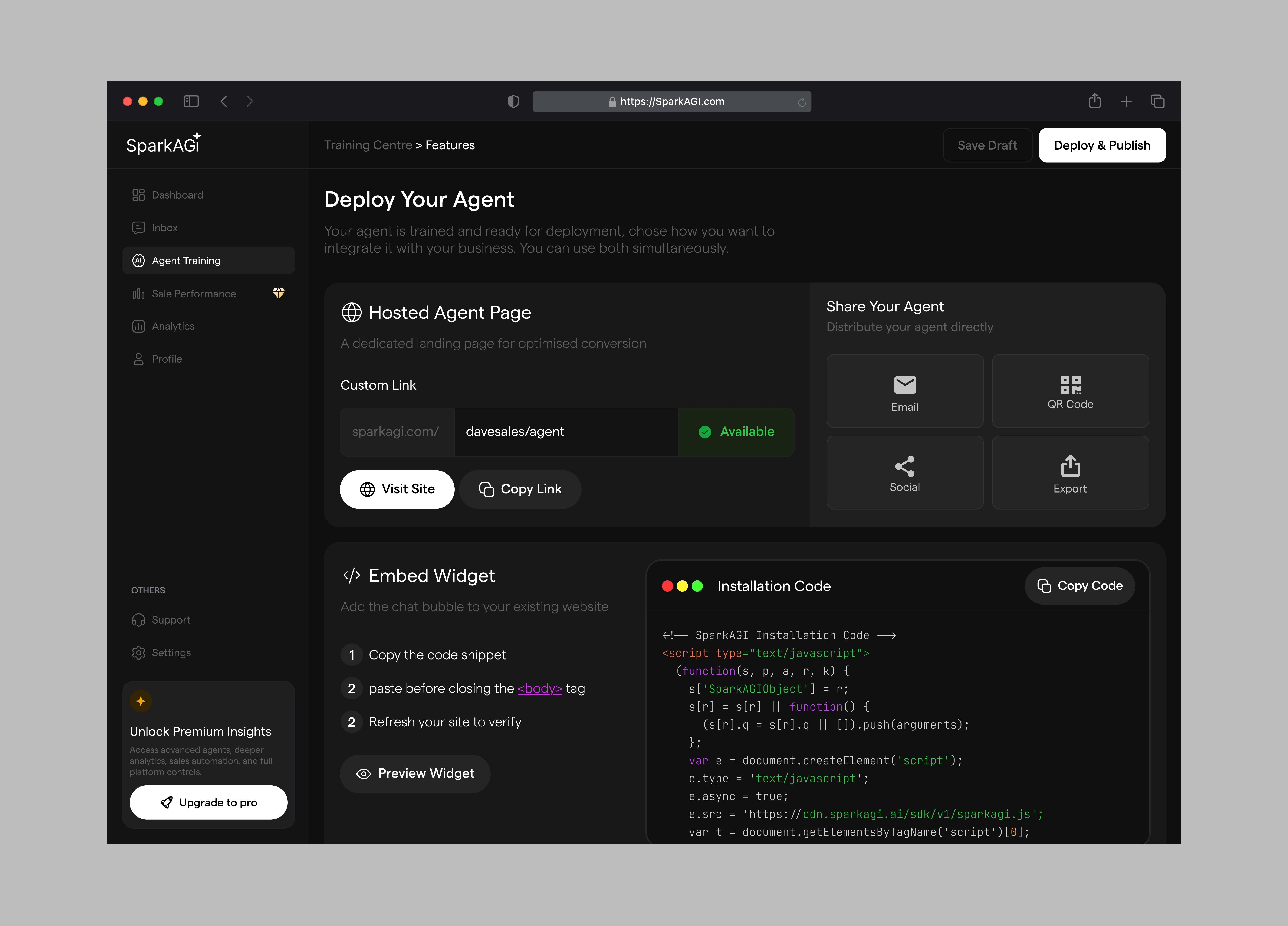
Phase 5: Deployment (Launch): A one-click code generator or unique link router (sparkagi.ai/MoesAgent) to push the agent live in under 60 seconds.
Phase 1
Phase 2
Phase 3
Phase 4
Phase 5
Unified Inbox
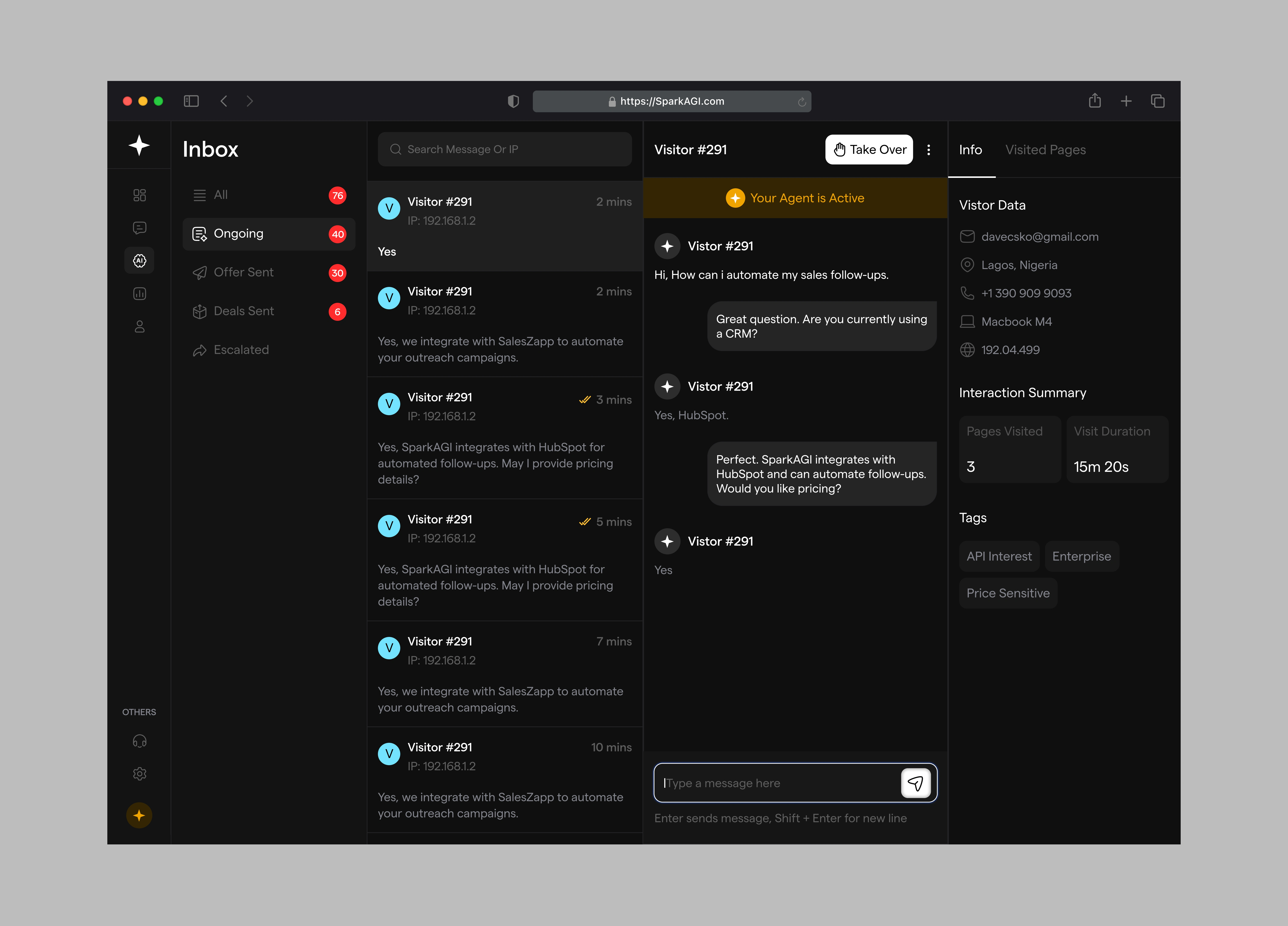
When the AI agent flags a high-value lead for escalation a visitor exhibiting buying signals too strong to leave automated it surfaces in the Unified Inbox for a human to take over.
The layout uses modular vertical panels: conversation thread on the right, lead context and qualification data on the left, action controls inline. Operators can filter by deal status, search by company, flag closed conversations, or override the AI's response with a manual message.
The design decision that mattered most here: I didn't design for the average conversation. I designed for the moment an operator is reviewing 40 conversations after a campaign drop. Scannability, not beauty. Every row communicates status, source, and value at a glance.
Revenue Intelligence Dashboard
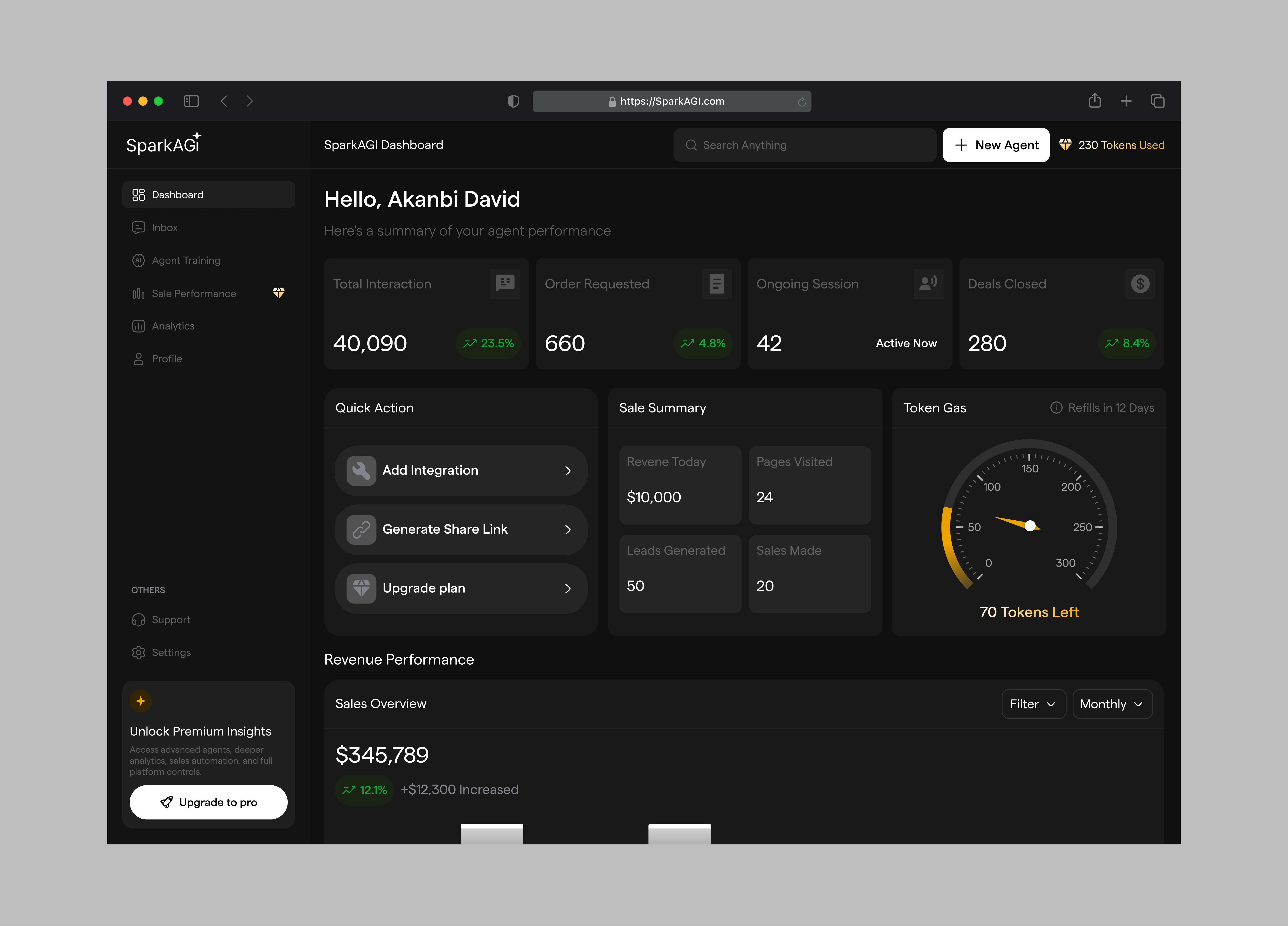
This is the screen a founder opens first thing in the morning.
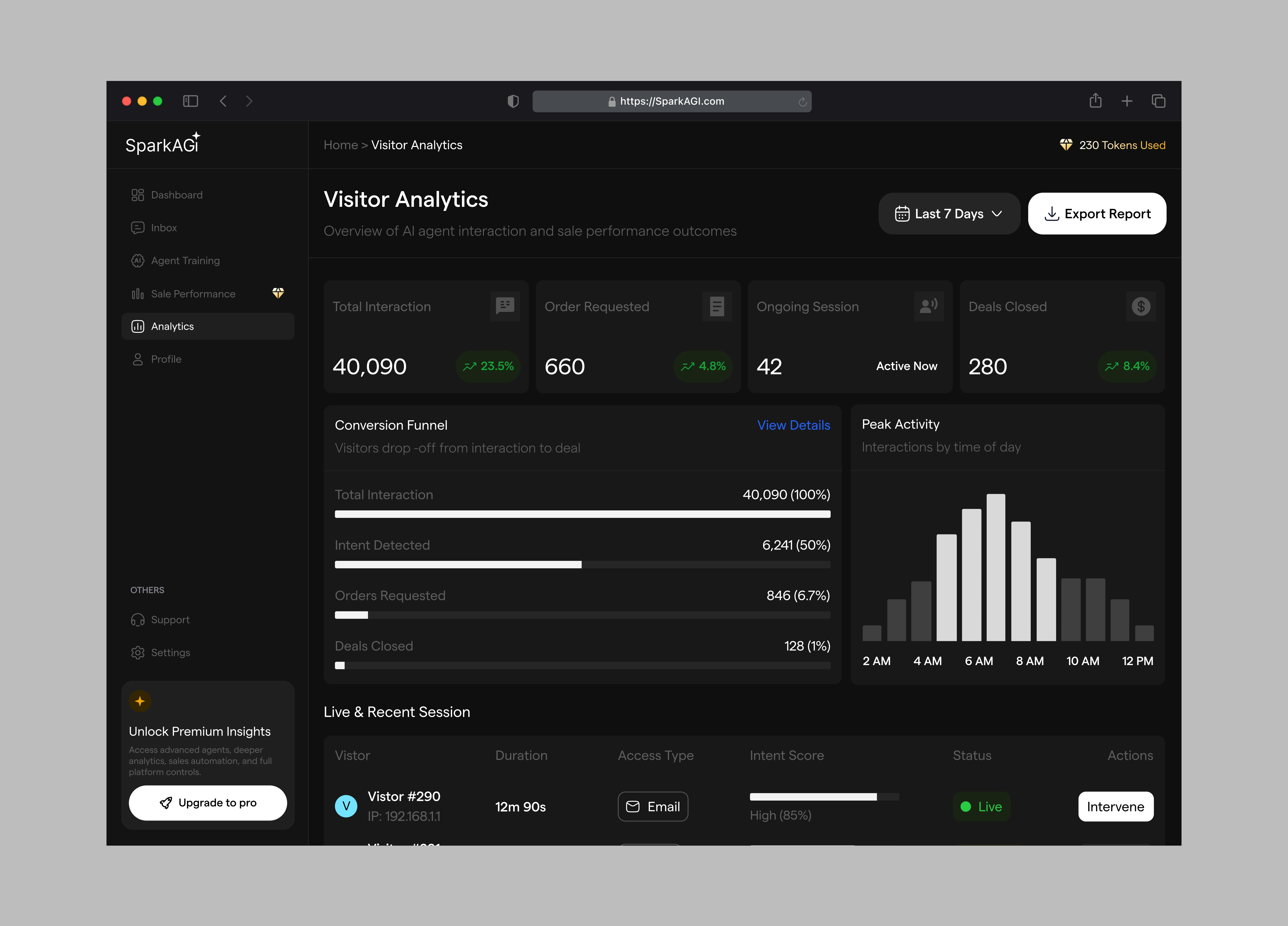
Most analytics dashboards are organized around what the system tracks. This one is organized around what the operator needs to decide. The hierarchy is:
Total revenue generated by the AI agent (top, largest, always visible)
Conversion trend over time (directional; is the agent getting better or worse?)
Proposals viewed vs. closed (where is the drop-off happening?)
Visitor session logs with regional breakdown (who is coming, from where, and when?)
The design deliberately avoids chart-for-chart's-sake. Every visualization earns its place by answering a specific operational question.
The Autonomous Widget
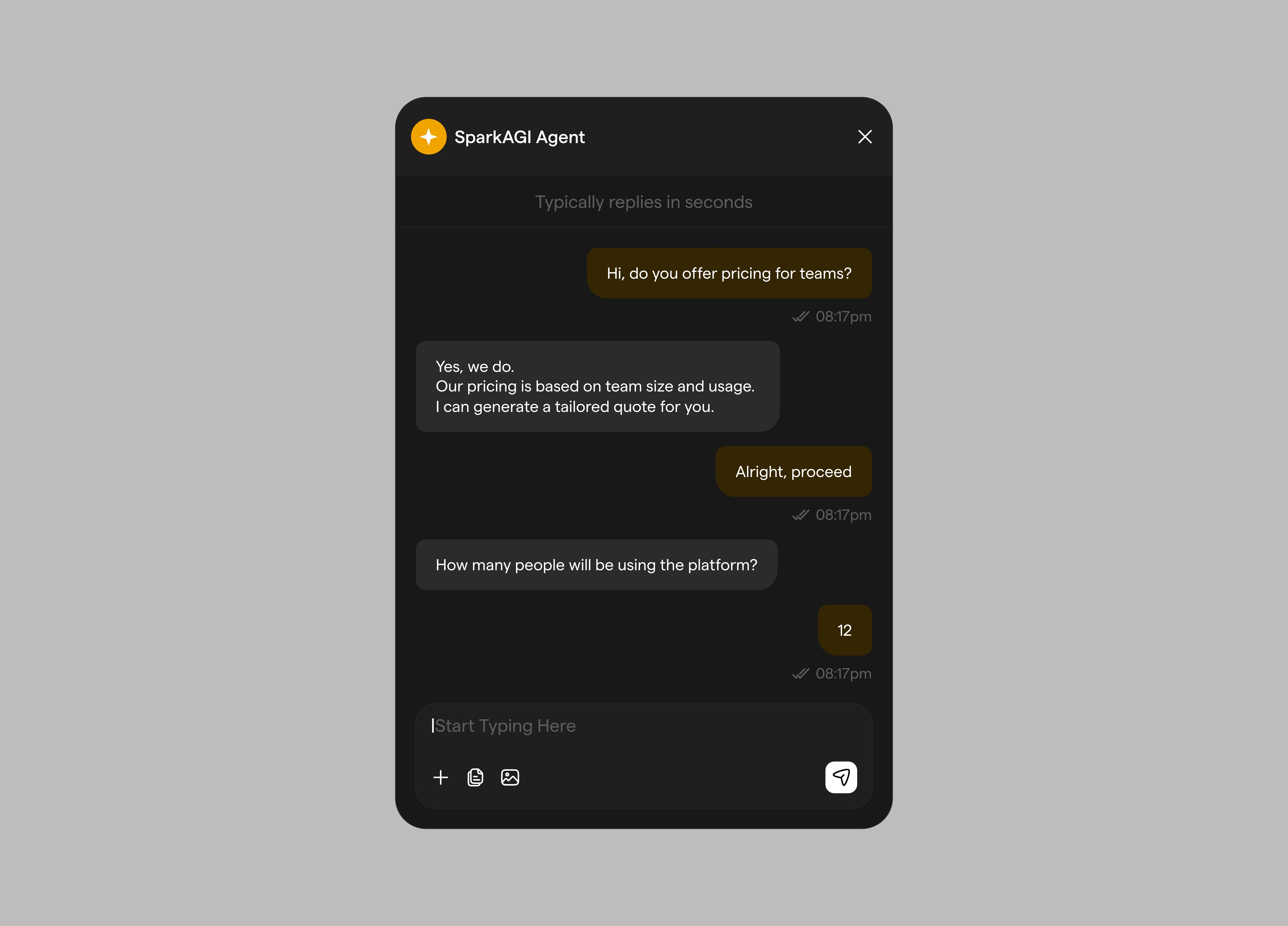
The entry point of the entire product. This is what a visitor sees when they land on a client's website.
The constraint that shaped everything: the widget loads on someone else's website, over their brand. It had to be opinionated enough to feel premium but neutral enough to adapt without clashing.
Final Result
SparkAGI is a fully designed, engineering-ready system that covers:
A customer-facing AI widget capable of handling pricing, qualification, and booking without a human
A revenue intelligence dashboard built around decisions, not vanity metrics
A unified inbox for human-AI escalation workflows
An operator-facing training center with live sandbox testing
A technical monitoring suite for API health and uptime
A global admin control layer for multi-account enterprise management
What I learned
The biggest design mistake in AI tooling is designing for the AI's logic instead of the operator's mental model. Most dashboards in this space show you what the system tracked. SparkAGI shows you what you need to decide.
The Sandbox was the clearest proof of this principle: making the machine's reasoning visible didn't just improve usability. It became the product's primary sales tool. Clients who saw the split-screen testing interface during demos understood the product's value in 90 seconds without a single slide.
The design decision that mattered most: treating the Training Center not as a settings page but as a command center. That framing operators commanding an intelligent agent rather than configuring a tool shaped every interaction in that view.
Preview Link
For Partnership And Collaboration
Whether you’re building a new product or refining an existing product, Let's lcollaborate and ship your idea to life
📧Email: davecsko@gmail.com
Like this project
Posted Jun 27, 2026
End-to-end product design and system architecture for an automated AI B2B software platform.