Smart Shuffle Filters for Spotify

Shay Delagarza


Spotify is a leading music streaming platform known for its powerful algorithm-driven personalization. While features like Discover Weekly and Smart Shuffle curate music automatically, users have limited direct control over how their libraries are shuffled.
Research revealed that shuffle is one of Spotify’s most used, and most frustrating, features. Users experience repetition and lack of variety, yet continue relying on it daily. The opportunity: improve shuffle without compromising Spotify’s simplicity or personalization.
Smart Shuffle Filters: an enhancement that lets users refine shuffle by mood/genre and toggle Discovery, Rediscovery, and Current Favorites. Built within Spotify’s existing design system, the feature adds control without added complexity.
I'm an avid Spotify user - music, podcasts, the occasional audiobook on a long hike. When I took on this project it wasn't initially out of personal frustration, but genuine appreciation for the app and the design challenge of improving something already well-built.
I started by reading reviews on Google Play and the App Store. The number one complaint among paid subscribers, by a significant margin, was shuffle. Users felt their saved songs weren't actually being shuffled, only their current top tracks were cycling through. That became the focus.
Research began with user reviews across Google Play, the App Store, and Reddit, where shuffle emerged as the top complaint among paid subscribers, by a significant margin. I looked at Apple Music, YouTube Music, and Amazon Music. Shuffle frustration was wide-reaching across all of them, and none of the platforms allowed users to customize how shuffle behaved by genre, mood, recency, or artist separation. The gap was consistent and clear. Surveys and user interviews were then conducted to understand the root frustrations in depth.
Across reviews on Reddit, Google, and the App Store, premium users repeatedly described shuffle as too repetitive, despite having large libraries. Many felt the algorithm limited what they could hear, burying saved songs and reducing variety. I also realized that while Spotify is strong in algorithmic personalization, it offers very little direct user control beyond single-genre filters.
Users don’t want to replace the algorithm, they want to guide it. When paying subscribers feel disconnected from their own libraries, frustration builds. Adding meaningful control isn’t just a feature improvement, it’s a trust and retention opportunity.

persona
Alex, 29, is a grad student and long-time Spotify Premium user who listens daily across work, commuting, and downtime.
She values music that feels emotionally aligned with her mood, blending familiar favorites with meaningful discovery, without having to overthink it. She needs a smarter shuffle experience that reduces repetition, resurfaces forgotten songs, and gives her light, intuitive control over vibe and variety.
“I just want shuffle to understand my vibe, surprise me a little, and actually play the songs I forgot I loved.”
Research revealed that shuffle is one of Spotify’s most-used features, and also one of its biggest frustrations. Users feel stuck hearing the same songs, unable to access the full depth of their libraries, and limited by filters that don’t reflect their mood or intent. This pointed to a clear opportunity: design a smarter shuffle experience that balances discovery and rediscovery, adds lightweight user control, and enhances personalization without increasing complexity. Doing so could improve daily engagement, strengthen loyalty, and reinforce Spotify’s promise of truly personalized listening.
Users expect shuffle to surface their full library, but it favors recently played tracks, limiting variety and reducing trust.
Shuffle under-delivers on resurfacing forgotten favorites, instead prioritizing new tracks influenced by recent listening.
With research findings in hand, the direction became clear: this wasn't about replacing what Spotify had built, it was about adding one thoughtful layer on top of it. Users weren't asking for a new product. They were asking to be heard by the one they already loved. Every design decision that followed had to earn its place within a system that users already trusted and had high expectations for.
Initial brainstorming kept the core insights separate: resurfacing long-unheard saved songs, maintaining discovery based on saved genres, allowing multiple genre/mood selections (Spotify currently limits this to one), and giving users control over whether current favorites were included or deprioritized. Early concepts treated these as distinct features.
I eventually funneled them into one layered feature: Smart Shuffle Filters. A second feature had also been in development: a "vibe check" where users could rate each song as good, meh, or bad to further influence the algorithm over time. After careful consideration, I cut it. Smart Shuffle Filters was already layered enough to address the core pain points well, and adding a second feature risked diluting the MVP focus.
AI was used throughout, starting with data discovery during research, research synthesis, and early brainstorming to pressure-test which directions were worth pursuing.
With clear problem statements and HMWs in place, these insights were translated into a focused feature addition that strengthened shuffle without overcomplicating it.
The result is Smart Shuffle Filters: a lightweight layer of user control that allows listeners to guide shuffle by selecting multiple moods/genres and refining results through Discovery, Rediscovery, or Current Favorites.
The feature was designed to reduce repetition and restore a sense of agency, while working seamlessly within Spotify's existing system.
Smart Shuffle Filters is a guided shuffle experience that helps users move from passive listening to intentional discovery.
After tapping shuffle, listeners can select multiple moods or genres and refine their session with options like Discovery, Rediscovery, or Current Favorites. This allows them to shape the vibe, surface forgotten songs, and reduce repetition.
Smart Shuffle Filters onboarding
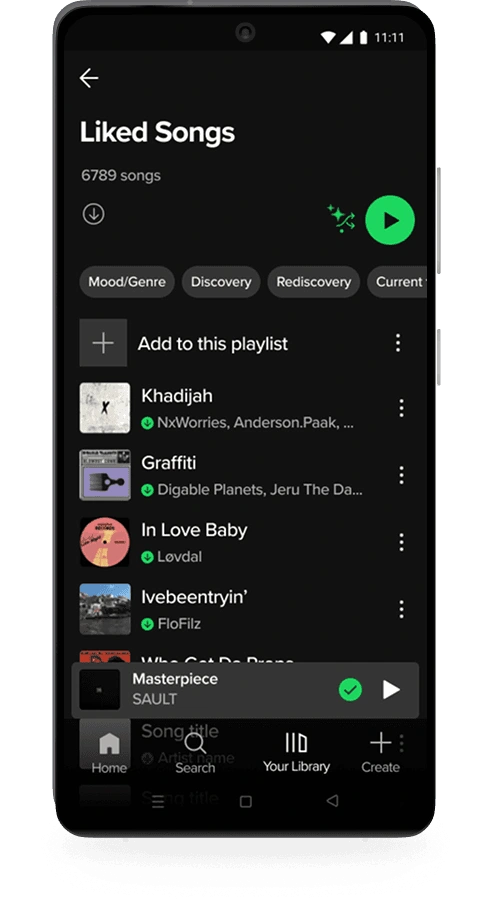
played on the existing Smart Shuffle icon
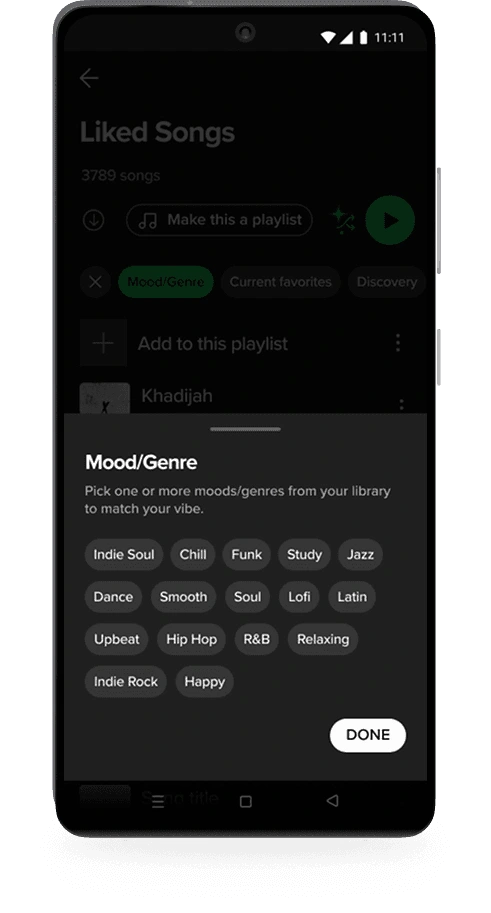
Allow multiple mood/genre selections
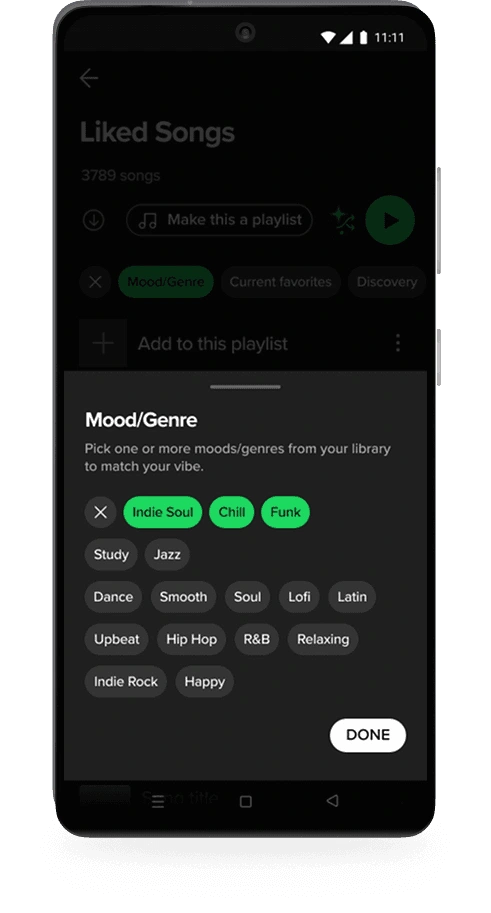
utilized Spotify's existing UI design for familiarity
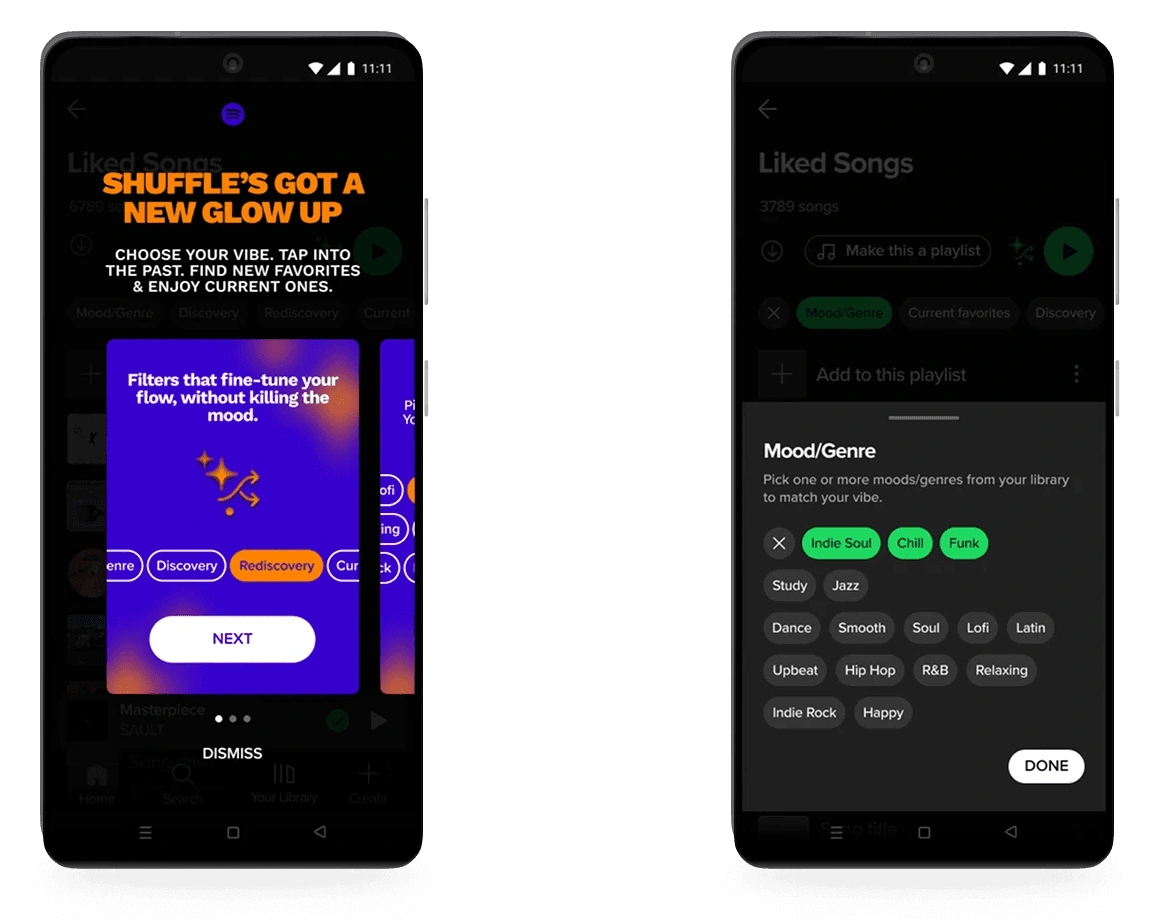
Users begin in their Liked Songs by tapping the updated Smart Shuffle icon, which is an evolution of the existing feature. Once activated, four filter options appear inline in a format familiar to Spotify’s UI. If users select Mood/Genre, a drawer slides up displaying the moods and genres already present in their library, allowing for multiple selections.
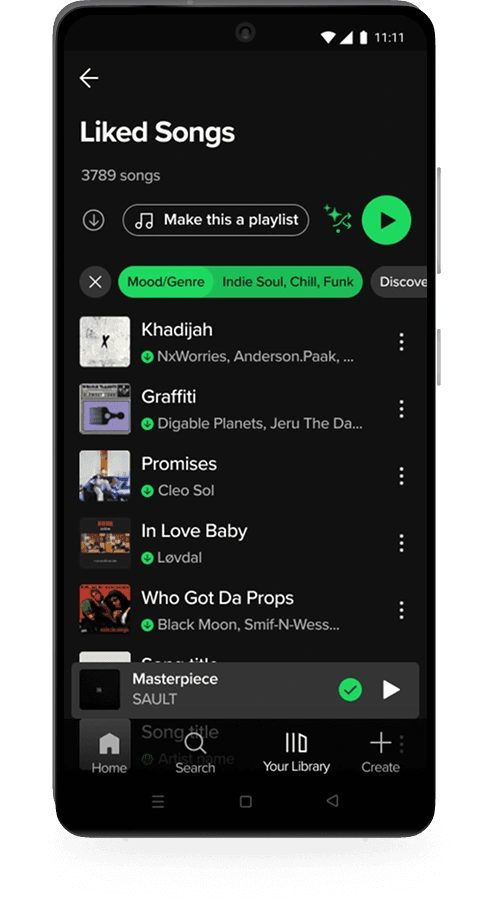
one filter has been used, with three more filter options inline with the mood/genre filter
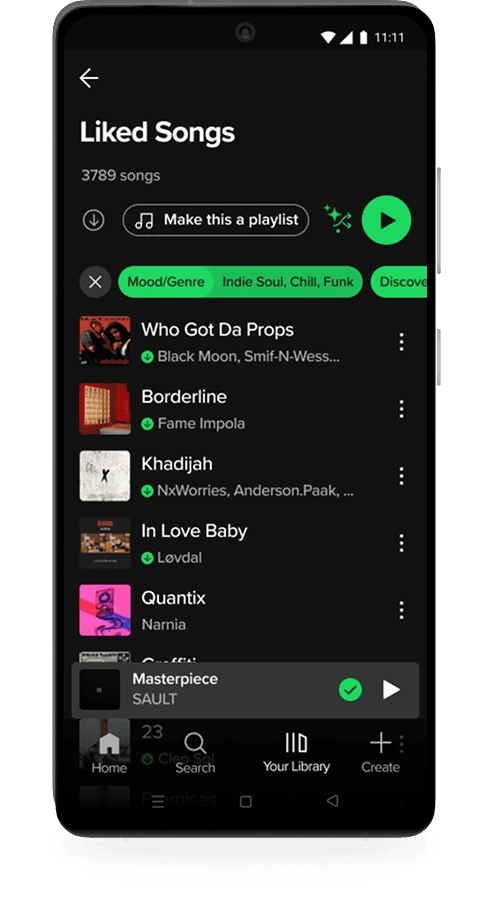
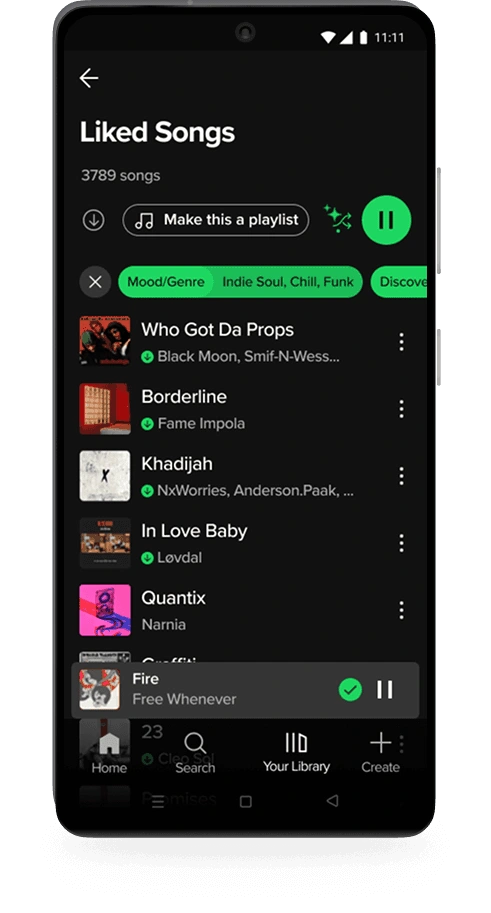
After confirming their choices, they can further refine their session with Discovery, Rediscovery, or Current Favorites. Each act as lightweight toggles.
Smart Shuffle Filters flow
Together, these filters let users shape not only the vibe of their shuffle, but also the balance between new finds, forgotten tracks, and recent favorites. Users can apply one filter or combine several, creating a listening experience that feels both personalized and intentional, while remaining simple and familiar.
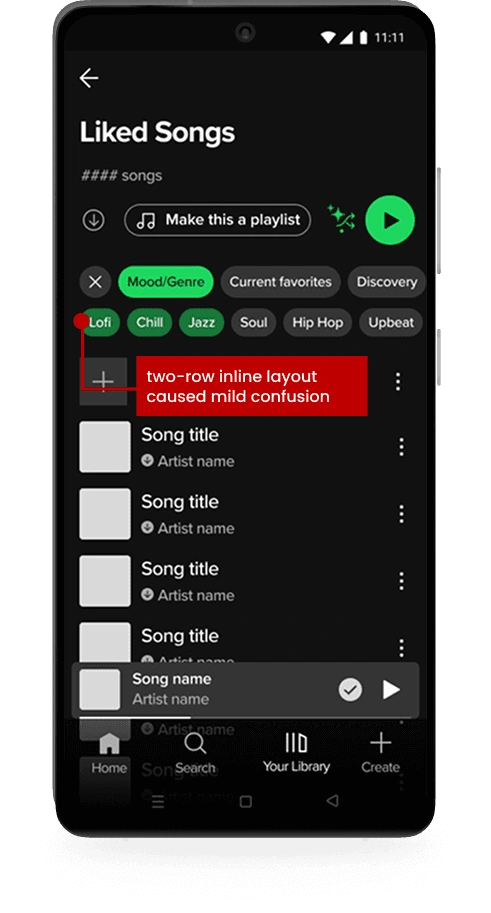
initial version 1
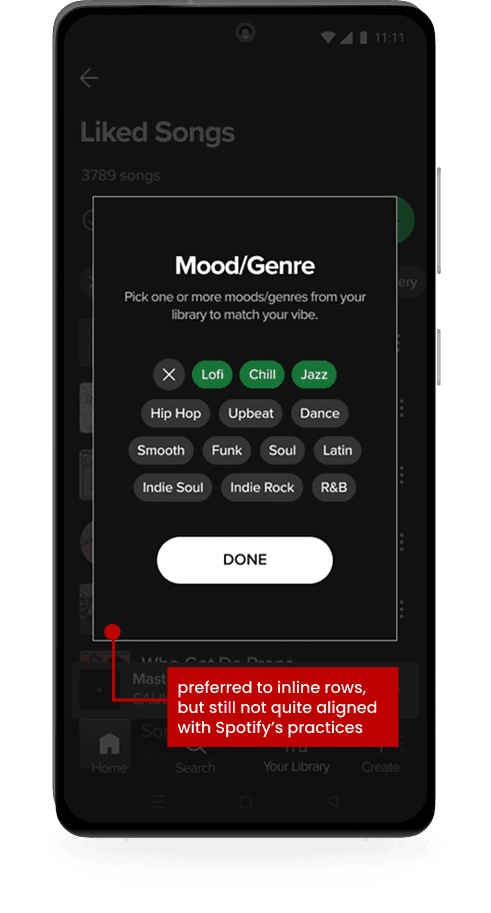
initial version 2
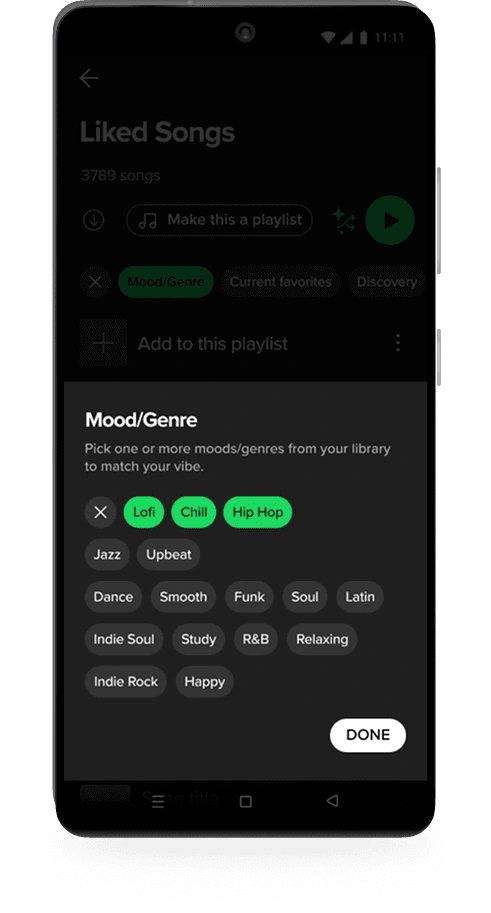
final version = drawer
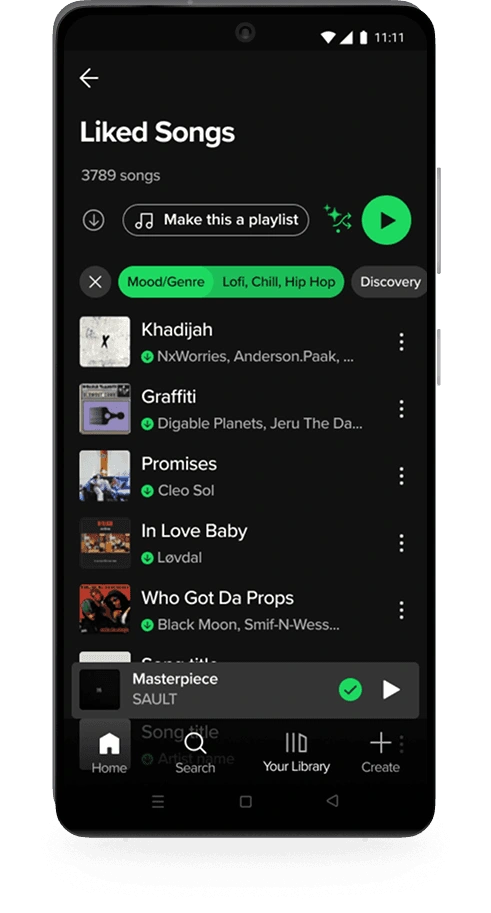
final version shown after selections are made
Mid-fidelity testing revealed the mood/genre filter needed refinement. A two-row inline layout caused confusion, while a modal view improved clarity for most users. To better align with Spotify's established patterns, a drawer interaction was implemented with visible applied tags for feedback and reassurance. In high-fidelity testing, all five participants reported the updated filter felt native to Spotify.
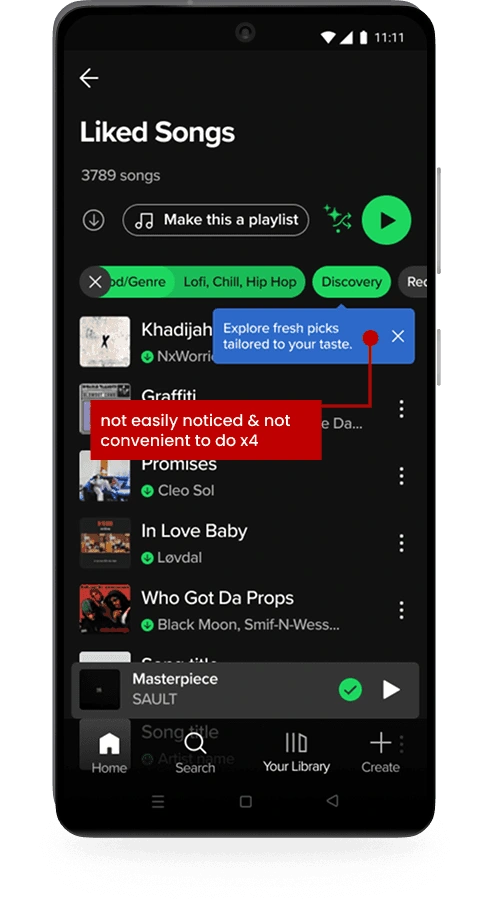
initial way to introduce feature
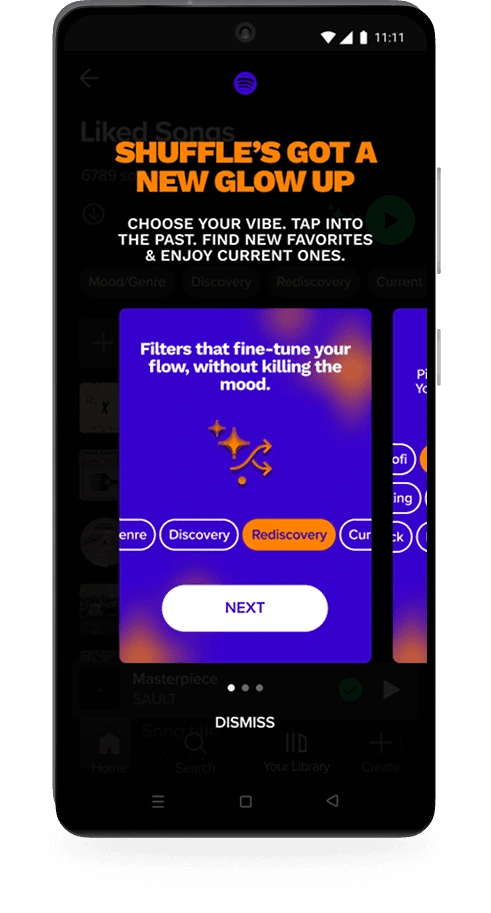
final version = pop-up onboarding
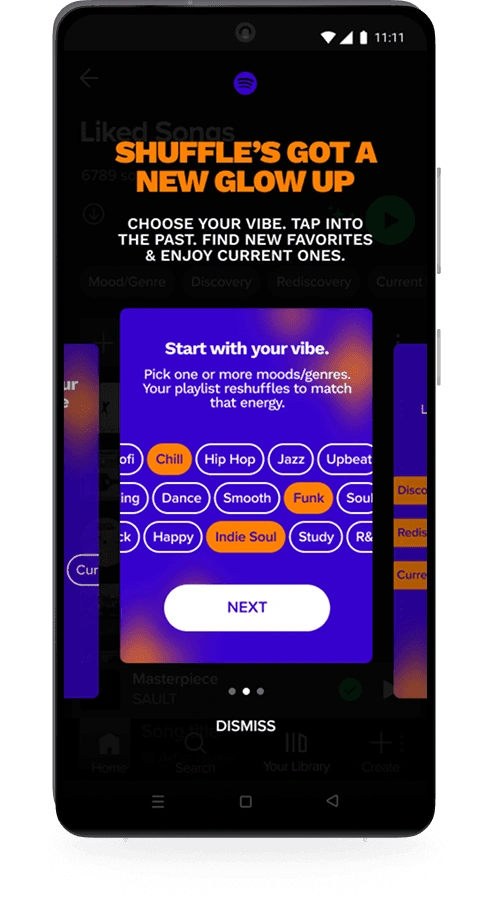
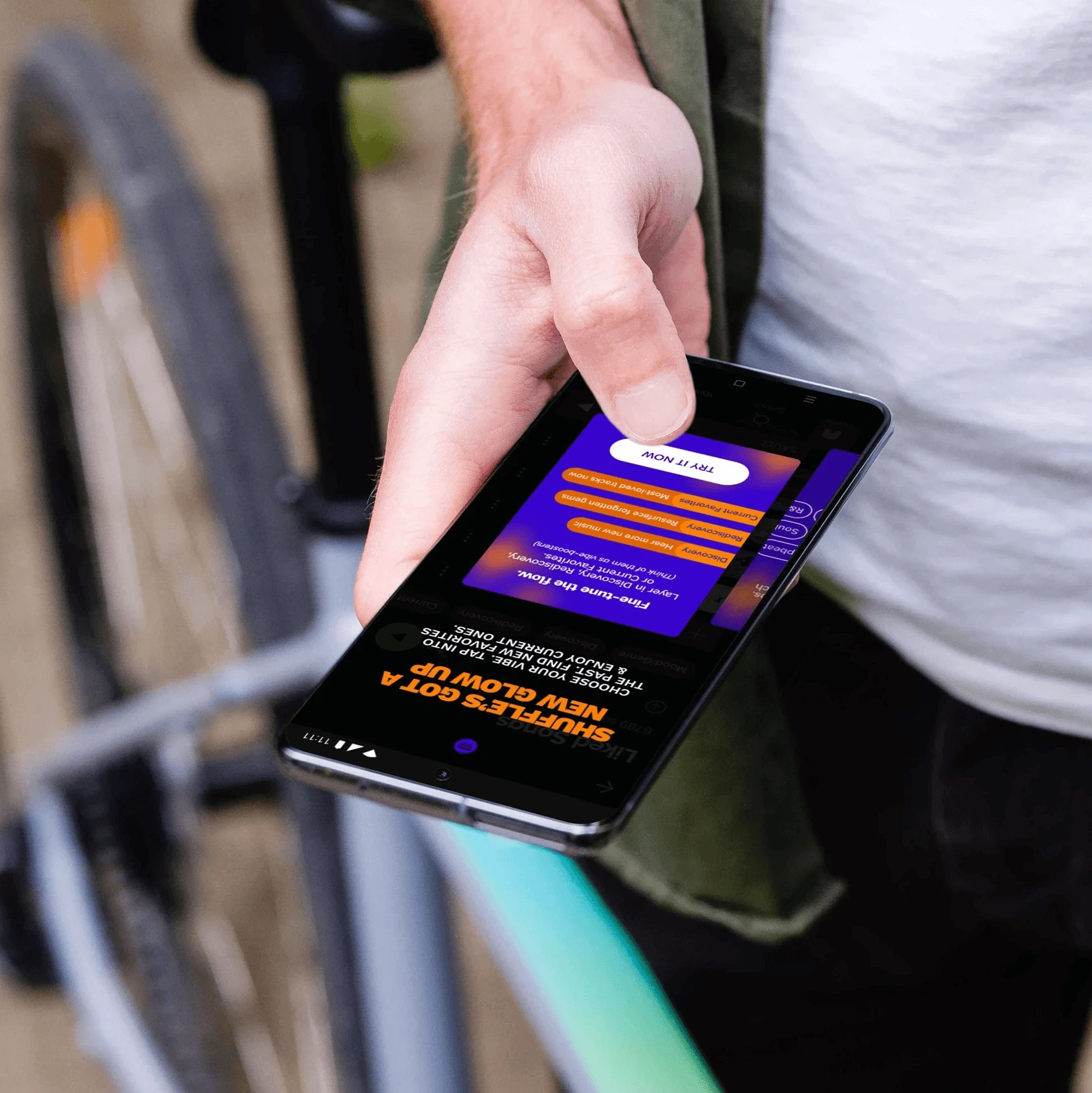
Tooltips were clear but passive for a feature that meaningfully expands Smart Shuffle. An onboarding carousel modal replaced them, using familiar card-based UI to introduce the new flow more intentionally.
5/5 users during high-fidelity testing reported they'd use the feature in real life, expressing strong interest in having more shuffle control
Smart Shuffle Filters enhanced personalization by reducing repetition, supporting rediscovery, and giving users simple, meaningful control over their listening experience. Testing showed it felt intuitive, native to Spotify, and aligned with how users want to listen.
Designing within Spotify's existing system was less intimidating than expected. Adopting their UI meant faster decisions and a smaller drawing board. The real challenge was designing a feature worthy of a highly polished, high-expectation product, and ensuring it would be technically feasible within what Spotify had already built rather than requiring significant new development. The hardest design problem was consolidating four filter concepts into one cohesive feature that still felt simple and native. An early version displayed multiple rows of options directly on screen, but it took up too much real estate and felt clunky. Users already have high standards for Spotify. It needed to feel like it had always been there. The modal vs. drawer decision came from testing, where users felt something was off with the modal interaction but couldn't articulate why. Going back into the app myself made the answer clear: modals are used for onboarding new features in Spotify's UI, while drawers are used for selections. A small distinction, but the kind that separates something that feels native from something that doesn't.
This project strengthened my ability to design within an existing system and make new features feel native rather than bolted on. Working within Spotify's constraints was clarifying rather than limiting. It narrowed the decision space and pushed me toward solutions that had to earn their place. I learned to balance user needs with technical feasibility, and that early research is the difference between designing something users want and designing something that sounds good in theory.
I can improve by validating ideas earlier and stress-testing feasibility at the concept stage. Recruiting testers sooner and anticipating system constraints upfront will help me move faster and design more strategically.
Future iterations could expand filter options (year, language, top-played) and allow users to save custom filter combinations. Improving queue visibility could further reinforce clarity and trust in shuffle behavior.
THANK YOU FOR EXPLORING MY WORK ~
exploring other work of mine: ClearMind

exploring other work of mine: Island Britt
exploring other work of mine: Inner Bloom
Like this project
Posted Apr 2, 2026
Developed Smart Shuffle Filters to enhance Spotify's shuffle feature.