Source & Claim Verification Case File

Facthread Research


This is a spec/sample project. All claims, subjects, sources, and findings shown are entirely fictional. No real individuals, organizations, or records are represented. This case study demonstrates Facthread's source and claim verification methodology and deliverable structure.
Research Question
Can a set of factual claims attributed to a single subject be independently verified, partially supported, or contradicted using publicly accessible sources, and where do unresolved questions remain?
Scope
The project involved evaluating a collection of claims spanning multiple categories. For each claim, the objective was to:
Identify relevant publicly accessible sources
Evaluate each source for reliability and independence
Cross-check findings across sources to determine corroboration, partial support, or contradiction
Assign a confidence level to each finding
Document conflicting evidence with specifics
Flag unresolved questions where verification was not possible
Verification Methodology
The verification process followed a structured, claim-by-claim approach:
Step 1: Claim Inventory
Each claim under investigation was logged individually with its original wording, the context in which it appeared, and the category it fell under. This created a clear checklist ensuring no claim was overlooked and each was evaluated on its own terms.
Step 2: Source Identification
For each claim, relevant publicly accessible sources were identified. Source types included:
Government and institutional records
Court and legal filing indexes
Official organizational records (registries, filings, public disclosures)
Third-party aggregators and directories
Published media coverage
Publicly available digital records (web archives, cached pages, public posts)
Sources were selected for independence from one another. Two sources drawing from the same underlying database were treated as a single source for corroboration purposes.
Step 3: Source Evaluation
Before any finding was recorded, each source was evaluated for reliability:
Source Category | Reliability Assessment |
|---|---|
Primary government/institutional record | Highest. Official records with defined custodial chains. |
Court/legal filing | High. Public filings with procedural accountability. |
Official organizational record | High. Registered filings, public disclosures. |
Third-party aggregator | Moderate. Useful for corroboration, but may contain outdated or merged data. |
Published media | Moderate. Depends on editorial standards and sourcing transparency. |
Digital records (archives, cached pages) | Low to Moderate. Useful for establishing timelines, but subject to alteration or removal. |
Directories, forums, social profiles | Low. Corroborative only. Not treated as standalone evidence. |
Step 4: Cross-Referencing and Conflict Documentation
Each claim was checked against multiple independent sources. The outcome for each claim fell into one of four categories:
Corroborated: Two or more independent sources agree, with no contradictions found.
Partially supported: At least one source supports the claim, but full corroboration is incomplete (e.g., one detail confirmed, another unverifiable).
Contradicted: One or more sources directly conflict with the claim. The specific conflict was documented: which sources disagreed, what each stated, and whether the discrepancy could be explained by timing, jurisdiction, or data-entry differences.
No corroborating source found: The claim could not be confirmed or denied with available sources.
Where sources conflicted, the conflict was not resolved by choosing a "preferred" source. Instead, both positions were documented with their respective source evaluations, and the conflict was flagged as an open question.
Step 5: Confidence Level Assignment
Each finding received a confidence level based on the strength and consistency of the evidence:
High: Corroborated by two or more independent primary or high-reliability sources with no contradictions.
Moderate: Supported by one primary source and at least one secondary source, or by multiple secondary sources without contradiction.
Low: Supported by a single source only, or where sources partially conflict but the weight of evidence leans in one direction.
Unverified: No corroborating source found, or sources directly contradict each other with no clear resolution.
Step 6: Unresolved Questions
Claims that could not be verified or where conflicting evidence remained unresolved were documented separately. For each unresolved question, the case file recorded:
The original claim
What was found (including partial or conflicting evidence)
Why verification was not possible (e.g., records not digitized, jurisdiction limitations, source behind restricted access)
Suggested next steps if further investigation were pursued (e.g., specific record types or jurisdictions to check)
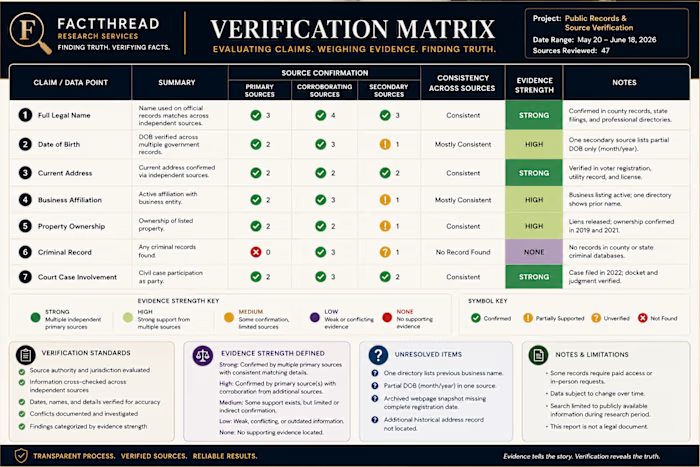
Verification Matrix
The core working document was a structured verification matrix. Each row represented a single claim, with columns for:
Column | Purpose |
|---|---|
Claim ID | Unique identifier for tracking |
Claim text | Original wording of the claim |
Category | Claim type (identity, timeline, affiliation, etc.) |
Sources consulted | List of sources checked, with access dates |
Source evaluations | Reliability rating for each source |
Corroboration status | Corroborated / Partially supported / Contradicted / No source found |
Conflicting evidence | Details of any disagreements between sources |
Confidence level | High / Moderate / Low / Unverified |
Open questions | Unresolved items and suggested next steps |
The matrix served as both the working research log and the auditable evidence trail for the final case file.
Limitations
Research was limited to publicly and legally accessible sources. Records behind restricted-access databases, sealed filings, or non-digitized archives were not consulted.
Source availability varied by category and jurisdiction. Some claims had fewer independent sources available than others, which is reflected in the confidence levels.
Third-party aggregators may contain outdated, incorrectly merged, or incomplete records. Where aggregator data was the sole source, confidence was reduced and the limitation was noted.
Digital records (web archives, cached pages) can be altered or removed. Where digital records were used, the access date and archival status were documented.
This study represents a point-in-time snapshot. Records may have been updated, corrected, or removed after the research was conducted.
Conflicting evidence was documented, not adjudicated. The case file presents both sides of a conflict rather than selecting a winner.
Final Deliverable
The deliverable was a single, organized case file containing:
Claim inventory: Complete list of claims under investigation, categorized and numbered.
Verification matrix: The structured spreadsheet described above, with every claim, source, evaluation, corroboration status, confidence level, and open question documented in one auditable location.
Evidence summaries: For each claim, a concise written summary of what was found, which sources supported or contradicted the claim, and the assigned confidence level. Written in plain language for a non-specialist audience.
Conflict log: A dedicated section documenting every instance where sources disagreed, what each source stated, and why the conflict remained unresolved.
Unresolved questions and next steps: A clear list of claims that could not be fully verified, with specific reasons and recommended avenues for further investigation.
The case file was designed to turn scattered, conflicting information into an organized, source-supported reference that clearly separates verified findings from open questions.
Facthread separates verified facts from open questions and clearly documents sources and research limitations in every engagement.
Like this project
Posted Jul 27, 2026
Spec project demonstrating source and claim verification methodology: structured cross-referencing, conflict documentation, confidence levels, and an auditable case file deliverable.
Likes
0
Views
5