Public Records Verification: A Multi-Source Research Study

Facthread Research


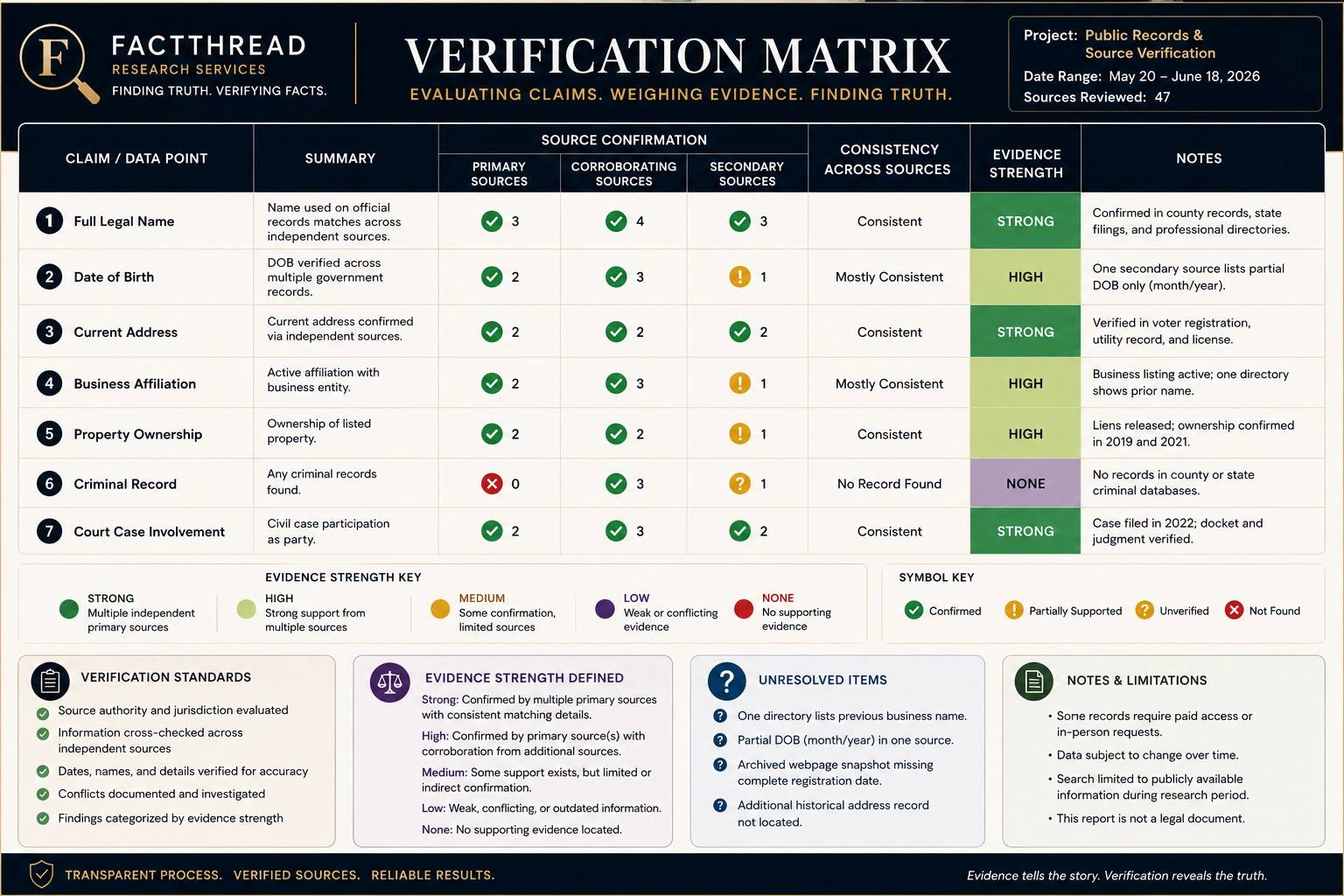
This is a spec/sample project. All identifying information, names, addresses, and data shown are entirely fictional. No real individuals, businesses, or records are represented. This case study demonstrates Facthread's research methodology and deliverable structure.
Research Question
Can identity, address, business registration, and timeline claims attributed to a single subject be independently verified using legally accessible public records, and where do gaps or contradictions exist?
Scope
The project required verifying four categories of claims:
Identity claims (name, aliases, date of birth)
Address history (residential addresses over a defined period)
Business associations (registered entities, officer roles, filing status)
Timeline consistency (whether claimed events align chronologically across independent sources)
Methodology
Research followed a structured, source-first process:
Source identification. Identified legally accessible public-record databases relevant to each claim category, including state business registries, county property records, court filing indexes, and publicly available directory aggregators.
Independent cross-referencing. Each claim was checked against a minimum of two independent sources. No single source was treated as authoritative on its own.
Source strength evaluation. Each source was rated for reliability based on whether it was a primary government record, a secondary aggregator, or a tertiary reference. Primary sources (e.g., state filing databases) were weighted higher than aggregated directories.
Conflict and gap documentation. Where sources disagreed or where no corroborating record could be found, the discrepancy was logged with specifics: which sources conflicted, what each source stated, and possible explanations.
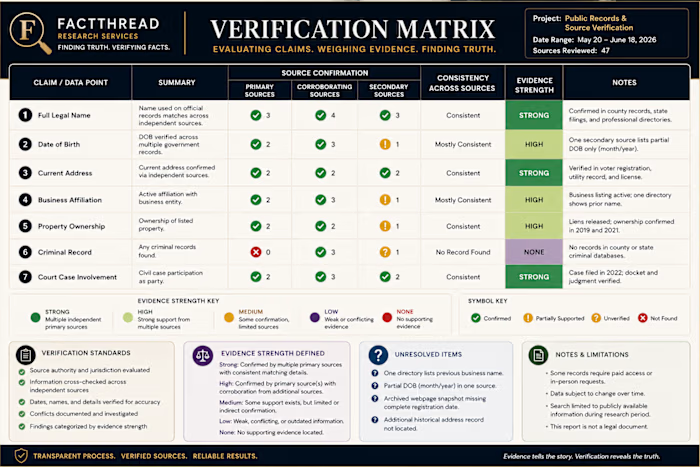
Confidence level assignment. Each finding was assigned a confidence level:
High: Confirmed by two or more independent primary sources with no contradictions.
Moderate: Supported by one primary source and at least one secondary source, or by multiple secondary sources with no contradictions.
Low: Supported by a single source only, or where sources partially conflict.
Unverified: No corroborating source found, or sources directly contradict each other.
Source Verification
Sources were categorized and evaluated before any findings were recorded:
Source Type | Example | Reliability Weight |
|---|---|---|
Primary government record | State business registry, county recorder | Highest |
Court/legal filing index | Federal or state court docket search | High |
Secondary aggregator | Public-record aggregation services | Moderate |
Tertiary/directory | Online directories, social profiles | Low (corroborative only) |
No source behind a paywall or requiring non-public access was used. All sources were legally accessible at the time of research.
Findings Summary
Findings were organized by claim category. For each claim, the report documented:
The specific claim being tested
Sources consulted (with access dates)
Whether sources corroborated, partially supported, or contradicted the claim
The assigned confidence level
Any open questions or gaps
Example structure (fictional data):
Identity claim: Subject's legal name confirmed via two primary state records. One alias appeared in a single secondary aggregator but could not be corroborated. Confidence: High for legal name, Low for alias.
Address history: Three of four claimed addresses confirmed via county property records and utility-linked directories. One address returned no matching records in any source consulted. Confidence: High for three addresses, Unverified for one.
Business associations: Two registered entities confirmed via state business registry with subject listed as officer. A third claimed entity returned no results in the relevant state registry or neighboring states. Confidence: High for two entities, Unverified for one.
Timeline consistency: Claimed sequence of events was broadly consistent across sources, with one date discrepancy (a business filing date preceded the claimed incorporation date by several months). Flagged for further review. Confidence: Moderate overall.
Limitations
Research was limited to publicly and legally accessible sources. Records behind restricted-access databases, sealed court records, or non-digitized archives were not consulted.
Source availability varies by jurisdiction. Some claim categories had fewer independent sources available than others.
Aggregator databases may contain outdated or incorrectly merged records. Where aggregator data was the only source, this was noted and confidence was reduced accordingly.
This study represents a point-in-time snapshot. Records may have been updated, corrected, or removed after the research was conducted.
Deliverable
The final deliverable package included three components:
Source Map: A visual diagram showing which sources were consulted for each claim category, how they connected, and where corroboration succeeded or failed.
Verification Matrix: A structured spreadsheet logging every claim, the sources checked, corroboration status, confidence level, and open questions. Each row linked back to the specific source and access date.
Evidence-Based Findings Report: A concise written summary organized by claim category, presenting confirmed findings, flagged discrepancies, unverified claims, and recommended next steps for any open questions.
Facthread separates verified facts from open questions and clearly documents sources and research limitations in every engagement.
Like this project
Posted Jul 27, 2026
Spec project demonstrating multi-source public-records research methodology: source verification, cross-referencing, confidence levels, and structured deliverables.
Likes
0
Views
4