Competitive Intelligence Study: Productivity Software Market

Facthread Research


This is a spec/sample project. All company names, product details, market data, and findings shown are entirely fictional. No real companies or proprietary data are represented. This case study demonstrates Facthread's competitive intelligence research methodology and deliverable structure.
Research Question
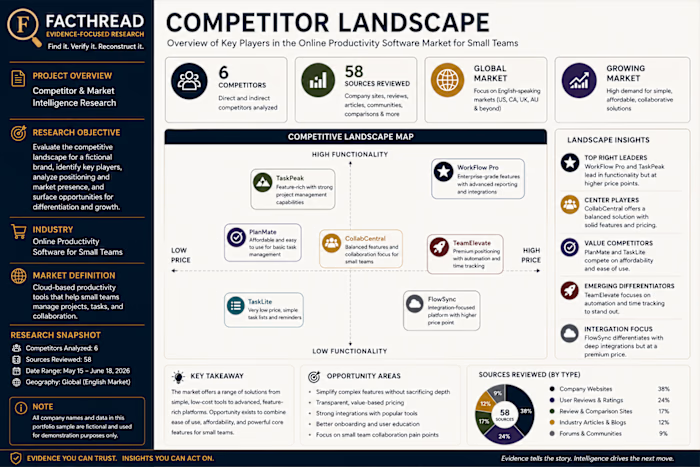
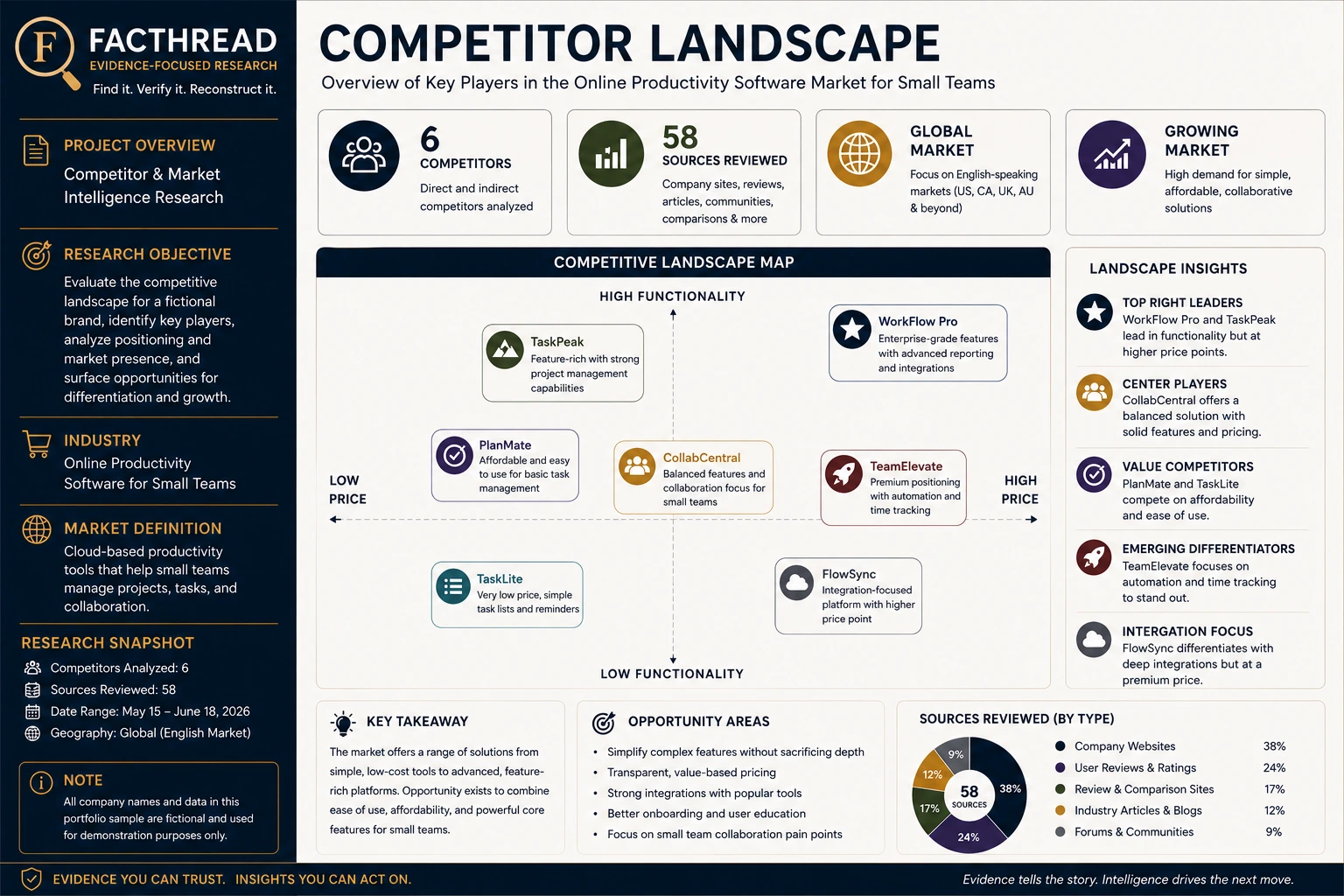
What is the competitive landscape for a fictional productivity software market, and where do meaningful gaps, risks, and strategic opportunities exist across six competing products?
Scope
The study examined six fictional competitors across seven dimensions:
Pricing (plan tiers, price points, free vs. paid feature gates)
Features (core functionality, differentiating capabilities)
Positioning (target audience, messaging, brand positioning)
Integrations (ecosystem compatibility, third-party connections)
Customer sentiment (publicly available reviews, recurring praise, recurring complaints)
Strengths (where each competitor leads)
Weaknesses (where each competitor underperforms or faces criticism)
Methodology
Research followed a structured, multi-phase process:
Phase 1: Source Identification and Collection
Identified publicly accessible sources relevant to each competitor and dimension. Source types included:
Official product websites and public documentation
Publicly available pricing pages and changelogs
Third-party review platforms with user-generated feedback
Industry publications and analyst commentary
Public integration directories and marketplace listings
A total of 58 sources were collected and cataloged across all six competitors. Each source was logged with its URL, access date, source type, and the competitor/dimension it addressed.
Phase 2: Cross-Referencing and Verification
No single source was treated as definitive. For each competitor and dimension:
Claims from official sources (e.g., pricing pages, feature lists) were cross-referenced against third-party reviews and independent coverage where available.
Customer sentiment was drawn from multiple review platforms to reduce platform-specific bias.
Where sources disagreed (e.g., a feature listed on a product page but flagged as broken or missing in reviews), the discrepancy was documented.
Phase 3: Source Strength Evaluation
Each source was categorized by reliability:
Source Type | Example | Reliability Weight |
|---|---|---|
Official product source | Pricing page, public docs, changelog | High (for stated facts); lower for subjective claims |
Third-party review platform | Aggregated user reviews | Moderate (volume-dependent) |
Industry publication | Analyst reports, editorial coverage | Moderate to High (depends on methodology transparency) |
Community/forum | User discussions, Q&A threads | Low (corroborative only) |
Phase 4: Confidence Level Assignment
Each finding was assigned a confidence level:
High: Corroborated by two or more independent source types with no contradictions.
Moderate: Supported by one primary source and at least one secondary source, or by multiple secondary sources without contradiction.
Low: Based on a single source, or where sources partially conflict.
Unverified: No corroborating source found, or sources directly contradict each other.
Phase 5: Synthesis and Gap Analysis
Verified findings were synthesized across all six competitors to identify:
Where the market is crowded (features or positioning shared by most competitors)
Where meaningful gaps exist (underserved needs, missing integrations, pricing blind spots)
Where risks concentrate (common weaknesses, sentiment trends, dependency on single platforms)
Findings Summary
Findings were organized into four deliverable components (see Deliverables below). At a high level, the research produced:
Per-competitor profiles covering all seven dimensions, with source citations and confidence levels for each data point.
Cross-competitor patterns, including which features were table stakes vs. differentiators, where pricing models clustered, and where integration ecosystems overlapped or diverged.
Market gaps identified where multiple competitors underperformed or where user sentiment consistently flagged unmet needs.
Risk factors flagged where competitors shared common vulnerabilities (e.g., dependency on a single integration partner, recurring complaints about a specific workflow).
Example structure (fictional data):
Pricing: Five of six competitors offered a free tier. Price points for paid plans clustered in a narrow range, with one outlier significantly above market. Confidence: High (sourced from official pricing pages, cross-checked against third-party comparisons).
Customer sentiment: Recurring complaints about onboarding complexity appeared across four of six competitors on multiple review platforms. Confidence: Moderate (consistent across platforms, but sample sizes varied).
Integrations: One competitor had significantly fewer third-party integrations than the rest, confirmed via official marketplace and independent directory. Confidence: High.
Market gap: No competitor offered a specific workflow capability that appeared repeatedly in user feature requests across review platforms. Confidence: Moderate (based on user-generated content; no official roadmap data available).
Limitations
All research was limited to publicly accessible sources. No proprietary data, internal documents, or paid analyst reports were used.
Customer sentiment analysis relied on publicly posted reviews. Review platforms may not represent the full user base, and sentiment can be skewed by self-selection bias.
Pricing and feature data reflect a point-in-time snapshot. Products in this market update frequently; findings may not reflect changes made after the research period.
The study compared six competitors. The fictional market may include additional players not covered in this scope.
Source volume varied by competitor. Competitors with larger public footprints had more available sources, which may affect the relative depth of analysis.
Deliverables
The final deliverable package included four components:
Competitive Landscape Overview: A written summary of the market structure, key players, positioning clusters, and high-level patterns across all six competitors.
Comparison Matrix: A structured spreadsheet comparing all six competitors across all seven dimensions. Each cell included the finding, source citation(s), access date(s), and assigned confidence level.
Market Gaps and Risks Report: A focused analysis identifying underserved needs, common vulnerabilities, and areas where the market is over-indexed or under-indexed. Each gap and risk was tied to specific evidence from the comparison matrix.
Strategic Recommendations: Actionable, evidence-based recommendations derived from the gaps and risks analysis. Each recommendation cited the specific findings and confidence levels that supported it.
Facthread synthesizes multi-source research into structured, evidence-based intelligence with clear confidence levels and documented limitations.
Like this project
Posted Jul 27, 2026
Spec project demonstrating competitive intelligence methodology: multi-source research across 6 competitors, cross-referencing, confidence levels, and strategic deliverables.
Likes
0
Views
5